Object-Oriented Languages Reject C's Radical Dating Advice
Why is this Languages meme funny?
Level 1: Treat People Like People
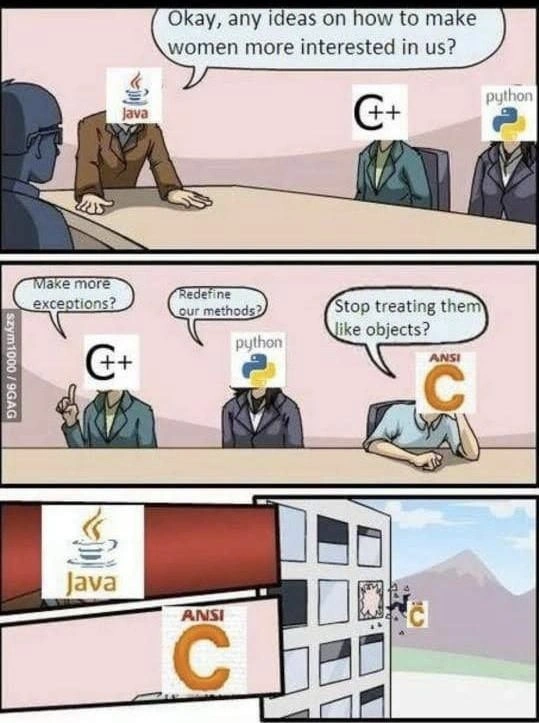
In this comic, each person in a business meeting has the logo of a programming language as their head (so they’re like the languages come to life). The boss (with a Java coffee logo head) asks his team how they can get more women to like or join them. Two team members give fancy-sounding answers: one says “make more exceptions” (like “maybe we should allow special cases for them”) and another says “redefine our methods” (meaning “change how we do things”). These answers use big words but are a bit silly and avoid the real issue. Then the last team member, the one with the orange “C” logo head (that’s the C programming language), says plainly: “Stop treating them like objects?” In normal words, he’s saying, “Maybe just stop treating women like things instead of people.”
That suggestion is obviously the most direct and sensible: if you want people to be interested and involved, you should treat them with respect. But in the joke, the boss really doesn’t like that answer – so much that he literally throws the guy who said it out of a tall office building window! The final picture shows the C logo person flying out the window. It’s outrageous and cartoonish, and that’s where the humor comes from: the one person who spoke the simple truth was tossed out for it.
The phrase “treating them like objects” is a play on words. In everyday life, calling someone an “object” is bad – it means you’re not seeing them as a human with feelings. But these characters are programming languages, and in coding, “object” has a different meaning (like a bundle of data and actions in code). The C language is actually known for not using “objects” in the coding sense, so it’s cheekily suggesting “hey, maybe stop using objects so much — both in code and in how you view people.” It’s a bit like if a very old-fashioned grandpa figure gave a piece of simple, old-school advice.
So why is it funny? It’s the mix of something very serious (showing respect to women) with something very silly (a boss yeeting an employee out a window over a comment). The dramatic overreaction is cartoon humor – obviously in real life you wouldn’t fling someone through a window for giving good advice! The joke also tickles programmers because it sneaks in references to how different programming languages “think.” But at its heart, even if you don’t get the tech stuff, the message you end up laughing at is: if you want people to like you, don’t treat them like things – and ignoring that truth is ridiculously foolish. It’s a funny way to remind us: always treat people like people, with respect.
Level 2: Methods & Manners
Let’s break down the joke in simpler terms. This meme shows four famous programming languages sitting in a meeting room (classic comic setup) trying to answer a tough question: “How do we get more women interested in us?” Here “us” implies either programming at large or their specific language communities – a reference to the push for more women in tech (developer culture has historically been male-dominated, so this is a gender_discussion_in_dev scenario). Each language character suggests a solution, and each suggestion is a play on programming terminology as well as common phrases:
Java (the boss): Java is portrayed as the one leading the meeting. Java is a very object-oriented language – it treats almost everything as an object, and you normally organize Java code into classes (blueprints for objects). It’s fittingly the “boss” here because Java often has a reputation in jokes as the stodgy corporate language (picture a suit-wearing, coffee-loving executive – the Java logo is literally a coffee cup). Java asks for ideas, setting the stage for the others to respond.
C++: The C++ logo person raises a finger and says, “Make more exceptions?”
- In everyday language, “make an exception” for someone means to allow something that’s usually against the rules, just for them. It’s like saying, “Okay, we normally wouldn’t do this, but we will for you.” C++ suggesting this might imply, in a tongue-in-cheek way, “Should we have special rules or accommodations to attract women?” (It sounds a bit clueless on purpose, as if women are some strange case needing special treatment).
- In programming, an exception is an error or unexpected event. Both C++ and Java use exceptions as a way to handle errors: you throw an exception (trigger it) when something goes wrong, and you catch it with special code to handle the issue. C++ has this feature built-in (unlike the older C). The word “exception” is a technical term here.
- So this line is a pun: it uses the phrase make exceptions both in the social sense (special-case treatment) and the coding sense (more error objects). It’s also poking fun that a very C++-like solution to a people problem might be “add more tech complexity” (more exceptions!) which is humorous because it’s not actually how you solve social issues.
Python: The Python logo character suggests, “Redefine our methods?”
- To non-programmers, changing/redefining our methods means “let’s change how we do things” — basically improve our approach or strategy. It’s a reasonable idea: if what we’re doing now doesn’t attract women, maybe do something differently (like reform our events, outreach, tone, etc. – methods in the general sense).
- In programming, a method is just a function that belongs to a class/object (especially in object-oriented languages). For example, if you had a
Carobject, it might have methods likestart()orhonk(). In many languages you can redefine a method, meaning you provide a new version of that function (perhaps in a subclass or by overriding a default behavior). Python, being very flexible, lets you even change methods of classes at runtime or override them easily. - So “redefine our methods” is a pun as well. Python’s character is essentially making a programming joke about its own flexibility with methods while also saying “we should alter our methodology.” It’s funny because Python’s known to be easy to change and adapt (just like adapting a strategy), whereas “redefining methods” in real life means trying a new tack. It’s a softer suggestion than C++’s and not as on-the-nose as C’s, which fits Python’s often friendly, inclusive community vibe (Python communities often focus on outreach and welcoming newcomers).
ANSI C: The ANSI C logo person says, “Stop treating them like objects?”
- In normal conversation, saying someone is treated “like an object” is criticism – it means you’re not respecting them as a person, just using them or viewing them in a superficial way. It’s a common phrase especially when talking about how women might feel in a male-heavy field: e.g. if they’re only valued for appearances or tokens, that’s objectification (treating a person as an object, not a full human with feelings and agency). So ANSI C is suggesting, in plain terms, “Maybe if we respect women and don’t objectify them, they’ll be more interested.” It’s a straightforward, sound suggestion about manners and attitude.
- In programming, an object is a core concept of Object-Oriented Programming (OOP). An object is like a container that holds data and functions together. For instance, you might have an object
userwith data likenameand a function (method) likelogin(). Languages like Java, C++, and Python are built around objects. But C (especially classic ANSI C from the late 80s) isn’t an OOP language at all – it doesn’t have objects or classes; it’s procedural. So C humorously saying “stop treating them like objects” also sounds like “stop using objects (OOP) altogether,” which is exactly C’s philosophy in coding! It’s a dig at the others: C might be implying the other languages are too obsessed with OOP concepts (treating everything in code as an object), and maybe that mindset leaks into how the community treats people too. - This line is the zinger because it directly addresses the real issue (respect) and simultaneously serves as a joke about programming paradigms. It’s an example of objectification_wordplay: using the word “object” in the human sense and the coding sense at once.
Now, why does this “end badly” as the title says? Because of the meme format: in the third panel, the boss (Java) doesn’t praise C for the idea – instead, Java throws C out the window! This is a popular punchline in the boardroom_meme template: the boss violently rejects the suggestion that is truthful but inconvenient. In our context:
- Java, being an OOP-centric language, literally cannot handle the idea of “no objects” – it’s both funny and metaphorical. In a way, Java “throwing” C out is like saying “that idea (of not objectifying / not using objects) is so incompatible with our system that it’s being forcefully removed.”
- There’s also a cheeky nod to how Java code handles errors. In Java, if something is wrong or not allowed, you throw an exception (and if nothing catches it, the program terminates that flow). C’s suggestion of not using objects is like an error to Java’s worldview, so Java throws it out – quite literally hurling C out the window. That’s why devs see Java’s action as a visual pun: the frame of C being tossed out is like an error being thrown out of a stack.
The whole comic is a tech humor take on both programming and social issues:
- It highlights an inside joke that different programming languages have different “personalities” and preferred solutions (this reflects how their communities or typical use-cases differ). This is the language_wars aspect – languages are often cast as characters that poke fun at each other’s quirks. Here Java is inflexible, C++ is complex, Python is adaptive, and old C calls out the uncomfortable truth.
- It also touches on a relatable humor aspect in developer culture: many in tech have witnessed awkward initiatives to get more women involved that miss the point. The meme jokingly suggests that instead of gimmicks or minor tweaks (exceptions, new methods), perhaps the culture (how women are treated) should change – an idea that shouldn’t be radical, but often faces resistance.
- Seeing ANSI C, the C language, being chucked out by Java is extra funny to programmers because C is like the “grandfather” of both C++ and Java (they both descended from C). It’s as if the progeny (Java) is rebelliously tossing out its ancestor’s advice. This reverses the usual respect for C as an old but wise language, which itself is humorous in an absurd way.
In essence, the meme works on two levels: (1) as a straightforward joke about not objectifying women (with the absurd boss reaction illustrating what not to do), and (2) as an in-joke about programming concepts (objects, methods, exceptions) and the stereotyped behaviors of different programming language communities. Even if you don’t catch all the coding puns, the image of a guy being flung out a window for making a sensible comment is classic slapstick absurdity. But for those who code, each speech bubble is a tiny Easter egg referencing coding terminology, making the meme extra satisfying. It’s the kind of meme a programmer might chuckle at and say, “Haha, that’s so Java to do that to C,” appreciating both the pun and the commentary.
Level 3: Objects and Objections
This meme mashes up a classic boardroom meeting comic with programming language personifications to deliver layered humor. The "boss" at the head of the table has a Java logo for a face, and he's asking how to attract more women to "us" – implying the world of programming languages or tech communities (a nod to real-world gender gaps in developer culture). His team consists of C++, Python, and ANSI C (each depicted by their logos on suit-wearing figures). The humor is rich in Object-Oriented Programming wordplay and language wars rivalry:
C++ suggests “Make more exceptions?” – a clever double entendre. In plain speak, “making an exception” means bending the rules for someone. In coding, an exception is a special error object that languages like C++ or Java can throw and catch to handle unusual conditions. C++ is both highly object-oriented and notorious for its complex exception handling (some devs debate whether to use exceptions at all in C++). So C++ offering “more exceptions” riffs on both making special cases for women and cranking up a technical feature it knows well. It’s poking fun at the idea that the solution could be just tweaking technical rules or tolerances (making exceptions) rather than addressing root causes.
Python pitches in with “Redefine our methods?” – another pun straddling tech and everyday language. In a meeting, changing our methods just means altering how the group operates to be more welcoming. But in OOP terms, a method is a function associated with an object or class. Languages like Python let you redefine methods (for example, by overriding them in a subclass, or even monkey-patching at runtime) to change an object’s behavior. Python, as a dynamic language, is known for flexibility – you can even add or modify methods of classes on the fly. By saying this, Python’s character hints, tongue-in-cheek, that maybe the programming community should override its current practices with new ones. It’s a sly reference to Python’s ethos of cleaner, more intuitive code (“There should be one–and preferably only one–obvious way to do it”), suggesting perhaps the community needs a clearer method to include women. The pun works both as a genuine suggestion (“let’s change how we do things”) and as a wink to Python’s object model where redefining methods is literally a feature.
ANSI C finally quips “Stop treating them like objects?” which is the punchline that gets him ejected (literally). This line is loaded with meaning. In social terms, treating people like objects means viewing individuals (often women, in the context of gender discussion in dev) as things or prizes rather than human beings – a direct call-out of objectification and lack of respect. That’s the serious truth hiding in a joke. But being spoken by ANSI C (a procedural language that predates mainstream object-oriented programming and pointedly does not use objects in its design) makes it a brilliant OOP pun. C is the odd one out here: it’s a language from the 1970s standardized by ANSI, and it has no concept of classes or objects – it’s all functions and data structures, the antithesis of Java’s and C++’s object-oriented approach. So C’s suggestion “maybe stop using objects altogether” is hilariously on-brand for C (the language that would indeed solve problems without any objects) and also the most direct answer to the boss’s question (show basic respect). It’s a zinger aimed at the others’ OOP obsession: C is essentially saying, “Our object-oriented culture might be the issue – try being less object-focused” with a perfect double meaning that roasts both coding practice and community behavior. No wonder the Java boss – whose language philosophy revolves around everything being an Object (in Java even strings and file handles are objects of some class) – reacts so violently!
The final panel shows Java’s logo figure literally throwing ANSI C out the window in classic meme fashion. This visual gag is a staple of the boardroom_meme template – usually, the boss tosses out the person who gives a too-real or unwanted answer. Here it completes the wordplay trifecta: in programming, what do you do with an unwanted condition? You throw an exception! And indeed, Java throws C out, just like one would throw an exception object in code (Java actually uses the keyword throw to signal an error). It’s as if Java treated ANSI C’s suggestion as a bug and invoked a throw. The humor works on multiple levels for developers:
- It parodies real tech dev community discussions – superficial solutions (“more exceptions!” “change methods!”) often get airtime, while blunt cultural truth (“show respect”) gets you ostracized.
- It uses “objectification wordplay” – linking the idea of treating women as objects to the literal concept of programming objects – to highlight irony: in code, treating something as an Object is normal, but in life, treating a person like an object is wrong.
- It features an inside joke that Java “threw” C out, mirroring how Java would handle an unacceptable condition by throwing an exception. (In one Reddit comment, a user might quip that Java’s finally found a use for a C object – as an exception to toss!)
To seasoned programmers, this meme is pure gold. It combines relatable humor about tech’s gender inclusivity problem with nerdy references to language design. Java playing the corporate boss fits perfectly: Java has long been the king of enterprise software (suit-and-tie kind of language), often seen as conservative and heavy with OOP patterns. C++ is the seasoned engineer, powerful but complex, chiming in with a technical approach. Python is the modern pragmatist, high-level and flexible, suggesting adaptation. And old ANSI C is the grizzled old-timer (perhaps the cynical veteran of languages) who drops a truth-bomb that offends the higher-ups. The language_wars trope is present too – Java literally discarding C reflects how newer OOP paradigms sidelined the old procedural C mindset in industry (even though C is still very much alive in systems programming, thank you very much). The meme wittily critiques that trend: maybe in racing to make everything an object, the industry “threw out” some wisdom from the old days about keeping things simple (and treating people decently).
In summary, on this advanced level, the meme is a multi-layered inside joke. It mocks the tech industry’s sometimes clueless attempts at diversity (“make exceptions? redefine methods?”) while indulging in nerdy programming puns. The collision of tech humor and a real social issue gives it a bit of an edge – we laugh, but we also nod, because yeah, maybe we should stop objectifying people. And the execution is spot-on: personified programming languages in a meeting, a perfectly timed pun from C, and a literal window “throw” that evokes a throw Exception. It’s a tiny comic strip packed with commentary, and every developer in the room who’s battled through Java classes, C++ exceptions, or Python methods finds something to chuckle (or groan) at.
// Java's pseudo-code reaction to ANSI C's suggestion:
if (suggestion.equals("Stop treating them like objects")) {
throw new SuggestionOutTheWindowException("ANSI C was thrown out");
}
// (Java devs: note the use of 'throw' — exactly how you yeet an object in code!)
Description
This is a three-panel comic strip using the 'Boardroom Suggestion' meme format. In the first panel, characters with programming language logos for heads (Java, C++, Python) are in a meeting. Java, as the boss, asks, 'Okay, any ideas on how to make women more interested in us?'. In the second panel, C++, Python, and ANSI C offer suggestions. C++ asks, 'Make more exceptions?', a pun on exception handling. Python asks, 'Redefine our methods?', a pun on method overriding. ANSI C, the procedural language, delivers the punchline: 'Stop treating them like objects?'. This is a clever double entendre, critiquing both the objectification of women and the core principle of object-oriented programming (OOP) that Java, C++, and Python are built on. In the final panel, C is thrown out of the building's window by Java, humorously illustrating the dogmatic rejection of any alternative to the OOP paradigm by its proponents

Comments
31Comment deleted
Java's response was, of course, to throw an unhandled exception: `UnsupportedSocialParadigmError`
Java’s diversity workshop turned into a live demo of exception handling: feedback was caught, wrapped, and re-thrown - along with ANSI C - straight out the window
The irony of object-oriented languages literally discussing how to stop treating women as objects perfectly captures the tech industry's occasional lack of self-awareness - though at least ANSI C, being procedural, can throw shade without the baggage of having a class hierarchy
The real irony here is that C's suggestion is actually the most technically sound - treating data structures as objects instead of raw memory addresses would indeed make the codebase more maintainable. But in a room full of OOP evangelists, suggesting we stop objectifying things is career suicide. Classic case of 'technically correct but politically incorrect,' which is why C got defenestrated faster than you can say 'segmentation fault.'
Java heard “stop treating everything like objects” and did what it always does - throw C; nobody had a catch block
Java asked for ideas and immediately threw C’s suggestion - fitting, since C can’t catch exceptions anyway
C++ drops the mic: after decades of OOP, the real undefined behavior is treating humans like polymorphic base classes
nice one Comment deleted
class Woman extends Human What's wrong? Comment deleted
Nah, a classy woman usually extends man Comment deleted
WTF!? Comment deleted
The problem is that Human extends Object, cause EVERYTHING EXTENDS OBJECT IN JAVA! Comment deleted
That's why I do not like java Comment deleted
If this is the reason for you to dislike java then I don't know what to say... Comment deleted
Випав Comment deleted
Please, refrain from usage of any language except English during chatting there, Comment deleted
Why some of you then payed for an ad in Russian meme server Comment deleted
А чому так? А якщо з перекладом? But why? And what about comments with a translation? Comment deleted
so everyone can understand each other - adding a translation is fine. Comment deleted
すみませんでも面白いピクチャーを思い出した Comment deleted
There's literally "translate" button in telegram Comment deleted
well... at least not in telegram desktop Comment deleted
translation: [Excuse me] I thought I found an interesting picture Please use English in this chat / 英語を使ってください Comment deleted
bruh it's russian inside Comment deleted
Now you need to translate it :D Comment deleted
no i dont think so Comment deleted
Interesting Comment deleted
Lmao Comment deleted
Ну що тут скажеш. Слава Україні Nothing else to say. Have a lack of Ukrainian trollibb themes. Comment deleted
Вставай Донбасс We love Ukraine Comment deleted
Идитi в пiзду The best country Comment deleted