Doctor Strange's Guide to Asynchronous Operations
Why is this Languages meme funny?
Level 1: Skipping the Line
Imagine you have a giant line of 78 billion people waiting to tell you their story. If you talk to them one by one, you’ll be there forever, listening to each person in order. That’s like waiting for each task to finish before starting the next – super slow. Now picture a bit of magic: you somehow talk to all 78 billion people at the same time. You don’t wait for the first story to finish before hearing the second; you hear snippets from everyone all at once. You’d get through the whole line almost instantly!
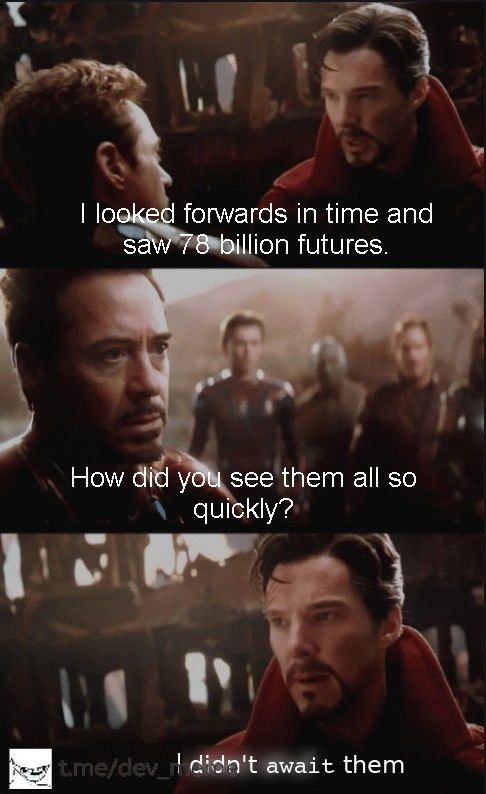
This meme is funny because Doctor Strange basically says he did the same kind of magic with time. In normal words, he didn’t wait at all. In programming, “await” means to wait, so by saying “I didn’t await them,” he’s joking that he didn’t wait for each future outcome to finish before looking at the next one. It’s like he skipped the waiting line. The teammate’s face is like “How is that even possible?!” and the joke is that Strange used a trick (not waiting) that only makes sense if you know coding. Even if you don’t get the tech part, you can laugh because essentially he’s saying, “I saw everything everywhere all at once by not waiting.” It’s a silly, clever twist – mixing a superhero’s time-travel scene with a coder’s shortcut – and it makes us smile because he found a cheeky way to save time.
Level 2: Asynchronous Shortcut
At its core, this meme is playing with the idea of async/await, which is a common feature in modern programming languages for handling tasks that take time (like fetching data from a server). The scene shows Doctor Strange saying he saw “78 billion futures” and then revealing his secret: “I didn’t await them.” In programming terms, await literally means “wait for it to finish.” So if you don’t await, you’re not waiting for each task to finish before starting the next one.
Think of it like this: normally, if you had a list of things to do one after another, you’d finish the first, then move to the second, and so on. In code, that’s what happens if you put await in front of each asynchronous operation – the program pauses until that one thing is done. But if you skip await, the program just starts the task and immediately goes ahead to start the next one, without pausing. All those tasks (or async functions) get kicked off almost at the same time. They run concurrently (side by side) instead of sequentially (one after the other).
In the meme’s context, each “future” Doctor Strange looked at is like an asynchronous task. To see a future might normally take some time (imagine it’s like calling a function seeFuture() that returns a result later). If he had done it sequentially, looking at even a few million futures would be super slow – he’d have to wait for each timeline vision to complete before moving to the next. This would be like doing:
// Pseudocode for sequential checking (slower)
result1 = await seeFuture(1);
result2 = await seeFuture(2);
result3 = await seeFuture(3);
// ... and so on up to 78 billion (ouch!)
That await means Strange would wait for seeFuture(1) to finish before even starting seeFuture(2). But what he claims in the meme is essentially:
// Pseudocode for concurrent checking (faster)
promise1 = seeFuture(1); // start looking, but don't wait
promise2 = seeFuture(2); // start the next one immediately
promise3 = seeFuture(3); // start another one...
// ... up to 78 billion futures started without waiting
// (he might not even need to await if he can see them mentally as they run!)
By not awaiting each call, Doctor Strange started all 78 billion future-visions at once, or at least in a rapid-fire way. In real coding, those promise1, promise2, etc., are Promise or Future objects – basically placeholders that will eventually contain the result of each seeFuture() call. In JavaScript, for example, calling an async function returns a Promise immediately, but if you don’t await it, your code keeps going. Later on, you could use something like await Promise.all([promise1, promise2, ...]) to wait for all of them to finish together. The meme skips showing that part (Doctor Strange doesn’t show how he processes the results; he’s a wizard, he just “saw” them). The key joke is simply that he did everything simultaneously by skipping the waiting part.
For a junior developer or someone new to these terms, it helps to clarify definitions:
- Asynchronous (async): a way for a program to start a task and then move on without stopping to wait for it to finish. The task does its work in the background, and the program can come back to check on it later.
- Await: a keyword used in async functions that tells the program “pause here until the asynchronous task is done, then give me the result.” It’s like saying “wait right here for that promise to resolve.”
- Promise/Future: an object that represents a result that isn’t ready yet but will be. You can think of it as a ticket you get now that you can redeem for the actual value later when it’s available. In JavaScript it’s called a Promise, in some other languages (like Python or Java) similar concepts are often called Futures. In both cases, it’s something you can wait on.
So when Strange says “I didn’t await them,” he’s humorously using coding lingo in normal speech. It’s as if he said “I didn’t wait for each one.” His friend (Tony Stark in the movie, though the meme doesn’t name him) is basically asking, “How on earth did you do that so fast?” And Strange’s answer is a tech inside-joke: he’s saying he did it the async way. This resonates with developers because it’s a relatable dev experience to discover that doing things in parallel (when possible) is much faster than doing them in sequence. It’s also relatable because many of us have made the mistake of forgetting an await, causing our code to run ahead without the data, leading to confusing situations. Here that concept is turned into a positive: Strange intentionally didn’t wait, and that gave him a superhuman speed advantage.
The meme combines tech humor with a pop culture reference. In Meme Culture, it’s common to take a famous movie scene and replace the dialogue with something that fits a completely different context (like programming) but still matches the expressions or drama of the scene. Here, Doctor Strange’s intense focus and Tony’s bewilderment match perfectly with a senior dev dropping a knowledge bomb and a junior dev being amazed. The text overlays on the images mimic the style of classic movie still memes, and anyone who knows both the Avengers scene and a bit of async code will immediately get the double meaning. It’s a fun way to remember a programming concept: once you’ve seen this meme, you’ll never forget to ask, “hmm, did I await that promise or not?”
Level 3: Threading the Multiverse
In this meme mashup of Avengers: Infinity War and coding humor, Doctor Strange essentially becomes a master of asynchronous programming. In the movie scene, Strange uses the Time Stone to explore millions of possible futures. Here the meme exaggerates it to “78 billion futures,” and the punchline is that he did it by skipping await. This is a wink to seasoned developers: by not awaiting asynchronous calls, Strange made all those futures resolve in parallel instead of one by one. It’s a perfect blend of Marvel’s multiverse concept with programming’s multithreading and event loop magic.
To a senior developer, the humor lands because it’s multi-layered. First, there’s a pun: in computing, a Future (or Promise) represents a result that hasn’t happened yet, similar to how Strange is literally looking at future timelines. By saying “I didn’t await them,” he’s implying he unleashed 78 billion asynchronous operations at once. This is a playful nod to how async/await works in languages like JavaScript, Python, or C#. Usually, writing await doTask() pauses execution until doTask finishes. But if you omit the await, the task starts and your code races onward immediately, much like a sorcerer skipping the waiting period and peeking at all outcomes instantly. Seasoned devs have seen this pattern: it’s essentially doing a Promise.all – kicking off many tasks together and waiting for all to finish later (if at all). It’s both a clever performance trick and a common source of bugs when someone forgets to wait.
There’s also a feel of “we’ve all been there” for engineers. Many remember the first time they forgot an await: the function just returned a Promise without actually giving a result, leading to bizarre bugs or things happening out of order. The meme plays on that “oops, I didn’t wait” bug (skip_await_bug as the tags hint) but turns it into a superpower. Doctor Strange basically did what any overly eager script might do: fire off a ton of tasks concurrently. The difference is Strange, unlike our programs, can apparently handle 78 billion concurrent futures without crashing! This absurd number pokes fun at how developers sometimes talk about massive scaling or concurrent.futures in a fanciful way. It’s an exaggeration that says: “Sure, I just parallelized everything — no big deal.” We all know in reality launching billions of threads or API calls would break the universe (or at least your CPU), but that’s exactly why it’s funny. It’s taking a real concept to a comically unrealistic extreme.
From a computer science fundamentals perspective, skipping await means Strange moved from a sequential approach to a concurrent one. If exploring one future timeline is like one function call, doing them one by one would take linear time (O(n), with n = 78 billion – utterly impossible in real life). But by not awaiting, he theoretically did it in one giant batch — almost like constant time O(1) (with infinite resources, of course!). It’s like he had an infinitely large thread pool or a time-turning algorithm. This touches on the idea of parallelism: given enough parallel threads (or sorcerer’s power), you can tackle a huge number of tasks in the time it takes to do one. Real computers have limits (Amdahl’s Law reminds us that full parallelization has bottlenecks), but Strange is basically saying “I found a shortcut in the space-time continuum (or code) to bypass the usual wait.” It humorously connects to how developers dream of magically speeding up tasks.
To illustrate the difference in code, consider two strategies for checking futures in a pseudo-JavaScript style:
// Sequential approach: each future is awaited one by one
await seeTimeline(1);
await seeTimeline(2);
await seeTimeline(3);
// ... (takes a long time, waiting for each timeline in sequence)
// Concurrent approach: start all futures without waiting
const future1 = seeTimeline(1); // starts exploring timeline 1 (no await yet)
const future2 = seeTimeline(2); // starts exploring timeline 2 concurrently
const future3 = seeTimeline(3); // starts exploring timeline 3 concurrently
// (Now timeline 1, 2, 3 are all being explored in parallel)
await future1;
await future2;
await future3;
// (wait for all to finish; total time ≈ longest single timeline, not sum of all)
In the first case, you await each call, so you don’t start the next until the previous future is fully seen. In the second, you don’t await immediately – you kick off all the seeTimeline() tasks almost at once, then await their results collectively. The meme’s joke is that Doctor Strange chose the second approach: he spawned billions of futures concurrently by effectively doing a massive Promise.all. It’s the ultimate asynchronous shortcut. No wonder Tony (the teammate in the scene) is astonished, asking, “How did you see them all so quickly?” The answer is a geeky punchline: “I didn’t await them.”
Developers find this hilarious because it rewrites a dramatic superhero moment in terms of a nerdy coding habit. It’s MemeCulture mixing with real DeveloperHumor. The image of a master wizard leveraging a programming trick to beat a time challenge is just perfect. And it’s relatable: plenty of us have joked about code being so fast only because we skipped the part where we actually wait for things to finish (like boasting that our code completed instantly… because we forgot to handle the result!). The meme is essentially a nod to anyone who’s dealt with Async/Await bugs or optimizations. It says: what if you could magically handle an insane number of tasks by simply not waiting? The laugh comes from knowing that in real development, forgetting an await is usually a mistake, but here it’s portrayed as a genius move by Doctor Strange. It’s a stellar example of tech humor taking a complex concept (concurrency and futures) and making it as epic (and silly) as a superhero story.
Description
A three-panel meme using a scene from the movie 'Avengers: Infinity War' featuring Doctor Strange and Tony Stark (Iron Man). In the first panel, Doctor Strange says, 'I looked forwards in time and saw 78 billion futures.' In the second panel, Iron Man asks, 'How did you see them all so quickly?' In the final panel, Doctor Strange delivers the punchline: 'I didn't await them.' A watermark for 't.me/dev_humor' is visible in the bottom left corner of the last panel. The humor lies in the double meaning of 'futures.' In programming, a 'Future' or 'Promise' is an object that represents the eventual completion (or failure) of an asynchronous operation. The 'await' keyword pauses execution until that promise is resolved. The joke implies that Doctor Strange processed all possible outcomes concurrently, without waiting for each one sequentially, which is a core concept in high-performance, asynchronous programming
Comments
7Comment deleted
He didn't await them, which is great for throughput, but I bet error handling was a nightmare. Probably just wrapped the whole multiverse in a global try...catch
Skipping await to look like Doctor Strange is great - right up until 78 billion unhandled rejections show up in Sentry and Ops asks which universe owns the stack trace
Doctor Strange's approach to async operations is exactly how junior developers handle database migrations in production - fire off 78 billion promises, close the laptop, and let the on-call engineer discover which timeline we're in
The real magic isn't seeing 78 billion futures - it's explaining to your PM why spawning them all without awaiting doesn't actually make the feature ship faster, just makes your event loop cry and your memory usage chart look like a hockey stick. Classic case of confusing concurrency with parallelism, though at least Doctor Strange didn't have to deal with JavaScript's single-threaded runtime limitations
I saw 78 billion futures instantly - just didn’t await them; amazing how fast insights arrive when error handling is on-call’s pager
Skipping await is how you “process” 78B futures - until the connection pool keels over, the error budget evaporates, and PagerDuty reminds you why bounded concurrency exists
Strange's multiverse hack: Promise.allSettled(14e6 timelines) without awaiting the cloud bill