Skip to content
DevMeme
895 of 7435
If Programming Languages Were Chairs: A Comedic Showroom Tour
Languages Post #1012, on Feb 1, 2020 in TG

If Programming Languages Were Chairs: A Comedic Showroom Tour

Why is this Languages meme funny?

Level 1: Different Chairs for Different Folks

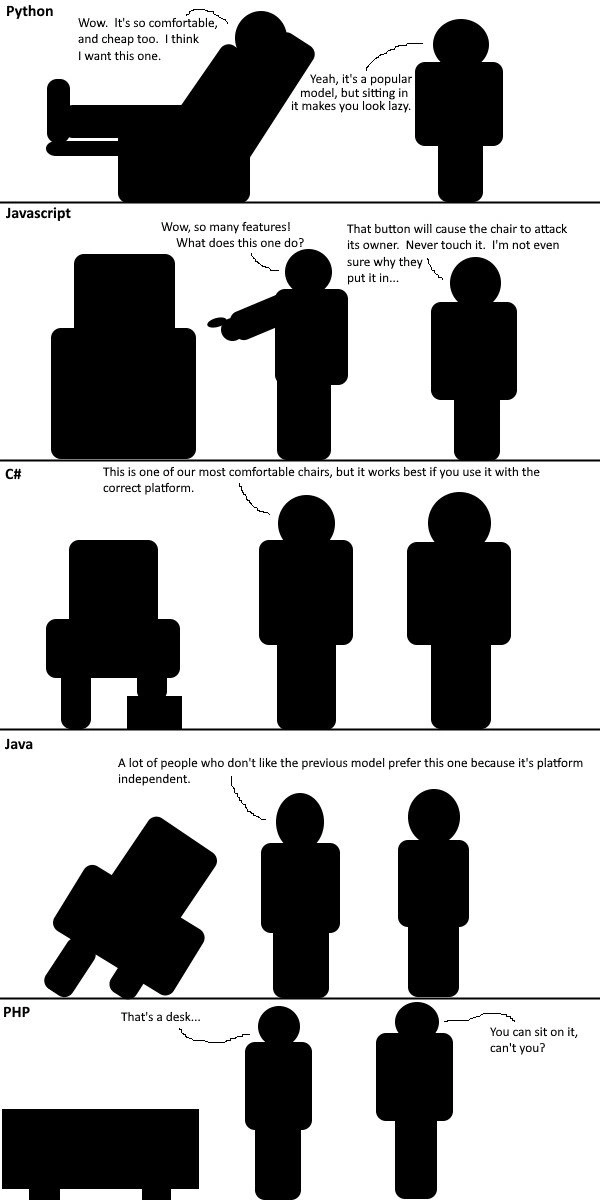
Imagine you’re in a furniture store where each chair has very different qualities, just like people say each programming language has its own personality. One chair is a super comfy recliner that everyone likes to sit in because it’s so easy to relax (that’s like Python, which is very easy to use). Another chair is big and fancy with lots of buttons — one button even makes the chair go crazy and try to throw you off! (That wild chair is like JavaScript, which has many cool tricks but also a few crazy features you should be careful with.) Then you see a nice office chair that feels great, but the salesperson says it only works really well with a specific matching desk (this is like C# — a great chair if you’re in the Microsoft room, but not as perfect elsewhere). Next, there’s a strange one-legged chair balanced in a funky way; it doesn’t look as cozy, but the cool thing is you can put it in any room and it will stand up (that’s Java: not the plushest seat, but you can use it on any computer platform and it’ll work). Finally, you spot what you think is a simple bench or table, and you say, “Hey, I could sit on that, right?” The store owner replies, “Well, you could sit on it… but it’s actually a desk, not a real chair.” (That’s PHP – it’s actually meant for a different purpose, but people often use it as a chair anyway when they just need somewhere to sit!). The whole scene is funny because each customer is treating these pieces of furniture in odd ways, just like programmers sometimes choose a tool that’s comfiest, or has lots of gadgets, or works anywhere, or even use something in a way it wasn’t intended. In simple terms: just as there’s no perfect chair for everyone (some are cozy, some are weird, some only fit in certain places), there’s no one perfect programming language — each has its own quirks that make us laugh and its own strengths that make someone out there love it. The meme makes us smile because we’ve all seen people sit on something weird or use a tool in a funny way and say, “Hey, it works for me!”

Level 2: Chair Analogy 101

Let’s break down the meme’s joke in simpler terms, focusing on what each panel means and some key concepts for a junior developer or anyone new to programming:

  • Python – The Comfy Recliner: Python is shown as a reclining chair because Python is known for being easy and comfortable to use. In programming, Python’s syntax is very readable (almost like English), and you can do a lot with few lines of code. It’s free (open-source), so calling it “cheap” fits too. The customer saying “It’s so comfortable, I want this one” matches how beginners often love Python — it’s welcoming and you feel productive quickly. The salesperson’s joke “sitting in it makes you look lazy” comes from a stereotype: since Python doesn’t require you to deal with tedious details (for example, you don’t need to declare variable types explicitly, and the language manages things like memory for you), some developers from more complex languages tease that Python programmers have it easy. Lazy here doesn’t mean Python coders don’t work hard; it’s poking fun at the fact that Python lets you accomplish the same work with less effort (which, frankly, is a strength, not a flaw!). As a junior dev, you might have noticed how quickly you can write a script in Python to do something that might take far more code in, say, C or Java. That’s developer ergonomics: Python is designed to minimize the strain on the programmer. The trade-off is that behind the scenes Python might run slower than a lower-level language, but when you’re starting out, the immediate comfort and productivity are obvious — just like a recliner that you can sink into and relax.

  • JavaScript – The Feature-Filled Chair with a Trap: JavaScript is depicted as a big armchair full of buttons and features, and the customer is curious “What does this one do?” This is because JavaScript, the main language of web browsers (and also used on servers with Node.js), has tons of features and quirks accumulated over time. It’s a very flexible language: you can program in different styles (functional, object-oriented, etc.), and it’s famous (or infamous) for letting you do things in unconventional ways. The salesperson warns that one mysterious button will “cause the chair to attack its owner” and even admits, “I’m not even sure why they put it in.” This refers to the fact that JavaScript has some features that can backfire or confuse you badly if used. For example, JavaScript has something called eval() which will take a string and execute it as code. That’s as dangerous as it sounds (imagine a button on a chair that makes it go berserk). Most devs say never use eval() because it can introduce security risks and bugs — much like a self-attacking chair function that should never have existed! Another example: older JavaScript had a feature called with to shorten code, but it caused so much confusion with variable scope that it’s essentially banned in strict mode. These are often called “footguns” in programming – meaning a feature that, if you’re not careful, will shoot you in the foot (hurt you/your code). The humor is that JavaScript has a few design warts from the early days (it was created very quickly in 1995), and everyone in web development knows about these JavaScript dangerous features. As a newcomer, you might find JavaScript both amazing (it can do so much!) and puzzling (why does typeof null return "object"? Why does adding [] + {} result in a weird string?). The meme is basically saying: “JavaScript is powerful and popular, but watch out for those odd parts that nobody should touch.” So the big comfy chair has all these cool buttons (features), yet one button is a trap — a perfect metaphor for the language that’s indispensable but has its WTF moments. It’s funny because the salesperson’s reaction (“not sure why they put it in…”) is how developers often feel about some of JavaScript’s design decisions: we just shake our heads and work around them, and warn newbies “Yeah... don’t press that.”

  • C# – The Great Chair on the Right Floor: C# is drawn as a nice modern office chair, and the salesperson says it’s one of the most comfortable chairs but “works best if you use it with the correct platform.” C# (pronounced “see-sharp”) is a programming language developed by Microsoft. It’s used with the .NET platform, kind of like a whole suite/framework for building applications, mainly on Windows. Think of the platform as the environment or operating system and its ecosystem. C# was designed to be very comfortable for developers (in fact, it took a lot of inspiration from Java and improved on some things). Many find writing C# code to be smooth and pleasant, especially with tools like Visual Studio (a powerful Integrated Development Environment by Microsoft). That’s the “comfortable chair” part — it provides a great developer experience with features like auto-completion, a huge standard library, and well-structured frameworks. However, historically C# was tightly tied to Windows (the correct platform). If you tried to use it elsewhere, you wouldn’t get the same seamless support. It’s like an office chair that rolls perfectly on a certain type of mat but might not on others. In practical terms, while today you can use C# on Linux or Mac thanks to .NET Core, for many years if you weren’t on Windows, C# was either not an option or was harder to use (there were projects like Mono to run .NET on Linux, but they often lagged behind). So developers who were all-in on the Microsoft stack loved C# (the chair fits their office perfectly), but developers on other systems tended to avoid it. The humor here is kind of poking at the platform dependence: C#’s power really shines when you commit to using Microsoft’s ecosystem (Windows OS, Microsoft’s libraries, etc.). The line implies a little “vendor lock-in” joke — like you buy this fancy chair, but oh by the way, it only attaches to a Microsoft-brand desk! As a junior developer, you might not have felt this yet, but this was a big point in the classic Java vs. C# debate: Java people would brag their code runs anywhere, whereas C# folks would brag about the great tools and features but had to accept being mostly on Windows. So in the store analogy, the salesperson is basically an honest salesman: “This chair is amazing, just know it performs best in one specific setting.” It’s a lighthearted way to say C# is awesome, but historically came with strings attached (the Windows platform).

  • Java – The Odd Platform-Independent Chair: Java is represented as a weird chair with one leg, mounted sideways. The idea of a one-legged chair might sound strange, but the key phrase is “platform independent.” In computing, platform independent means the software (or code) can run on any operating system or environment without modification. Java achieved this with the Java Virtual Machine (JVM), which is like a special engine that runs Java programs the same way on any operating system. It was often marketed with the slogan “Write Once, Run Anywhere.” In our furniture metaphor, a platform-independent chair is one that you can place on any floor surface (tile, wood, carpet, uneven ground) and it will still stand. The comic exaggerates this by showing the chair balancing on one leg (perhaps implying it has some gyroscopic balance or magic, who knows!). It looks a bit awkward to sit on, right? That’s reflecting how Java, while extremely portable and popular because of it, isn’t always the most comfortable or modern in its design. Especially if you compare older versions of Java to C#, Java had more boilerplate code and fewer modern language features for a long time. For example, before Java 8, doing simple things like filtering a list took a lot of code, whereas C# had LINQ which was concise. Java’s insistence on being strictly cross-platform sometimes meant it was slower to adopt platform-specific optimizations or new syntactic sugar. But importantly, the comic text says people who don’t like the previous chair (C#) prefer this one because of platform independence. This mirrors reality: many developers and companies chose Java in the 2000s explicitly because they didn’t want to be tied to Windows or Microsoft. They accepted any oddities in Java’s design as the price of freedom. So if C# is a super comfy chair that only fits one office, Java is a slightly funky chair that you can bring to any office. As a newer dev, you should know Java is everywhere — from huge enterprise servers to Android apps — largely thanks to that portability. The meme is making a playful jab that Java’s design might be a bit clunky or “sideways” (the one-leg design looks less stable than C#’s four legs), but hey, at least you’re not confined to one company’s ecosystem. It’s a trade-off: consistency across platforms at the cost of maybe not using some platform-specific fancy features. The humor lands because the drawing is ridiculous — a sideways one-legged chair — yet it maps to a real technical idea: Java’s “write once, run anywhere” approach sometimes leads to compromises that more platform-specific languages (like C# on Windows) didn’t have to make. If you’ve done any Java programming, you might have found it verbose or wondered why it has certain limitations — some of that is due to prioritizing universality and backward compatibility. So, this panel teaches that Java is beloved for its ability to run on any system, and people indeed would choose it for that reason, even if other languages might feel fancier or more tuned to a particular environment.

  • PHP – The Desk as a Chair (Improvisation): The last panel switches up the formula by revealing “PHP” as not a chair at all, but a desk. The customer’s response, “You can sit on it, can’t you?” is both the funniest line and the crux of a long-running joke about PHP. PHP is a scripting language mainly used for web development. Unlike the other languages here, which were designed with fairly clear principles from the start (Python for readability, JavaScript for web interactivity, C# and Java with their object-oriented structures), PHP kind of evolved in a haphazard way. It started as a simple set of scripts to add functionality to early web pages (developed by Rasmus Lerdorf around 1994 to handle his personal webpage forms). Over time people kept bolting on new features, and it grew into a full programming language, but without a strong unified design. This history means PHP has a lot of odd edges: inconsistent function naming (some functions_named_like_this, othersLikeThis), unexpected behaviors (type juggling that can surprise you), and a mix of features thrown together. Seasoned devs often criticize PHP for being inelegant or a big mess. Now, why a desk? A desk is a piece of furniture meant to hold things, not for sitting. But if someone insists, yes you could sit on a desk – it’s just not what the desk was made for, and it might be uncomfortable or even break if you use it wrong. That’s the perfect analogy for PHP. “You can sit on it, can’t you?” is like a defensive PHP developer saying, “Well, it works, doesn’t it? Who cares if it’s not meant to be pretty.” PHP often gets the job done (you can build websites with it that work just fine – in fact a huge chunk of the internet, including WordPress blogs and Wikipedia, runs on PHP), but many software engineers will say it’s the wrong tool for many jobs, or at least not a well-designed tool. It’s similar to using a screwdriver as a hammer because you happen to have one — sure you can pound a nail with a screwdriver handle if you really try, but a real hammer would be better. PHP’s flexibility and ease made it super popular for quickly building web applications, especially in the 2000s – it was essentially everywhere, because hosting it was cheap and straightforward (just drop your PHP files on a server with PHP installed and boom, your site works). Beginners often start with PHP for web because it’s straightforward to embed PHP code directly into HTML pages. However, as you gain experience, you notice PHP’s oddities and why some people discredit it. The desk vs chair joke encapsulates that feeling: other languages are purpose-built chairs with specific strengths, while PHP is portrayed as this jerry-rigged solution – not really intended to be a full application language, but people sat on it anyway until it became one. If you’re a junior dev, you might hear a lot of conflicting takes on PHP. Some will say “don’t use it, it’s awful,” others will say “it’s fine, I built a whole business with it.” This meme sides with the playful criticism that “PHP isn’t a real programming language” (the desk isn’t a real chair) — an exaggeration, of course, since PHP is a real language, just one with an unorthodox lineage. It highlights an important lesson in tech: sometimes tools succeed not because they’re the best designed, but because they’re available and good enough. Many of us have at one point sat on something that’s not a chair because we needed a seat; likewise, many coders have used PHP because it was the tool at hand that solved the immediate problem, design elegance be damned.

In summary, each panel uses a furniture_metaphor to teach something about programming languages: - Python: easy and comfy (great developer experience, but you might get spoiled by how easy it is). - JavaScript: powerful but beware of its weird/dangerous parts (it has some legacy quirks that can bite, so handle with care). - C#: excellent comfort within its intended ecosystem (works best with Microsoft’s platform; a top choice if you’re in that world). - Java: not as fancy in feel, but works everywhere (the go-to if you need cross-platform reliability and don’t mind some clunkiness). - PHP: not originally meant to be a “proper” chair, but people sit on it anyway (a pragmatic but messy solution that nevertheless is very widely used).

For a junior developer, the meme’s joke is a fun way to remember some key differences and running jokes about these languages. It’s like a quick tour of programming language lore using chairs:

  • You learn that Python is beginner-friendly and powerful (no wonder it’s so popular, even if someone jokingly calls you lazy for using it).
  • You learn that JavaScript, while essential for web development, has some “don’t touch that!” aspects due to its quick creation and evolving nature.
  • You see that C# and Java often get compared, with the big difference being Windows-specific vs cross-platform philosophy.
  • You discover that PHP has a reputation for being the wild-west tool – often criticized, yet undeniably practical in many scenarios (and that debate is a bit of a holy war in itself).

This meme is part of the broader “language wars” and language_personification tradition in developer humor, where programming languages are given human or object traits to highlight their identities. Even without deep knowledge, you can appreciate that each “chair” has something unique (comfort, too many features, platform dependence, platform independence, not really a chair), which correlates to real attributes of each language. It’s educational beneath the humor: after seeing this, you might be curious and go ask, “Hey, what’s so weird about JavaScript that you shouldn’t press some feature?” or “In what way is PHP not like the others?” That’s a great conversation starter with more experienced programmers — and chances are, they’ll have plenty of stories to share for each one!

Level 3: Sitting on Syntax

At this level, we dissect how each programming language is humorously portrayed as a piece of furniture, highlighting deeper technical and cultural nuances that senior developers recognize. The comic isn’t just random; it taps into well-known language stereotypes and Developer Experience (DX) differences:

  • Python as a Recliner: In the first panel, Python is the ultra-comfy reclining chair. This represents Python’s reputation for being easy to learn and highly productive. Python’s syntax is clean and high-level, acting like a plush cushion that lets you lounge while the language handles a lot of heavy lifting (memory management, huge standard library, dynamic typing). It’s “cheap” in the sense that it’s open-source and widely available, lowering barrier to entry. But the salesperson’s quip about it making you look lazy reflects a real-world sentiment: because Python lets you accomplish tasks with minimal code (and you might rely on tons of built-in conveniences), some hardcore low-level programmers tease that Python devs have it too easy. There’s a kernel of truth in the joke — using Python can feel like reclining, because you don’t need to wrestle with manual memory allocation or verbose boilerplate. The language ergonomics are excellent, but the joke implies a trade-off: if you’re always in a coding “La-Z-Boy”, are you getting out of your comfort zone? Seasoned devs smile at this because they know Python’s ease can indeed spoil you with convenience. Yet, beneath the humor is respect: Python’s “comfort” is a deliberate design choice to maximize developer productivity and readability. The lazy look comment is a tongue-in-cheek nod to how effortless Python can make complex tasks appear — something that sometimes irks developers from more demanding language backgrounds who had to do it the hard way.

  • JavaScript’s Dangerous Features: The second panel shows JavaScript as a feature-packed armchair with an ominous mysterious button that will “cause the chair to attack its owner.” This is a sharp satire of JavaScript’s infamous footguns — features or quirks in the language that can hurt the developer if misused. JavaScript is powerful and flexible (so many buttons!), but not all its features are safe. For instance, JavaScript has some dangerous features like the old-school with statement, or using eval() to execute strings as code, which can lead to chaos (security holes or bugs biting you unexpectedly). There are also bizarre type coercions and legacy quirks: e.g. using == instead of === can produce unpredictable results ("5" == 5 is true due to type coercion, which can be as startling as a chair suddenly flipping on you). The meme’s “I’m not even sure why they put it in…” line echoes what many devs feel about JavaScript’s wackier features — a mix of bewilderment and frustration that such things exist in the language. Historically, JavaScript was created in a rush (10 days in 1995), so it has some questionable design choices left in for backwards compatibility. Senior engineers have learned to never press that button (just avoid the wonky features!). The humor here comes from collective experience: everyone using JavaScript has their cautionary tales of something weird happening because of a seemingly innocent feature. The salesperson’s warning could be every experienced JS developer advising a newbie: “Yes, JavaScript has fancy capabilities, but trust me, don’t go poking that odd part of the spec — you’ll only hurt yourself.” It’s a comical exaggeration of real pitfalls, like how calling setTimeout("attackUser()", 0) (string form) is essentially letting the chair attack (since setTimeout with a string will eval it). The broader commentary is on language design vs. safety: JavaScript gives you lots of rope, enough to lasso a horse... or hang yourself, if you’re not careful. Seasoned devs nod knowingly here, recalling countless “WAT” moments (like the famous talk “JavaScript WTF” that highlights these surprises) that make you wonder why that button exists at all. It’s an exaggeration — a chair likely wouldn’t literally attack you — but in coding terms, a feature that crashes your app or creates a security hole does feel like being attacked by your own tool. This panel cleverly captures the mix of love and fear in the JavaScript community: we adore its capabilities but warn others about its sharp edges.

  • C# and Platform Lock-In: Panel three introduces C# as a sleek, modern office chair. The salesperson calls it “one of our most comfortable chairs” which aligns with C#’s reputation among many developers: it’s a well-designed, modern language with lots of syntactic comforts (garbage collection, rich standard libraries, elegant syntax improvements over Java, LINQ for data queries, etc.). Many who have used C# praise how comfortable it is to write large applications with it, especially with the full support of Microsoft’s ecosystem (Visual Studio, robust debugging, etc.). However, the kicker is “it works best if you use it with the correct platform.” This alludes to C#’s history as a language tightly integrated with the .NET framework and, for a long time, primarily targeting Windows. The joke is that this fancy ergonomic chair might have wheels or a base optimized for a specific floor (like a special track or platform). In real terms, although C# is technically standardized (as ECMA/ISO C#) and implementations like Mono/Xamarin existed, traditionally you’d get the best experience using C# on Windows with the official .NET/CLR runtime. It’s like buying a great office chair that only fits a certain kind of desk setup. Senior devs recall the early 2000s: if you loved C#’s comfort but worked on Linux/Unix, you were out of luck — you either stick to Windows or use less ideal substitutes. This panel pokes fun at how Microsoft’s ecosystem historically locked you in. It hints at enterprise reality: lots of shops went with C# (and its close integration with Windows Server, SQL Server, Active Directory, etc.) because when you commit to that platform, everything just clicks – the chair rolls smoothly on that platform’s floor. But try to take it elsewhere and it might squeak or get stuck. It’s worth noting that by 2020 (when this meme was posted), .NET Core had already emerged to make C# cross-platform, but the meme leans on the long-standing stereotype from the Language Wars: Java vs C#. Microsoft created C# in the shadow of Java, copying Java’s comfy features and then adding more padding. But in doing so, they tied it to Windows (like a chair that requires a proprietary attachment). The humorous truth is that many devs who used Java in the early days did so because they didn’t want to be tied to one vendor’s platform. So the salesperson’s line is effectively acknowledging, “This chair is amazing… as long as you also buy our matching Microsoft desk (Windows).” Tech veterans chuckle because they’ve seen the industry debates over this — C# fans tout its comfort and advanced features, Java fans retort “yeah, but I can run my code anywhere, not just on Windows!”. This panel encapsulates that debate in a single witty furniture analogy.

  • Java’s One-Legged Platform Independence: The fourth panel is Java, depicted as a bizarre chair mounted sideways on a single leg. The salesperson explains, “A lot of people who don’t like the previous model prefer this one because it’s platform independent.” This is a brilliant visual joke about Java’s core philosophy: “Write Once, Run Anywhere” (WORA). Java was designed to be platform independent – code that runs on any operating system via the Java Virtual Machine (JVM). In our chair analogy, being platform independent might mean the chair has an adjustable single leg or gyro that lets it balance on any surface (be it carpet, tile, or hardwood floor – analogous to Windows, Linux, Mac, etc.). It’s a one-size-fits-all solution, but as the image shows, it’s also an odd design: the chair is sideways on one leg, looking slightly uncomfortable or counterintuitive. This humorously reflects criticisms of Java: in achieving portability and decades-long backward compatibility, Java can feel more cumbersome or less ergonomic than a platform-tuned language like C#. For example, Java historically had more boilerplate code (lots of FactoryFactory classes and verbose syntax, especially before Java 8’s improvements), and it carried some baggage for the sake of cross-platform consistency (e.g., Java’s early UI toolkits looked equally clunky on every OS). The line about people preferring it because they “don’t like the previous model” (C#) is a nod to the Sun vs. Microsoft saga. Many devs in the late ’90s and early ’00s chose Java specifically to avoid being dependent on Microsoft’s platform. If C# was the comfy chair tied to Windows, Java was the eccentric chair that works anywhere – maybe not as plush, but it gives you freedom to move it to any room. It’s also a subtle dig: the chair’s on one leg, which might be less stable or modern-looking compared to the solid 4-legged C# chair, implying Java might be a bit outdated or awkward, but hey, at least it’s not locked down. Seasoned developers recognize this trade-off: Java’s “design once for all platforms” approach meant some design choices (like the JVM overhead, or the “write once, debug everywhere” joke when WORA didn’t perfectly hold) could seem as odd as a sideways chair, yet it became hugely popular in enterprise environments where being able to run on any server was a massive advantage. The meme captures the irony that Java folks often cite platform independence as a deciding factor, even if the language has its warts. In essence, Java is portrayed as the alternative chair you pick out of principle (or necessity) — you accept its peculiar ergonomics because you value its independence from a particular platform. For veteran developers, this panel resonates with years of Java vs C# debates: Java proponents championing the JVM flexibility and open community, while acknowledging maybe C# had a bit more padding and recline features (but came at the cost of Windows-only for a long time).

  • PHP the “Not-A-Chair” Desk: The final panel is the knockout punchline. PHP is literally depicted as a plain rectangular desk, which the customer is attempting to use as a seat. The salesperson says, “That’s a desk…” and the customer defensively replies, “You can sit on it, can’t you?” This is savage commentary on PHP’s reputation in the programming world. PHP started as a simple set of tools (it literally stood for “Personal Home Page” in its earliest incarnation) for making basic web pages dynamic. It wasn’t carefully engineered as a full-fledged programming language at the outset — it kind of became one over time through organic growth. In other words, PHP wasn’t originally designed to be a fancy ergonomic chair; it was more like a makeshift bench that people ended up sitting on because, hey, it’s there and it works. The meme equates that history to someone mistaking a desk for a chair just because you can sit on it. This captures the essence of PHP’s pragmatic (if messy) nature. In practice, PHP is often viewed as the language you use when you’re hacking together something quick for the web — a lot of WordPress and simple websites run on PHP because you can just drop PHP files on a server and get results. It’s not elegant, it has plenty of design inconsistencies (just like a desk isn’t optimized for sitting, PHP has quirks like inconsistent function naming and surprising behaviors due to its organic development). Seasoned devs often joke that PHP is held together with duct tape: it will get the job done, but it ain’t pretty. The dialogue in the panel is essentially a conversation between a software purist and a pragmatist. The purist (salesperson) says “That’s not even a chair (not a real programming language in the academic sense)”, and the pragmatist (customer) says “Meh, I can sit on it (I can use PHP to solve my problem), so why not?” This reflects the real-world scenario where PHP, despite all the criticism about its design, powered huge portions of the web, because for many developers and startups, “good enough” beats purity. People build entire systems on PHP (the desk) and sit on it comfortably enough, even if language aficionados cringe. The humor hits home for anyone who’s seen messy PHP codebases that nonetheless work just fine. It’s a commentary on developer mindset: some care about design elegance (using the right tool for the job, i.e., a real chair), others care about getting results (if a desk works as a seat, so be it). There’s also a hint of language wars elitism being mocked: where one dev snobbishly says “PHP isn’t a real language” and the other says “I got my website working over the weekend with it, so I don’t care.” The stick figures perfectly embody this tension. Seasoned programmers laugh because they’ve either made this joke or lived it — perhaps reluctantly maintaining a PHP app that started as a quick hack (sitting on a desk) which became mission-critical (now it’s an unofficial chair).

Why it’s so funny for experienced devs: Each panel distills a complex, nuanced tech debate or cultural trait into a simple visual gag. The humor comes from recognition — we’ve heard all these arguments and stereotypes before, possibly in heated forum threads or over coffee with colleagues. The meme uses a furniture metaphor to make these abstract comparisons tangible: we can see how absurd some attitudes are when put in these terms. Yet, there’s truth behind every absurd image: - Python really does let you be super productive (sitting back comfortably), but some will still judge you for not working in a “harder” language. - JavaScript’s ecosystem is amazingly rich (so many features), but it has dark corners that everyone warns you about (the self-attacking switch you should never flip). - C# feels polished and enterprise-ready (luxury chair), yet for years it implicitly forced you into Microsoft’s world – a strategic comfort with strings attached. - Java prioritizes universality over fancy design (the odd one-legged chair), and that ideological stance won it a huge following of developers who cared about independence from vendor lock-in. - PHP is the scrappy underdog (or ugly duckling) that breaks the rules of good design, but pragmatically, it’s everywhere because it’s simple and was in the right place at the right time – akin to sitting on whatever’s around to get the job done.

Experienced devs appreciate how the furniture_personification exaggerates each language’s rep for comic effect. It’s basically an inside-joke roast of popular languages. This meme also implicitly pokes fun at “Language Wars”: decades of debates where developers defend their favorite languages almost like one would champion a preferred chair – often a matter of personal comfort and habit as much as objective merit. Each panel can spark a war story: a Python guru defending why less code is more, a JavaScript old-timer facepalming about a junior dev who used a harmful feature, a C# and Java dev debating performance vs portability, a PHP developer proudly pointing out how quickly they got something working while others over-engineered. The meme gets big laughs (and some groans) because it nails these archetypes succinctly. It shines light on the quirks in language design and usage that senior engineers often gripe about or laugh at. Underneath the humor, there’s almost a sense of camaraderie — a we’ve all been there feeling. The comic format also reminds us not to take these debates too seriously: after all, at the end of the day, whether you sit on a recliner, an office chair, or even a desk, the important thing is getting comfortable enough to do your work (write code). The absurdity helps defuse the language holy wars by framing them in such everyday terms. In sum, this meme resonates on multiple levels with experienced developers: it’s a witty commentary on technical differences (like platform_independence or type systems) and on the human tendency to jury-rig solutions or develop loyalties to our tools. The “chairs vs languages” analogy will have a senior dev chuckling and perhaps reminiscing about the times they had each of those chairs in their career journey.

Description

A five-panel vertical comic strip that uses simple black silhouettes to personify programming languages as chairs in a showroom. Each panel depicts a different language with a short dialogue exchange. 1. Python: A customer relaxes in a comfortable recliner, loving its comfort and price, while the salesman notes it 'makes you look lazy'. 2. Javascript: The customer points to a button on a complex chair, and the salesman warns that it will 'cause the chair to attack its owner' and they don't know why it's there. 3. C#: The salesman presents a sturdy but platform-specific chair that 'works best if you use it with the correct platform'. 4. Java: In response to the previous model, the salesman offers an awkwardly tilted chair, preferred by those who want something 'platform independent'. 5. PHP: The customer is shown a desk, and when the salesman points this out, the customer replies, 'You can sit on it, can't you?'. The comic humorously skewers the common stereotypes and perceived flaws of each language, from Python's simplicity to JavaScript's dangerous quirks, C#'s ecosystem dependency, Java's clunky portability, and PHP's chaotic design


Comments

7
Anonymous ★ Top Pick Choosing a language is like buying furniture. You've got the comfy Python recliner for quick naps, the over-engineered JavaScript chair with a 'self-destruct' button, and then there's PHP... which, as it turns out, was a poorly documented IKEA desk all along
  1. Anonymous ★ Top Pick

    Choosing a language is like buying furniture. You've got the comfy Python recliner for quick naps, the over-engineered JavaScript chair with a 'self-destruct' button, and then there's PHP... which, as it turns out, was a poorly documented IKEA desk all along

  2. Anonymous

    Our tech stack review is basically that showroom: we all nap in the comfy Python recliner until latency wakes us, someone presses JavaScript’s mysterious “==” button, ops grumble the C# chair won’t roll far from Windows, Java insists its sideways seat is “platform-independent posture,” and PHP - still a desk we’ve been sitting on since the dot-com crash

  3. Anonymous

    After 20 years in the industry, you realize every language is just a different way to sit uncomfortably while management asks why the desk isn't walking yet - and somehow PHP developers have convinced everyone that sitting on a desk is perfectly normal architecture

  4. Anonymous

    This perfectly captures the eternal language debate: Python devs are judged for writing readable code in their pajamas, JavaScript devs navigate a minefield of `undefined` behaviors and framework churn, C# devs enjoy enterprise comfort until they need to deploy on Linux, Java devs carry their JVM everywhere like a security blanket, and PHP devs... well, they've been sitting on that desk since 1995 insisting it's 'web scale' while everyone else wonders if they should stage an intervention

  5. Anonymous

    Tech stacks: comfy for Python prototypes, catastrophic once the JVM and PHP crash the party

  6. Anonymous

    Enterprise stack procurement is just furniture shopping: Python is ergonomic, JavaScript ships a footgun as a feature, C# comes with a platform EULA, Java’s “portable” option arrives with a forklift, and PHP is the desk someone already declared a seat in prod

  7. Anonymous

    Choosing a language is just office furniture procurement: Python’s the recliner that accrues posture debt, JavaScript ships a footgun labeled “feature,” C# is comfy only with the OEM legs, Java is portable but never sits quite upright, and PHP is a desk someone insists counts as a chair

Use J and K for navigation