Skip to content
DevMeme
896 of 7435
The Developer's Perpetual Apprenticeship vs. Instant Expertise
MentalHealth Post #1013, on Feb 1, 2020 in TG

The Developer's Perpetual Apprenticeship vs. Instant Expertise

Why is this MentalHealth meme funny?

Level 1: The Beginner and the Expert

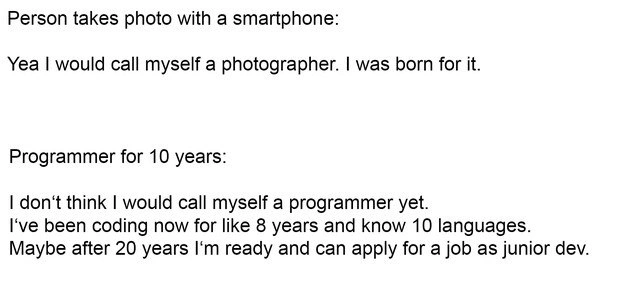
Imagine two friends: One friend takes one photo with their phone and immediately says, “Wow, I’m a great photographer! I was born to do this!” They’re super confident right away, even though they just started. Now, the other friend has been doing something hard (like coding on a computer) for 10 years. This second friend has learned a lot and made many cool things over the years. But funny enough, they say, “I don’t think I’m really a programmer yet. Maybe after doing it 10 more years, I’ll feel good enough to just be a beginner.” It sounds silly, right? The person who’s new is bragging, and the person who’s actually very experienced is doubting themselves.

This is why the meme is both funny and a little sad: it’s like a kid who draws one picture and proudly calls themselves an artist, while an actual painter who’s been painting for years is shy and says, “I’m not that good.” We usually expect it to be the other way around! The joke shows how sometimes people who know only a little feel very sure of themselves, and people who know a lot feel not sure at all. It makes us chuckle because it’s such a big flip of what you’d think. And it also reminds us of an important feeling: even if you’re really good at something, you might still feel nervously that you’re not good enough. Everyone else can see the expert is truly skilled, so it’s a bit absurd (and sweet) that the expert doesn’t see it themselves. This little story helps us remember to believe in ourselves a bit more—and it’s okay to laugh at how weird we can be about our own talents.

Level 2: Not a Real Programmer

This meme is highlighting imposter syndrome, a term for when skilled people feel like frauds or doubt their abilities. In the text, a person who took a simple smartphone photo immediately calls themselves a “photographer.” That’s like someone snapping one picture and already feeling confident enough to claim they are good at photography. In contrast, the meme shows a programmer with 10 years of experience who says, “I don’t think I would call myself a programmer yet.” This programmer has been coding for about 8-10 years and even knows 10 programming languages (like Python, Java, C++, etc.), which is a lot! By any normal standard, this person is definitely a software developer or even a senior one. But because of imposter syndrome, they still feel not “real” enough to own the title.

Let’s clarify some terms:

  • Programmer / Developer: Someone who writes code to create software. If you’ve been doing this for 10 years, you’re typically considered an experienced or senior developer in the industry. It’s common to know multiple programming languages (different coding syntaxes like JavaScript, Python, C#, etc.) over a long career. Knowing 10 languages is a sign of a very skilled, polyglot programmer (polyglot means multi-lingual, in this case proficient in many coding languages).
  • Junior Dev (Junior Developer): A job title usually for someone new to the field (often with ~0-2 years experience). It’s the entry-level position in software. After 10 years of coding, you’d normally be far beyond junior level – usually you’d be a Senior Developer or at least a mid-level developer. So the line “after 20 years I’m ready and can apply for a job as junior dev” is an intentional exaggeration to be funny. It’s showing how absurd the programmer’s self-doubt is (they think they’d still only qualify as a beginner even after two decades of experience!).

The meme humorously points out how someone with very little experience can be overly confident, while someone with a lot of experience can be overly humble or unsure. The first character taking a photo is basically a beginner but boldly says “I was born for it,” meaning they think photography is their natural talent after one try. The second character is a seasoned programmer who has probably written thousands of lines of code, built many projects, and debugged countless issues. Yet they hesitate to even call themselves a “programmer.” This is a classic sign of imposter syndrome in developers – many developers feel like they’re not “real” programmers, even when they actually are quite accomplished. They worry they still don’t know enough or that others are much more qualified.

This is also touching on mental health in tech. Feeling like you’re not good enough (despite evidence to the contrary) can affect a developer’s confidence and anxiety levels. It’s very common in the tech industry for people to struggle with this. The meme is relatable for junior and senior developers alike because many have had that thought: “Do I really know what I’m doing? Am I actually a programmer or just faking it?” It also lightly mocks how the industry sometimes has crazy job requirements. (For example, you might see a job posting for a “junior developer” that asks for 5+ years of experience, which doesn’t make sense – that’s more like a senior level.) The programmer in the joke saying they need 20 years to be a junior dev is poking fun at that kind of thing and at themselves for feeling so underqualified.

In summary, this meme uses a simple comparison to explain a big feeling: even if you’ve been coding for a long time, you might still feel like a newbie. And that’s ironically the opposite of someone trying something once and feeling like an expert. It’s a humorous reminder that titles like “expert” or “programmer” are sometimes more about confidence than actual skill – and that many skilled people have a hard time seeing their own talent. If you’re a new developer (a junior), this meme might also be encouraging; it shows that even people you consider seniors sometimes feel the same insecurities you do. It’s saying: “Hey, we all feel like we’re not good enough sometimes, even after years of experience – you’re not alone.”

Level 3: A Decade of Doubt

At the core, this meme hilariously contrasts overconfidence and imposter syndrome in tech. It sets up a scenario where a person snaps a single photo on a smartphone and immediately proclaims “I was born for it.” Meanwhile, a programmer with a decade of coding experience (who knows ~10 programming languages) still says, “I don’t think I’d call myself a programmer yet.” This extreme self-deprecation is a familiar form of developer humor. It satirizes how seasoned software engineers often struggle with professional insecurity and self-doubt, even as they accumulate skills. The humor cuts deep because it rings true: in tech culture, even ten-year veterans question their legitimacy. Everyone laughs, but nervously – we recognize that pang of imposter syndrome from our own careers.

This juxtaposition highlights a paradox: in many fields, a tiny bit of skill can breed oversized confidence, while vast expertise can make someone feel like they know nothing. Psychologists call this the Dunning-Kruger effect – novices are too ignorant of the craft’s complexity to doubt themselves, while experts are keenly aware of everything they don’t know. The meme’s “photographer” exemplifies the early confidence peak (boldly self-identifying as a pro after one snapshot). The “programmer” represents the humbled expert, acutely aware of the endless learning curve in software development. After 10 years in the industry, this coder clearly isn’t a junior developer, yet they still feel unworthy of the title “programmer.” It’s a geeky confidence paradox that experienced devs immediately recognize: the more you learn, the more you realize how much remains to be learned.

Why is this so relatable to developers? Tech is a field of constant change – new languages, frameworks, and “best practices” emerge non-stop. Even a polyglot programmer (one who has mastered multiple programming languages) can feel outdated when a new technology trend hits. There’s a pervasive culture of DeveloperSelfDeprecation, where calling oneself a “coder” or “engineer” feels like a big claim unless you’re some legendary 10x guru. Many senior developers joke that they still feel like imposters who just “Google things and stackoverflow” all day. The meme exaggerates this to absurdity: “Maybe after 20 years I’m ready and can apply for a job as junior dev.” That line pokes fun at both the individual’s low self-esteem and the tech industry’s warped job title expectations. (It’s a sly nod to the fact that sometimes even “Junior” job postings ask for unrealistic experience, causing further DeveloperAnxiety.)

To break it down, the meme uses a simple two-part text format to deliver its punchline. The first part is everyday life: taking a quick photo and instantly claiming creative professional status. The second part is the programmer’s inner monologue: a SeniorVsJuniorDevelopers reversal where the actual expert feels like a newbie. Visually, it’s just text on a white background – no fancy image needed – because the irony carries itself. It resonates especially with those in the software industry who’ve felt imposter syndrome despite years of accomplishments. It’s equal parts career humor and cautionary tale: even an accomplished developer can feel like they’re “not there yet.” The shared experience of this self-doubt is what makes the meme funny and bittersweet. We chuckle at the photographer’s brash confidence, but we identify with the coder’s relentless uncertainty. In a way, the meme is a gentle reminder in tech culture that questioning your own expertise (while everyone else thinks you’re an expert) is surprisingly common – and yes, a little absurd.

Let’s compare the two characters side by side:

Person Actual Experience Self-Assessment Quote
New smartphone photographer Took one photo (almost no experience) Yea I would call myself a photographer. I was born for it.” (💯 confident)
Programmer (10-year veteran) 10 years coding, knows ~10 languages (expert) I don’t think I would call myself a programmer yet...” (🤔 full of doubt)

The stark contrast is what drives the humor. The novice in photography has sky-high confidence after doing the bare minimum, whereas the expert coder has imposter syndrome despite a strong résumé. It’s an ironic role reversal that anyone in tech can recognize. In real life, developers with 10+ years often mentor others, architect complex systems, and debug hairy production issues at 3 AM. Yet many of those same folks privately feel, “I’m not that great – real programmers know X better than me.” This meme exaggerates that feeling to highlight the absurdity: if 10 years and 10 programming languages aren’t “enough” to feel like a programmer, will anything ever be? It’s laughing at a painful truth about mental health in tech – that internal developer anxiety doesn’t always match external qualifications.

Ultimately, this meme captures a slice of developer culture: it’s a mix of relatable humor and a commentary on how the tech industry’s high standards (and our own perfectionism) can mess with our heads. It reassures us that feeling like an imposter is so common that we’ve turned it into a joke. And by laughing together at this imposter syndrome meme, maybe we all feel a little less alone in our self-doubt. After all, if even the coder with a decade under their belt feels like a fraud sometimes, the rest of us can cut ourselves some slack!

Description

A text-only meme presented on a plain white background, contrasting two attitudes towards professional identity. The first part reads: 'Person takes photo with a smartphone: Yea I would call myself a photographer. I was born for it.' This is immediately followed by the second part: 'Programmer for 10 years: I don't think I would call myself a programmer yet. I've been coding now for like 8 years and know 10 languages. Maybe after 20 years I'm ready and can apply for a job as junior dev.' The meme uses hyperbole to highlight the pervasive imposter syndrome and culture of humility within the software development community. For senior engineers, it's a deeply relatable joke about how the more one learns in the vast and ever-changing field of technology, the more one becomes aware of the sheer volume of what they don't know, leading to a chronic feeling of inadequacy despite significant experience and skill

Comments

7
Anonymous ★ Top Pick In tech, the Dunning-Kruger effect is shaped like a cliff. You peak at 'I've centered a div,' and then spend the next 10 years in a freefall of realizing you know nothing about distributed systems
  1. Anonymous ★ Top Pick

    In tech, the Dunning-Kruger effect is shaped like a cliff. You peak at 'I've centered a div,' and then spend the next 10 years in a freefall of realizing you know nothing about distributed systems

  2. Anonymous

    A decade spent refactoring the same monolith into 42 microservices and I still hesitate to tick “expert” on LinkedIn - meanwhile my friend snaps one brunch photo and rebrands as “Senior Director of Mobile Imaging.”

  3. Anonymous

    The more you know about distributed systems, the less distributed your confidence becomes - it all consolidates into a single point of failure called imposter syndrome

  4. Anonymous

    After a decade of production code, mastering ten languages, and surviving countless on-call rotations, the senior engineer still introduces themselves as 'just someone who dabbles in code' - meanwhile, someone who completed a weekend bootcamp has already updated their LinkedIn title to 'Full-Stack Architect & Thought Leader.' The irony is that the person who truly understands the depth of software engineering knows exactly how much they don't know, while the Dunning-Kruger effect ensures that confidence inversely correlates with competence. It's the eternal curse: the more you learn, the more you realize you're perpetually unqualified - even as you're the one everyone calls at 3 AM to fix production

  5. Anonymous

    Photographers hit prod-ready in O(1); programmers accrue imposter Big O over decades of framework churn

  6. Anonymous

    Everyone with a smartphone is a photographer; after a decade of production, my job title still type-checks as Maybe<Junior>. Confidence is strongly consistent in the Dunning - Kruger cluster; mine’s eventually consistent

  7. Anonymous

    After 10 languages and a few 3am rollbacks, the only title I trust is ‘it depends’ engineer

Use J and K for navigation