Skip to content
DevMeme
1409 of 7435
A Hierarchy of Programming Language Complaints
Languages Post #1582, on May 14, 2020 in TG

A Hierarchy of Programming Language Complaints

Why is this Languages meme funny?

Level 1: At Least You Have Letters

Imagine four friends complaining about how they have to send messages, each in a more difficult way than the last. The first friend says, “I hate that my teacher makes me use proper punctuation when I text – typing commas and periods is such a bother!” The second friend replies, “Oh, that’s nothing. I’m only allowed to send messages by telegram, and I have to write the word ‘STOP’ at the end of every sentence. It’s so annoying!” The third friend interjects, “Well, I have it worse: I’m using Morse code with a flashlight to communicate. I have to blink every single dot and dash to spell out letters – it takes forever just to say hello.” Finally, the fourth friend looks at all of them in disbelief and says, “Wait, you guys get to use actual letters? I’m stuck sending smoke signals with a blanket over a fire!” In this funny scenario, each person’s gripe sounds serious until you hear the next person, who has an even more ridiculous challenge. By the time we get to the friend using smoke signals (with no alphabet at all, just puffs of smoke), the earlier complaints about punctuation and telegrams seem silly. This is just like the meme: the Python and C# folks are whining about little writing rules in their coding languages, then the Assembly friend says they have to do something much harder, and finally the Brainfuck friend says, “You’re upset about that? I don’t even get regular words to code with!” The humor comes from comparing these situations and realizing how each step down makes the previous complaints sound trivial. It’s a playful reminder to appreciate what you have — at least you’ve got letters to work with, unlike that poor smoke-signal guy (or in the meme’s case, the Brainfuck programmer)!

Level 2: Language Quirks 101

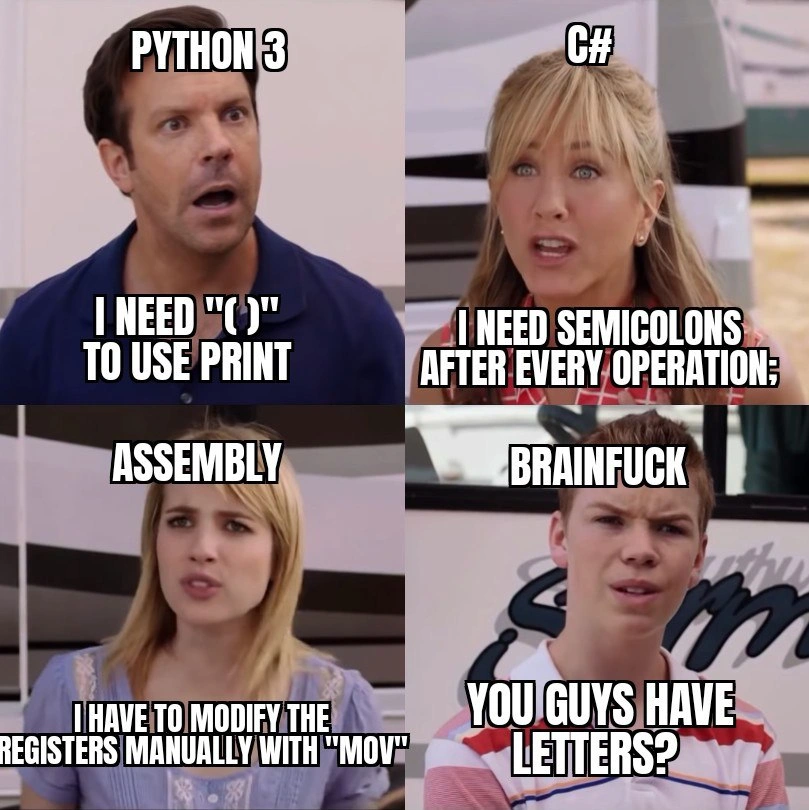
Let’s break down what’s happening in this meme in simpler terms, especially if you’re newer to programming or only familiar with one of these languages. We have four panels, each representing a different programming language and its syntax quirk (an odd little rule or requirement of that language’s grammar). The meme uses a popular format (the “We’re the Millers” movie meme) where each character complains about something, and the last character delivers a punchline that outdoes the rest. Here the theme is programming language complaints:

  • Python 3: In the top-left, Python is saying “I need () to use print.” This refers to how in Python version 3 and above, print is a function and requires parentheses around its argument. For example, you have to write print("Hello"). In older Python (version 2), you could simply write print "Hello" without parentheses. So this line pokes fun at Python 3 demanding a pair of parentheses. It’s a mild gripe—most Python programmers got used to it quickly, but you’ll still hear the occasional old-timer playfully grumble about it. The key term here is that Python now treats print like a normal function call (hence needing parentheses), whereas it used to be a language statement. If you’re a new programmer, just know: in Python (unlike some languages), whitespace and punctuation are usually minimal, but in Python 3, yes, you do need those () when you call print. It’s a tiny change that became an inside joke during the transition from Python 2 to 3.

  • C#: The top-right has C# (a programming language by Microsoft, similar in style to Java and C++). The caption says “I need semicolons after every operation;” and even includes a semicolon at the end for emphasis. This is highlighting that in C# every statement must end with a ; (semicolon). This is true of many programming languages such as C, C++, Java, and JavaScript as well. The semicolon is basically a required punctuation mark that tells the compiler “this line of code is complete – move on to the next.” For instance, in C# if you wrote int x = 5 and forgot the semicolon, the code wouldn’t compile; it expects int x = 5;. New programmers often forget one here or there and get errors like “Syntax error, ‘;’ expected.” It can feel like a nitpicky rule, hence the joke of a C# developer complaining about having to type ; constantly. In reality, most C# developers don’t mind semicolons (you get used to it, and your editor might even auto-insert them nowadays), but when compared to languages like Python (which don’t require semicolons due to using new lines or indentation to separate statements), it stands out as a difference. So this panel is a lighthearted jab about semicolon_termination in C# and similar languages: it’s a “quirk” of that language’s syntax that you just have to know.

  • Assembly: The bottom-left introduces Assembly. Assembly language is quite different from Python or C#. It’s a low-level programming language, meaning it’s much closer to actual machine code. Each assembly instruction typically corresponds to one basic operation on the CPU. The text says, “I have to modify the registers manually with MOV.” Let’s unpack that: registers are small storage slots inside the CPU (think of them like super-fast variables built into the hardware). MOV is an assembly instruction (short for ‘move’) that moves data into or between those registers (or between memory and a register). For example, in an assembly program you might write something like MOV EAX, 1 to put the number 1 into the CPU register named EAX. When the assembly programmer in the meme says they have to modify registers manually with MOV, they’re basically complaining, “I have to do everything myself at the hardware level.” Unlike Python or C#, where you can do complex things with a single line (and the language’s runtime or compiler does the heavy lifting behind the scenes), in assembly you must explicitly tell the computer each small step. Even printing a simple message or adding two numbers can take several lines of assembly instructions, a lot of which involve moving data around with MOV or similar operations. This is indeed a common perception: assembly programming is tedious and challenging because of how manual it is. So, this panel’s joke is that an Assembly programmer’s “complaint” makes the Python and C# complaints look trivial. Needing to type () or ; is nothing compared to needing to manage CPU registers and memory by hand! It’s highlighting the huge gap in abstraction: assembly is so low-level that it doesn’t even have loops or print statements in any high-level sense—you have to construct those from basic operations. (Imagine if to print text, you had to specify every character’s ASCII code manually—that’s what it can feel like.) For someone who’s only used to high-level languages, assembly is like learning how a clock works by assembling all the gears yourself. The mention of MOV specifically is a nod to the most basic operation you do in assembly all the time: moving data around. It’s not something you think about in Python at all (you just assign variables and call functions, Python hides the implementation), but in assembly, moving data is explicit.

  • Brainfuck: Finally, the bottom-right panel brings in Brainfuck. Despite the provocative name, Brainfuck is indeed the name of a real (though purposely impractical) programming language. It falls into the category of esoteric_languages, which are more of a fun experiment or puzzle than a language you’d use for real-world software development. Brainfuck’s defining trait is that its entire syntax consists of only 8 characters: >, <, +, -, ., ,, [ and ]. Notice something? None of those are letters. There are no traditional words or keywords like “print” or “MOV” in Brainfuck — just punctuation symbols. Each symbol is a command (for example, + means “increase the current memory cell’s value by 1”, and > means “move the pointer to the next cell to the right”). The meme’s Brainfuck panel caption is “YOU GUYS HAVE LETTERS?” This is the punchline of the whole meme. The Brainfuck programmer is basically wide-eyed and astonished that the other languages even use letters in their code. It humorously implies, “Wow, you all have it so easy that your code has actual readable words (like print, MOV, etc.). In my world, code is just gibberish characters!” This exaggeration lands the joke: compared to Brainfuck, even assembly language (which itself is pretty cryptic to beginners) looks comfortable because at least assembly uses alphabetic opcodes (like MOV, ADD) and labels. Brainfuck is intentionally designed to be minimal and extremely hard to read or write, as a kind of puzzle or joke about how far you can strip down a programming language. The humor here is that Brainfuck’s “complaint” dwarfs everyone else’s. It’s like, “Parentheses? Semicolons? Manual registers? Ha! In Brainfuck I don’t even get to use the alphabet!”

So in plain terms, each panel is one language pointing out a thing about its syntax that could be seen as inconvenient, with the inconvenience growing more severe as we go down the panels:

  • Python 3: must use parentheses when calling print (small change, minor inconvenience).
  • C#: must use semicolons to end statements (a bit of punctuation every line, a common newbie annoyance).
  • Assembly: must directly manipulate CPU internals with instructions like MOV (major effort, requires understanding hardware details).
  • Brainfuck: has no normal syntax at all, only symbolic commands (extreme difficulty, it’s like writing code in a secret code!).

The meme uses the we_re_the_millers_template format to exaggerate these differences in a comedic way. In that template, people complain in sequence, and the last person reveals they have it way worse, often phrased as a shocked question (“You guys have X?”). Here Brainfuck is that final kicker. If you’re new to programming, it’s worth knowing that Brainfuck isn’t actually used for development projects; it’s more of a toy language that programming enthusiasts play with to challenge themselves or to make jokes. But it serves as a perfect contrast to illustrate how much nicer and easier mainstream languages like Python and C# are. Even assembly, which is famously hard, has things like readable instructions (they may be short words like MOV, but at least it’s text). Brainfuck has none of that — its code looks like ++++++++[>++++[>++>+++<<<-]>>+.] and trust me, that’s actually a “Hello World” program in Brainfuck! You can imagine how inscrutable that is.

To someone early in their coding journey, this meme is a fun peek into programmer culture: we often tease about our languages’ little annoyances. You might not yet have written in assembly or heard of Brainfuck, but now you know: assembly is what you’d use if you wanted to program a computer at the most fundamental level (above only writing raw binary), and Brainfuck is an example of an esoteric_language created to be purposefully minimal and quirky, mostly just for laughs (and brain-bending challenges). And the joke is basically that as you go lower-level, the complaints shift from “Ugh, syntax is slightly inconvenient” to “OMG, nothing is done for you in this language!” to finally “This isn’t even normal code anymore!”

In summary, each character in the meme is joking about a specific LanguageQuirks:

  • Python 3’s quirk: needing parentheses for print() – a simple syntax rule change.
  • C#’s quirk: needing semicolons at line ends – a common syntax rule in many languages.
  • Assembly’s quirk: needing to manually handle CPU operations (with things like MOV) – that’s just how low-level it is.
  • Brainfuck’s quirk: basically everything, since it has no letters or typical syntax – it’s a language made of punctuation marks.

And the humor is how they’re stacked together as if these four are comparing battle scars, with Brainfuck’s “scar” clearly the largest. A junior dev can chuckle at the exaggeration and also learn a bit about how different languages can be! The meme is essentially saying: the lower-level the language, the more wild the syntax or lack thereof — so be grateful for the niceties your language gives you.

Level 3: Syntax Suffering Scale

From a seasoned developer’s perspective, this meme humorously illustrates the hierarchy of complaints that programmers have about syntax, scaling from petty annoyances to downright masochistic complexity. In the top panels, we see high-level language users (Python 3 and C#) nitpicking about relatively minor syntax rules. This is the kind of everyday DeveloperHumor where one language’s “quirk” becomes the butt of a joke. Python 3 says, “I need () to use print,” referencing the well-known change from Python 2 to Python 3 where print became a normal function. (In Python 2, you could write print "Hello" without parentheses; in Python 3 you must write print("Hello"). That backward-incompatible change caused a lot of griping and endless memes about print_parentheses.) The Python community had a years-long lighthearted grumble about having to type two extra characters. It’s a trivial thing, but developers love to bond over syntax_complaints like this.

Meanwhile, the C# panel complains, “I need semicolons after every operation;” – pointing out the semicolon_termination rule inherited from the C/C++ lineage. In C#, as in Java or C or many traditional languages, every statement must end with a ;. Forget one, and you’ll get a compiler error. It’s such a routine part of coding in these languages that we hardly think about it, but novices certainly do (who hasn’t seen the “expected ‘;’” error and facepalmed?). This meme exaggerates that feeling: the C# dev acts like writing a ; each time is a heavy burden. It’s poking fun at how different language communities sometimes envy or mock each other’s syntax. (Python folks might tease C/Java folks: “Haha, no semicolons needed on our side!” while C-family folks might retort about Python’s mandatory indentation or other quirks.) Each language has its own LanguageQuirks, and developers often have friendly arguments over these little things in a LanguageComparison context. The meme captures that by having Python and C# characters voice two classic complaints: one about function call syntax, one about statement terminators.

Then we descend a rung on the abstraction ladder to Assembly. The assembly panel’s caption, “I have to modify the registers manually with MOV,” represents a completely different scale of “problem.” Here the meme shifts from high-level syntactic sugar gripes to the harsh realities of LowLevelProgramming. An experienced developer knows that assembly language is as close to the metal as you can get with actual code. When writing in assembly, you’re dealing with CPU registers (tiny pieces of fast storage on the processor) and shuffling data in and out of them explicitly using instructions like MOV. In high-level code, if you want to add two numbers, you just write something like c = a + b and the language (through its compiler or interpreter) handles all the low-level steps. In assembly, you’d have to do that yourself, step by step:

; Example: add two numbers in x86 assembly
MOV AX, 7      ; load the number 7 into register AX  
MOV BX, 3      ; load the number 3 into register BX  
ADD AX, BX     ; AX = AX + BX (add the values, result in AX)  
; (Now AX holds 10, which is 7+3)

Every operation is explicit. There’s no concept of a high-level print function magically handling I/O for you; you have to call interrupt routines or system calls. There’s no automatic memory management; you manipulate pointers and addresses directly. So when Assembly says, “I have to modify the registers manually with MOV,” it’s highlighting how tedious and detail-oriented low-level programming is. To a seasoned dev, this part of the meme elicits a knowing chuckle: Yes, compared to worrying about a missing parenthesis or an extra semicolon, having to micromanage CPU state with MOV instructions is on a whole other level. It’s a playful jab at how high-level language users sometimes forget how much work is being done on their behalf under the hood. The assembly programmer’s complaint effectively one-ups the high-level folks: “Oh, you’re whining about punctuation? Try doing my job where every tiny step is manual.”

Finally, we hit rock bottom (in a fun way) with the Brainfuck panel: “YOU GUYS HAVE LETTERS?” This is the meme’s grand punchline, and anyone who knows Brainfuck or similar esoteric_languages will likely burst out laughing here. In the world of programming jokes, Brainfuck is legendary — it’s the archetypal language used to illustrate absurd complexity or minimalism. By having Brainfuck act astonished that other languages even allow alphabetic characters in code, the meme exaggerates the idea that Brainfuck is as low-level (or as “alien”) as it gets. A senior developer reading this knows that Brainfuck code consists solely of symbols like > < + - . , [ ]. There are no English keywords, no readable variables, nothing familiar. It looks like someone mashed their keyboard or like the “censored swearing” symbols in comic strips. In fact, that’s part of the joke behind Brainfuck’s name — it’s meant to “mess with your brain” and its code looks like a string of profanity. So when the Brainfuck character says, “You guys have letters?” in response to Assembly’s complaint, it’s the ultimate perspective flip. It humorously implies: “I’ve been coding with only punctuation marks and you’re complaining about moving registers? At least you have actual words to work with!” It’s the classic punchline structure where the last person in the conversation reveals they have it far worse than everyone else, making the others feel foolish for whining.

This format is actually lifted from the film “We’re the Millers” scene, often memed: in the original, one character incredulously asks “Wait, you guys are getting paid?” upon learning the others received money. Here, Brainfuck’s “You guys have letters?” plays the same role. It’s a comedic we_re_the_millers_template inversion that resonates with developers. Experienced folks recognize the pattern and also the truth behind it: high-level language debates (like whether print should have parentheses or if mandatory semicolons are good or bad) can seem almost petty to someone who has written in truly low-level or esoteric environments. The meme is essentially staging a syntax complaints Olympics, where each panel tries to outdo the previous in how rough they have it:

  • Python 3 dev: “Man, having to add parentheses for print is such a drag.”
  • C# dev: “Oh yeah? Try typing a semicolon after every line; it’s so annoying!”
  • Assembly dev: “Both of you are spoiled. I’m toggling CPU registers with MOV instructions over here!”
  • Brainfuck dev: “Registers? Letters? You guys get actual letters in your code? I code with nothing but punctuation – beat that!”

For seasoned programmers, this is both funny and endearingly relatable. It reflects a shared understanding: as you go lower-level, the conveniences drop away and the code gets progressively harder to write. LanguageComparison humor like this also gently satirizes the feuds between language camps. Sure, Python vs C# arguments happen about syntax, but both sides would agree they live in paradise compared to wrestling with assembly. And even an assembly veteran might shudder (with a laugh) at the insanity of writing serious programs in Brainfuck. It’s a communal inside joke: no matter how much we bicker about curly braces or whitespace, at least we’re not coding in pure binary or its deranged cousin, Brainfuck. The meme takes a friendly jab at Python and C# for complaining, a nod of respect (and pity) toward assembly for being hardcore, and then lands the comedic finishing blow with Brainfuck, the absurd extreme, to put everything in perspective. The SyntaxHumor here comes from contrast and escalation. Each panel raises the stakes, and the final panel flips the table by revealing an almost unimaginable level of inconvenience.

In summary, at this senior perspective, the meme is hilarious because it rings true on multiple levels. It acknowledges actual programmer pet peeves (like semicolon usage and function call syntax) and then reminds us, with a smirk, of just how good we have it in modern languages. It’s the kind of joke you chuckle at after you’ve spent a day chasing a missing semicolon bug, or reminiscing about that one time you tried writing a simple Brainfuck program for fun and ended up with a newfound appreciation for your compiler. The LanguageQuirks being exaggerated here all serve to reinforce a classic lesson in programming: higher-level abstractions save us from a world of pain that still lurks beneath. And if you ever forget that, the Brainfuck dev in this meme is here to say: “Check your syntax privilege, folks!”

Level 4: Turing Complete, Syntax Optional

At the most theoretical level, this meme highlights how programming languages span from high-level convenience down to minimalistic machine models—and it’s poking fun at those extremes. The final panel’s Brainfuck reference is a nod to the idea that even letters in code are optional when all you care about is raw computational power. Brainfuck is a classic esoteric_language designed as a Turing tar pit: it uses only eight punctuation commands yet remains Turing-complete. In other words, despite having virtually no recognizable syntax or keywords, it can compute anything any other general-purpose language can (in theory). This absurd minimalism comes at a cost: writing Brainfuck code is like programming a theoretical Turing machine by hand.

Consider what Brainfuck actually provides: a memory tape (an array of cells), a pointer that moves along that tape, and simple operations to modify and output the cell values. Its entire “alphabet” of commands consists of symbols:

>  Move the pointer one cell to the right  
<  Move the pointer one cell to the left  
+  Increment (increase) the value at the current cell  
-  Decrement (decrease) the value at the current cell  
.  Output the value at the current cell (e.g. print as a character)  
,  Input a value and store it in the current cell  
[  If the current cell value is zero, jump forward to the command after the matching ']' (skip loop)  
]  If the current cell value is non-zero, jump backward to the command after the matching '[' (loop)  

These eight symbols are all Brainfuck has — indeed a punctuation_only_language with no traditional keywords. Brainfuck programs look like line noise, but they are legitimate code. For example, a trivial Brainfuck snippet like +++++ . will increment a cell 5 times and then output it (which would print the character with ASCII code 5 — not a readable letter, but it shows the mechanism). A more elaborate sequence of + and > can produce actual text output, but the code ends up resembling an encryption puzzle. The brainfuck_syntax is intentionally unfriendly, serving as a tongue-in-cheek showcase of how minimal a programming language can get while still being computationally complete. The punchline “You guys have letters?” rests on this theoretical bedrock: it’s funny because it’s true that letters aren’t even necessary for computation. Brainfuck demonstrates that any program can be composed with just those symbols manipulating a tape — a fact from formal computer science (all Turing-complete languages are equivalent in capability) presented in a comically exaggerated form.

Now compare this to assembly language. Assembly is often considered LowLevelProgramming because it’s just a thin textual layer over actual machine code. Each assembly instruction corresponds closely to a CPU instruction. For instance, MOV is a mnemonic for a machine operation that moves data between CPU registers or between a register and memory. In x86 AssemblyLanguageX86 (the assembly language for Intel/AMD 32-bit and 64-bit processors), you might see MOV AX, BX to copy the value from register BX into register AX. Here AX and BX are CPU registers (small storage areas in the processor). Assembly provides letters like MOV, ADD, etc., but these are really just human-friendly aliases for binary opcodes. The assembly panel’s gripe about having to modify registers manually with MOV underscores that at this level, nothing happens automatically — you’re explicitly telling the CPU what to do step by step. High-level languages automatically handle data movement and storage (the compiler or interpreter inserts loads, stores, moves for you), but in assembly you are the compiler, manually orchestrating every little data transfer and arithmetic operation.

From a theoretical perspective, assembly and Brainfuck are equally “powerful” (both can express any computation), but Brainfuck is like an extreme minimal abstract machine (akin to a simple tape-based computer in theory), whereas assembly deals with the concrete architecture of real hardware. An assembly programmer thinks in terms of registers, memory addresses, and CPU instructions. A Brainfuck programmer, by contrast, thinks in terms of a memory pointer moving left and right along an array of bytes. Notably, Brainfuck’s pointer and cells are an abstraction of the memory tape from Turing’s theoretical model of computation. In fact, Brainfuck was designed in 1993 by Urban Müller to be as small as possible – its original compiler fit in just 240 bytes! – serving as a proof of concept that you could have a fully working programming language built on almost nothing but minimal syntax. This is computer science humor at its finest: a practical demonstration of the Church-Turing thesis (that any Turing-complete system can emulate any other) turned into a joke. The Brainfuck developer’s incredulous line “You guys have letters?” is effectively saying, “Look, I operate at a level so low and abstract, even the notion of alphabetical keywords is a luxury. I’m down to pure logical primitives over here.” It’s a humorous reminder that everything in software ultimately boils down to extremely simple operations, whether or not we dress them up in readable syntax.

So at Level 4, the meme hints at deep concepts: the abstraction ladder of programming languages and the realization that high-level conveniences (like keywords, structured syntax, and yes, letters) are optional from a mathematical standpoint. It’s both absurd and enlightening — the kind of inside joke that tickles programmers who appreciate the under-the-hood sameness of all languages. Brainfuck’s shock that others “have letters” satirizes the fact that we’ve built many layers of abstraction (with various syntax quirks) on top of the same fundamental computing machinery. In short, the theoretical punchline is that beyond all the curly braces, semicolon_termination, and fancy syntax, ultimately it’s all just moving bits around – something Brainfuck and assembly make you acutely (and painfully) aware of.

Description

This meme uses the four-panel 'We're the Millers' format to compare the grievances of different programming languages. In the first panel, Python 3 (represented by Jason Sudeikis) complains, 'I NEED "()" TO USE PRINT'. In the second, C# (Jennifer Aniston) says, 'I NEED SEMICOLONS AFTER EVERY OPERATION:'. The third panel features Assembly (Emma Roberts) stating, 'I HAVE TO MODIFY THE REGISTERS MANUALLY WITH "MOV"'. The punchline comes in the fourth panel, where the esoteric language Brainfuck (Will Poulter) asks with a bewildered expression, 'YOU GUYS HAVE LETTERS?'. The humor lies in the escalating scale of difficulty and abstraction. While developers of high-level languages complain about relatively minor syntax rules, low-level and esoteric languages present far more fundamental challenges, making the initial complaints seem trivial in comparison
Comments

7
Anonymous ★ Top Pick Brainfuck's main contribution to computer science is making every other language's developer docs look like a relaxing beach read
  1. Anonymous ★ Top Pick

    Brainfuck's main contribution to computer science is making every other language's developer docs look like a relaxing beach read

  2. Anonymous

    In our monorepo, Python bikesheds over print(), C# over semicolons, Assembly over MOV - meanwhile the Brainfuck service ships straight to prod because GitHub sees the patch and shrugs: “binary file, no diff available.”

  3. Anonymous

    Meanwhile, the Rust compiler is in therapy explaining how it just wants everyone to be safe but nobody appreciates its borrow checker until they're debugging a segfault in production at 3 AM

  4. Anonymous

    The real joke here is that after 20 years of arguing about whether Python's forced whitespace or C's semicolons are more elegant, we've all secretly written at least one Brainfuck program just to prove we could - and immediately understood why some abstractions exist for a reason. Meanwhile, the Assembly programmer is still waiting for their code to compile while manually calculating memory offsets, wondering why everyone else is complaining about syntax sugar

  5. Anonymous

    Language ergonomics in one slide: Python bikesheds parentheses, C# taxes you a semicolon per line, Assembly is stick‑shift with registers, and Brainfuck is the Turing tarpit that optimized away the alphabet

  6. Anonymous

    Python 3 devs mourning print() parens, while Brainfuck vets chuckle - 'letters? We ship with symbols and a prayer.'

  7. Anonymous

    We bike-shed print() vs semicolons, but at 3 a.m. incidents it’s mov rax,1 - and the Brainf*** tape has somehow become the config backend

Use J and K for navigation