Skip to content
DevMeme
1408 of 7435
The Architectural Integrity of a Legacy Codebase
TechDebt Post #1580, on May 14, 2020 in TG

The Architectural Integrity of a Legacy Codebase

Why is this TechDebt meme funny?

Level 1: Crooked LEGO Wall

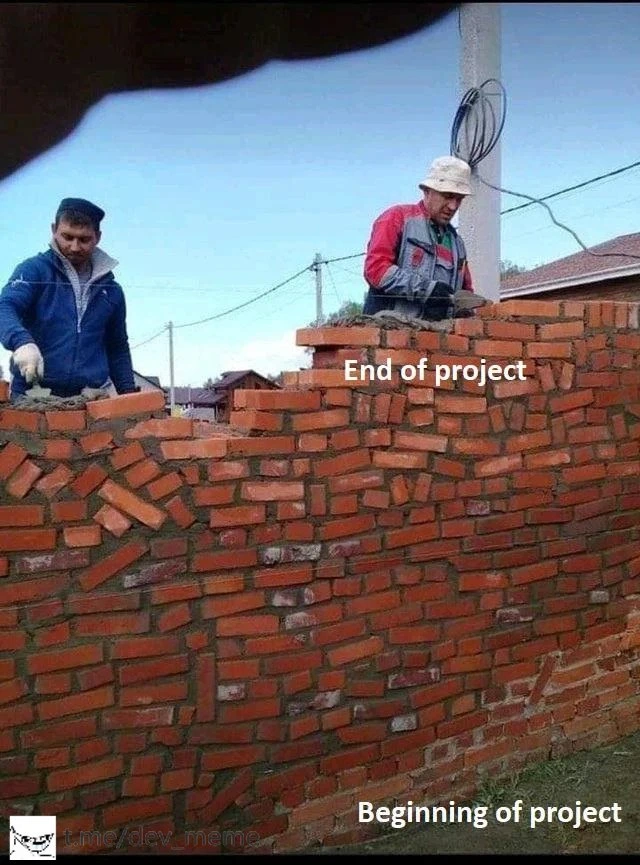
Imagine you and your friends are building a wall out of LEGO blocks, but you’re all in a hurry. Instead of clicking the blocks together neatly, everyone just sticks them in at weird angles and in any place they fit. Now you step back and look at it: the wall is crooked, full of gaps, and some bricks are barely hanging on. It hasn’t fallen down yet, but it sure looks wobbly. You wouldn’t want to put your toys on top of it because it might all tumble over. It’s a bit funny to look at – kind of like a very silly, lopsided fortress that a group of clumsy wizards might build. But it’s also a bit worrying, because you know a wall shouldn’t look like that! In simple terms, this is what the meme is saying about a computer program. The bricks are like pieces of code, and the wall is like the whole program. If the pieces of code are put together without care (just like the LEGO bricks were), the program might still work for now, but it’s fragile and might break easily. We laugh at the picture because we all know the wall is built the wrong way – it’s obvious even to a kid. It’s a goofy reminder that if you build something quickly and sloppily, you might end up with a result that’s strangely shaped and ready to collapse. That feeling – thinking “Haha, that looks so bad, I can’t believe it’s standing!” – is exactly why the picture is funny. It’s showing in a simple, crazy way what happens if you don’t build things with a good plan: you get a crooked wall that everyone can tell is just one poke away from falling apart.

Level 2: Spaghetti Code Wall

For a less experienced developer, let’s break down what’s going on here. The brick wall in the image is a metaphor for a codebase (the entire collection of source code for a project). Ideally, a codebase is organized and structured – like a brick wall with neat, even rows and a solid foundation. CodeQuality is the measure of how well-written and maintainable that code is, similar to how a well-built wall is sturdy and straight. In the meme, the wall is terribly built: bricks are sticking out at odd angles, the rows are uneven, and the whole thing looks ready to collapse. That visual mess represents low code quality: a codebase full of problems often called CodeSmells. A code smell is a hint that something is wrong in the code – for example, a function that’s 500 lines long or a class named Manager5 that does everything under the sun. Just like a strange bulge or crack in a wall signals poor construction, a code smell signals poor design or Architecture in the software.

One common cause of such a messy codebase is SpaghettiCode. This term describes code with a tangled, twisty structure, where the flow jumps in confusing ways – imagine a pile of spaghetti noodles where you can’t follow one strand without getting lost in the tangle. In a spaghetti code project, functions call each other in convoluted loops, logic is duplicated in many places, and it’s hard to figure out how things really work. In the wall analogy, it’s like bricks placed without pattern – some horizontal, some vertical, some diagonal – making it tough to see where one layer ends and the next begins. Working with spaghetti code is frustrating: change one part and you accidentally break another, because everything’s indirectly connected. Beginners might first encounter this in a school project or early job where the code just “evolved” without a clear plan. If you’ve ever tried to fix a bug and found that the fix for one thing unexpectedly affected something else, you might have been in spaghetti territory.

Now, why do we end up with such a chaotic structure? Often it’s due to Technical Debt. Think of technical debt like taking shortcuts in your homework: you save time now, but you’ll pay for it later when trying to fix or extend what you did. In software, technical debt happens when developers choose an easy or quick solution instead of the better-designed one. Maybe you write a clunky bit of code to meet a deadline, promising yourself you’ll clean it up later. That’s like using a broken or wrong-sized brick just to finish the wall today. It holds up for the moment, but it’s not ideal. Each time the team does this, it’s like borrowing trouble from the future – the debt accumulates. Later, when someone does try to improve things, it’s much harder (the “interest” on the debt). If no one ever goes back to refactor (rework the code properly), the codebase becomes more and more brittle – just like a wall built on quick fixes would start to look crooked and might even crumble if you add more weight. The meme’s wall is basically TechnicalDebt made visible: many quick-and-dirty decisions piled on top of each other.

Over time, all these quick fixes and inconsistencies lead to what we call ArchitectureDecay. Software architecture is like the blueprint or overall design of the system – how components connect, the rules for where code should go, much like a building’s floor plan and structural design. Architecture decay means the codebase no longer follows its original design principles. It “decays” because people have been adding exceptions, special cases, or hacks that don’t fit the original plan. For example, imagine an app that was supposed to have clear layers (UI on top, logic in the middle, database at the bottom). After years of rushed changes, you might find UI code calling database queries directly, or utility modules being used all over the place in ways they weren’t intended. It’s as if the builders of a house started ignoring the blueprints and put a bathroom in the kitchen and a staircase outside the house! In the brick wall picture, architecture decay is shown by bricks no longer lining up – the plan (to have a straight wall) has been abandoned. Every new brick (piece of code) was put wherever it would fit at the time.

Let’s also talk about LegacyCode – a term you’ll hear for older codebases that have been around a while (often years) and have seen many modifications. Legacy code is usually someone else’s code that you inherit and have to work with. It often has little or no documentation, and it might not have automated tests. This makes it scary to change, because you’re not sure what each part does anymore (the original authors might have left the company or forgotten the details). In many companies, legacy code is exactly like that brick wall: it’s been patched and extended by dozens of different developers, each with their own style or understanding, resulting in an inconsistent structure. A new developer joining the project might be as puzzled as a new builder looking at that wavy wall asking, “How on earth did it end up like this?” It’s both amusing and intimidating. CodeQuality issues in legacy code mean that even simple changes can be risky. Just as adding one more brick to a shaky wall could make it collapse, adding one more feature to a fragile codebase can introduce bugs or break existing functionality. That’s why developers find this meme so relatable – it visualizes the invisible chaos of a bad codebase in a way anyone can see. The humor has a bit of ouch to it: it’s funny because it’s true, and many of us have had to carefully add “one more brick” to a system like this, holding our breath that the whole thing doesn’t come down.

For a junior developer or someone early in their career, the lesson here is the importance of good structure and taking the time to do things right. It shows why mentors and senior devs harp on about clean code, refactoring, and code reviews. Those practices are like using a level and proper mortar when laying bricks – they keep the wall straight. Skipping them might seem fine at first (you got the feature working, after all), but the problems accumulate. If you’ve ever hurried through a coding assignment and ended up with something that works but you’re not exactly proud of, you understand the temptation. Now imagine a whole team doing that for months – you’d get a codebase that “works” but is very hard to maintain or extend. The meme exaggerates it with a lopsided wall to make the point crystal clear. And even though it’s exaggerated, it resonates because almost every developer has seen at least a mild version of this in real life. So we share a laugh and maybe a groan, and we remember why we strive for better CodeQuality – so our projects don’t turn into that wall.

Level 3: Structural Integrity 404

This meme paints a painfully familiar picture: a codebase piled high with quick fixes, misaligned modules, and ad-hoc solutions, all masquerading as a coherent structure. The image – a wall of bricks turned every which way – is essentially a photograph of architecture decay in software. In formal terms, it’s the infamous Big Ball of Mud pattern materialized: an "architecture" in name only, where any initial design has been buried under layers of hacks. Seasoned developers have seen this horror before. We’ve built it at 2 AM under deadline pressure, and we’ve inherited it from projects where “refactoring” was always penciled in for next sprint eventually. The humor here is dark and cathartic: everyone recognizes that wavy, unstable wall as their nightmare legacy system held together by hope and duct tape (or in this case, mortar). TechnicalDebt is written in every misaligned brick. Each brick represents a bug fix jammed in without proper design, or a feature bolted on without refactoring – and each adds to the interest we’ll pay later. The wall hasn’t fallen yet, just like that convoluted program hasn’t crashed yet, but neither is structurally sound. CodeQuality has clearly left the building – or rather, was never invited. This is what you get when “it compiles, ship it” becomes the guiding principle.

Why is this funny to developers? Because it’s painfully true. The wall is an exaggerated visual of SpaghettiCode – code so tangled and inconsistent that it looks like a plate of pasta thrown against a wall (quite literally in the image). In real projects, this happens when teams keep slapping on one quick workaround after another. The first few bricks (initial modules) might have been laid correctly (a clean design, perhaps a layered architecture), but then reality hits: a hotfix here, a special-case there, and soon the once straight wall is a chaotic mosaic. We laugh because we’ve all walked by that construction site in our own repos. It’s the project where CodeSmells proliferate: giant classes that do too much, functions with dozens of flags (the code equivalent of bricks sticking out at odd angles), and copy-pasted logic everywhere (duplicated bricks, any one of which could be the loose one that brings the whole thing down). The meme exaggerates it to absurdity – a wall so sloppily built that even non-engineers cringe – which mirrors how obvious bad code architecture can appear in hindsight. Developers share this as a cautionary chuckle: “Look, our codebase has become this wall. Scary, huh?” It’s funny until you realize you’re the one on call for it.

This scenario is a textbook case of ArchitectureDecay. The system likely started with a sound plan (straight rows of bricks, a clear blueprint). But as new requirements came and deadlines loomed, nobody had time to rebuild or properly extend the foundation. Instead, they resorted to haphazard implementation — making each new feature “fit” by any means necessary. Over time, the initial structure was lost in a sea of patchwork. In the image, the bricks at odd angles are glaring; in code, the red flags might be inconsistent naming, modules that break the project’s layering, or circular dependencies that make the dependency graph look like a pretzel. LegacyCode typically ends up like this: a structure that has been modified by dozens of hands, each with a different idea of what “good” looks like, or no time to care at all. No single developer intended to build a Frankenstein wall of code, of course. It’s usually the inevitable outcome of iterating under pressure: when fixing things “for now” triumphs over doing them right. The joke lands because it’s a shared secret in the industry — behind many software products (even successful ones), there’s a scary mess that outsiders would never believe. We call it DeveloperHumor to cope with the fact that we might be one deployment away from the whole wobbly edifice crashing.

Let’s talk structural integrity: that wavy top of the wall in the photo is a perfect metaphor for an unstable system boundary. If you tried to add one more row of bricks (or one more feature), who knows which part might collapse. In software, this is the codebase where every new change risks breaking something unrelated. You fix one bug, three more appear (whack-a-mole debugging as the veterans sigh). The wall’s builders in the meme are smiling in disbelief (or embarrassment) – much like devs in stand-up meetings joking “It’s not pretty, but it works… for now.” There’s an implicit understanding: this won’t hold in the long run. The Architecture is so flimsy that any stress (traffic spike, new requirement, deploying on a Friday) could trigger a failure. Why don’t we just fix it, you ask? Well, the same reason you can’t straighten that wall without knocking it down. Major refactoring is expensive and risky – it’s like demolishing and rebuilding while residents (users) are still living in the house. Management often responds like: “If it hasn’t fallen yet, it’s good enough. Ship the next feature.” So the team carries on, adding bricks to the wobbly wall, hoping it doesn’t topple on their heads. The meme strikes a chord because it captures this absurd cycle visually. It’s both a laugh and a wince – we laugh at how ridiculous it looks, and we wince knowing we’ve been those workers slathering mortar over cracks, convincing ourselves it’s fine.

Manager: "It looks fine from my office. The wall is up, right?"
Developer: "Sure... it’s up. But you realize one strong breeze could bring it down?"
Manager: "It’s up. Ship it. We’ll fix it in post."
Developer: sigh "Roger that – deploying to production."

This tongue-in-cheek dialogue is basically how TechnicalDebt snowballs. Short-term relief (“the wall is up, the feature is done”) trumps long-term stability. The result? A system that “works” only in the narrow sense that it hasn’t collapsed today. Every veteran engineer recognizes this trade-off and has war stories of 3 AM emergencies caused by exactly such chaotic masonry. The meme encapsulates the unwritten motto of too many rushed releases: If it’s standing, it’s done. We laugh because otherwise we’d cry.

Description

The image shows two construction workers building a brick wall with red bricks and grey mortar against a clear blue sky. However, the construction is utterly chaotic; the bricks are laid haphazardly at various angles, creating a disorganized and structurally unsound wall. One worker on the left is actively laying a brick, while another worker on the right looks on. The scene is a powerful visual metaphor for a poorly constructed software project. For developers, this image represents a 'big ball of mud' architecture or a system riddled with technical debt. It's the kind of codebase that was likely built with no standards, planning, or consistency, making it a nightmare to maintain, debug, or extend. Each randomly placed brick is like a quick fix, a poorly implemented feature, or an inconsistent coding style that contributes to the overall decay of the software's structure. A small watermark for 't.me/dev_meme' is visible in the bottom-left corner
Comments

7
Anonymous ★ Top Pick I see they're using the 'Agile' bricklaying methodology. The wall's velocity is high, but the technical debt is accumulating faster than the mortar can set
  1. Anonymous ★ Top Pick

    I see they're using the 'Agile' bricklaying methodology. The wall's velocity is high, but the technical debt is accumulating faster than the mortar can set

  2. Anonymous

    Behold the Distributed Monolith pattern: every brick committed independently, the wall still compiles, and gravity is our only remaining integration test

  3. Anonymous

    When you finally achieve perfect microservice isolation but forget to document the API contracts

  4. Anonymous

    This is what happens when the product owner says 'just ship it' and you have to build your microservices architecture around that one monolithic legacy system nobody wants to touch. Sure, we could refactor the entire foundation and relocate the dependency, but the sprint ends Friday and the wall needs to be 'done done.' Twenty years from now, some architect will look at this and wonder 'why is there a pole in the middle of our domain model?' - and the answer will be lost to time, documented only in a JIRA ticket marked as 'won't fix.'

  5. Anonymous

    This is what happens when “temporary hotfix” becomes the architecture - still upright, but the load‑bearing abstraction is a cron job nobody admits owning

  6. Anonymous

    Misalign one brick up top, and it's CAP theorem in action: the wall picks partition tolerance over consistency

  7. Anonymous

    Our codebase after a decade of hotfixes: alignment optional, patterns ad hoc, and the mortar acting as the service mesh - eventual consistency by gravity

Use J and K for navigation