TCP/IP Nervously Eyes the End of Handshakes
Why is this Networking meme funny?
Level 1: No Handshakes? Wait, What?!
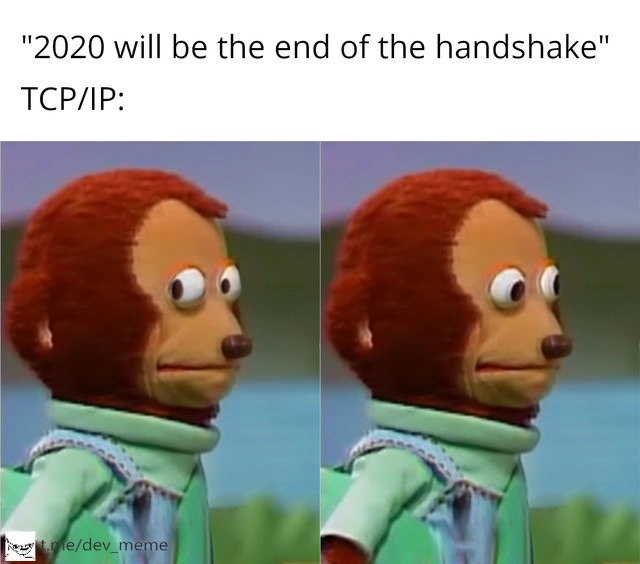
Imagine you hear your teacher say, “No one will high-five or shake hands ever again!” You might laugh, but picture your favorite game or toy robot that only knows how to start when you shake its hand. That poor robot would give a surprised, worried look, right? That’s essentially the joke here. In 2020, people thought we should stop shaking hands to stay safe from germs. But computers have their own special “handshake” (a little greeting they must do to connect and talk to each other). The meme shows a funny monkey puppet looking sideways all freaked out, as if TCP/IP (the brains of the internet) is that monkey saying, “Wait… end of handshakes? But that’s how I say hello!” In simple terms, the meme is funny because it’s like telling the internet “you can’t say hello anymore.” The internet (as the monkey) is left wide-eyed and awkward because without its handshake, it wouldn’t know how to start talking! It’s a playful way to show how something that sounds normal in everyday life (“no more handshakes”) can sound totally alarming to a computer who lives on handshakes.
Level 2: TCP Explained, No Handshakes?
Let’s break down the joke in simpler terms. The meme text says, “2020 will be the end of the handshake.” This refers to the idea that during the year 2020 (when COVID-19 was spreading), people thought we’d stop shaking hands forever to avoid germs. Now, right under that, it says “TCP/IP:” and shows a picture of a monkey puppet looking to the side with a startled, awkward expression. That puppet image (often called the side-eye monkey meme) is a popular internet way of showing someone feeling suddenly nervous or called out. It’s like the face you’d make if you overhear your boss saying “we’re going to eliminate coffee breaks” and you’re the person holding a coffee cup. In this meme, TCP/IP – which is basically the language of the Internet – is portrayed as that nervous monkey. Why? Because TCP/IP relies on something called a “handshake” for every connection, so the joke is that TCP/IP would be very shocked to hear handshakes might end!
Now, to understand the pun, you need to know what TCP/IP and a handshake mean in tech. TCP/IP stands for Transmission Control Protocol/Internet Protocol. It’s a pair of core protocols that govern how data packets travel across networks — essentially the foundation of the entire internet. When your computer talks to a server (for example, loading a website), it likely uses TCP/IP to ensure the messages get through reliably. TCP is in charge of making a reliable connection and checking that all data arrives in order, while IP handles addressing and routing the data between machines.
When two computers start a conversation using TCP, they perform something called a TCP three-way handshake. This isn’t a physical handshake, of course, but a sequence of computerized “hello” messages. It works like this: one computer (the client) says, “Hey, I’d like to talk!” (that’s the SYN message). The other computer (the server) replies, “Sure, I hear you. I’m ready to talk too!” (that’s the SYN-ACK message, meaning it acknowledges the request and says hello back). Then the first computer responds one more time with “Great, we’re both on the same page – let’s begin!” (that final ACK message). After this exchange of SYN and ACK signals (synchronize and acknowledge), both computers know the connection is established and they can start sending the actual data (like your webpage or API data). Because it took three messages to complete, we call it a “three-way” handshake. It’s like an agreement: “I’m here,” “Okay, I’m here too,” “Awesome, let’s go!” – all done with network packets. This handshake is a fundamental stepping stone in networking whenever you use TCP. If this handshake doesn’t happen successfully, the connection won’t be set up and your data won’t get through.
Now, let’s connect this back to the meme’s humor. In regular life, due to the pandemic, people were saying “no more handshakes” (meaning the way we greet each other might change — like doing elbow bumps or just saying hi without touching). The meme takes that statement literally into the tech world. It imagines TCP/IP hearing “the end of the handshake” and going, “Uh… come again? The end of what?” – because if you take that literally, it sounds like “no more TCP handshakes,” which would break the entire internet’s way of connecting! The monkey puppet’s side-eye glance perfectly captures TCP’s fake confusion and panic. Of course, the statement wasn’t about network handshakes at all, but that’s the joke: it’s a play on words. The meme is funny to developers and IT folks because it mixes up a serious real-world issue (the end of handshakes in society) with a geeky NetworkingProtocols fact (the handshake that computers do). It’s the kind of joke where if you know both meanings of “handshake,” you get a good chuckle.
To put it simply: TCP (the Internet’s reliable messenger) always begins conversations with a little handshake procedure. The year 2020 made everyone talk about “handshakes” (the greeting) being potentially banned. So, in this meme, the Internet protocol TCP is personified as a worried character, thinking “Wait, I need handshakes to do my job!” It’s a classic case of tech humor using a pun. If you’re new to these concepts, just remember: a “handshake” in tech is like a greeting between computers, and TCP can’t start working without it. So the idea of ending handshakes made TCP do a double-take — which is exactly what that monkey’s expression is showing. The meme gets its laugh from that clever crossover between a news headline and computer science lingo.
Level 3: Three-Way Humor
This meme is a perfect slice of DeveloperHumor that plays on a double meaning. In early 2020, during the COVID-19 pandemic, there was widespread talk that traditional greetings like the handshake might disappear for good (to avoid spreading germs). Articles and experts earnestly proclaimed “2020 will be the end of the handshake.” For the general public, that line is about changing social norms. But to those of us in tech, especially folks familiar with networking, the word “handshake” immediately also brings to mind the TCP three-way handshake – the essential process every TCP connection uses to start a conversation. So the meme sets up a clash between pandemic reality and technical reality for comedic effect.
The format of the meme is text at the top and a reaction image below. It starts with the quote:
“2020 will be the end of the handshake”
TCP/IP: (😅 nervous side-eye puppet glance)
Reading that, anyone who knows networking protocols will get the joke: TCP/IP, the very foundation of internet communication, is personified here. When confronted with the proclamation that “the handshake is over,” TCP/IP gives a classic side-eye monkey puppet look — a two-panel image of a brown monkey puppet in a green shirt looking awkwardly to the side. This image is a well-known meme template for “oh… this is awkward” or “excuse me, hope nobody notices me in this conversation.” It’s as if TCP is thinking, “Umm… you’re ending what now? Because I kind of do a handshake every time I connect to anything…” The monkey’s expression of visible discomfort and confusion hilariously captures how TCP would react if it were a person hearing that statement. It's the digital equivalent of someone announcing "we're banning breathing," and oxygen (if it had feelings) going wide-eyed in panic.
For seasoned developers, the humor works on multiple levels. First, there's the anthropomorphic absurdity of TCP/IP (a networking protocol suite) reacting like a human being — a classic trope in tech memes where inanimate tech concepts are given personalities. We all know TCP isn’t actually self-aware, but imagining it sputtering “Wait, you want to get rid of handshakes?!” is comedy gold for the geeky mind. Second, it’s funny because it’s true that TCP connections literally use a handshake. Every back-end service, website, or API call over TCP starts with that SYN, SYN-ACK, ACK sequence. The idea of “no more handshakes” would give any backend engineer pause, because it sounds like “no more new TCP connections.” 😅 In reality, of course, the meme isn’t suggesting the internet will shut down — it’s poking fun at the phrase by taking it out of context. But the overlap of terminology makes it feel like a dramatic, if unintended, proclamation about networking. It’s exactly the kind of inside joke that people who live and breathe internet protocols find hilarious: a bit of TechHumor that juxtaposes mundane news with a core technical concept.
There's also an ironic historical subtext. The handshake has been such a resilient cornerstone of networking that even decades of technological evolution haven’t eliminated it. (Sure, we’ve tweaked it, optimized it, even encrypted it, but we still do it.) So when a headline suggests ending “the handshake,” veteran engineers can’t help but chuckle. It’s as if a piece of infrastructure — something as crucial as, say, DNS or the concept of an IP address — is suddenly declared obsolete due to a social trend. The meme captures that tongue-in-cheek sentiment: TCP hearing about the end of handshakes is like a fish hearing that water is canceled. 😂
Finally, consider the timing and context: this was posted in May 2020, when pandemic safety recommendations were a hot topic. Everyone was talking about avoiding physical contact, adopting elbow bumps, etc. Technologists, like everyone else, had this on their minds, and many turned to humor to cope. This meme is essentially a pandemic handshake joke tailored for the IT crowd. It comically reminds us that while we humans were navigating Zoom calls and socially distant greetings, the underlying network protocols enabling those very interactions were still happily performing thousands of handshakes per second. In other words, we stopped shaking hands, but our computers certainly didn’t! The shared experience of 2020, combined with the nerdy pride in knowing how TCP works, made this meme instantly relatable within developer circles. It’s a wink and a nod: “Handshakes ended? Yeah… tell that to TCP/IP.”
Level 4: Syn-Ack Anxiety
In computer networking, the classical three-way handshake used by TCP is far more than a casual greeting—it's a mathematically grounded protocol ritual that ensures reliable communication across an inherently unreliable medium. The handshake is fundamental to how the Transmission Control Protocol (TCP) establishes a connection: a client and server exchange a specific sequence of messages (SYN, SYN-ACK, then ACK) before any real data flows. This process is deeply baked into the design of internet networking protocols and has been so since the early ARPANET days (as outlined in RFC 793, 1981). It was metaphorically named a "handshake" because, much like two people shaking hands to say "we agree to communicate," two machines must acknowledge each other before transmitting information. Crucially, this isn’t just tradition or overhead – it’s there to solve a hard problem in distributed systems.
At its core, the TCP handshake addresses the need for synchronization and agreement between two endpoints. It's essentially a practical solution (though not a perfect one) to the classic two generals problem in networking, which illustrates the uncertainty of sending messages over an unreliable channel. No finite number of back-and-forth messages can guarantee that both sides absolutely know a connection is established (there’s always that sliver of doubt about the last message). But TCP’s three-step handshake is a clever compromise that achieves a high degree of confidence and reliability with minimal overhead:
// Simplified TCP three-way handshake exchange:
Client -> Server: SYN (seq = X) // Client sends a synchronize request with initial sequence number X
Server -> Client: SYN-ACK (seq = Y, ack = X+1) // Server acknowledges X and sends its own sequence Y
Client -> Server: ACK (ack = Y+1) // Client acknowledges Y, completing the handshake
// Connection is now established; both sides have agreed on starting sequence numbers.
In this exchange, the SYN (synchronize) packet from the client carries an initial sequence number (ISN), essentially a starting ticket number for the bytes it will send. The server responds with SYN-ACK, acknowledging the client’s ISN (thus ACK = X+1) and offering its own ISN (Y) for the return path. Finally, the client sends an ACK confirming it received the server’s sequence (acknowledge Y+1). After these three messages, both sides have mutually acknowledged each other’s existence and sequence expectations. This handshake initializes sequence numbers and session parameters so that every byte of data that follows can be tracked and acknowledged. It also prevents stray or duplicated packets from previous connections from wreaking havoc: by picking new ISNs (often pseudo-randomly chosen to enhance security and avoid collisions), TCP ensures a fresh context. Only after this careful introduction do the parties proceed to the actual data exchange, with confidence that they're in sync.
The robustness of this design is why TCP/IP has been so reliable over decades. For example, if the third ACK gets lost, the server will not transition fully to "established" state and will resend the SYN-ACK, or eventually timeout—mechanisms built as safeguards around the handshake. The handshake also lays the groundwork for TCP’s other features like flow control and congestion control (which build on this initial trust that both sides are cooperating). In short, the handshake is like a mandatory courteous bow between two devices before they can dance (exchange data) without stepping on each other’s toes.
Even newer protocols and improvements on classic TCP incorporate some form of handshake. Modern TLS (SSL) still performs its own multi-step encryption handshake on top of TCP to agree on keys and algorithms. Cutting-edge transport protocols like QUIC (used in HTTP/3) were designed to reduce latency by combining steps, but they still haven’t eliminated the need for an initial greeting exchange — QUIC essentially performs a cryptographic handshake over UDP, often with 0-RTT resumption when possible. These handshakes, whether 3-way or 1.5-round-trip, fulfill the same purpose: establishing mutual agreement and trust before real communication begins. There’s simply no free lunch in networking; you can’t skip the handshake if you want reliability and security. (Computers can’t just do an elbow bump or a Vulcan salute 🖖 to start sending data — they have to stick with SYNs and ACKs!)
So, when we hear “2020 will be the end of the handshake,” any veteran network engineer will smirk, because under the hood of the internet, handshakes are never going away. You can enforce social distancing in the physical world, but bits traversing fiber-optic cables still must perform their little handshake dance to set up connections. No matter how contactless human society becomes, the digital realm isn’t about to abandon this introductory protocol ritual. In fact, during the very pandemic that discouraged personal handshakes, internet traffic surged — meaning behind the scenes, billions of TCP handshakes were happening every minute. For TCP/IP, the handshake isn’t a quaint custom; it’s a non-negotiable requirement grounded in the physics and math of reliable data exchange. The meme wryly highlights this irony: even if people stop shaking hands, our computers literally can’t stop doing it.
Description
This meme uses the 'Awkward Look Monkey Puppet' format, which shows two identical side-by-side images of a monkey puppet looking away with a concerned and shifty expression. The text above the images reads, '"2020 will be the end of the handshake"' followed by 'TCP/IP:'. The humor is a clever technical pun. In 2020, due to the COVID-19 pandemic, physical handshakes were discouraged for health reasons. The joke personifies the TCP/IP networking protocol, which fundamentally relies on a 'three-way handshake' (SYN, SYN-ACK, ACK) to establish a reliable connection. The meme playfully suggests that the protocol itself is nervous about this social trend, as 'handshakes' are essential to its very function
Comments
7Comment deleted
TCP is sweating. If handshakes are out, it might have to downgrade to UDP and just start yelling packets at the server with its fingers crossed
“2020 outlawed handshakes; TCP kept its three-way, and QUIC just rebranded it as a 0-RTT fist bump to keep marketing quiet.”
While consultants pitched 'zero-touch architectures' and executives mandated 'contactless everything,' TCP quietly continued its 40-year tradition of mandatory handshakes before every conversation - proving that some legacy protocols outlast even global pandemics and their accompanying enterprise transformation initiatives
While the world abandoned handshakes in 2020, TCP/IP kept doing its three-way handshake billions of times per second - SYN, SYN-ACK, ACK - completely oblivious to social distancing guidelines. Turns out the most reliable relationship in your life isn't with people, it's with a 50-year-old protocol that still insists on proper introductions before every conversation, even if it adds 1.5 RTT of latency to your Zoom calls
Handshakes are dead; long live TCP's immortal three-way dance
“2020 will end the handshake.” TCP/IP: SYN, SYN‑ACK, ACK - then TLS does its own; sorry, the stack optimizes for reliability, not etiquette
“No more handshakes” is cute until you drop SYN/SYN-ACK/ACK - then it’s not social distancing, it’s half-open connections and a 3am pager