Programming Language Smackdown: The Great Loop Debate
Why is this Languages meme funny?
Level 1: Wait, You Guys Got Candy?
Imagine four kids comparing how many candies they each received. The first kid has three candies and quickly says, “Wait, I can explain...” because he sees the others looking at his bigger stash. The second kid pouts and says, “You have three candies? I only got two!” She’s upset that she didn’t get as many. Then the third kid chimes in, “Two candies? I only got one.” He’s feeling even more left out. Finally, the fourth kid, who got nothing at all, looks at the others in disbelief and says, “Wait—you guys got candy?” He’s shocked that the others even received any, since he ended up with zero. This candy story mirrors the meme’s joke: each kid is like one programming language, and the candies represent the loop types they have. Each child thinks it’s unfair or surprising how the candy (the looping options) is distributed. The last kid’s reaction is the big punchline because he didn’t get any candy while everyone else did. It’s funny and easy to understand – everyone else has something you don’t, and you react with, “Huh, you all got that and I got nothing?!” That feeling of surprise and the exaggerated way each kid complains make it humorous. Even without knowing anything about programming, you can laugh at the idea of someone realizing they completely missed out when others have more. That’s the heart of why this meme is funny: it’s like a playful scene of kids whining about who has more candy, except the “candy” is actually loop tools in different programming languages.
Level 2: From Three Loops to None
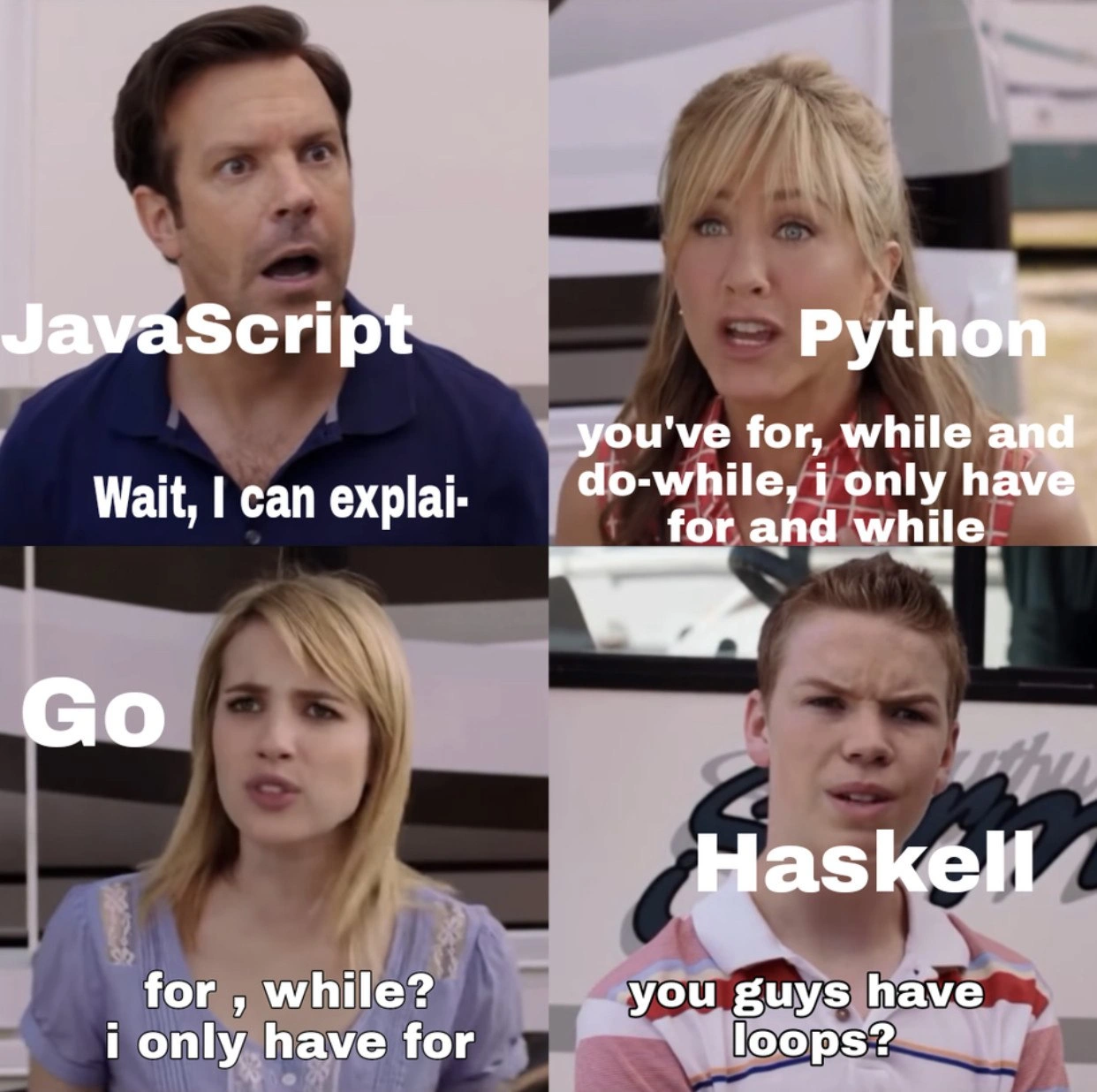
Let’s break down what each panel is really saying in plain terms. This meme uses a scene from the comedy movie “We’re the Millers” – the famous bus meme format where characters in an RV argue and one oblivious kid says, “You guys are getting paid?” Here, that format is repurposed to compare programming loop constructs across four languages. Each character in the image is labeled as a programming language (JavaScript, Python, Go, Haskell), and their dialogue is about how many loop types that language has. The joke is essentially a comparison: each language has fewer looping constructs than the previous, and they’re all reacting to that fact.
Here’s what each language-character is talking about:
JavaScript – It has three kinds of loops built into the language syntax:
forloops,whileloops, anddo...whileloops.- A
forloop in JavaScript is typically used when you know how many times you want to iterate or you have a counter. For example:
This will print “JS loop iteration: 0”, then 1, then 2. It runs the loop three times (i = 0, 1, 2). The structure// JavaScript for loop example for (let i = 0; i < 3; i++) { console.log("JS loop iteration:", i); }for(init; condition; increment)is classic in C-style languages. - A
whileloop in JavaScript runs as long as its condition remains true, checking the condition at the start of each iteration. For example:
This will do the same thing (print 0, 1, 2) and then stop whenlet x = 0; while (x < 3) { console.log("JS while iteration:", x); x++; }xis no longer< 3. It checksx < 3before each loop round, so ifxis 3 or more, it won’t enter the loop at all. - A
do...whileloop is similar to a while loop, but it checks the condition at the end of each loop iteration instead of the beginning. This means a do-while loop always runs the body at least once, then repeats if the condition is true. For example:
This will also print 0, 1, 2. The difference is that the checklet y = 0; do { console.log("JS do-while iteration:", y); y++; } while (y < 3);y < 3happens after printing, so the loop body executes first before any condition check. Ifystarted at 5, the do-while loop would print 5 once and then checky < 3(which would be false) and stop – so it would have executed one iteration even though the condition was false at the start. In contrast, a regular while loop withystarting at 5 would not run its body even once because the condition fails immediately. - In the meme, JavaScript’s character (the man in the polo) is saying “Wait, I can explai–” because the others are about to pounce on him for having that extra
do...whileloop type. He’s basically the one with the most “toys” in the loop department, and he wants to defend why JavaScript needs all three. It’s a comedic way to point out that JavaScript is more feature-packed (some might say more complicated) when it comes to loops.
- A
Python – It has two loop constructs: a
forloop and awhileloop (and notably, nodo...whileloop).- Python’s
forloop is used to iterate over items of a collection (like elements of a list, characters in a string, etc.) or a range of numbers. It’s a bit different from JavaScript’s C-styleforbecause you don’t explicitly write the increment; Python handles iteration for you. For example:
This will print “Python loop iteration: 0” then 1, then 2.# Python for loop example for i in range(3): print("Python loop iteration:", i)range(3)generates 0, 1, 2 and the loop goes through each of those. You could also loop directly over a list, likefor name in ["Alice", "Bob", "Charlie"]:to print each name. Python’s for-loop is very high-level and convenient. - Python’s
whileloop works like the typical while: it repeats as long as a condition is true. For example:
This does the same 0,1,2 printing. It checksx = 0 while x < 3: print("Python while iteration:", x) x += 1x < 3before each iteration and stops whenxreaches 3. - Python does not have a
do...whileloop structure. If you want that “do-then-check” behavior (ensure the loop runs at least once), Python programmers usually do this:
Herex = 0 while True: # loop indefinitely print("Python pseudo do-while iteration:", x) x += 1 if x >= 3: break # exit the loop manuallywhile Truestarts an infinite loop, andbreakis used to exit once the condition is met (whenxis no longer < 3). This pattern achieves the same result as the do-while examples did: it prints 0,1,2 and then the break stops the loop. It’s a bit more manual, but it’s clear and it works. Python’s philosophy prefers this approach over adding another keyword. - In the meme, the Python character (the teenage girl) says: “you’ve for, while and do-while, I only have for and while.” She’s essentially pointing out the absence of
do...whilein Python. The tone is like she’s annoyed or feeling a bit jealous: “Hey JavaScript, you have one more loop than me!” It’s playful, because in reality Python developers don’t usually mind not having do-while, but here it’s framed as a kind of complaint to fit the meme’s exaggerated drama.
- Python’s
Go (Golang) – It has one loop construct: the
forloop. There is no separatewhileordo-whilein Go; everything is done with variations offor.- Go’s
forcan work just like a C-style for or like a while. For instance, the equivalent of a while loop in Go is to useforwith just a condition, as shown:
This prints 0,1,2. It looks a lot like the earlier Python/JS while loops, except it says// Go as a 'while' loop using for i := 0 for i < 3 { fmt.Println("Go loop iteration:", i) i++ }for i < 3instead ofwhile. In Go, that’s valid: if you put one boolean condition afterfor, it will loop as long as that condition is true, exactly like a while loop. - You can also write a traditional for-loop in Go with initialization and increment in the header:
This also prints 0,1,2. Herefor j := 0; j < 3; j++ { fmt.Println("Go classic loop:", j) }j := 0is the initialization,j < 3is the condition, andj++is the increment each time. - For an infinite loop, Go lets you just do:
which is likefor { // do something repeatedly until a break }while(true)in other languages. You’d break out of it with abreakstatement when you need to stop. - Because Go covers all these scenarios with just
for, the language designers felt no need to include awhilekeyword. It keeps things simple and uniform. People coming from other languages might need a day or two to get used to it, but then it feels natural. - In the meme, the Go character (woman in the bottom-left panel) says, “for, while? I only have for.” She’s responding to Python’s gripe about having two loops by saying, essentially, “Oh you think that’s few? I’ve got it even simpler – just one!” Her face looks a bit incredulous, as if she’s mock-arguing that she has the most minimalist language of them all. This is both a point of pride and a source of humor. Go programmers often boast about the language’s simplicity, but here that simplicity is used as a comedic point — like Go might be feeling a tad left out (“Aw, you guys at least have different loop keywords; I’ve just got one blunt tool!”). It’s a friendly jab at Go’s design choice.
- Go’s
Haskell – It has zero native loop constructs in the way the other languages do. Haskell is a purely functional language, meaning it avoids changing state and running loops with counters. Instead, it uses recursion and functional patterns to achieve repetition.
- In Haskell, if you want to do something repeatedly, one approach is to use recursion. For example, to print numbers 0 to 2, you might write a recursive function (this is a bit pseudo-codey for illustration):
CallingprintNumbers n = if n < 3 then do print n printNumbers (n+1) else return ()printNumbers 0would print 0, 1, 2. Here,printNumberscalls itself (printNumbers (n+1)) instead of looping. Each call handles one “iteration” and then recurses for the next. The recursion stops whennis no longer< 3. This is how you’d perform a loop-like operation explicitly in Haskell – by function calls rather than a looping construct. - More commonly, Haskell provides high-level functions to do repetitive tasks so you rarely even need to write explicit recursion. For instance, to apply an action to every element of a list, you might use
mapM_for side effects or justmapto produce a new list. To loop a specific number of times, you could use a combination ofreplicate(which creates a list with something repeated) and then traverse that list. The idea is that Haskell handles loops through its libraries and recursion, not via language syntax likefor/while. - This is very different from how imperative languages work, and it can be mind-bending for someone encountering Haskell the first time. But it works well in Haskell’s paradigm because avoiding explicit loops encourages a different way of thinking (often safer and without explicit mutable counters).
- In the meme, the Haskell character (the teenage boy in the bottom-right) asks in genuine surprise, “You guys have loops?” This is the punchline of the meme. It’s funny because it’s the dramatic extreme – he has none, and he didn’t even expect loops to be something you’d have. If the other panels were people comparing what’s in their wallets, Haskell is the one turning out empty pockets saying, “You all carry cash?” It emphasizes just how unlike Haskell is from the others. For someone who doesn’t know Haskell, this line might prompt curiosity: “Wait, is it true Haskell doesn’t have loops?” And yes, strictly speaking, it doesn’t in the way we normally think of them. Haskell programmers don’t feel deprived, though, because they have other tools to do the job. But in the context of the meme, it makes for a hilarious contrast. The guy’s face is bewildered, which fits the line perfectly. He’s not angry or snarky; he’s honestly taken aback, which adds to the humor because it implies loops are a foreign concept in his world.
- In Haskell, if you want to do something repeatedly, one approach is to use recursion. For example, to print numbers 0 to 2, you might write a recursive function (this is a bit pseudo-codey for illustration):
To put it all together: the meme is funny because it personifies each language and has them react as if the number of loop constructs is some sort of status symbol or grievance. JavaScript is on the defensive for having “too many”; Python complains it’s got one fewer; Go one-ups Python by saying “I’ve got even fewer than you, only one!”; and Haskell blows their minds by essentially saying “Loops? What are those? We don’t even use that concept.” It’s an exaggeration, of course, but it highlights real differences:
- Some languages give you lots of explicit tools for loops (JS),
- Some give you only the essentials (Python, Go),
- One changes the game entirely (Haskell).
From a newcomer’s perspective, it’s a quick lesson that not every programming language treats loops the same way. But you’ll also notice: despite these differences, all these languages can accomplish the same outcomes. JavaScript, Python, Go, or Haskell can all, say, calculate factorial of a number or iterate over a list of users – they just express the “looping” part differently. That’s an interesting aspect of programming: there are many paths to implement repetition.
The meme uses a bit of LanguageComparison and lighthearted rivalry to make this point. It also leverages the recognizable movie meme format – if you’ve seen the “You guys are getting paid?” meme, you anticipate the structure. Here, the final twist (“You guys have loops?”) mirrors that famous punchline and delivers the laugh. Even if someone didn’t know all the technical details, the way the dialogue is structured (3, 2, 1, 0) is a comedic progression that anyone who’s ever shared uneven things with friends can relate to.
In summary, each panel of the meme corresponds to a real fact about a programming language’s looping features:
- JavaScript: 3 loop constructs (
for,while,do...while). - Python: 2 loop constructs (
for,while). - Go: 1 loop construct (
foronly, does everything). - Haskell: 0 traditional loop constructs (relies on recursion and other patterns).
It’s a humorous way to show how languages can be quirky and different. Each character’s reaction is over-the-top for comedic effect, which makes the meme enjoyable. If you’re a beginner, you also inadvertently learn something cool: not all languages have the same keywords! And if you’re more experienced, you nod and laugh because you remember encountering these differences. The meme essentially says, “Look how loops – the most basic thing – vary across languages,” and does so in a jokey, syntax humor kind of way. By the end, with Haskell’s line, it also gives a wink to functional programming concepts (since Haskell is the poster child for functional languages) – highlighting that functional languages handle looping in their own unique way. All of this is delivered in one neat, relatable scene from a movie, which is why the meme works so well both as humor and as a tiny lesson in language design.
Level 3: One Loop to Rule Them All
This meme hits home for anyone who’s juggled multiple programming languages. It humorously imagines a programmer meetup on a bus: JavaScript, Python, Go, and Haskell are personified as people in a tense conversation about loops. The comedic setup is that each language in the conversation has fewer loop constructs than the one before. This creates a classic escalation joke among developers: “You have three kinds of loops? I only have two!” “Two? I only have one!” “Wait—you guys have loops at all?” It highlights a fundamental control flow concept – looping – and how differently each language handles it, with increasing minimalism. It’s funny because it’s grounded in truth about each language’s design, yet it’s exaggerated in a way that every programmer can recognize and laugh at.
Let’s walk through the panels. JavaScript, coming from a traditional imperative background, indeed has a pretty full toolbox of loop statements. When the JavaScript guy (top-left, played by Jason Sudeikis in the movie scene) says, “Wait, I can explai–,” he’s the one with the most goodies (for, while, do...while), trying to justify himself before the others cut him off. In the meme format, he’s about to be attacked not for a mistake or bug, but for having one more loop construct than Python does. This is poking fun at JavaScript’s reputation for having a lot of quirks and extra features. Seasoned devs often tease JavaScript for things like having both == and === or its array of (sometimes inconsistent) behaviors. Here, the tease is about loop variety. The JavaScript character’s expression is panicked and defensive, as if he knows the criticism that’s coming: “Hold on, I can explain why I have that extra loop type!” It’s the face of someone in a tech discussion who realizes everyone else is about to dogpile on their technology choice. Many of us have been that person at some point – maybe you were the one JavaScript dev in a Python shop, and people joked about your language’s oddities, or vice versa. This panel captures that feeling perfectly.
Next, the Python panel (top-right, with Emma Roberts’ character looking shocked) jumps in with, “You’ve for, while and do-while; I only have for and while.” The tone here is half complaining, half astonished. Python is basically saying, “Dude, you have an extra loop that I don’t – what’s up with that?” This reflects a shared experience among many developers. If you learned programming in Python first, you might not even know do...while loops exist until you encounter another language. Conversely, if you come from a C or Java background into Python, you might go looking for a do-while and realize it’s not there. That moment of, “Huh, Python doesn’t have do-while? Interesting,” is exactly what this panel is about. It’s a bit of syntax humor and language quirk rolled together. The Python character’s annoyed expression sells it: she feels it’s almost unfair that JavaScript has an extra construct. Of course, in reality Python doesn’t need do...while and most Pythonistas don’t miss it, but the meme exaggerates the sentiment for comedic effect. It’s like Python is saying, “Look at Mr. JavaScript flaunting all his loop types. We simple folk in Python-land get by with two, thank you very much.” This touches on an underlying truth: Python culture often values simplicity and there’s a pride in having a “cleaner” language. However, here that pride is flipped into a mock envy just to make the interaction funnier. Experienced devs might chuckle remembering the first time they had to emulate a do-while in Python (using a while True and break) – a minor but memorable little discovery.
Then Go steps up (bottom-left, Jennifer Aniston’s character with a sarcastic look) with the line, “for, while? I only have for.” To a seasoned developer, this line is practically a meme on its own because Go’s single-loop design is well-known. The Go community often touts the mantra that one for loop is all you ever need. So having the Go person scoff at Python, saying in effect, “Oh, you think you have it tough with only two loops? I have just one!” is both a brag and a humorous complaint. It resonates with anyone who’s learned Go after being used to languages with more constructs. The first time you type while in a Go program, you get a surprise (the compiler error) and then an “aha” moment: “Right, it’s just for for everything in Go.” The meme captures that moment and dramatizes it. Go’s expression in the meme is almost proud-disdainful. She’s proud that Go is so minimalistic, yet also teasing Python for even having a while at all. This is reflecting a common tongue-in-cheek argument between Go enthusiasts and others. A Go developer might joke, “Why have a separate while when a for can do it? Less is more!” Meanwhile, a Python or Java dev might reply, “Sure, it works, but having that one keyword for readability isn’t so bad either.” In other words, the meme hints at the ongoing language wars where each community playfully defends their design choices. The “I only have for” line is extra funny because of the phrasing – it sounds like someone lamenting hardship: “You guys at least have more than one, I only got this one thing.” It reminds us of that classic hyperbolic one-upmanship: “You have two? Luxury! Back in my day, we had one!” (There’s even an old Monty Python sketch about people competing over who had it worse – this line channels a bit of that absurdity in a coder context.)
Finally, we reach the punchline: Haskell (bottom-right, with Will Poulter’s famously meme-able bewildered face) says, “you guys have loops?” This line flips the entire conversation on its head. Up to now, each character was complaining about having fewer loops than the previous one, but at least they all had some loop construct. Haskell comes in from an entirely different world – the world of functional programming – and genuinely doesn’t have any traditional loops. So the Haskell character isn’t just playing the game of one-downsmanship; he’s genuinely surprised that loops are even a topic. This is hilarious to those familiar with Haskell (or similar languages like ML, Scheme, etc.) because it’s a bit true: when you’re immersed in the functional paradigm, you start to forget that in other languages, people write for and while all over the place. The humor is twofold: if you know Haskell, you’re laughing because “Haha, yeah Haskell doesn’t have loops, so he’s being cheeky”; if you don’t know Haskell, the line comes off as absurd in a different way — “Wait, a programming language with no loops? How is that even possible?” Either way, it delivers a surprise. It’s the equivalent of that scene in the original movie where the young guy learns everyone else got paid and he didn’t — it makes you re-evaluate the whole conversation.
For experienced devs, Haskell’s comment also carries a whiff of that snooty functional programmer stereotype (said with affection!). You know, the friend who has dove into Haskell or Lisp and now looks at us imperative folks like we’re writing assembly by hand. They might say, “Oh, loops? We don’t bother with those; we have map and fold.” It’s both impressive and a bit comical. The meme leverages that stereotype – the Haskell guy isn’t even upset; he’s just astonished. In real life, a Haskell programmer might explain how they use recursion or high-level combinators instead of loops, possibly making the others feel like they’re dealing with archaic tools. The meme condenses that whole paradigm clash into one wide-eyed one-liner: “You guys have loops?” as if loops are some outrageous thing to have.
The reason this meme clicks with developers is because it’s relatable on multiple levels. On the surface, it’s about syntax and language features – you have to know a bit about each language’s loop constructs to get the joke fully. That insider knowledge makes it rewarding: when you see Haskell’s line, you might giggle thinking “Classic Haskell, always doing things differently.” At a deeper level, it’s poking at the culture and pride each language community has. We’ve all been in friendly debates (sometimes not so friendly!) about whose language is more elegant or whose approach to a basic task is superior. Here, the basic task is looping/repetition. Each panel effectively says:
- JavaScript: “I have excess (maybe even legacy cruft) in my syntax.”
- Python: “I trimmed some fat; I’m more lean.”
- Go: “Oh yeah? I went on a serious diet – just one loop type here.”
- Haskell: “Loop? I transcended that concept entirely.”
It’s a perfect comedic exaggeration of real differences. The bus meme format amplifies it, because in that format the last line is always an over-the-top zinger that recontextualizes the whole conversation. (The original being “Wait, you guys are getting paid?” which has the same energy as Haskell’s line here.) Developers familiar with meme culture likely recognized the setup by the third panel and were eagerly anticipating Haskell’s punchline. It’s the kind of joke that makes you feel “in on it” if you know the tech context.
In a real-world scenario, differences like these can cause momentary confusion but also learning. For instance, imagine a team meeting where one developer says, “In our pseudocode here, we’ll use a do-while loop,” and a Python developer on the team raises an eyebrow, “You mean just a while-loop with a break, right? We can’t do a do-while in our codebase if it’s Python.” It’s a minor thing, but it sparks a quick discussion on how to implement that logic. Or consider a newbie who learned to code with Go as their first language. They might see a JavaScript while loop for the first time and think, “Why do you need a separate keyword? Couldn’t you just use for?” Meanwhile, a programmer moving from Python to Go tries to find a while and momentarily panics (“Did I forget the syntax? No… it really doesn’t exist!”) until they realize the idiom is different. These little “aha” or “uh-oh” moments are part of a programmer’s journey, and this meme brings those moments to life as a comedic conversation.
The shared laughter here also hides an appreciation: all these approaches work. There’s no fundamental flaw in any of them – they’re choices. So the meme also gently satirizes how programmers sometimes argue over what ultimately comes down to taste or convention. It’s like arguing whether it’s better to have two words for something or just one, or to have a formal procedure versus doing it informally – each has pros and cons, but it’s funny how attached we get. The meme’s characters act like it’s a hostage scenario (“How dare you have something I don’t!”) which is ridiculous when you think about it, and that’s why it elicits a chuckle. We know, deep down, a loop is a loop; each language finds a way to do it. But seeing them anthropomorphized and bickering is comedy gold for the insider crowd.
All in all, the meme uses the loop construct debate as a proxy to poke fun at programming language differences. It’s syntax humor wrapped in a familiar pop-culture package. An experienced dev finds it hilarious because it’s both clever and true – you recognize each language’s personality in their one line. JavaScript is kind of over-featured, Python is pragmatic and concise, Go is ultra-pragmatic to a spartan degree, and Haskell is on another planet (academically quirky). The meme nails these characterizations in just a few words each. It’s the kind of joke where you might tag a friend on social media and say, “Haha, remember when we were confused about Go’s loops?” or “This is so you, Mr. Haskell!” It creates a moment of camaraderie among those who know. And even if someone only knows two of the four languages, they’ll get the idea and might learn something about the others (prompting them to ask, “Wait, does Haskell really have no loops?” — and then you get to be the one explaining, feeling like the wise guru for a moment). In the end, beyond the technical specifics, it’s the universal feeling of surprise at being the odd one out that carries the humor. Each panel exaggerates that feeling, and by the time we see Haskell’s face, we’re in on the joke: sometimes the differences in our tools are crazy, but hey, that’s what makes programming an ever-interesting field. We can laugh about it together, one loop (or zero loops) at a time.
Level 4: Loopless Lambda Land
From a computer science perspective, loops are a convenience rather than a necessity. All these languages are Turing-complete, meaning they can perform any computation given enough resources, even if their loop syntax varies or is non-existent. Under the hood, any loop is fundamentally just a control flow that repeats code – something that can always be achieved with either jumps (like a low-level goto) or by using recursion (a function calling itself). In fact, one of the deepest truths in programming language theory is that iteration (loops) and recursion are equally powerful: anything you can do with a loop, you can do with recursion, and vice versa. The differences we see here are more about language design philosophy than capability.
Haskell’s functional programming philosophy chooses recursion and higher-order functions over explicit looping constructs. In pure lambda calculus (the theoretical core of functional languages), there is no notion of a for or while loop. Instead, repetition is achieved by defining functions that call themselves or by using fixed-point combinators (like the famous Y combinator) to create recursion. Haskell inherits this loopless model: you won’t find a for or while keyword in its syntax at all. This isn’t because Haskell can’t loop – it certainly can – but because it treats looping as a pattern of recursion or list processing rather than as a primitive control structure. In Haskell, if you want to repeat an operation, you typically do one of two things:
Use recursion – write a function that calls itself with new parameters, converging toward a base case. This is the direct functional equivalent of a loop. Haskell relies heavily on recursion, and thanks to compiler optimizations like tail-call optimization (TCO), a recursive function can reuse stack frames and act just as efficiently as an imperative loop in many cases. Conceptually, a loop is just a recursion that happens to mutate a counter; Haskell would rather you think in terms of a self-referential definition than a mutable counter stepping through a loop.
Use higher-order functions – leverage built-in abstractions like
map,foldl/foldr(reduce), or list comprehensions. These are essentially looping mechanisms at a higher level. For example, doingmap f listin Haskell applies functionfto every element oflist(that’s a loop in disguise, handled for you). List comprehensions in Haskell let you write something that looks mathematically like{ f(x) | x in list, condition x }which the compiler turns into iteration under the hood. In these cases, you’re not writing the loop mechanics yourself; you’re declaring what you want done to each element, and the library or language runtime takes care of the how (the iteration).
If you need to perform an action repeatedly for its side effects (say, printing to the console multiple times), Haskell provides utility functions in monadic contexts (like the IO monad) such as replicateM or looping constructs via recursion in a do block. There’s even a function forM_ in the standard library that takes a list and an action, and performs the action for each element – conceptually similar to a for-each loop in other languages, but it’s just a regular function you call, not new syntax. The key point is that Haskell, being born from the FunctionalProgramming world, doesn’t need a special loop keyword because its whole paradigm avoids mutable state and explicit iteration. Everything loops implicitly through recursion or by processing lists of data. This is why in the meme the Haskell character incredulously asks, “You guys have loops?” It’s both a joke and a truth: in Haskell’s view (and in functional programming concepts), explicit looping constructs are unnecessary – they’re a relic of the imperative approach. Haskell is effectively saying, “I’ve transcended the need for loop syntax; I solve repetition through functions and recursion.” It’s a very different mindset.
On the opposite end of the spectrum, JavaScript comes from the tradition of C-style imperative languages (its syntax was influenced heavily by Java and C). As such, it implements the classic trio of structured loop constructs: for, while, and do...while. Each of these is basically syntactic sugar over the same underlying idea: repeating a block of code while a condition holds (or until some condition is met, often signaled by a break). The while loop checks its condition at the start of each iteration, the do...while checks at the end of each iteration, and the for loop is essentially a convenient packaging of a while-loop that handles initialization and iteration in one line. From a compiler or theoretical standpoint, none of these is fundamentally new – you could achieve any of them with just a goto and an if (that’s how early assembly or machine code implements loops). Dijkstra’s structured programming principles introduced loops to avoid chaotic jumps, bringing clarity. JavaScript carrying all three loop types is a reflection of that history – it didn’t drop any of the traditional constructs. In fact, JavaScript even adds extra loop variants for specific scenarios, like for...in (to loop over object properties) and for...of (to loop over iterable values like arrays). So one might say JavaScript is rich in looping syntax options. There’s a little historical reason for this: early web developers coming from languages like Java or C++ would find JavaScript familiar and comfortable if it had the same basic loops. Including do...while was part of that completeness. The downside is that not all those loops get used equally – many JavaScript developers might go months or years without ever writing a do...while loop (it’s less commonly needed), yet it’s there in the language. So in the meme, when JavaScript says, “Wait, I can explai–”, he’s cut off before he can defend himself for having all the loop types. This playful interruption implies the other languages are about to gang up on him as if to say, “Whoa, Mr. JavaScript, you have three ways to loop, don’t you think that’s a bit much?” It humorously casts JavaScript as the guy with an overstocked toolbox trying to justify why he carries so many wrenches for one simple task.
Moving down the simplicity scale, Python makes a design choice to omit the do...while loop entirely. Python’s philosophy (as stated in the Zen of Python by Tim Peters) includes the line: “There should be one— and preferably only one —obvious way to do it.” Having both a while and a do...while was likely seen as unnecessary redundancy. After all, any logic you’d put in a do-while can be achieved with a regular while-loop by rearranging things a bit. So Python provides just what you truly need: a for loop and a while loop. Its for loop is actually a high-level iterator (it loops over elements of a sequence or any iterable, rather than being tied to a numeric index as in C). And its while loop covers the “repeat until condition false” case. If you ever require the “do-while” behavior (loop body executes at least once before condition check), the Pythonic way is to use a while True: loop and put a conditional break inside at the end. It’s a tiny bit more verbose, but it’s clear and it avoids adding another keyword to the language. The benefit of this simplicity is that Python’s syntax is easier to learn and read; there are fewer moving parts. The trade-off is that a newcomer from, say, JavaScript might feel something is missing initially. Indeed, many of us have seen a Stack Overflow question or two along the lines of: “How do I write a do-while loop in Python?” only to be answered with the pattern above. In real usage, it’s seldom a limitation. The meme references this with Python’s character complaining, “you’ve for, while and do-while; I only have for and while.” She’s essentially pointing out (with a bit of mock indignation) that Python has one fewer loop construct. The underlying joke is also a nod to Python’s ethos: it “only” has two because that’s all it actually needs. A Python developer might slyly think, “Yeah, and we’re better off for it!” But in the meme’s comedic framing, Python sounds like it feels short-changed compared to JavaScript, which is an amusing reversal of how these debates usually go. Technically, Python’s lack of do...while is a conscious design choice that has been upheld for decades (there’s never been a serious proposal to add it, because the community agrees it doesn’t really add power, just another way to do the same thing).
Now enter Go, which pushes the minimalism even further. The creators of Go (often stylized as GoLang, created at Google around 2009) set out to make a language that is easy to read, simple to parse, and avoids unnecessary complexity. In Go’s syntax, there is exactly one loop keyword: for. There is no while loop and no do-while loop. At first, this might sound shocking if you’re coming from C or Java – how can a language not have while? But Go’s for is very versatile. It can be used with the same structure as a classic for-loop (with an initializer, condition, and increment expression); or it can be used in a simplified form that acts just like a while. For example, in Go you can write:
// Traditional for-loop form in Go (like C):
for i := 0; i < 5; i++ {
fmt.Println(i)
}
or equivalently,
// While-loop form in Go (using for with only a condition):
i := 0
for i < 5 {
fmt.Println(i)
i++
}
Both of those will print 0 1 2 3 4 and then stop. The second form is essentially “while i < 5, do the following...”. Go simply decided that having a separate while keyword didn’t justify itself when for could cover that case. Similarly, you can mimic a do...while by using a for loop and breaking out when a condition fails at the end, or by structuring your code slightly differently. Go’s simplicity in loop syntax is part of a broader trend in the language: for example, it also has no separate foreach keyword – you use for range to iterate over collections. Fewer keywords, fewer special cases. From a compiler design perspective, this keeps the language grammar simpler, and from a programmer perspective, once you learn for, you know all the looping constructs of Go. The meme’s Go character exasperatedly saying, “for, while? I only have for,” is funny to experienced Go developers because it’s true – Go is proud (almost defiantly proud) of that single-loop design. It’s as if Go is bragging, “I make do with just one loop, thank you very much,” while also humorously implying, “...and maybe I wish I had a bit more variety, but nah.” The reality is, when you’re actually coding in Go, you rarely feel limited by the single for (you just use it in different idiomatic ways), but the meme exaggerates the feeling of being the odd one out in this company of languages. In a way, Go’s approach was a reaction against the complexity of older languages – it aimed to prove that you don’t need multiple kinds of loops. And it succeeded; it just means the burden is on the programmer to remember how to use for flexibly. The senior engineers reading the meme might chuckle, recalling the first time they wrote while in Go and the compiler squawked at them, prompting a quick realization: “Oh right, it’s just for for everything in Go.”
In essence, the meme humorously illustrates a mini language comparison of loop syntax, which also hints at the broader programming paradigms at play. It’s showing an evolution (or devolution, depending on perspective) of loop constructs:
- Going from the imperative camp (JavaScript, with all the bells and whistles in control flow),
- Through a cleaner imperative/script idiom (Python, trimming the fat),
- To a deliberately minimal modern systems language (Go, one loop to rule them all),
- And finally to the functional programming camp (Haskell, where loops as the others know them simply don’t exist).
Each step strips away something: first do...while, then even the while, until nothing remains but recursion and higher-order logic. The comedic effect comes from the characters behaving like a bickering family in that classic We’re the Millers bus meme format – each one upping the last by claiming an even more drastic lack. It resonates with developers because it’s a exaggeration of real differences: we’ve all had those “Wait, what do you mean my language doesn’t have X?” moments. And we’ve also seen the flip side, the pride of a language designer or experienced user saying, “We don’t need X; our way is better/simpler.” The meme captures both the surprise and the pride in a few short lines. It’s a playful reminder that in programming, there are many paths to the same goal. Some languages hand you a Swiss army knife with every tool (and you might not use half of them), others give you a sharp single-purpose knife that does it all if you know how, and some give you a whole different toolkit altogether. The SyntaxHumor here is that something as mundane as a loop – which every newbie learns in their first week – can become the subject of a tongue-in-cheek “mine is different than yours” skit among languages. And despite the academic underpinnings (like lambda calculus vs structured programming) that we explored, the meme keeps it light and relatable: just four personas on a bus, arguing about loops, making even seasoned engineers smirk and nod. After all, whether you shout “It’s over 9000!” about JavaScript’s multiple loop types or preach the purity of recursion, at the end of the day, we’re all a little loopy when it comes to our favorite languages’ quirks.
Description
This meme uses the four-panel 'We're the Millers' road trip argument format to compare loop constructs across different programming languages. The first panel shows a defensive Jason Sudeikis as 'JavaScript', saying, 'Wait, I can explai-', alluding to its many, sometimes confusing, loop types. The second panel has Jennifer Aniston as 'Python' stating, 'you've for, while and do-while, i only have for and while,' highlighting its simpler approach (though Python lacks a do-while loop, the sentiment stands). The third panel features Emma Roberts as 'Go', looking puzzled and saying, 'for, while? i only have for,' referencing Go's minimalist design where a single 'for' keyword handles all looping. The punchline comes in the fourth panel, with a confused Will Poulter as 'Haskell' asking, 'you guys have loops?'. This joke lands with experienced developers because Haskell is a purely functional language that avoids traditional imperative loops in favor of recursion and higher-order functions like map, making the very concept of a 'loop' foreign to its paradigm
Comments
58Comment deleted
The difference is simple: imperative programmers ask 'how many times?', while functional programmers ask 'on what data are we mapping this function?'
JS, Python, and Go can’t decide how many loop keywords the bus needs; the Haskell dev just re-models the trip as a lazy list - iterations only happen if someone observes them, which is exactly how our production dashboards work anyway
The real plot twist is when you realize Haskell developers have been using map, fold, and recursion to solve every problem while the rest of us are still arguing whether ++i or i++ is more performant in our for loops that the compiler optimizes away anyway
Haskell developers don't need loops - they just keep calling themselves until the problem goes away. Meanwhile, JavaScript developers are still trying to decide between for, while, do-while, for...in, for...of, forEach, map, reduce, and 'should I just use recursion?' It's the classic trade-off: you can have explicit iteration primitives for every conceivable use case, or you can embrace mathematical elegance and let the compiler figure out how to actually execute your beautifully composed functions. Go took one look at this mess and said 'for is for everything,' proving that sometimes the best design decision is just picking one thing and sticking with it - a philosophy that clearly didn't make it to the JavaScript standards committee
Go collapses while into for, Python makes for a protocol, JS keeps do-while for spec archaeology, and Haskell just says ‘have you tried folding the monoid?’ - same control flow, four ideologies, one bikeshedded PR
Haskell devs eyeing loops like COBOL codebases: quaint relics for mortals who fear stack overflows
JS flexes for/while/do-while; Python just yields; Go ranges with one for; Haskell folds - and the pager still says “infinite loop” at 3 a.m
All the cool kids use map, filter, reduce Comment deleted
how do go programmers do things without while Comment deleted
Their for loop covers while true usage as just for {} or for true {}, which makes it overall as "while with batteries" Comment deleted
thats odd but handy Comment deleted
i like never use while Comment deleted
But every for is while anyway Comment deleted
reject loops return to goto Comment deleted
BASIC flashbacks in my head Comment deleted
C and C++ has goto as well Comment deleted
Those languages have way more options for shooting the leg. Comment deleted
return to lambda calculus Comment deleted
i don't think i use for that much too nowadays Comment deleted
In functional programming we use recursive functions for loops Comment deleted
How do you BREAK out of recursion? Comment deleted
Just like in any other language - on some exit condition you just don't call the recursive method anymore Comment deleted
But you need to go all the way back the stack, with loops you just break the loop as soon as you've found something Comment deleted
Yep. See my previous message Comment deleted
Yep, but tail recursion still uses stack of the os Comment deleted
tailrec annotation checks if this recursive function is tail recursion. Such functions are optimized in functional languages (here you see Scala) in a way so they are stack-safe (they becomes loops under the cape). Comment deleted
Tail recursion ahoy! Comment deleted
Yes, but it takes just one stack frame since it is just a loop under the cape. Comment deleted
I was using iterative dfs to find a node in the graph and then print the path, as soon as I find it I just break the loop and return the result. How do I do that with recursion? Comment deleted
Well i am not sure about specific of this task, but nothing stops you from using IFs in recursion: Comment deleted
Yes, I can add another if to each call and a parameter to the function which says if the node is found or not, but that will quadruple the time of excexution Comment deleted
I can't really argue with that since i have no understanding of that task. Why would if and extra parameter quadruple the time? It is not the same as adding extra recursive/iterative calls. Comment deleted
Because first you have to go down the graph and then up the stack, calling double Ifs each time. Although one if can be faster than another, and goind up the stack can be faster than going down the graph, so quadruple is worst case scenario Comment deleted
if you are looking for speed, python should not be your goto Comment deleted
I can use Javascript but python with numba is faster Comment deleted
at least do it in kotlin/c# (i don't think c++ will be an option for you) Comment deleted
Y tho Comment deleted
Anything with C bindings is faster Comment deleted
Flipping bits in ram with a piece of uranium is even faster Comment deleted
Polonium would be better if we don't count artificial elements and short-lived ones Comment deleted
What language are you using where a single branching statement quadruples execution time? O.o Comment deleted
I'd like to ask Haskell devs AFAIK, you use recursion instead of loops But how do you deal with stack overflow? Do function calls work completely different in Haskell? Comment deleted
tco exists in fp langs, which eliminates recursion and replaces it with what is effectively loops Comment deleted
So actually you don't have recursion in Haskell but you do have loops Comment deleted
no, it's all recursion, but it's sometimes optimized away by the compiler Comment deleted
I have another question Is Haskell actually useful in modern programming? Like, can you effectively develop a GUI application or a backend for a product? Comment deleted
backend yes, compilers yes, i don't think gui will be easy, and certainly not embedded (it doesn't fit there) Comment deleted
You can do really nice GUIs with Haskell but in web. There's a list of GUI toolkits, but I definitively recommend to take a look at Integrated Haskell Platform (IHP) Comment deleted
well, not that interested in the web, but thanks for advice anyway Comment deleted
I wasn't, and I think the web itself it's an gigantic, unfixable mess. But since HTML5 it lets you build most of the everyday applications, so having IHP and Elm around is a nice way for not getting your hands dirty with Windows or shittylangs Comment deleted
yeah, using webapps is ways better than using windows, i agree Comment deleted
It's best for things like what JavaScript does Comment deleted
also, it may not even be a loop too, bc haskell is a lazy language, so many function calls can be inlined away as transformations to the data Comment deleted
and it can even avoid some allocations too Comment deleted
Haskell's interpreter is really good at Tail End Recursion, so it optimizes these for the target CPU. Since all CPUs these days are practical Turing Machines, it converts a lot of recursion into loops and branches Comment deleted
Wait, Haskell is interpreted? Comment deleted
When I learned it in ~2014 it was with an interpreter. I'm sure there's compilers too Comment deleted
GHC is the compiler, GHCi is the interpreter. I imagine both do similar optimisations Comment deleted