Skip to content
DevMeme
2750 of 7435
Manager Praises a Crash as an Unintended Feature
Bugs Post #3038, on May 4, 2021 in TG

Manager Praises a Crash as an Unintended Feature

Why is this Bugs meme funny?

Level 1: Break It to Fix It

Imagine your mom asks you to turn off your video game console, and instead of using the power button, you yank the plug out of the wall. The TV and game shut off alright – everything is dark and quiet now. You accomplished the goal of turning it off, right? Your mom peeks in, sees the game is off, and says, “Good job turning it off so quickly!” She’s happy because from where she stands, you did what she asked. But you and your sibling watching you do this are giggling because you know you did it the wrong way – you basically “turned it off” by causing a mini power outage for the poor console.

That’s exactly what this meme is showing, but with a computer program. The boss wanted the app to have a way to quit. The developer made a button that does quit the app, but it does it by making the app crash (break) internally. It’s like turning something off by breaking it. The boss is like the mom who doesn’t know about computers – he’s just happy the app closes when you press the button, saying “Well done!” Meanwhile, the developer knows the app basically fell apart to obey that button.

It’s funny because normally, you’re not supposed to break something to make it stop. The boss praising the developer for this is like praising someone for cleaning their room when they actually just shoved everything into the closet. The room looks clean, the app looks like it closes properly – but behind the scenes there’s a big mess hiding. Everyone who knows about the mess can’t help but laugh at how silly it is that it’s being celebrated.

Level 2: Crash vs Close

Let’s break down what’s happening in simpler terms. We have an app (application) that now has an Exit button. The Exit button is supposed to let the user close the app intentionally. In a well-behaved program, “closing the app” means the software stops running cleanly: it might save your data, shut down its processes properly, and then exit. Think of a graceful exit like saying goodbye and leaving a room calmly – everything is in order when you’re gone.

Now, what does it mean when an app crashes? A crash is when the app stops running unexpectedly because something went wrong (like a serious error in the code). Instead of the program carefully shutting itself down, it’s more like it tripped and fell. For example, if an app tries to do an impossible math calculation or access something that isn’t there, it can cause an error that halts everything. That’s a crash – sudden and usually unintended. The program doesn’t get a chance to clean up after itself; it just vanishes or freezes up until the operating system closes it.

In this meme, the developer made the Exit button cause a crash on purpose. When you click the button, it triggers an unhandled exception (an error that the code doesn’t catch). This unhandled error forces the app to stop immediately – effectively closing it, but not in a healthy way. It’s like a “rage quit” for the program. 😅 The result from the user’s perspective is that the app does close when they press “Exit”. So it appears the feature is working – press button, app goes away. But under the hood, this is happening via a fault in the software, not a proper exit routine.

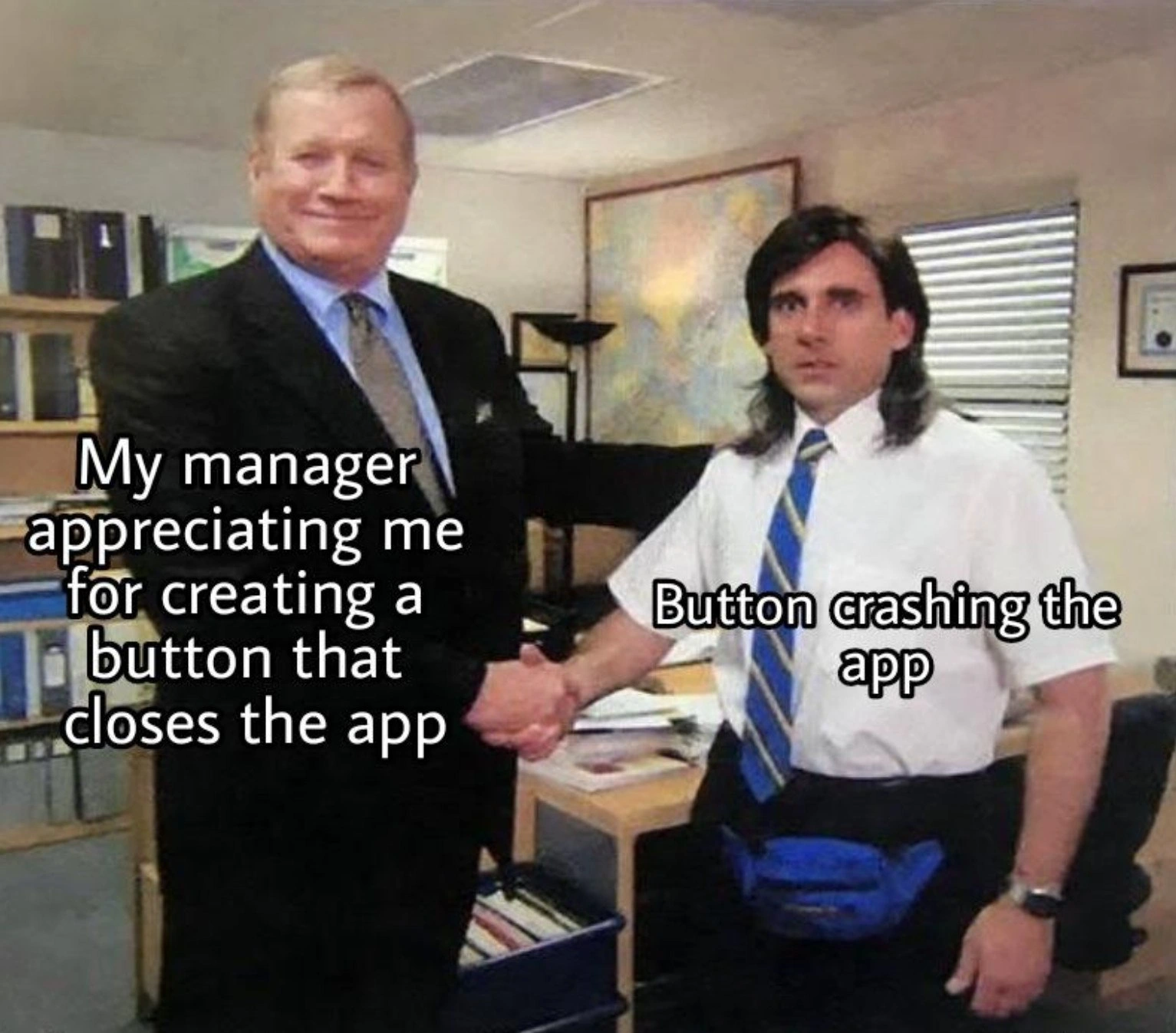
Now look at the text on the image: on the left side, the manager character says, “appreciating me for creating a button that closes the app.” On the right side, the employee (with the blue fanny pack) is labeled “Button crashing the app.” This shows two perspectives:

  • Manager’s perspective: “Great, the developer added the feature I asked for. When I click this new Exit button, the app closes like it’s supposed to. Good job!” The manager is happy because the requirement (having a way to exit) is apparently fulfilled. The manager likely isn’t very technical, so they judge success simply by trying the app: they clicked the button, and the app is no longer open. That meets their expectations, so they’re giving praise. This is the manager_approval_misfire – the boss approving something that’s actually wrong, due to not understanding the implementation.

  • Developer’s (or reality) perspective: “Uh, yeah, the button works by basically crashing the app.” This caption personifies the button (or the bug in the code) as the guy shaking hands with the boss. The dev knows that the implementation is flawed: rather than closing things properly, the app is force-stopping via an error. In other words, what the manager sees as a finished feature is actually a bug in disguise. It’s an unhandled_exception_feature – a feature delivered by using an unhandled exception. That’s not something to be proud of in terms of coding standards!

This scenario is a tongue-in-cheek example of the classic saying, “It’s not a bug, it’s a feature.” Developers often joke with that phrase when something wrong or unexpected in the software is played off as an intended feature. Here though, it literally happened: a genuine bug (the app crash) is being passed off as if it were just the feature (the app closing) that the boss wanted.

Let’s clarify a couple of terms and why this is bad practice:

  • Bug: A bug is an error or flaw in software that causes it to produce an incorrect or undesired result. In this case, the way the button was coded is actually a bug because it causes a crash (an undesired result) rather than a controlled shutdown.
  • Feature: A feature is a functionality intended as part of the software – something the software is supposed to do. Here, the intended feature was “the user can close the app by clicking a button.” That’s a normal request.
  • Bug vs Feature: Sometimes there’s confusion or jokes about what’s a bug and what’s a feature. Ideally, a crash is never a feature – it’s a bug. But this meme jokes that the crash is being treated like a feature because it superficially meets the requirement.
  • Code Quality: This refers to how well-written and maintainable the code is. A high-quality solution for an exit button would involve properly handling the shutdown. A low-quality (poor code quality) solution is what happened here: doing something sloppy like forcing an error. It works, but it’s not clean or reliable.
  • Technical Debt: This means the future problems and extra work you invite by choosing an easy but messy solution now instead of a better solution that might take longer. Here, using a crash as an exit is definitely adding technical debt. Maybe it was faster to implement (perhaps the developer was rushed or didn’t know the correct approach), but later on, another programmer will have to fix this properly. It’s like taking a shortcut that you’ll pay for later – perhaps a user will someday lose data because the app didn’t save on exit, or perhaps debugging future issues becomes harder because the program doesn’t shut down consistently.

The image itself (two people shaking hands in an office) is actually a popular meme template often used to show ironic agreements. This one looks like a scene from The Office (a TV show known for its office humor), which adds to the comical tone. Usually, in these memes, Person A and Person B shaking hands are labeled with two related ideas that are humorously being equated. Here, Person A (the manager) is labeled with the praise for the dev, and Person B is labeled as the faulty button. The handshake implies the manager is effectively congratulating the faulty button (or by extension, the dev who made the faulty code) as if it’s something great.

For a junior developer or someone new to coding, the lesson hiding in this joke is: don’t confuse making something appear to work with doing it the right way. Non-technical folks might not know the difference immediately, but as developers, we have to live with the code afterwards. The meme is funny because the manager has no idea that the “solution” is held together with duct tape. But if you’ve ever been that developer, you also know it’s a bit stressful – eventually someone will discover the truth. Until then, though, you might just smile awkwardly and accept the praise, as depicted in the handshake. It’s a form of satire about workplace dynamics: the boss is happy with a delivered feature, and the developer (or the code) is standing there like “...if only you knew how I achieved it.”

In summary, this meme highlights a disconnect between management’s understanding and technical reality. It resonates with developers because we’ve often been in situations where a quick, dirty fix gets unearned praise. It’s both funny and a little too real: the button technically does what the manager wanted (closes the app), but the way it does it is totally wrong. The humor comes from that irony and from recognizing the scenario in our own projects.

Level 3: Crash-Driven Development

At the core of this meme is a darkly humorous truth: sometimes a buggy shortcut masquerades as a "completed feature." Here, the developer likely implemented the app’s Exit button by triggering a crash – an unhandled error that force-stops the program. From a senior developer’s standpoint, this is the software equivalent of wiring the emergency eject button straight to a self-destruct sequence.

In a quality codebase, clicking "Close App" would initiate a graceful shutdown: save user data, close files, disconnect from servers, then politely terminate the process. Instead, our ingenious dev chose the one-step plan: boom, app gone. No cleanup, no questions asked. The code might look something like this:

// In the exit button's event handler:
public void onExitButtonClick() {
    // Quick and dirty solution:
    throw new RuntimeException("Goodbye!");
    // This crashes the app instead of shutting it down gracefully.
}

By throwing an uncaught exception (or calling a brutal System.exit(1)), the app indeed closes – but in the most abrupt, chaotic way possible. There’s no proper logout, no "Are you sure you want to exit?" prompt, not even a chance for the app to save state. It’s like slamming a laptop shut so hard that it powers off; sure, the screen is black now, mission accomplished, but God knows what we just corrupted.

The humor is amplified by the visual: a manager in a suit shaking hands with the very bug that undermines the app. It’s a classic office handshake meme, essentially the boss congratulating the problem itself, oblivious to the damage. The left side text – “My manager appreciating me for creating a button that closes the app” – tells us the manager is thrilled the requirement was met. The right side – “Button crashing the app” – reveals the dirty truth: the button closes the app only by causing a fatal error. The manager is literally congratulating a crash as if it were a well-implemented feature.

Why is this so relatable (and cringeworthy) to experienced devs? Because we’ve seen this play out in real life. Management often measures success in checkboxes ticked: Feature implemented? ✅ App closes when button is clicked? ✅. They rarely peek behind the curtain at how the sausage is made. If the app window disappears when the button is pressed, it works as far as the manager is concerned. They might even demo it to stakeholders: “Look, our app now has a fancy Exit button!” Meanwhile, the dev team knows that under the hood this “feature” is a ticking time bomb.

This situation oozes technical debt. Technical debt is the accumulation of quick-and-dirty solutions that “work” today but will come back to haunt you tomorrow. Here, crashing the app via an unhandled exception instead of shutting it down cleanly is a prime example of a shortcut with consequences. It’s faster to implement (maybe a one-liner hack) and it gives the desired immediate outcome (app closes on click), so it feels like a win. But it’s a debt because eventually someone will pay the price: maybe the app doesn’t release file locks, or user data gets lost, or a nightly crash report triggers an alarm. Sooner or later another developer (perhaps a future you, cursing past you) will have to refactor this “exit feature” into something maintainable. By then, the cost of unearthing and fixing this buried bug-feature will be much higher than doing it right initially.

There’s an unwritten shared trauma among developers about managers who can’t tell a bug from a feature as long as the demo looks good. It’s the old "It’s not a bug – it’s a feature!" line, but flipped on its head: here a bug is posing as a feature and getting a round of applause. The dev likely didn’t advertise “I crash the app to close it,” they just said “Yep, button implemented!” and the manager gave a thumbs up. This parallels countless real-world scenarios where non-technical stakeholders unknowingly praise a fragile workaround: maybe a memory leak “fix” that simply restarts the server every hour (boss sees uptime, not the band-aid), or a security hole closed by literally disabling the security module (hey, the app is working again, good job!). Each time, the developers exchange knowing glances (or memes) because we recognize the hidden mess behind the celebratory handshake.

From a senior perspective, the meme is both funny and painfully on-point. It satirizes corporate dysfunction: the manager’s approval misfire encourages sloppy coding practices. The dev meets the letter of the request (“provide an exit button”) but not the spirit (a proper, safe exit) – and gets praised for it! It’s a classic incentive problem: when speed or surface-level results are valued over code quality, developers learn that shipping a feature bug can be more rewarding than doing it right. In the short term, everyone’s happy – the app closes as required, the boss feels progress, the developer maybe gets a pat on the back. In the long term? The team inherits a volatile codebase where any innocent button could be a doomsday switch.

For seasoned coders, the absurd handshake in the photo is a mirror of experience: we’ve all had that facepalm moment when a higher-up gleefully accepts a solution we know is held together with duct tape and prayer. It’s both cathartic and comical to see that shared experience distilled into an image. The next time this happens in real life, you can’t help but chuckle (or cry a little) remembering this meme – the manager proudly pumping the hand of a catastrophic hidden bug.

Description

This meme uses the 'Michael Scott and Ed Truck handshake' format from the American TV show 'The Office'. On the left, a smiling, suited man representing management is labeled 'My manager appreciating me for creating a button that closes the app.' On the right, a younger man with an awkward expression, representing the developer, is labeled 'Button crashing the app.' They are shaking hands in an office. The humor comes from the disconnect between perception and reality: the manager sees a desired outcome (the app closing) and praises it, while the developer is aware that this is caused by a critical bug, not an intended feature. This scenario is a classic example of the 'task failed successfully' trope in software development, where a flaw accidentally produces a result that aligns with a stakeholder's request, leading to an awkward moment of undeserved credit for the engineer

Comments

11
Anonymous ★ Top Pick Some call it a segmentation fault, I call it 'proactive resource de-allocation'. It's all about how you frame it in the sprint review
  1. Anonymous ★ Top Pick

    Some call it a segmentation fault, I call it 'proactive resource de-allocation'. It's all about how you frame it in the sprint review

  2. Anonymous

    Leadership loved my new “Quit” button - it's just an uncaught panic, but because the OKR only measures latency, a 0 ms shutdown counts as “blazing fast.”

  3. Anonymous

    Ah yes, the classic 'System.exit(0)' vs 'throw new UnhandledException()' debate - both close the app, but only one gets you a promotion while the other gets you paged at 3 AM when the crash reporter hits threshold alerts

  4. Anonymous

    Ah yes, the classic 'graceful exit' implementation - where the app exits so gracefully it takes the entire process tree with it. Management celebrates the new close button while you're frantically checking if it's a race condition in the cleanup handlers, an unhandled promise rejection, or just the OS finally giving up on your memory leaks. Nothing says 'production-ready' quite like a feature that works perfectly... until someone actually tries to use it. At least the crash logs will be comprehensive - assuming the logging framework doesn't crash first when trying to log the crash

  5. Anonymous

    Specs said “close app”; I wired onClick to kill -9 - fastest shutdown SLA we’ve ever met

  6. Anonymous

    The ultimate UX optimization: a 'close' button that SIGKILLs the process, freeing RAM faster than any GC ever could

  7. Anonymous

    Rebranded an unhandled exception as “Close App” - PM loves the zero-latency shutdown; SRE calls it crash-only architecture with better marketing

  8. @feskow 5y

    def mousePressed(event): a = 1/0

    1. Deleted Account 5y

      mov rbp, 0

  9. @qtsmolcat 5y

    In a manner of speaking that does exactly what the manager thinks

  10. @Supuhstar 5y

    The best part is this is the only way to quit an iOS app

Use J and K for navigation