Skip to content
DevMeme
2748 of 7435
Linux Audio Works Better on Mars Than on Earth
OperatingSystems Post #3036, on May 3, 2021 in TG

Linux Audio Works Better on Mars Than on Earth

Why is this OperatingSystems meme funny?

Level 1: Mars Beats Earth

Imagine you have a bunch of toy robots at home that are supposed to talk or play music, but many of them have broken speakers and stay silent. Now imagine that far away on Mars there’s one robot, and it can play sound just fine. It would be pretty funny to say, “Wow, Mars is better than Earth for robots that can make sound!” You’d never expect to compare Earth and Mars like that, right? But since all your Mars robots (there’s just that one) can make noise, and a lot of your Earth robots can’t, in a silly way Mars wins the sound contest.

This meme is joking about that kind of situation with real computers. Linux is a kind of computer system (like Windows) that many people use. On Earth, a lot of folks have had trouble getting their Linux computers to play sound – like the sound is off or the computer’s audio isn’t working without some fixing. But NASA sent a machine to Mars that uses Linux, and that machine’s sound worked perfectly (it even recorded the wind on Mars!). So the joke is saying Mars is beating Earth in this little category: Linux computers with working sound. It’s funny because normally you’d expect Earth to be the best at things (since we have so many computers and experts here). The idea that Mars, a planet with just a couple of machines, could be “ahead” of Earth in anything tech-related is very goofy and unexpected. That surprise – thinking “no way, how is Mars better at computer audio than us?!” – makes people laugh. It’s a friendly way for computer geeks to poke fun at how tricky our Earth gadgets can be, by joking that maybe we should all move to Mars for a better experience!

Level 2: Mic Check on Mars

Let’s break down the joke in simpler terms. Linux is an operating system, like Windows or macOS. Many developers and tech enthusiasts use Linux on their computers. One thing about Linux is that you sometimes have to manually set up or troubleshoot hardware features. For example, getting the sound to work on a Linux PC can occasionally require some tweaking. An audio driver is the software that helps the operating system talk to the sound hardware (speakers, microphones, sound cards). If that driver isn’t set up just right, your computer might stay oddly silent even when it should play a sound. This is a known quirk in the Linux world: a fresh Linux installation might not play audio immediately due to a muted setting or a missing configuration, and the user has to do a bit of techie stuff to fix it. It’s not very common these days on well-supported computers, but it happens enough that it became a running joke among developers.

Now, what does Mars have to do with anything? In 2021, NASA sent the Perseverance rover to Mars, and with it a small helicopter drone named Ingenuity. Here’s the cool part: that helicopter’s onboard computer runs Linux! Even the rover itself carried a Linux-powered system for certain tasks. One of those tasks was recording sound on Mars with a microphone. Yes, we actually have audio recordings of Martian wind and the rover’s movements, thanks to that microphone working properly. So essentially, a Linux system on Mars managed to capture audio without a hitch.

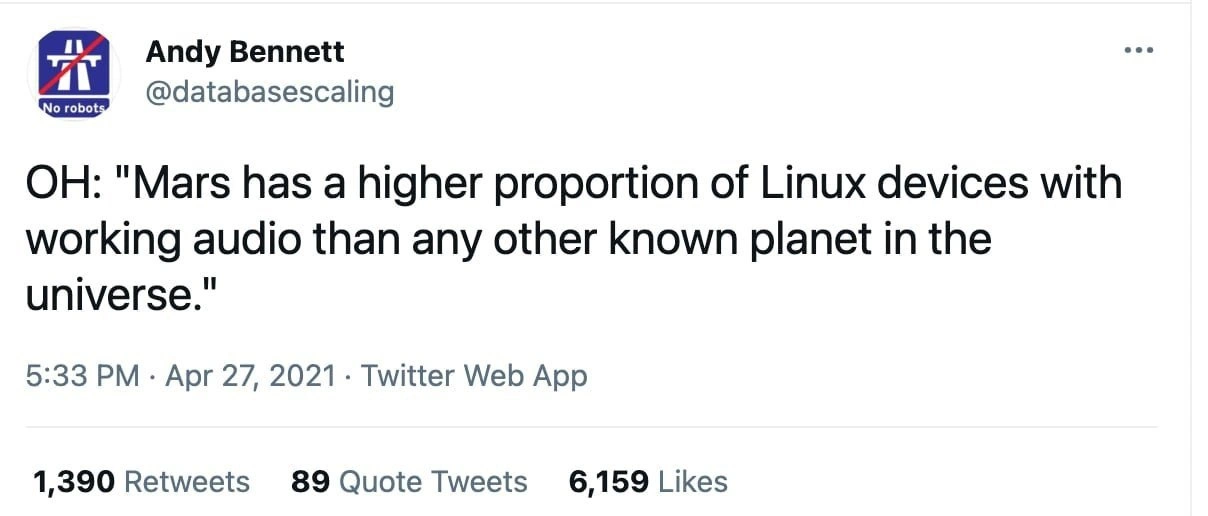
The tweet jokes that “Mars has a higher proportion of Linux devices with working audio than any other known planet.” In plain language, it’s saying: on Mars, basically 100% of the Linux computers have their sound working, because there are only one or two of them and they all succeeded in recording sound. On Earth, not all Linux computers have their sound working, because out of the millions here, some percentage are always giving people trouble. So if you compare the percentage (proportion) of working-audio Linux machines, Mars beats Earth. It’s a playful, exaggerated way to say “our Linux audio issues on Earth are so persistent, it’s like Mars (with one perfectly working example) is statistically ahead.”

The term "OH" at the start of the tweet stands for “Overheard.” This is used on social media, especially on Twitter, when someone is quoting a funny remark they heard in conversation. Andy Bennett, the person tweeting, is sharing this witty line with the world, and clearly a lot of other developers found it amusing. It combines a bit of space trivia with a bit of inside tech humor. People in dev communities find it funny because it’s both surprising and relatable. Surprising because who compares planets on tech stats? And relatable because anyone who’s struggled with setting up sound on a Linux computer has probably joked about how hard it can be. In the end, it’s a lighthearted way to tease the tools we work with. Even though Linux powers super advanced things (like a Mars helicopter!), it still gives us a hard time with something as simple as audio here on Earth. That contrast – space_program_humor mixed with everyday computer problems – is what makes the meme work.

Level 3: Works on Mars

For longtime Linux users, this tweet is as hilarious as it is relatable. After years of tinkering with laptop sound settings and debugging why the speakers are mute, it’s a punchline to hear that Mars — yes, the planet Mars — has a better track record with Linux audio. The tweet by Andy Bennett (@databasescaling) claims that “Mars has a higher proportion of Linux devices with working audio than any other known planet.” It’s a ridiculous statement on the surface (as if we seriously compare planets this way), but it riffs on two truths: NASA did get Linux machines to capture audio on Mars, and back here on Earth, the joke is that getting audio working on Linux can be surprisingly challenging. This contrast between space program success and everyday PC frustration is what makes tech folks smirk and nod knowingly.

The humor clicks because of a shared understanding of linux_audio_driver_jokes. In many dev communities, it’s common knowledge that setting up sound on a Linux desktop used to be (and sometimes still is) a bit of an adventure. Everyone has a story: maybe you installed Ubuntu on your PC and the sound was dead until you spent an evening messing with alsamixer (a low-level audio mixer) turning on some oddly named channel, or editing a config file to unmute your headphone jack. The Linux audio subsystem has multiple layers — kernel drivers (often ALSA) handle the hardware, then user-space sound servers like PulseAudio mix audio from different apps. Each layer can misbehave. PulseAudio in its early days was so infamous for glitches that “blame PulseAudio” became a running gag. (Seasoned users recall angrily typing pulseaudio -k to kill and restart the sound server when audio mysteriously died.) Even though modern Linux distributions have improved a lot (Ubuntu and others now usually have sound working out-of-the-box, and newer tech like PipeWire is simplifying things), the reputation from past pain persists. It’s an industry in-joke at this point: “Linux is great, except when you want to play a sound.”

Now, why bring Mars into it? Here’s the cool part: in 2021, NASA’s Perseverance rover and its little helicopter drone Ingenuity made history. Ingenuity was the first aircraft on Mars, and it ran Linux! Meanwhile, Perseverance carried a microphone that captured the first audio ever recorded on Mars (the breeze, the rover’s motors, etc.). So literally, Mars had a Linux device that successfully recorded audio. When Andy says “higher proportion … than any other known planet,” he’s mock-seriously framing it like a statistic. Earth has millions of Linux devices, but let’s be honest, not all of them have working sound. Some are servers with no speakers, some are desktops with misconfigured drivers — the point is, Earth’s batting average for “Linux with working audio” isn’t 100%. Mars, on the other hand, might have only one or two Linux systems total, and they all had sound working (100% success!). By that tongue-in-cheek math, Mars comes out on top in this extremely narrow category. It’s a classic nerdy joke: take a minor fact to an extreme logical conclusion for comedic effect.

To put that in perspective, here’s the tongue-in-cheek “scoreboard” the tweet implies:

Planet Linux machines (with audio) Machines that actually made sound Success Rate
Mars ~1 (Mars rover mic) 1 (yes, recorded wind!) 100% 😀
Earth Millions of devices Many… but not all < 100% 🙃

The absurdity of comparing planets aside, this joke also resonates because it’s self-deprecating. The TechHumor here is essentially saying, “We can put Linux on Mars and have it work flawlessly, yet we still struggle with it at home, ha ha what’s new?” Devs love to celebrate Linux’s victories (like running the Martian helicopter), but we also bond over its hassles (like driver issues). The meme balances both: pride that Linux is literally extraterrestrial, and the humility of admitting that even so, a trivial issue like sound still trips us up on Earth. It’s like cheering that your hometown team won the championship, but also joking that they can’t win a simple exhibition match back home.

The fact that this was posted on Twitter (a hub for SocialMedia savvy developers) and labeled as “OH” (Overheard) gives it a water-cooler-conversation vibe. It’s as if someone quipped this one-liner in an office or chat and Andy found it too good not to share. Over 1,300 retweets and 6,100 likes later, it’s clear the joke struck a nerve. RelatableDeveloperExperience is at the core here: so many devs have felt the annoyance of silent Linux speakers or microphones that the exaggeration “Mars is better than us at this” elicits a knowing laugh. It’s a form of communal catharsis – we poke fun at our tools and ourselves. In the end, the tweet cleverly combines space exploration geekery with an inside joke about everyday coding life. Mars winning the “working Linux audio” trophy is a funny idea, and it shines a light on how far technology has come (Linux on another planet!) while winking at the problems we still deal with (pesky audio drivers). In other words: Houston, we have sound… but back on Earth, we’re still debugging our audio settings. 🚀🔊

Level 4: One Giant Leap for ALSAkind

On a planet millions of miles away, with an atmosphere so thin that sound barely carries, a tiny Linux-powered computer aboard NASA’s Perseverance rover flawlessly recorded audio of Martian wind. This wasn’t a typical Ubuntu laptop playing music; it was a specialized, embedded Linux system running on the Perseverance/Ingenuity mission. The engineers likely used a minimal real-time Linux kernel to ensure every whisper of Martian breeze was captured with precise timing. Under the hood, the rover’s microphone interfaced with a custom ALSA (Advanced Linux Sound Architecture) driver in the kernel. Unlike the messy diversity of PC sound cards on Earth, this driver was tailor-made and rigorously tested for one specific hardware setup. There’s no “plug-and-pray” here – every byte of audio data from the microphone, through the kernel buffer, to storage was accounted for because you can’t exactly push a quick patch update to a Mars rover once it’s launched. NASA had one shot to get the audio subsystem right, and they did. In the vacuum (or rather, thin air) of space, Linux achieved something akin to audio nirvana: a perfectly working sound setup on the first try, with no user intervention needed.

From an operating systems perspective, this scenario is a case study in controlling variables. On Earth, the Linux audio stack (kernel drivers -> sound server -> application) has to handle countless combinations of hardware and software. It’s a complex dance between the kernel (via ALSA) and user-space mixers like PulseAudio (or the newer PipeWire), juggling multiple audio streams and device quirks. Every PC has different sound chips, connectors, and use-cases (music, voice calls, etc.), which introduces opportunities for things to go wrong – timing issues, driver bugs, configuration mismatches, you name it. But on Mars, all those variables were stripped away. There was exactly one audio input device, one purpose-built recording application, and a straightforward data path between them. With a fixed hardware design and a lean software stack, the system becomes deterministic and much easier to stabilize. It’s as if Linux was put into monk-like isolation: no unpredictable USB headphones being plugged in, no Bluetooth pairing oddities, no desktop mixing multiple apps’ audio. The result? Rock-solid sound recording in an environment where failure was not an option.

It’s ironic and a bit poetic that the frontier of space is where Linux audio found zero glitches. Historically, desktop Linux users have joked that getting sound to work can require black magic (sacrificing a rubber chicken to the sound gods, as the saying goes). Yet here we are – on a rover millions of miles away, Linux sings (or at least listens) without a hiccup. This “one giant leap for ALSAkind” was enabled by meticulous engineering: the Mars team treated Linux like a tightly-controlled appliance. They likely ran a real-time scheduler to prioritize audio capture, ensured no extraneous processes interfered, and tested the heck out of that microphone pipeline before launch. In essence, NASA’s use of Linux on Mars turned a long-standing Earth-bound joke on its head by proving that when you truly engineer away all the usual chaos, Linux can handle something as finicky as audio in one go. The fundamental lesson aligns with academic principles of systems design: reduce complexity, and you reduce bugs. It just so happens that this lesson played out in the most literally out-of-this-world setting imaginable.

Description

This image is a screenshot of a tweet by Andy Bennett (@databasescaling). The text of the tweet reads: 'OH: "Mars has a higher proportion of Linux devices with working audio than any other known planet in the universe."'. 'OH' stands for 'overheard'. The humor is a deeply layered in-joke for the tech community, especially those familiar with Linux. It references the fact that NASA's Perseverance rover on Mars runs on Linux and has successfully recorded audio. This is contrasted with the long, painful history of configuring audio on desktop Linux systems, a task notorious for its complexity due to driver incompatibility and confusing sound servers like ALSA, PulseAudio, and now PipeWire. The joke's punchline is that it was easier for NASA to get audio working on a different planet than it is for a typical user to do so on Earth, hilariously highlighting the poor state of Linux desktop audio support


Comments

20
Anonymous ★ Top Pick Earth: Billions of Linux devices, audio is a 50/50 gamble. Mars: A handful of Linux devices, pristine audio recording. Clearly, the signal-to-noise ratio is just better without end-users and their esoteric hardware
  1. Anonymous ★ Top Pick

    Earth: Billions of Linux devices, audio is a 50/50 gamble. Mars: A handful of Linux devices, pristine audio recording. Clearly, the signal-to-noise ratio is just better without end-users and their esoteric hardware

  2. Anonymous

    After 20 years of ALSA → PulseAudio → PipeWire, NASA finally discovered the real fix for Linux audio: a 54-million-kilometre air-gap to Mars

  3. Anonymous

    The real reason we're colonizing Mars isn't for humanity's survival - it's because after 30 years, we've finally found a planet where PulseAudio doesn't randomly decide your HDMI output is now a microphone at 3am during a production incident

  4. Anonymous

    The beauty of this observation is that it's technically correct - the best kind of correct. Mars rovers run Linux flawlessly because they don't need audio drivers, which is exactly the workaround every Linux desktop user has considered after their fifth PulseAudio reinstall. It's the ultimate 'works on my machine' scenario: just deploy to Mars where the requirements don't include sound. NASA accidentally solved Linux audio by launching it to a planet with no atmosphere to carry sound waves - a more elegant solution than any amount of ALSA configuration could ever achieve

  5. Anonymous

    Linux audio works best on Mars - apparently the stack stabilizes once you’re 1.5 AU away from Bluetooth, HDMI, and the PulseAudio/JACK turf war

  6. Anonymous

    Earth's Linux servers: headless. Mars rover: mic'd up and recording symphonies at 4 light-minutes latency

  7. Anonymous

    Amazing what happens when you control 100% of the hardware matrix and there are zero Bluetooth headsets within 225 million kilometers - the Linux audio stack suddenly looks production-ready

  8. @prkiso 5y

    Realtek >:(

  9. @NiKryukov 5y

    Oh...

  10. @asoteric 5y

    i havent had any problems with linux audio this side of 2015, 7 years ago

    1. Deleted Account 5y

      I have

    2. @RiedleroD 5y

      I've had some problems as well: JACK doesn't seem to like me at all, portaudio is mostly broken, pulse works perfectly, except in LMMS, SDL2 works mostly, and all that didn't change once I installed the pipewire equivalents. I really hope pipewire will fix some of that stuff though, because I'd really like to have proper low-latency audio.

      1. @RiedleroD 5y

        oh and OSS only started to work after I've installed pipewire, which was kinda neat, but still.

      2. @asoteric 5y

        ive fortunately never had to use jack. always heard problems with it

        1. @RiedleroD 5y

          it's the only good low-latency audio solution on Linux up until pipewire afaik

          1. @asoteric 5y

            i remember hearing people having to fight with it in a later signals processing class i didnt have to take

            1. @RiedleroD 5y

              I just gave up installing it eventually. Didn't get a toot out of the mfer

      3. @asoteric 5y

        i only ever use pulseaudio and its worked fine for years. its default on most distros

        1. @RiedleroD 5y

          ye, it works ok. It just has quite some delay & consumes a lot more resources than necessary.

  11. @asoteric 5y

    complaining about ancient problems like theyre modern day back in my day we had to install pavucontrol and alsamixer and unmute our audio to make it work ok old man

Use J and K for navigation