An Opinionated Guide to 2019's Programming Languages
Why is this Languages meme funny?
Level 1: Seasoned Advice vs. Shiny Ads
Imagine a big toy store’s website shows a banner: “Top 7 Toys Every Kid Should Have in 2019!” with a lineup of the coolest-looking toys. But then your wise older sibling looks at that list and gives you the real story for each toy:
They point to the first toy – a super cool building set (like Lego but newer). “That one’s a good choice,” they say. It’s fun and everyone is talking about it. The next item is a fancy puzzle game. “Oh, that one is really nice to play with,” they nod – it might be a bit challenging, but in a fun way that really pays off. Third on the list is a toy that's only for Apple devices, like a game that only runs on an iPad. “That one’s useful if you have an iPad – great toy, but you can’t use it without Apple stuff,” they caution. Fourth is an advanced chemistry kit. Your sibling says, “This kit is very useful — you can do a lot of cool experiments, but it’s pretty hard to master.” In other words, not the easiest toy in the box, but you’ll learn a ton if you put in the effort. Fifth is a new version of a popular board game that comes with extra rules to make it better. “This is basically a more convenient version of the game you already know,” they smile – meaning it’s easier to play and fixes some problems the old game had. Sixth is an old classic toy – like a plain yo-yo or an old-model video game console. Your sibling shrugs, “Try the newer edition instead,” suggesting there’s a fresh, improved version you’d enjoy more. They’ve seen the old one and know the new one is just better for you.
Finally, you both look at the seventh item – it’s a bizarre, shape-shifting mystery toy that glows and makes strange sounds. Your older sibling scratches their head, “What on earth is that supposed to be?” 😕 They’re genuinely confused – out of all the toys, this one is so odd that even your experienced sibling can’t figure it out at first glance. But then they chuckle and say, “Hey, respect to the kids who play with it, though!” meaning if you can handle that crazy toy, more power to you, no insult intended.
This whole scenario is funny because for the first six toys, your sibling had clear, calm opinions – either positive or with slight warnings – just like giving honest advice. But for the last super-weird toy, their reaction suddenly becomes exaggerated and puzzled. It’s like seeing someone very knowledgeable get completely stumped by one wacky item. We laugh because it shows even experts can be bewildered by something that’s supposed to be “the next big thing.” It’s the difference between shiny advertising and real-life experience: the toy store’s list makes everything look equally amazing, but your older sibling’s real talk helps sort out which toys are truly great, which have caveats, and which one is just plain huh?!. That contrast – especially the “What is this?!” outburst at the end – is what makes the meme humorous and relatable, even if you’re not a developer.
Level 2: Best Languages Explained
Let’s break down the meme’s content for a newer developer or someone not deeply familiar with these programming languages. Imagine you saw a list of “best programming languages in 2019” and someone experienced is commenting on each – what do they mean?
Kotlin – Kotlin is a modern programming language primarily used for developing Android apps (it runs on the same platform as Java, the JVM, which powers many apps). When the meme says “Good choice” with a green checkmark, it means Kotlin is widely regarded as a smart pick for learners in 2019, especially if you’re interested in mobile development. Why? Kotlin was officially supported by Google for Android development, and it’s designed to be more concise and safer than Java (which was the old default for Android). For example, Kotlin helps you avoid null pointer errors – a common bug in Java – by built-in null safety features. So an experienced dev is basically saying: “Yes, learning Kotlin is worth it – it’ll serve you well and it’s in demand.”
Rust – Rust is a relatively new systems programming language (backed by Mozilla) that focuses on performance and memory safety. The comment “Very nice to use” and a checkmark is high praise coming from a veteran. Rust is often compared to C++ (both can make fast, efficient programs), but Rust was designed to catch many mistakes at compile time (before the program runs) so you don’t get nasty surprises later like crashes or security bugs. It has a concept called ownership and borrowing which ensures your program manages memory safely (you won’t accidentally use data that’s gone). Many experienced developers in 2019 were excited about Rust because it lets you write low-level code without the usual headaches of C++ (like manual memory management). When a senior dev says Rust is “very nice to use,” they mean that despite being powerful, it’s also enjoyable and robust to work with, once you learn it. It indicates Rust isn’t just hype – it’s practically helpful and even loved by those who use it (indeed, Rust topped surveys as a “most loved language” around that time).
Swift – Swift is Apple’s programming language for iOS and macOS app development. The meme’s note “iOS exclusive but still viable” (with a green check) means that Swift is a great language, but its use is mostly limited to the Apple ecosystem. “iOS exclusive” implies if you want to build iPhone or iPad apps (or software for Macs, Apple Watch, etc.), Swift is the go-to language – in fact, Apple essentially requires it for modern app development (it replaced the older Objective-C). It’s “still viable” meaning it’s a solid skill to have if you’re targeting that platform. However, unlike some other languages on the list, Swift isn’t used for things outside the Apple world. You wouldn’t typically use Swift for web development or programming a Windows application. So an experienced dev is tempering their praise: “Yes, Swift is good… just remember it’s mainly for iOS.” They’re giving context: if you learn Swift, you might become an iOS developer; if you’re not interested in Apple’s platform, Swift might not be useful to you. That’s a practical insight beyond the generic “Swift is one of 2019’s top languages!” headline.
C++ – C++ is a powerful, old-school programming language that’s been around for decades (originating as an extension of C in the 1980s). It’s known for being used in software where performance is critical – like game engines (Unreal Engine), operating systems, high-frequency trading systems, and so on. The meme says “Useful but difficult to learn” with a checkmark. In plain terms: C++ can do a lot (it’s useful indeed – many foundational programs are written in C++), but it has a steep learning curve. Why difficult? C++ gives the programmer a lot of control, especially over memory (you manage allocation and deallocation of memory manually, like handling raw ingredients in a kitchen rather than using pre-measured kits). This control means you must be very careful – a small mistake can cause a program crash or security issues. C++ also has a very large number of features (different programming paradigms, complex syntax in parts, etc.) because it evolved over a long time. For a new coder, wrapping your head around pointers, references, manual memory management, and weird compile errors can be intimidating. The senior dev acknowledges C++’s importance (“useful” – there are many jobs and projects that rely on it) but warns newbies that it’s hard mode in the world of programming. Essentially: “Yes, learning C++ pays off for certain fields, but brace yourself – it’s not friendly to beginners.” The green check is still there because they aren’t saying “don’t learn it” – just know what you’re getting into. Many beginners start with easier languages and come to C++ later because of this challenge factor.
TypeScript (TS) – TypeScript is a language that builds on JavaScript by adding static typing. It was created by Microsoft and became open-source and widely used. The meme’s description “More convenient JavaScript” with a checkmark means TypeScript is basically an improved way to write JavaScript code. To explain: JavaScript by itself doesn’t require you to declare variable types – you can just do:
let x = "hello"; x = 42; // JavaScript lets you do this (x was a string, now it's a number)This flexibility is nice, but in a big codebase it can lead to confusion or errors (what if you thought
xwas always a number, and later someone sets it to a string? You might get a runtime error). TypeScript requires you to define types, so you’d catch those mistakes early:let x: string = "hello"; x = 42; // Error! Can't assign a number to a string.That way, TypeScript will complain while you’re coding rather than failing unpredictably when the program runs. It also adds modern features that JavaScript (at the time) lacked or only got later, making coding smoother. In 2019, many developers started preferring TypeScript for large projects because it made maintenance easier and code more robust. Calling it “more convenient JavaScript” sums up that it’s basically JavaScript (it runs anywhere JS runs, after being compiled to JS), but with quality-of-life improvements that seasoned devs appreciate. If you’re a new developer, the advice here is: “Learning JavaScript? Consider TypeScript – it’ll help you avoid common mistakes and you’ll still be able to do everything you do in JavaScript.” The meme’s green check from a senior dev means they endorse TypeScript as a smart technology to use; it’s not just a fad — it genuinely addresses real problems in JavaScript development.
Java – Java is one of the most established programming languages (originated mid-90s). It’s taught in many universities and used heavily in enterprises (banks, large corporations) and was historically the main language for Android app development. The meme’s verdict “Try Kotlin instead” with a check implies that while Java itself is a solid language, an experienced dev in 2019 would recommend a newcomer to pick Kotlin over Java, if possible. Why might they say that? Kotlin and Java can do very similar things (since Kotlin runs on the Java platform and can use all the same libraries), but Kotlin was designed to be more concise and solve some of Java’s long-standing pain points (like reducing boilerplate code, adding features like extension functions, coroutines for concurrency, etc.). In Android development, Kotlin was officially preferred by 2019, meaning new projects were likely to start in Kotlin to begin with. So a senior developer is essentially giving career advice: “Java is fine and still everywhere, but if you’re learning a language now for those same uses, Kotlin will give you a more enjoyable and modern experience.” It doesn’t mean Java is obsolete – knowing Java is still very useful (huge legacy codebases, lots of companies use it). However, the meme humorously suggests that Java’s spot in “top languages to learn” lists might be overtaken by its younger sibling. The tone “Try Kotlin instead” is a bit like an expert saying “Why settle for the old model when there’s a new improved one available?” – especially if you’re starting fresh. If you imagine a junior developer asking “Should I learn Java or Kotlin for Android development?”, this senior’s answer is clearly: Kotlin.
JavaScript – JavaScript is the language of the web – it runs in all modern web browsers and is also used on servers (with Node.js). It’s arguably one of the most important languages to know because virtually every interactive webpage uses JavaScript. But here, the meme’s senior developer reaction is “What the f**k is this?” with a confused emoji and a glowing brain image, instead of a simple checkmark. This dramatizes how confusing or bizarre JavaScript can appear, especially to those familiar with more structured languages. Let’s clarify:
- JavaScript’s nature: It’s dynamically typed and very forgiving. This means you can do unusual things like mix types without immediate errors (as shown earlier,
"5" + 3becomes"53"because JavaScript will convert the number to a string and concatenate). It was created in just 10 days back in 1995 to add some interactivity to webpages, and no one imagined it would one day be used to build huge applications. As it evolved, it kept backwards compatibility (to not break the web), which means all its quirky behavior from the early days still exists. This has given JS a reputation for weird, “wat?” moments that people love to joke about. For example,typeof NaNreturns"number"even though NaN means “Not a Number” – things like that can make one scratch their head. - Ecosystem complexity: By 2019, JavaScript had a massive ecosystem with countless libraries and frameworks. This is great because you can do a lot with it, but it’s also overwhelming. A beginner googling “how to build a web app” might be bombarded with terms like React, Angular, Vue, webpack, Babel, etc., and feel lost. Even experienced devs sometimes feel like JavaScript’s world moves too fast. This sentiment is often called “JavaScript fatigue.” The meme’s over-the-top “WTF is this?” reflects that feeling of bewilderment when facing the sprawling JS universe. It’s like the senior dev is saying: “I’ve seen a lot in my career, but JavaScript still has the power to confuse the heck out of me.”
- Why include it on the list then? Because every “top languages” list inevitably includes JavaScript – it is extremely popular and in-demand. The experienced dev isn’t denying that; instead, they’re half-joking that JavaScript is so unique and chaotic that it practically breaks the format of the meme. Instead of an orderly check and comment, it gets a big, visually loud reaction. However, notice the fine print: “respect to all the JavaScript programmers out there!” That means the meme is not truly insulting JS devs – on the contrary, it’s acknowledging that JavaScript programming can be challenging exactly due to the weird behavior and ever-changing tools. It’s saying “much respect, you handle this craziness daily.” For a new developer, the takeaway is: JavaScript is vital and ubiquitous, but be aware it’s a bit of a wild ride. Expect some confusion and lots of learning as you go – even veterans are sometimes perplexed by it.
- JavaScript’s nature: It’s dynamically typed and very forgiving. This means you can do unusual things like mix types without immediate errors (as shown earlier,
The common theme in the meme’s “Actually:” section is giving honest context about each language:
- Some languages are great but niche (Swift: great for iOS, not beyond).
- Some are powerful but tough (C++: worth it for certain areas, but challenging).
- Some new ones are genuinely improvements (Kotlin over Java, TypeScript over JavaScript).
- And one (JavaScript) is indispensable yet notoriously quirky, eliciting a mix of admiration and head-shaking.
For someone early in their career, this meme is humorous but also educational. It basically says: “Don’t trust every shiny 'Top 10 languages' article at face value. Here’s how an experienced developer views those technologies.” Many beginners ask “What programming language should I learn first?” and often run into conflicting advice. This meme’s senior dev perspective is giving a rough guide:
- Kotlin and Rust – thumbs up, they’re modern and worth it.
- Swift – good if you’re in the Apple zone.
- C++ – important in some fields, but be ready to put in serious effort to learn it.
- TypeScript – a smart way to do JavaScript development without the usual pitfalls.
- Java – plenty of use, but if you can choose, a newer alternative (Kotlin) might serve you better.
- JavaScript – you can’t avoid it in web development, but brace yourself; even pros find it a bit crazy at times.
It also touches on DevCommunities and attitudes: Each of these languages has communities and fanbases. There are often playful “language wars” or debates – e.g., fans of Java vs fans of Kotlin, or system-level programmers (C++/Rust folks) who poke fun at JavaScript for being scripting magic. The meme is a lighthearted reflection of those community sentiments circa 2019. A junior dev might not get all the in-jokes, but now you know: the pondering emoji and galaxy brain image for JavaScript signal the collective “WTF” feeling many have had with it, whereas the green checkmarks are basically saying “This language is okay/good in my book.”
Finally, it’s worth noting how the meme format itself is something common in developer humor:
- The first panel mimics an official or authoritative source (in this case, “Google:” suggests a search result or a Google article).
- The second panel labeled “Actually:” implies the real talk from someone experienced. It’s a bit like those “How it started vs How it’s going” or “Expectation vs Reality” memes. Here expectation is set by a generic “best languages” list; reality is delivered by a senior developer with dry wit. If you’re a new dev, this format teaches a subtle lesson: experienced engineers often have opinions that differ from the hype, because they’ve actually worked with these tools and know their pros/cons intimately.
So, in simpler terms: the meme is funny to developers because it takes a trending topic (best languages to learn) and injects candid, no-BS commentary for each language. It’s both a roast and an endorsement list, and understanding the specifics above helps you see why each one got the comment it did.
Level 3: Hype vs Reality Check
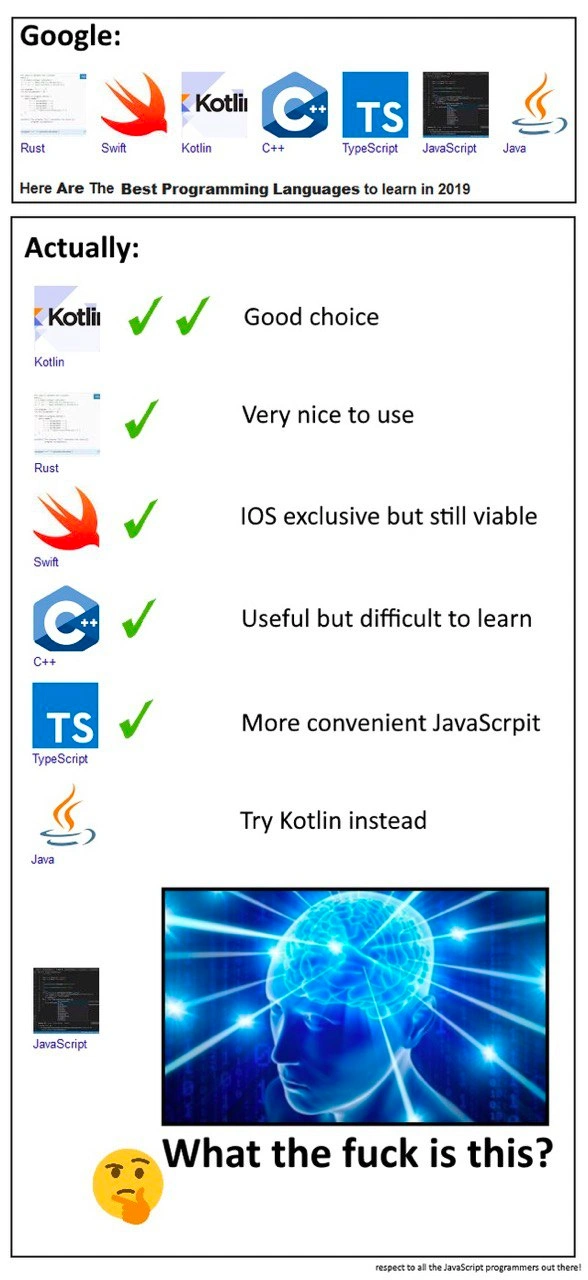
The meme lampoons the endless “Top Programming Languages of {year}” listicles by contrasting Google’s hype with a senior developer’s no-nonsense reality check. In the top panel, “Google: Here Are The Best Programming Languages to learn in 2019,” we see a lineup of trendy languages: Rust, Swift, Kotlin, C++, TypeScript, JavaScript, and Java – complete with logos and code snippet thumbnails. It looks like every clickbait article or Google search result that year, throwing out buzzworthy names to aspiring devs. The bottom panel, labeled “Actually:”, is the seasoned engineer’s commentary on each of those languages, marked with green checkmarks for approval – until we hit JavaScript, which gets a glowing blue galaxy brain image and a blunt “What the fuck is this?” (🤔) instead of a check. This punchline is a spicy roast of JavaScript amid otherwise measured advice, capturing a very 2019 senior developer perspective on the state of popular programming languages.
For each language on the list, the meme’s author (a battle-tested dev) translates the hype into frank guidance:
Kotlin – “Good choice” ✅. By 2019, Kotlin was the shiny new go-to for Android development, officially endorsed by Google over Java. A seasoned dev agrees Kotlin is a solid pick: it’s modern, concise, and interoperates with Java without the decades-old baggage. When a Java veteran says a new language is a “good choice,” that’s high praise – it means Kotlin solved real pain points (like null-pointer errors and boilerplate code) that had annoyed them for years. The subtext: “If you’re starting now, skip the crusty Java classes and go straight to Kotlin; you’ll thank me later.” Indeed, Google itself was pushing Kotlin-first for Android, so even the search giant’s listicle and the senior dev align here. This is a rare moment of tech hype meeting reality: Kotlin actually lives up to it.
Rust – “Very nice to use” ✅. Seasoned systems programmers nearly shed a tear of joy seeing Rust on a “best languages” list – and even more when it’s endorsed as “very nice to use.” Rust emerged to tackle what C++ developers call the nightmares (memory leaks, race conditions, undefined behavior) with a strict compiler and ownership model enforcing memory safety. A cynical old-timer might normally scoff at new languages, but Rust won them over by preventing those 3 AM production crashes caused by rogue pointers. The meme’s senior dev acknowledges Rust’s reputation: it’s fast like C++, but your chances of accidentally shooting yourself in the foot with a dangling pointer are near zero. It’s actually pleasurable (or at least deeply satisfying) to write Rust once you survive the learning curve – a shocker for anyone accustomed to C++ induced stress. In industry terms, Rust was the Stack Overflow Survey’s “most loved language” around that time; even jaded engineers found themselves enjoying it. So the green check and “very nice” is genuine respect. Under the hood this hints at a shift in the IndustryTrends_Hype cycle: Rust wasn’t just hype, it delivered real technical improvements (memory safety without a garbage collector) that made seasoned devs lives easier.
Swift – “iOS exclusive but still viable” ✅. The meme’s author gives Swift a cautious thumbs-up: “viable, but iOS-only.” This reflects an experienced understanding of Swift’s niche. Apple introduced Swift in 2014 to replace Objective-C for iOS/macOS development. By 2019 Swift had matured, and any iPhone/iPad app developer pretty much had to learn it. The senior dev in the meme isn’t knocking Swift’s design – in fact, Swift is modern and relatively developer-friendly – but they note its walled-garden limitation. Outside the Apple ecosystem, Swift’s utility drops off. You won’t be writing server backends or scripting in Swift at most companies (there were efforts, but nothing widespread in 2019). So a veteran’s advice to a new programmer might be: Swift is great if you plan on doing iOS/macOS work, otherwise it’s not broadly applicable. This is the kind of pragmatic career tip a junior might not glean from a generic “best languages” article that just hypes Swift’s popularity. The green check implies “Yes, Swift is a solid language,” tempered by the reality-check: know its context. A seasoned dev remembers the days of Objective-C with its clunky syntax and says “Swift is a blessing for iOS devs, but if you’re not in Apple-land, it’s a bit like learning to drive on the left side of the road – only useful in certain places.” It’s a viable skill, just not a general-purpose golden ticket.
C++ – “Useful but difficult to learn” ✅. Here comes the granddaddy of the list: C++, around since the 1980s, powering everything from game engines and operating systems to web browsers. The meme’s senior dev concedes C++ is undeniably useful – it’s a workhorse language for performance-critical software. But the follow-up “difficult to learn” is a huge understatement only a jaded engineer could deliver with a straight face. 😏 C++ is infamous for its complexity: manual memory management, pointer arithmetic, undefined behaviors that can crash or corrupt programs if you’re not careful, a sprawling feature set grown over decades, and error messages from the depths of template hell that scare even veterans. The humor is in the matter-of-fact tone: “useful but hard” – no sugarcoating. A newbie reading “Top 2019 languages” might not grasp why C++ is hard; the senior dev spells it out. They’ve been in the trenches chasing a memory leak at 4 AM or debugging a segfault caused by a stray
*or->. So when they say difficult, they mean “Prepare for a steep learning curve and some serious headaches.” Yet, the green check means it’s still worth knowing if you need ultimate speed and control. This line encapsulates a common senior-dev sentiment: C++ is powerful and widely used, but only recommend it if you’re ready for some pain. Many a gray-bearded programmer has muttered “C++... not even once” jokingly, while fully aware they’ll end up using it again because sometimes there’s just no substitute. The meme acknowledges this love-hate truth in one blunt sentence.TypeScript – “More convenient JavaScript” ✅. The meme’s author succinctly crowns TypeScript as basically JavaScript’s better half. TypeScript was created to fix many of JavaScript’s pain points by adding a static type system and modern language features. A senior dev in 2019 likely saw TypeScript rapidly gaining adoption in the dev community, especially for large front-end projects and Node.js backends. Why? Because maintaining a big JavaScript codebase without types often turned into a wild bug chase (“undefined is not a function” – every JS dev’s nightmare 😫). TypeScript offers compile-time error checking, improved IDE support (autocomplete, refactoring), and overall sanity when dealing with complex code. Calling it “more convenient JavaScript” is a bit tongue-in-cheek: it implies “JavaScript, but without so much of the usual chaos.” The green check mark from a cynical veteran means “Yes, if you have to do JavaScript, do it in TypeScript – you’ll save yourself a lot of grief.” It’s a pragmatic endorsement. There’s an underlying industry commentary here: by 2019, even many die-hard JavaScript teams (like those at Google with Angular, or Microsoft with VS Code) had embraced TypeScript, because it scaled better for large applications. The meme slyly validates that trend: an experienced dev essentially telling newcomers, “Learning JavaScript? You might as well start with TypeScript to avoid pulling your hair out later.” It’s the same reason the Common_Tags include
JavaScriptandTypeScripttogether – the meme contrasts them as raw vs refined. The humor is subtle: TypeScript is literally built on JavaScript, yet the senior dev treats it as the polite, civilized sibling of the wilder JavaScript – a very DevCommunities inside joke.Java – “Try Kotlin instead” ✅. Oof, poor Java – once the reigning king of enterprise programming and “learn to code” classes – gets a polite “you can do better” dismissal here. The meme’s veteran effectively says, “Java? Meh, just skip straight to Kotlin.” This reflects a major industry shift by 2019: Java was still everywhere (banks, big companies, Android’s legacy), but it had a reputation for being verbose, ceremonious, and maybe a bit stale compared to newer languages. Kotlin, by contrast, offered clean modern syntax, type inference, null safety, extension functions – features that made Java feel clunky. Google’s strong backing of Kotlin for Android development only accelerated this sentiment. A senior dev who’s written countless
public static void main(String[] args)might be frankly tired of Java’s boilerplate and conga-line of factory factories. The joke here is that on a “best languages” list you’d normally expect Java to be included as a safe bet – but the seasoned engineer confidently swats it away with “just use Kotlin.” It’s a bit savage: like telling someone asking about Java vs Kotlin that the debate is over and their Java textbook can collect dust. This line also hints at the LanguageWars that brew in dev communities: Java loyalists vs Kotlin enthusiasts. The meme firmly sides with the Kotlin camp, reflecting how many senior Android developers felt after Kotlin proved itself. Notice Java still gets a green check (so the dev isn’t saying Java is garbage – it is useful and ubiquitous), but the actual advice is “you could choose better for new projects.” It’s like giving Java a participation trophy while the gold medal goes to Kotlin. In context, this is a comedic inversion of the typical ranking: usually Java would rank high on “best languages to learn” for job prospects, but the meme’s expert has an opinionated edge, prioritizing developer happiness and modern trends (Kotlin) over legacy dominance (Java).JavaScript – “What the fuck is this?” 🤔 (Galaxy brain explosion). Here the meme swerves into pure comedic exaggeration and senior-dev trauma. After calmly approving all the other languages, the experienced engineer loses their composure at JavaScript. The line “What the fuck is this?” with a glowing blue brain image is a punchline that underscores how JavaScript is often viewed by back-end or systems programming veterans: as an enigmatic, bizarre world that barely makes sense. This is a classic javascript_roast — a staple of DeveloperMemes. Why such a dramatic reaction to JS? Let’s unpack the shared pain and jokes:
- Quirky Language Behavior: JavaScript is notorious for weird gotchas. Seasoned devs love to cite examples like
"" + [] === ""(an empty array concatenated to an empty string gives""), or the classic:
These WAT moments (made famous by Gary Bernhardt’s lightning talk “WAT”) feel absolutely illogical. A C++ or Java engineer seeing this behavior might literally say “WTF is this?!” because it defies the consistency they expect from a language. JavaScript’s type coercion and oddities (like[] + [] // "" - adding two arrays yields an empty string (!!) [] + {} // "[object Object]" {} + [] // 0 "5" - 3 // 2 (string "5" becomes number 5) "5" + 3 // "53" (number 3 becomes string "3")undefinedvsnull, or that infamousNaN– Not-a-Number – which paradoxically is a number type) have birthed countless jokes. The meme taps right into that frustration. - Ecosystem Fatigue: By 2019, JavaScript’s ecosystem was (and still is) overwhelming. New frameworks and libraries pop up monthly. A once trendy library can become obsolete by the time you finish a project. The phrase “What the fuck is this?” could also be the reaction of a developer opening a JavaScript project and seeing a
node_modulesfolder the size of a planet 😅, or trying to choose between React vs Angular vs Vue vs Svelte vs ... (insert endless list) and feeling their brain explode like the image shown. Every senior dev has witnessed “JavaScript fatigue”, where keeping up with the JS world feels like drinking from a firehose of blue-cabled brain energy. - Dynamic Typing & Runtime Surprises: Unlike all the other languages on the list, JavaScript is dynamically typed and was originally a simple scripting language for web pages. It grew explosively into a multi-purpose beast without a traditional period of design-by-committee. The result is a language that’s very flexible but also forgiving to a fault (it will often try to do something rather than error out, sometimes with absurd results). To a veteran used to the compiler yelling at every little mistake (like in Rust or C++), JavaScript’s “run and find out” approach feels alien. Hence the bewildered “WTF” – it’s the face of a strict parent walking into a chaotic teen party where the rules are… made up on the fly.
- Respect for JS Devs: The tiny text at the bottom, “respect to all the JavaScript programmers out there!”, is the meme equivalent of a roastmaster patting the butt of the joke on the back. It acknowledges that yes, we’re poking fun at JS, but seriously, props to those who wrangle it. A cynical veteran might grumble about JS, yet they know the web literally runs on it and those developers deal with a lot of complexity. It’s a mix of jest and genuine respect: working with JavaScript requires dealing with its quirks, the ever-changing tooling, and optimizing performance in a single-threaded event loop – not exactly a walk in the park. So the meme ends with that line as a nod: “No hard feelings, JavaScript devs; we kid because we care (and because we’ve been scarred by it too).”
- Quirky Language Behavior: JavaScript is notorious for weird gotchas. Seasoned devs love to cite examples like
Overall, this meme resonates because it captures a senior developer’s perspective in a humorous, brutally honest way. It skewers the IndustryTrends_Hype (those ubiquitous “Best languages 2019” lists that every junior reads) with candid one-liners for each technology. Each green check and comment distills years of collective developer experience and DevCommunity consensus:
- The hype around Kotlin and Rust in 2019? Actually justified – they’re worth learning.
- The buzz about Swift? Sure, but only relevant for the Apple world.
- The enduring importance of C++? Real, but gird yourself for complexity.
- The rising popularity of TypeScript? Absolutely, it’s making JS coding saner.
- The old guard Java? Solid, but there’s a trendier, more efficient kid on the block (Kotlin).
- The constant promotion of JavaScript as a must-learn? Yes, JavaScript is everywhere — but it’s also a weird beast, and diving into it often feels like entering the Matrix without the red pill.
The humor works on multiple levels. To a seasoned engineer, it’s a knowing chuckle: they’ve seen these exact debates on forums and experienced these realities first-hand. The LanguageWars tag is apt because the meme riffs on long-running arguments (Java vs Kotlin, the endless JavaScript good vs bad flamewars). The “Actually:” format itself is a meme trope, where initial hype is contrasted with a dose of truth. Here that truth is delivered with witty brevity, then capped off with an over-the-top reaction image for comedic effect. It’s the kind of post a developer shares with the caption “#truthbomb” because it’s relatable humor – we’ve all rolled our eyes at a “best languages” article or had that “WTF” moment with JavaScript. This meme simply puts those shared experiences into a single, easy-to-digest format that says: “Don’t believe everything you read – here’s what you really need to know, kid.”
Description
A two-part meme evaluating programming languages. The top section, labeled 'Google:', shows a search result for 'Here Are The Best Programming Languages to learn in 2019,' featuring logos for Rust, Swift, Kotlin, C++, TypeScript, JavaScript, and Java. The bottom section, labeled 'Actually:', provides a heavily opinionated review of these languages. Kotlin is a 'Good choice,' Rust is 'Very nice to use,' Swift is 'IOS exclusive but still viable,' C++ is 'Useful but difficult to learn,' and TypeScript is a 'More convenient JavaScrpıt' (sic). The meme disses Java, suggesting to 'Try Kotlin instead.' The final punchline is aimed at JavaScript, which is paired with an 'expanding brain' meme image and the text 'What the fuck is this?'. A small note at the very bottom adds, 'respect to all the JavaScript programmers out there!'. The meme satirizes the passionate and often tribalistic 'language wars' within the developer community, reflecting the 2019 trend of favoring newer, type-safe languages over older ones like Java and the often-maligned JavaScript

Comments
7Comment deleted
The JavaScript entry is perfect. It's the only language where you can write a ten-page think-piece on the event loop and still not be sure why your `this` is undefined in a callback
Google’s algorithm says all seven languages are must-learn, but by the time C++ finishes compiling that list Rust has added three ownership models and the front-end team has already migrated the slide deck to TypeScript
JavaScript is the only language where you can spend 20 years mastering it and still discover that `['1', '7', '11'].map(parseInt)` returns `[1, NaN, 3]` and somehow that's considered normal behavior
This meme perfectly captures the moment when Google's Android team finally admitted what Kotlin developers knew all along: Java's verbosity and null-safety issues were a self-inflicted wound. The real irony? Google spent years promoting Java for Android, only to pivot so hard to Kotlin that Java developers now get the 'try Kotlin instead' treatment - the enterprise equivalent of 'we need to talk.' Meanwhile, JavaScript sits at the bottom with the galaxy brain meme, representing every senior engineer's existential crisis when they realize they've spent 15 years mastering a language where `[] + {} !== {} + []` and `typeof null === 'object'`. At least with Kotlin's null-safety and coroutines, you can sleep at night knowing your code won't NullPointerException at 3 AM - unlike that legacy Java service still running on Java 8 because 'the migration is scheduled for next quarter.'
Language rankings are cute until prod pages you at 3am: Kotlin murders NPEs, Rust murders footguns, TypeScript murders “undefined is not a function,” and JavaScript murders your build by dragging in 600 transitive dependencies to render a button
Only JavaScript can make 'WTF is this?' a legitimate debugging question whose answer depends on call site, strict mode, and whatever your bundler emitted after transpiling
Google's tier list: Kotlin inherits the JVM throne painlessly, while Java devs inherit the exploding-brain refactor mandate