Skip to content
DevMeme
458 of 7435
Bisexual vs. Binary: A Programmer's Pun
DevCommunities Post #527, on Aug 6, 2019 in TG

Bisexual vs. Binary: A Programmer's Pun

Why is this DevCommunities meme funny?

Level 1: Silly Confusion

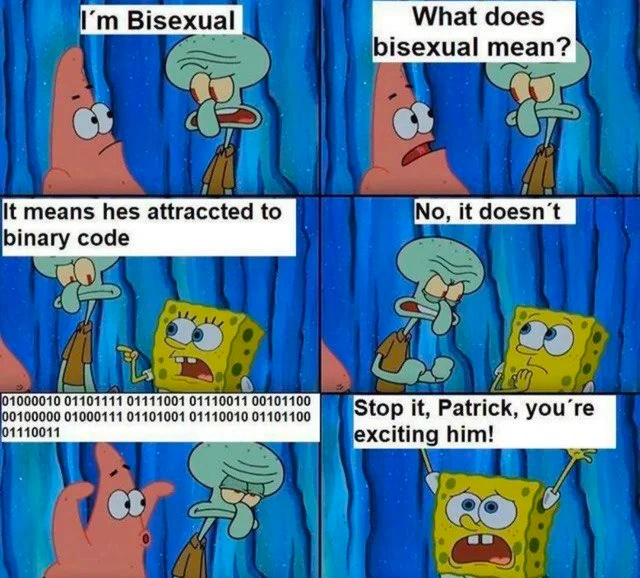
Imagine a funny mix-up: one character, Squidward, says he likes two kinds of people (that’s what “bisexual” means in real life – liking both boys and girls). But his friends get confused. Patrick asks what that big word means. Before Squidward can answer, SpongeBob excitedly says, “It means he’s attracted to binary code!” Now, binary code is just a fancy way of saying ones and zeros – it’s the language computers use internally. That’s nothing to do with people at all! It’s as if Squidward said he likes two flavors of ice cream, and SpongeBob thought he meant he likes the number two itself, and started showing him a bunch of “2”s. Pretty silly, right?

So in the next part, Patrick actually holds up a box or sign filled with a long string of 1s and 0s (that’s the binary code). Suddenly SpongeBob goes wild with joy, and Squidward’s face turns red. SpongeBob yells, “Stop it, Patrick, you’re exciting him!” In other words, “Quit showing him all those 1s and 0s – it’s making him too happy!” The joke is that Squidward might be getting thrilled by seeing all that computer code, as if it were something romantic or attractive.

Why is this funny? It’s a big misunderstanding. The word “bi” in bisexual means “two,” and SpongeBob took it way too literally. Instead of understanding Squidward meant two genders, SpongeBob imagined Squidward loves things that come in twos – like the binary digits 1 and 0. It’s like hearing someone say “I love BIrds” and you think they said “I love binary” and start talking about math. The humor comes from mixing up a normal life thing (who you have a crush on) with a nerdy computer thing (ones and zeros). It’s funny and absurd because nobody actually falls in love with ones and zeros in real life! Squidward blushing at a pile of numbers is a crazy, goofy image.

Even if you don’t know what binary code is, the pictures help you get the joke. You see Patrick showing a big block of gibberish (lots of 0s and 1s), and Squidward looking embarrassed but kind of excited, and SpongeBob warning Patrick to stop. You can tell from Squidward’s reaction that something inappropriate or unexpected is happening – he’s getting excited by something that normally wouldn’t be exciting. That’s the silly twist. It takes a serious statement (“I’m bisexual”) and spins it into a whimsical, geeky scenario (loving computer code). In simple terms: the characters mixed up the meaning of a word, and it led to a ridiculously funny situation. It’s the kind of pure, goofy misunderstanding that makes you laugh because it’s so over-the-top and unexpected.

Level 2: Two-Way Wordplay

So what’s going on here? The humor is all about a wordplay mix-up. Squidward says, “I’m bisexual,” meaning he’s attracted to two genders (that’s what bisexual commonly means in real life). But Patrick, being a bit clueless, asks for an explanation: “What does bisexual mean?” Before Squidward can answer, SpongeBob jumps in with a completely wrong definition: “It means he’s attracted to binary code.” Why binary code? Because the prefix “bi-” means two, and in the world of computers binary code is a language made of two symbols: 1 and 0. SpongeBob basically hears “bi-” and his programmer brain immediately thinks “binary!” – the stuff of computers. This is a binary_pun: mixing up bi (two) in sexuality with bi (two) in computing.

Let’s break down the elements for someone newer to coding or the joke:

  • Binary code: This is how computers talk under the hood. It’s a stream of 1s and 0s (each digit is called a bit, short for binary digit). For example, 01000010 is binary for the number 66 in decimal. Computers store letters as numbers, and in a common system called ASCII, the number 66 represents the letter B. So if you see a bunch of 0 and 1 squiggles like in the meme, it might actually be text in disguise!
  • ASCII translation: ASCII is basically a translation table from numbers to characters. When Patrick shows a white box filled with 01000010 01101111..., he’s literally showing text encoded in binary. If you translated that binary to letters using ASCII, you’d get something human-readable. It’s as if Patrick thought, “Oh, Squidward likes binary? Let me get some of that!” and then held up a sign full of binary to please him. It’s a super nerdy gesture – equivalent to showering someone with their favorite things, except the “favorite thing” here is raw computer code.
  • Bisexual (real meaning): Being bisexual means being romantically or sexually attracted to both males and females. It has nothing to do with computers or code. Squidward is stating something personal about himself.
  • Bi- prefix: The reason this joke works is that “bi” is a prefix meaning “two”. We see it in lots of words. Bicycle (two wheels), bilingual (speaks two languages), binary (using two symbols). Bisexual similarly implies two genders. SpongeBob’s answer treats “bisexual” as if it literally meant “binary-sexual” – someone attracted to “two-ness” or the two symbols of binary code 😜. That’s not what it actually means, but SpongeBob either misunderstands or is deliberately making a goofy joke.
  • SpongeBob meme format: This meme uses scenes from SpongeBob SquarePants, a cartoon almost everyone recognizes. Fans often take screenshots from the show and add new captions to create memes. Here we have six panels (pictures) from an episode set in the Krusty Krab (the burger restaurant in the show). The captions in each panel form a short dialogue. Using SpongeBob and Patrick works well because Patrick is known for asking naïve questions, and SpongeBob can be overly enthusiastic – perfect for this kind of silly explanatory joke. Meme makers love SpongeBob because the characters’ expressions are so vivid; in the final panel SpongeBob’s throwing his hands up with joy and Squidward is blushing. That accentuates the punchline visually: Squidward is actually getting excited by seeing that binary code, as SpongeBob predicted (much to Squidward’s embarrassment).

So, what’s the CSFundamentals angle? Well, knowing a bit about how binary code works makes the joke funnier. ComputerScienceHumor often requires just a pinch of computer knowledge:

  • You know that computers use only 1s and 0s internally.
  • You know that “binary” has that meaning (not just the prefix meaning two).
  • If you’ve ever learned a bit of coding, you probably touched on binary and ASCII early on, since it’s how text is stored. Seeing that block of 1s and 0s, a newcomer might ignore it, but a junior developer might think “Is that real binary for something?” and get curious. (It is real binary – you can actually translate it to letters!)
  • Even if you don’t translate it, just recognizing “oh, that’s binary code like we saw in class” adds a layer: Patrick isn’t just showing random gibberish, he’s literally catering to SpongeBob’s nerdy explanation. It’s like someone hearing “I love music” and Patrick dumping a box of musical notes in front of them.

The phrase “Stop it, Patrick, you’re exciting him!” is basically the comedic climax. SpongeBob says Patrick’s binary display is arousing Squidward. This is ridiculously funny if you know that normally, bisexual people are excited by other people (regardless of gender), not by abstract technology. The sexuality_wordplay flips it: Squidward’s not portrayed as excited by a man or woman, but by a sequence of symbols! It’s a playful jab at how some geeks seem more excited by their gadgets or code than by anything else. Think of a programmer who lights up when talking about the latest CPU or a clever algorithm – the meme takes that to an absurd literal place.

For a junior dev or someone learning CS, this meme is a crash course in binary humor. It reminds you that:

  • “Bi” can lead to funny misunderstandings if you mix contexts.
  • 1s and 0s humor is a staple in programming circles. People joke about “the language of binary” a lot (like the classic joke: “There are 10 kinds of people: those who understand binary and those who don’t.” In binary, 10 means 2 in decimal, so the joke itself is in binary – get it?).
  • And yes, some programmer out there probably does have a T-shirt or mug that says “I ❤ 01010101” or something similarly nerdy. We love this stuff unironically.

In simpler terms: the meme is funny to us because it’s combining a serious real-life concept (being bisexual) with a totally unrelated geek concept (binary code) just because of one little syllable “bi”. It’s unexpected and clever. And using SpongeBob characters to act it out adds a relatable, pop-culture wrapper around a geek joke, making it accessible and visually amusing. Patrick presenting a slab of binary like it’s a box of chocolates is such a bizarre idea that you can’t help but laugh at how stupidly adorable the whole thing is. Even if you’re not a coding expert, once you know binary = 1s and 0s, you can see why Squidward blushing at a bunch of 1s and 0s is pure silliness. The meme basically says: developers love their binary so much, it’s practically a romantic thing. 💾😍

Level 3: Double Entendre in Base 2

This meme brilliantly mashes up human identity with geek culture using a double entendre: “bi” as in bisexual (attraction to two genders) gets geekily mistaken for binary (the base-2 number system of 1s and 0s). The scenario unfolds in classic SpongeBob style: Patrick hears Squidward say “I’m bisexual,” and naively asks what that means. SpongeBob, being the ever-eager (if clueless) friend, chimes in with a totally wrong explanation: “It means he’s attracted to binary code.” Squidward facepalms with a firm “No, it doesn’t,” but the joke’s already in motion. Patrick then literally shows a wall of binary numbers (a bunch of 0s and 1s in a white box) as if offering Squidward some eye candy. SpongeBob’s eyes light up, hands raised in excitement, while Squidward blushes furiously. Finally, the punchline: “Stop it, Patrick, you’re exciting him!” – implying Squidward just can’t control his arousal at the sight of raw binary code. The absurd image of someone becoming giddy or even turned on by 0s and 1s is what sets off the laughter. It’s coding humor taking the phrase “turned on by technology” to a literal extreme (after all, in digital logic 1 means “ON” 😉).

This hits a sweet spot for developer humor because it plays on how programmers sometimes overly interpret words in a techy way. The prefix “bi” which simply means “two” is everywhere in everyday language (bicycle, binary, bifocal) and in sexual orientation (bisexual). Here, SpongeBob and Patrick comically confuse (or deliberately twist) *bi-*sexual to binary sexual. It’s a classic wordplay gag – essentially a nerdy pun. Seasoned engineers have seen this breed of joke countless times: like someone quips about being “bi-lingual” and a dev jokes “oh, you speak binary and hex?” or a colleague says “I feel bit lonely” and someone responds “8-bit or 16-bit?” 🙄 These geek humor moments elicit groans and chuckles in equal measure. We laugh partly because it’s so absurd – no one actually confuses sexual orientation with computer code – and partly because, admit it, some of us can’t help but think of binary code whenever we hear the syllable “bi-”! This meme captures that reflex perfectly.

The multi-panel SpongeBob meme format adds to the hilarity. By using familiar cartoon characters, it frames a ridiculous situation in an absurdly innocent setting (the Krusty Krab’s teal interior). Each character fits an archetype developers recognize:

  • Squidward as the one making a serious personal statement (the straight man of the joke, ironically coming out as bi).
  • Patrick as the lovable dummy who asks the obvious question (the newbie who genuinely doesn’t know the term).
  • SpongeBob as the overenthusiastic nerd who gives an overly literal, tech-infused answer (the know-it-all dev who just has to make it about code).

The dialogue could be straight out of a developers’ inside-joke thread. The comedic tension ramps up from panel to panel – first a sincere confession, then a misunderstanding, then an escalation with actual binary data, culminating in that over-the-top final frame. The phrase “Stop it, Patrick, you’re exciting him!” is the kind of punchline that lands because it flips expectations: Squidward’s legitimate sexuality reveal is completely derailed by a binary pun so much that he’s now depicted as literally aroused by a sequence of ones and zeros. It’s poking fun at how computer science fundamentals can seep into our humor and even our interpretation of language.

For developers, there’s an extra layer of wink-wink here. That block of binary isn’t just gibberish – it’s ASCII text in disguise. Many of us can’t resist pausing to decipher it, expecting an Easter egg or hidden message (the same instinct that makes us inspect element on webpages or decompile game files for secrets 😅). Indeed, decoding 01000010 01101111 01110011 01100101... yields a coherent string. Including that in the meme is like the creator saying, “I know my audience.” It’s a little ascii_translation challenge for the computer science humor aficionados. And when we do decode it (spoiler: it looks like "Bose, @Girtis"), we feel a small rush of satisfaction – as if we’re in on an exclusive joke within the joke. Not only are we laughing at the obvious gag (bi vs binary), but we’re also appreciating the commitment to the bit (no pun intended) by throwing real binary code in there. It’s humor that rewards technical literacy: The more you know about bits, bytes, and ASCII, the funnier (and more layered) the meme gets.

In essence, this meme mocks the way devs often can’t separate life from tech. It highlights that peculiar developer culture where someone’s earnest statement (“I’m bisexual”) might be met with a quip about bits or bytes, intentionally or not. It’s a gentle ribbing of our tendency to see binary_code everywhere – we joke that “there are 10 types of people in the world: those who understand binary and those who don’t.” Here, SpongeBob clearly does understand binary (and really appreciates it), while Patrick doesn’t, leading to the comical confusion. The absurdity of being sexually excited by machine language is an exaggeration of how passionate programmers can be about their craft. Many of us have joked about being “married to our code” or loving our keyboards a little too much during crunch time. Squidward blushing at a stream of bits is basically that feeling personified in a cartoon. It’s over-the-top silly, but it resonates because it caricatures a real aspect of geek life: an enthusiasm for technology so strong that it looks crazy to outsiders. And let’s be honest, the next time someone says they’re “bi–” something, a few of us will quietly chuckle thinking “1 or 0?” before correctly outing ourselves as the Patrick or SpongeBob of our friend group. This meme nails that intersection of sexuality_wordplay and programmer in-joke, leaving us laughing and maybe a tiny bit guilty for finding binary code that exciting.

Level 4: ASCII Aphrodisiac

At the binary core of this joke lies a fundamental truth of computing: everything in a computer is ultimately represented in 1s and 0s. Those seemingly random 01000010 01101111... bits in the meme aren’t random at all – they’re actual binary code for text. In fact, if you take 01000010 01101111 01110011 01100101 and translate from base-2 to ASCII, you get “Bose” (and the rest spells out a phrase with an @ symbol). ASCII, the American Standard Code for Information Interchange, maps letters and symbols to numeric codes, which computers store in binary. Each of those 8-bit groups is a byte (eight bits), capable of representing 256 possible values (0–255 in decimal). The ASCII table originally used 7 bits (0xxxxxxx in binary for 0–127) to encode English letters, digits, and punctuation – for example, the capital letter B is decimal 66, which is 0x42 in hex, and in binary becomes 01000010 (as seen in the meme).

Why binary? At a hardware level, binary arises from the way transistors and logic gates work – they’re basically microscopic switches that are either on (1) or off (0). This base-2 representation is electrically robust (less prone to ambiguity than, say, trying to have ten distinct voltage levels for a base-10 system), and it’s the foundation of all computer architecture. Chains of bits get grouped into bytes, and bytes into larger data types, but at the lowest level it’s just a sea of ones and zeros flipping on and off. Higher-level constructs – text, images, code – are all encoded in binary. ASCII encoding is one of the earliest standardized ways to represent human-readable text in that binary sea. Each ASCII character corresponds to a number, and that number has a unique binary pattern. Developers often memorize or recognize certain patterns: for instance, 0100 0001 is A (65 in decimal), 0100 0010 is B (66), 0100 0011 is C (67), and so on. In the meme’s fifth panel, Patrick’s white box of binary is essentially an ASCII love letter. It’s as if Patrick dumped a raw data stream of ASCII codes to tantalize Squidward. It’s a nerdy aphrodisiac made of pure binary – a literal representation of language in the form only a machine (or a seasoned CS geek) can directly read.

What makes this extra delightful for experienced devs is the hidden Easter egg: we can’t resist decoding that binary blob. It’s practically an instinct among programmers to translate binary, hex, or Base64 text on the spot, hunting for a secret message. Here it spells out a cheeky phrase (“Bose, @Girtis”), likely a credit or in-joke by the meme creator. Including a real binary-to-ASCII snippet is a wink to those who recognize it – a reward for the curious. It demonstrates how deeply our understanding of CS fundamentals runs: we see 8-bit patterns like 01000010 and immediately think “Hey, that’s 0x42, which is 'B'!” In other words, this meme operates on multiple levels of geekiness, with the literal binary code reinforcing the theme. Squidward’s “binary code passion” isn’t just portrayed conceptually – it’s spelled out in actual binary bits for those with the savvy to read it. The humor emerges from this interplay between human language and machine language: the prefix “bi-” (Latin for two) simultaneously references a sexual orientation (bisexual) and the two-symbol binary system that underpins all of computing. For a senior developer, the joke tickles both the linguistic and the technical intellect. It’s a reminder that even the loftiest computer science humor often boils down to flipping bits – and apparently, flipping someone’s switch on (to 1) in the process!

Description

A six-panel comic strip using characters from SpongeBob SquarePants. In the first panel, Squidward tells Patrick, "I'm Bisexual." Patrick asks what it means. In the third panel, Squidward incorrectly explains, "It means hes attraccted to binary code," while SpongeBob points accusingly. Below this is a string of binary code. In the fourth panel, SpongeBob corrects him, "No, it doesn't." The fifth panel shows Squidward blushing. In the final panel, SpongeBob shouts, "Stop it, Patrick, you're exciting him!" The binary code `01000010 01101111 01111001 01110011 00101100 00100000 01000111 01101001 01110010 01101100 01110011` is visible in the third panel. The humor stems from a pun on the word "bisexual," conflating it with "binary." The joke has a clever secondary layer for developers: the binary code shown in the meme actually decodes to the ASCII text "Boys, Girls," which cleverly winks at the real definition of bisexuality. This elevates a simple pun into a more nuanced joke that rewards technical curiosity. It's relatable to engineers who enjoy wordplay and finding hidden Easter eggs in code or text
Comments

7
Anonymous ★ Top Pick This is the only pull request where the binary diff is also the functional spec
  1. Anonymous ★ Top Pick

    This is the only pull request where the binary diff is also the functional spec

  2. Anonymous

    Patrick’s “bi = binary” moment is basically the product manager who designed our USERS table with a BIT(1) gender column - proof that inclusive UX can’t be patched with a single flag

  3. Anonymous

    Finally found someone who gets as excited about binary as I did before discovering that real systems use UTF-8, little-endian vs big-endian debates, and floating point representation where 0.1 + 0.2 somehow equals 0.30000000000000004

  4. Anonymous

    This meme perfectly captures how developers instinctively parse 'bi-' as base-2 before remembering the rest of the world doesn't think in hexadecimal, octal, and binary by default. The real joke is that after 20 years in the industry, you've probably debugged enough bit-shifting operations that your first thought genuinely *was* binary code - and you're not even sorry about it

  5. Anonymous

    Only in engineering do we hear “bi” and immediately design a type: enum {Zero, One} - then someone prints 01000010 and we’re debating ASCII vs UTF‑8 while the meeting derails

  6. Anonymous

    Classic semantic-layer bug: someone shipped ASCII 01000010… thinking “bi support” was transport; love is L7, not a 1/0 codec

  7. Anonymous

    We're all bisexual devs: helplessly flipped by both 0s and 1s, regardless of endianness

Use J and K for navigation