Skip to content
DevMeme
4252 of 7435
Khaleesi vs Brainfuck: developer meme on naming kids after languages
Languages Post #4651, on Jul 6, 2022 in TG

Khaleesi vs Brainfuck: developer meme on naming kids after languages

Why is this Languages meme funny?

Level 1: The Name Game

Imagine a dad who loves a TV show so much that he names his little girl after one of the show’s characters. Fast forward a few years: the girl is a teenager, and she comes home from school furious. She yells at her dad, saying she absolutely hates her name. Why is she so mad? Because the name is so obviously from that famous TV show, and it turned out to be more embarrassing than cool. Maybe other kids made fun of it, or maybe she’s just tired of explaining it to everyone. Either way, she wishes her dad had just named her something normal.

Now picture another dad, but this one is a total computer nerd. He decides to give his son the name of a really strange computer thing – basically a coding language with a crazy, not-so-polite name. You’d think that kid would be even more upset about his name, right? But here’s the funny twist: in the meme, the opposite happens. The son grows up big, strong, and completely owning that wild name, and the dad is beaming with pride. He’s basically saying, “I’m so proud of you, Brainfuck,” as if naming his kid something that outrageous was the best decision ever.

The whole joke is a goofy kind of name game. It shows two dads who named their kids after something they really love (one is into a fantasy TV show, the other is into computer programming). The first kid ends up hating the weird name she got, but the second kid somehow turns out just fine with an even weirder name. It’s funny because it flips what you’d expect: the more “normal” fan-inspired name causes big drama, while the absolutely bonkers techy name is portrayed as a total win (at least in this cartoon scenario). In real life, both of those kids might have a tough time! But by exaggerating everything, the meme makes us laugh. It’s poking fun at how parents sometimes make questionable naming choices based on their hobbies or obsessions, and it imagines the comical outcomes. We laugh because it’s so silly and over-the-top — a dad proudly calling his son “Brainfuck” is something you’d only ever see in a joke, and that contrast between mundane family life and absurd nerdiness is what makes it hilarious.

Level 2: Esolang Pride

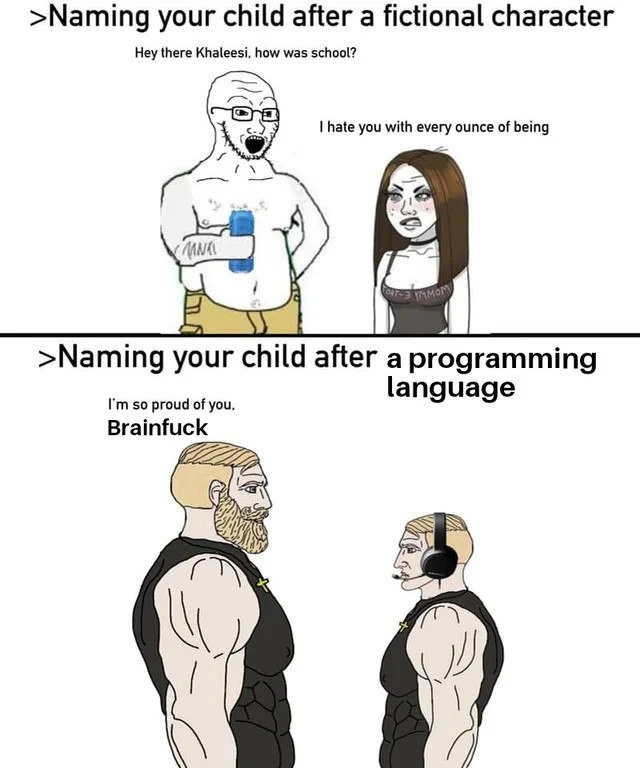
Let’s break down the meme step by step. The top panel is about fictional_character_naming: the dad has named his daughter Khaleesi, which is a title from the fantasy TV series Game of Thrones. (In the show’s lore, “Khaleesi” means a queen, and believe it or not, some fans actually started using it as a baby name – a real-life game_of_thrones_reference taken to the extreme.) The meme shows a typical teenager who is utterly embarrassed and angry about this name. She even wears a tank top that says “GOT MOM,” suggesting her mom (or both parents) were huge Game of Thrones fans. When her dad cheerily asks, “Hey there, Khaleesi, how was school?” she snaps back, “I hate you with every ounce of my being.” This exaggerates a real concern with naming kids after trendy pop culture: the kid might end up hating the name, especially if the trend fades or the character’s story goes sour. It’s a cringey dad moment — he thought he was being cool or unique, but his daughter considers it mortifying.

Now, the bottom panel flips to naming your child after a programming language. Here we meet the Chad father-son duo. The father is a blond, muscular “Chad” character (an internet meme symbol for someone who is super confident and successful). The son is also buff and is wearing headphones, looking calm and self-assured. The crazy part is the name: the father actually named his son Brainfuck. Brainfuck is the real (and unruly) name of a very quirky programming language. It’s what we call an esoteric language (or esolang for short), meaning it was created more as a fun experiment or puzzle than for practical use. Brainfuck is infamous among programmers for being extremely hard to write or read – it only has a few single-letter commands, so any code in Brainfuck looks like complete gibberish. The language’s name is a joke by itself (it contains a swear word to hint that it will “wreck your brain” if you try to use it).

So, in the meme, the Chad dad looks at his son and says, “I’m so proud of you, Brainfuck.” It sounds absurd (imagine a parent sincerely calling their kid that!), and that absurdity is exactly why it’s funny. Unlike Khaleesi, who clearly resents her geeky name, Brainfuck Jr. here doesn’t seem upset at all. In fact, the vibe is that both father and son are proud of this outlandish name. It’s like they’re sharing a special tech inside joke that outsiders wouldn’t understand. Esoteric programming languages like Brainfuck are a sort of badge of honor among programming nerds – they’re not useful for making normal software, but if you know about them or have dabbled in them, it shows you’re really deep into coding culture. This meme plays on that by suggesting the dad is such a hardcore programmer that he’d name his own child after one of the most impractical programming languages ever invented! And instead of the kid rebelling, the kid has grown up to be a total Chad himself, possibly embracing the uniqueness of his name. It’s an over-the-top “like father, like son” moment, based on extreme nerd pride.

The text at the top of each panel (>Naming your child after a fictional character and >Naming your child after a programming language) is formatted like an internet quote or prompt, setting up the two scenarios. The “>” is a common way on forums (especially old-school image boards) to quote or denote a scenario. So the meme is essentially comparing these two setups side by side. The first scenario is something we’ve actually seen in real life (parents giving kids pop culture names and those kids not always loving it), and the second scenario is a wildly exaggerated twist on programmer culture. It’s relatable humor for anyone in the developer community because it riffs on how we sometimes treat programming languages like fandoms. The wojak_vs_chad_template does a lot of the work: using the sad Wojak character (for the dad who made a cringey choice) versus the cool Chad character (for the dad who made an insane-but-proud choice) instantly tells us who’s supposed to be laughed at and who’s the “legend.”

In plain terms: the meme is saying, “naming your kid after a TV show character = risky and uncool, but naming your kid after a coding language = so nerdy it’s cool (at least in a meme-worthy way).” Of course, this is all tongue-in-cheek. Nobody is actually advising you to put Brainfuck on a birth certificate! Both naming choices are exaggerated to be ridiculous. But by showing the normal scenario ending badly and the crazy scenario ending surprisingly well, the meme gets a big laugh. It highlights how something that seems cool to a parent (whether it’s a hit TV series or an obscure coding language) might not be so cool from the kid’s perspective. And flipping that expectation – making the wildest choice look like the best one – is what makes the joke land. It’s a blend of everyday family humor and CodingHumor, and you don’t even have to know much about programming to find it silly. If you do happen to know what Brainfuck is, that just adds an extra layer of “I can’t believe they went there!” to the joke.

Level 3: Naming Conventions IRL

This meme taps into a classic internet MemeCulture format of the scrawny, awkward “virgin” Wojak character versus the ultra-confident Chad. In the top panel, the pale Wojak dad excitedly greets his daughter Khaleesi – named after a popular fictional character from Game of Thrones. In the bottom panel, a brawny Chad dad proudly addresses his son named after the programming language Brainfuck. The humor comes from the stark contrast in outcomes. The teenage daughter rolls her eyes and seethes, “I hate you with every ounce of my being,” while the son stands tall as his dad proclaims, “I’m so proud of you, Brainfuck.” It’s an absurd role-reversal: you’d expect a kid named after a fantasy character to maybe be just mildly annoyed, and a kid saddled with the name Brainfuck to be mortified. But the meme flips expectations. The Wojak father, who followed a mainstream naming fad, is portrayed as the failed, cringey parent, whereas the Chad developer dad who went with an outrageously nerdy, profane programming name is depicted as having the ideal father-son relationship. This exaggerated inversion is standard fare in TechHumor memes – it’s intentionally ridiculous, and that’s why it’s funny.

For developers, there’s a layer of inside joke here about naming things. In software, we joke that “there are only two hard problems: cache invalidation and naming things.” Picking good names is tricky, whether it’s for variables, projects, or even children. The first dad naming his kid Khaleesi reflects a real-world trend: fans often name their kids after beloved fictional characters (from Harry Potter, Star Wars, or in this case, Game of Thrones). It might seem cool at the time, but as we see, it can backfire spectacularly when the child grows up and grapples with that once-trendy name (especially if the pop culture reference doesn’t age well — fun fact: Khaleesi was a title in the show meaning “queen,” and a lot of parents used it without realizing it wasn’t actually the character’s real name, Daenerys. Awkward!). By contrast, the second dad went full geek. He named his son after an esoteric programming language—one whose name is literally a swear word. In reality, that would be social suicide; a kid named “Brainfuck” would have a hard time on the playground and on any official forms. But in the universe of DeveloperHumor, that’s exactly the point: it’s so over-the-top and niche that it signals commitment to the joke. It’s the ultimate nerd flex, akin to a programmer proudly naming their Wi-Fi network DROP TABLE as an SQL joke or commenting their code with an obscure esolang reference only hardcore coders would get.

This meme also pokes fun at our tendencies in the tech world: programmers often pride themselves on loving things that outsiders find bizarre or incomprehensible. The Brainfuck language is a prime example — it’s essentially a puzzle for programmers, not a tool for real development. By showing a father proud of a son named “Brainfuck,” the meme satirizes how developers sometimes treat their obscure interests (like mastering a ridiculous language or tool) as badges of honor. It’s saying, in effect, “Sure, normal people might give their kid a weird name because of a TV show and that’s lame — but a programmer dad one-upped that by using an even weirder coding language name, and somehow that’s portrayed as awesome.” The LanguageQuirks on display (a fantasy title versus a notorious coding language) highlight two flavors of nerdiness: pop-culture geek vs. programming geek. And of course, the programming nerd wins in this meme’s tongue-in-cheek logic.

Experienced devs reading this will nod at the underlying truth wrapped in the silliness. We’ve seen ill-advised naming choices before (in code and in life), and we’ve all encountered that one colleague who jokes about naming their future kid “Linux” or “Ada.” The meme just takes it to an extreme. It humorously implies that being all-in on our tech passions – to the point of bestowing an outrageously geeky name – is a Chad move, whereas being a regular fanboy parent is for Wojaks. In reality, neither is a great idea, but admitting that is what makes it CodingHumor. The shared laughter comes from recognizing both the external absurdity and the insider logic. In the end, it’s a perfect parody of child_naming_humor through a programming lens – the kind of joke only developers would come up with and appreciate.

Level 4: Turing Tar-Pit Parenting

In the bottom panel of this meme, naming a child Brainfuck elevates the joke to a kind of programming-language geekery that touches on theoretical computer science. Brainfuck isn’t just any language – it’s an archetypal esoteric language chosen for its minimalist, almost academic design. Brainfuck was created in 1993 by Urban Müller with the goal of implementing a full programming language using an extremely tiny compiler (the original compiler was only 240 bytes!). To achieve this, Brainfuck uses only eight single-character commands that manipulate an array of memory cells, much like moving a pointer along the tape of a theoretical Turing machine. This means Brainfuck is Turing-complete: given enough time and memory, it can compute anything any other programming language can — at least in theory.

That term, “Turing-complete,” is a big deal in computer science. It means the language can simulate a universal Turing machine (a fundamental model of computation defined by Alan Turing). Languages like Brainfuck are sometimes called Turing tarpits, because while they have the full power of computation, using that power is so inconvenient that writing even simple programs feels like your brain is stuck in tar. The name Brainfuck itself is an obscene nod to how using it can “mess up your brain” — every trivial task becomes a mind-bending puzzle of > < + - . , [ ] commands. For example, printing “Hello, World!” in Brainfuck results in a bewildering sequence of symbols:

++++++++++[>+++++++>++++++++++>+++<<<-]>++.>+.+++++++..+++.>++.<<+++++++++++++++.>.+++.------.--------.>+.>.

This snippet (a valid Brainfuck program) is essentially unreadable to anyone but a devoted esolang enthusiast, emphasizing how far removed it is from practical coding.

Now, in the meme’s universe, a father proudly naming his son “Brainfuck” is like paying homage to this extreme corner of programming theory. It’s a tongue-in-cheek way of saying the kid is forged in the fires of computational complexity from birth. While one parent chose a trendy fantasy name (Khaleesi from Game of Thrones), the other went for a name that references a programming language so hardcore and niche that it’s practically a nerd badge of honor. The contrast suggests that the second dad (the buff Chad character) values the deep technical elegance and challenge represented by Brainfuck — a language that is as powerful in theory as it is impractical. In other words, he didn’t just name his child after any coding language, but after the ultimate computability stress-test.

Underneath the humor, there’s a sly nod to the idea that naming things, even children, can follow conventions or inside jokes from technology. The father who picked “Brainfuck” is effectively embracing a form of geek folklore, referencing a language renowned in programming circles for pushing limits. It’s as if he’s saying: my child’s name embodies raw computational potential and the absurdity we programmers admire. This is developer humor at its finest — blending real computer science concepts (like Turing-completeness and language design minimalism) with an absurd everyday scenario. By choosing an esoteric name with such theoretical weight, the meme tickles those of us who appreciate how abstract LanguageQuirks can become a point of pride. It’s a reminder that in tech culture, even the most arcane CS concepts can be played for laughs when turned into real-life analogies.

Description

Two-panel Wojak/Chad meme. Top panel headline reads “>Naming your child after a fictional character”. A skinny, pale Wojak dad with a shaved head, blue water bottle, and yellow shorts cheerfully asks, “Hey there Khaleesi, how was school?”. His teenage daughter, wearing a dark tank top that says “GOT MOM” and sporting long brown hair, replies, “I hate you with every ounce of being.” Bottom panel headline reads “>Naming your child after a programming language”. A muscular blond Chad father in a black sleeveless shirt with a yellow star patch smiles proudly at an equally buff blond son wearing headphones; the dad says, “I’m so proud of you, Brainfuck.” The joke contrasts pop-culture baby names with naming a child after the esoteric programming language Brainfuck, playing on developer culture, language quirks, and meme stereotypes
Comments

6
Anonymous ★ Top Pick I named my kid Brainfuck - eight deterministic instructions, zero undefined behavior. If only our 300-service mesh came with specs that clear
  1. Anonymous ★ Top Pick

    I named my kid Brainfuck - eight deterministic instructions, zero undefined behavior. If only our 300-service mesh came with specs that clear

  2. Anonymous

    At least when little Brainfuck grows up and asks why you chose that name, you can honestly say it was the only language where eight characters could accomplish what takes other kids a thousand lines to express their feelings about you

  3. Anonymous

    Naming your kid 'Brainfuck' is the ultimate flex - it demonstrates you've achieved such mastery of esoteric languages that you're willing to inflict a Turing-complete nightmare on the DMV, school administrators, and every Starbucks barista for the next 18 years. At least when they inevitably rebel and change their name to 'JavaScript', you'll know you raised them to appreciate syntactic simplicity

  4. Anonymous

    Naming your kid after a language? Ada buys you safety, Rust buys you ownership, and Brainf*** buys you parent-teacher conferences conducted in ++[>++<-]

  5. Anonymous

    Brainfuck parents: Prioritizing Turing completeness over readability since birth - eight symbols to rule them all

  6. Anonymous

    Honestly, naming the kid “Brainfuck” prepares them for enterprise codebases - Turing‑complete, gloriously unreadable, and debugged with a tape pointer and vibes

Use J and K for navigation