Skip to content
DevMeme
345 of 7435
Developer Names and the React Monolith
Frameworks Post #404, on May 30, 2019 in TG

Developer Names and the React Monolith

Why is this Frameworks meme funny?

Level 1: No Cool Nickname

Imagine all your friends have fun club nicknames, except you. For example, suppose you have a group of friends who each love a different hobby:

  • Your first friend loves painting, and everyone calls her “Artist” as a special nickname.
  • Your second friend plays basketball, so we nickname him “Hoops.”
  • Another friend is really into music and earns the nickname “DJ.”

Now, you love playing with Lego blocks a lot. But instead of a cool creative nickname, people just call you “the Lego kid.” That doesn’t feel very special, right? It’s like you’re being named after the toy you use rather than who you are.

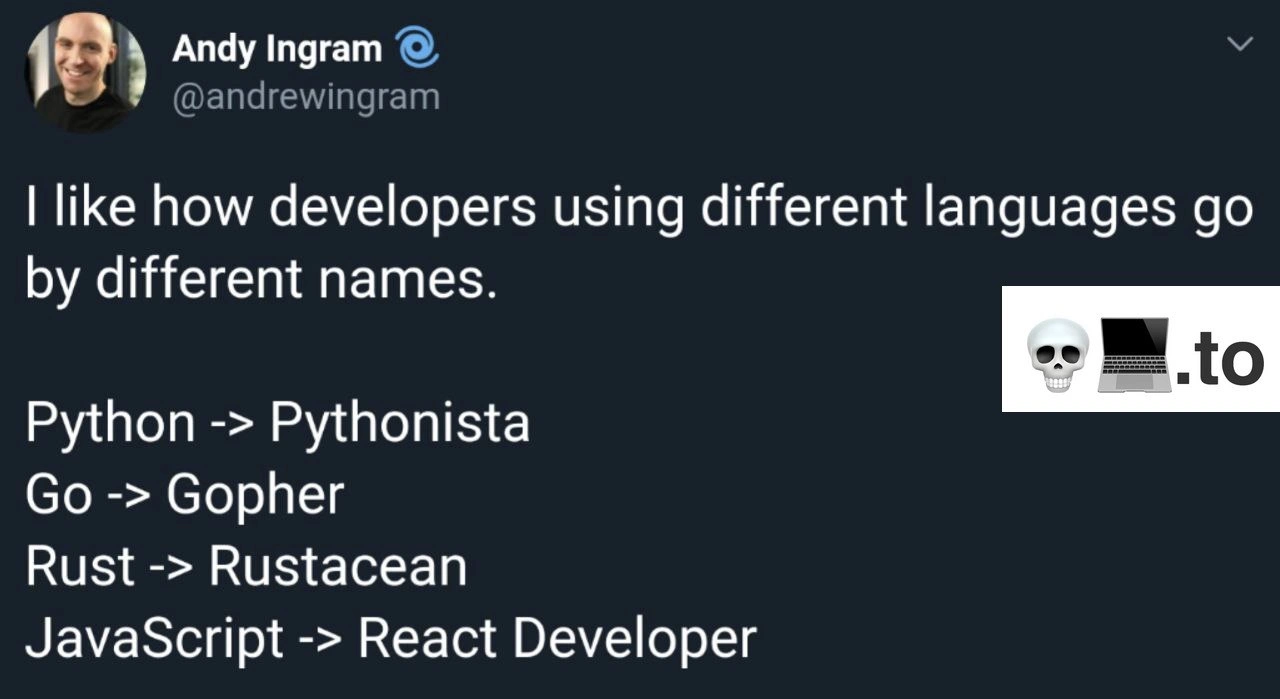
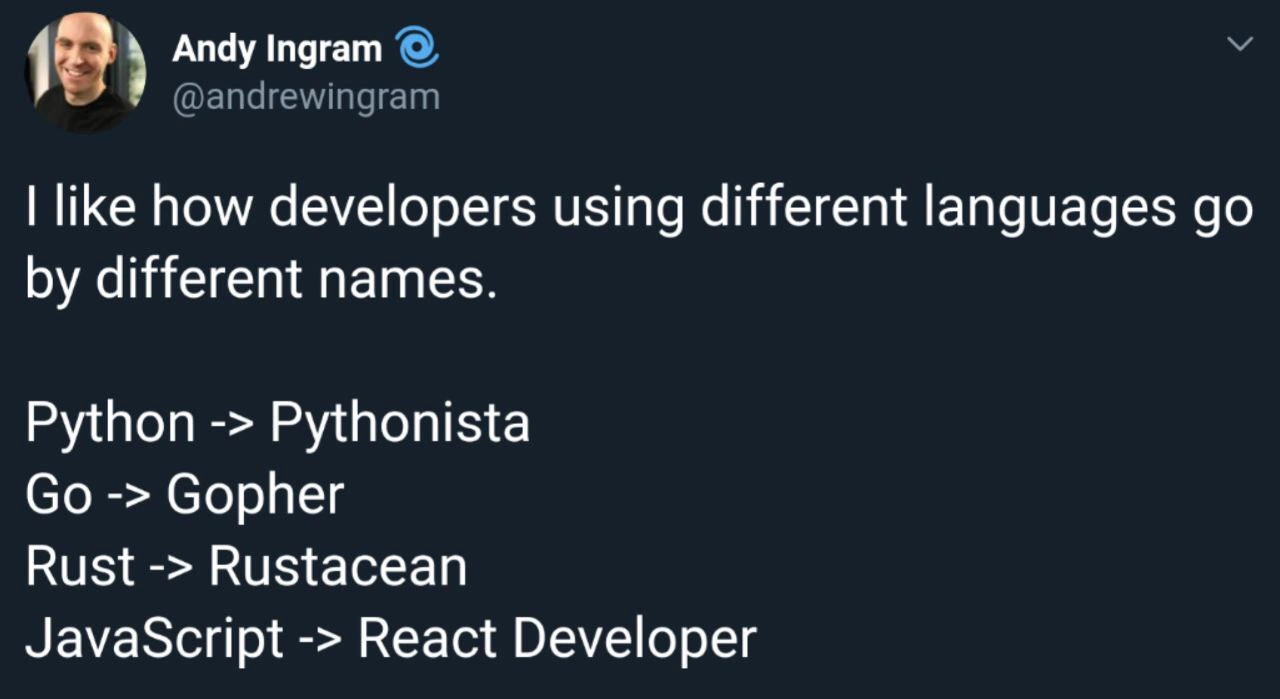
This meme is making a similar kind of joke, but with programming languages. Python programmers got a cool nickname “Pythonista” (like Artist for painters). Go programmers have “Gopher” (a fun name from Go’s mascot). Rust programmers came up with “Rustacean” (a quirky name from Rust’s crab symbol). But JavaScript programmers? They don’t have a unique nickname from the language itself – people just call them “React developers,” which is like calling our Lego-loving friend “Lego kid.” React is a tool JavaScript programmers use (kind of like Lego is the toy you use), and it became so popular that it took over the name. It’s funny because it’s as if JavaScript programmers lost their own special nickname and are known only by the tool they use. Everyone else gets a cool name based on what they love, and the JavaScript folks are basically known as the “React group.” That little twist makes tech folks laugh and say, “Poor JavaScript, even your nickname got taken over by React!”

Level 2: What’s in a Name?

Programmers love to come up with fun nicknames for themselves based on the programming languages they use. This meme lists a few popular ones and ends with a twist. Let’s break down each reference in that tweet and see what it means:

  • Python – Developers who write Python sometimes call themselves Pythonistas. It’s an affectionate term (like fashionista, but for Python). A Pythonista is just a proud Python developer. The Python community is known for being friendly and emphasizing clear, readable code. Using a special nickname like this builds a sense of identity and community around the language.

  • Go – Go (often called Golang) is a programming language created at Google. Its mascot is a cute blue gopher (a small burrowing animal). Go programmers adopted this mascot so strongly that they refer to themselves as Gophers. So if someone says “I’m a Gopher” at a tech meetup, they’re playfully saying they program in Go. It’s a little pun and badge of honor among Go fans. The Go community enjoys the gopher image so much that it appears in Go conferences, art, and stickers everywhere.

  • Rust – Rust is a systems programming language that focuses on performance and memory safety. Rust’s unofficial mascot is a friendly orange crab named Ferris. The Rust community came up with the nickname Rustacean, which rhymes with “crustacean” (a family of sea creatures that includes crabs). Calling yourself a Rustacean means you’re an enthusiastic Rust developer and part of Rust’s vibrant, nerdy community. It’s a fun way to show you’re on the Rust team, embracing both the language and its love of crab-themed jokes.

  • JavaScript – JavaScript is the main language used to make web pages interactive. It doesn’t have a widely-used cute nickname for its developers. People just say “JavaScript developer” or “JS developer.” But here’s the joke: in the web world, so many JavaScript devs use the React framework (a popular library for building user interfaces) that they often end up calling themselves React developers. React is a tool built on JavaScript, but it’s so dominant in front-end development that it’s become a identity of its own. The tweet humorously implies that if you’re coding in JavaScript these days, you’re probably using React – so much so that we might as well skip calling you a “JavaScript developer” and go straight to “React developer.”

In summary, Python, Go, and Rust communities each have their own special nicknames that come from the language’s mascot or culture (Pythonista, Gopher, Rustacean). These nicknames celebrate the language itself. JavaScript’s community, however, often identifies by frameworks. React is one of JavaScript’s most famous frameworks, and many developers specialize in it. So the tweet is joking that a JavaScript developer’s nickname isn’t based on JavaScript at all – it’s just “React Developer.” This highlights, in a lighthearted way, how huge React’s influence is in the JavaScript world.

Level 3: Taxonomy of Tech Tribes

The tweet humorously presents an anthropology of developer communities by listing how different language users refer to themselves: “Python → Pythonista, Go → Gopher, Rust → Rustacean”… and then delivers the punchline “JavaScript → React Developer.” This last line breaks the pattern, and that’s the joke. Other languages have clever nicknames drawn from their language’s identity or mascot, but JavaScript’s “nickname” is just the name of a popular framework. For seasoned devs, this lands as a knowing 😏 jab at how the JavaScript ecosystem has evolved (some might say fragmented) over the last decade.

In communities like Python, Go, and Rust, developers rally proudly around the language itself. They’ve adopted playful monikers: Pythonistas wear the mantle of Python proficiency with pride, Go programmers embrace the Gopher mascot (born from Go’s logo and branding), and Rust developers famously dub themselves Rustaceans – a pun nodding to “crustacean,” inspired by Rust’s unofficial Ferris the crab mascot. Each nickname reflects a cohesive language-centric culture. The language is the star of the show, and frameworks or libraries (e.g. Python’s Django, Rust’s Tokio) are just supporting characters. A Pythonista likely dabbles in many Python libraries, but their identity stays tied to Python itself.

Now enter JavaScript, the lingua franca of web development. JavaScript’s community has always been a bit different. Front-end developers in particular have endured a relentless churn of frameworks and libraries – from jQuery to AngularJS to React (with Vue, Ember, Svelte, and others in the wings). The meme’s punchline, “JavaScript -> React Developer,” encapsulates this reality: the framework has eclipsed the language in defining the developer’s identity. It’s as if the JavaScript world has ceded its naming rights to the most dominant library. A veteran dev reading this might smirk, recalling that a few years earlier it could have easily been “JavaScript -> Angular Developer” during the Angular boom. Go back further and we were joking about “jQuery ninjas”. The specific tech changes with time, but the pattern persists – the JavaScript community tends to identify itself by whatever tool is hot at the moment.

Why is this funny (and a bit painfully true)? Because it pokes at the framework overreach in web development. In a healthy ecosystem, the language unites its users. But JavaScript’s fate has been to serve as a foundation for towering frameworks that become worlds unto themselves. React became so influential by 2019 that saying “I’m a React developer” immediately communicated your skill set more clearly than saying “I’m a JavaScript developer.” After all, JavaScript can be used in so many ways (vanilla DOM scripting, Node.js backends, mobile with React Native, etc.) that just stating “JavaScript” is almost too broad. React, on the other hand, is a very specific and marketable subset of JavaScript work – primarily building rich single-page applications. The tweet wryly implies that JavaScript developers have almost lost their mother-tongue identity and slid into the identity of React specialists by default.

This speaks to an inside joke among developers: JavaScript fatigue. That term captures the exhaustion from keeping up with the ever-multiplying tools and frameworks in the JS world. When everyone is busy hopping onto the latest front-end library, it’s easy to feel like there’s no solid core identity — you’re just “currently using React.” The tweet’s author, Andy Ingram, is pointing out that contrast. Other languages have a stable self-image (no one doubts what a Pythonista does), but a “JavaScript developer” almost begs the follow-up question: “Cool, but which framework are you using?” The answer these days is likely React. So much so that folks skip the question and just say React developer up front.

From a historical perspective, this reflects how front-end development matured. In the early 2010s, JavaScript was often written with minimal structure – think of scattered <script> tags or using jQuery for everything. As applications grew, large frameworks stepped in to impose order (AngularJS was one of the first big ones around 2012). Then Facebook’s React (around 2014) changed the game with its component-based approach and quickly became the industry standard for new web apps. A whole generation of web developers came up identifying more with React (or Angular, or Vue) than with vanilla JavaScript. It’s akin to a dialect becoming so dominant that people forget the original language. A JavaScript coder from 2005 might marvel that in 2019 many front-end job postings and developer resumes shout “React” way louder than “JavaScript.”

There’s also a subtle commentary on community culture. Python’s culture values readability, education (think of the “Pythonista” identity tied to writing clean Pythonic code). Go’s community emphasizes simplicity and efficiency, and being a “Gopher” signals you’re part of that pragmatic, down-to-earth group. Rust’s culture is about safety and modern systems programming, and “Rustacean” conveys a bit of nerdy humor and pride in Rust’s unique approach (and its cute crab). JavaScript’s culture, by contrast, has been notoriously split and re-invented every few years. It’s not that JavaScript lacks a community — it’s that it has too many. Node.js back-end folks, old-school script hackers, framework fanatics, TypeScript converts, etc. There isn’t a single unifying nickname like “JavaScripter” that caught on in a positive way. (If anything, the term “JavaScripter” sounds a bit awkward, and “JS developer” is plain descriptive.) Instead, people narrow it down: “I’m a React dev,” or “I’m an Angular guy.” The tweet exaggerates this to comedic effect by implying JavaScript’s identity is nothing without React.

So, seasoned developers find this tweet hilarious because it rings true of their experience in the industry. It’s a reflection and a mild roast of JavaScript’s trajectory. The language that runs practically the entire client-side web doesn’t get a fancy nickname — instead, one of its many offspring (the React framework) stole the show and became the badge of honor. It’s like a royal family where the energetic prince (React) totally overshadows the reigning king (JavaScript). And as any battle-hardened coder will tell you, one of the classic jokes in programming is about how hard naming things can be. In fact:

“There are only two hard things in Computer Science: cache invalidation and naming things.” – (attributed to Phil Karlton)

Here, naming things includes what we call ourselves as programmers. JavaScript folks never settled on a cool self-name, perhaps because every time they tried, another framework came along and changed the conversation. The result? We just call them React developers now. Ouch. It’s a geeky joke, a bit of communal ribbing, and a commentary on tech trends all rolled into one. Senior engineers chuckle because they’ve lived through the hype cycles that made this happen, and they appreciate the irony: in the battle of Language vs. Framework for identity, framework won — at least in JavaScript’s case.

Description

A screenshot of a tweet from user Andy Ingram (@andrewingram) on a dark background with white text. The user's profile picture shows a smiling man. The tweet reads: 'I like how developers using different languages go by different names. Python -> Pythonista, Go -> Gopher, Rust -> Rustacean, JavaScript -> React Developer'. This meme is a satirical commentary on the frontend development landscape. It lists accepted community names for developers of Python, Go, and Rust, then subverts the pattern by stating that JavaScript developers are simply called 'React Developers.' The humor stems from the massive popularity and dominance of the React framework, which has, for many, become almost synonymous with JavaScript development itself. This resonates with experienced engineers who have witnessed React's rise and the subsequent industry trend where knowledge of this specific framework is often seen as a default requirement for any frontend role, sometimes overshadowing fundamental JavaScript skills

Comments

7
Anonymous ★ Top Pick My first JS job title was 'JavaScript Developer'. My second was 'React Developer'. Now it's 'YAML Engineer who occasionally touches a JSX file'. The language stays the same, the abstraction just gets deeper
  1. Anonymous ★ Top Pick

    My first JS job title was 'JavaScript Developer'. My second was 'React Developer'. Now it's 'YAML Engineer who occasionally touches a JSX file'. The language stays the same, the abstraction just gets deeper

  2. Anonymous

    Pretty soon TC39 will just ship `useState` as the new `var` keyword and call the spec done

  3. Anonymous

    The only JavaScript developers who still call themselves "JavaScript developers" are the ones maintaining your legacy jQuery codebase that somehow still processes 40% of revenue

  4. Anonymous

    The real joke is that 'JavaScript Developer' has become an extinct species - they've all evolved into React Developers, Angular Developers, or Vue Developers. It's like saying you're a 'database person' when everyone knows you're really a Postgres DBA who occasionally tolerates MySQL. The language itself has become just the runtime for the framework wars, where developers pledge allegiance to their component library of choice and forget they're all just writing closures and promises underneath

  5. Anonymous

    These days “JavaScript engineer” is a 301 redirect to React, with Next.js marked canonical

  6. Anonymous

    While Pythonistas embrace dynamic bliss and Rustaceans conquer lifetimes, JS devs remain eternally rebranded by the framework that npm'd hardest this sprint

  7. Anonymous

    JavaScript’s demonym is whichever framework recruiters grep for this quarter - today React, tomorrow Next - yet the postmortem still reads: TypeError: undefined is not a function

Use J and K for navigation