Skip to content
DevMeme
344 of 7435
When a For-Loop is the Only Universal Language
CS Fundamentals Post #403, on May 30, 2019 in TG

When a For-Loop is the Only Universal Language

Why is this CS Fundamentals meme funny?

Level 1: Mom on Fast-Forward

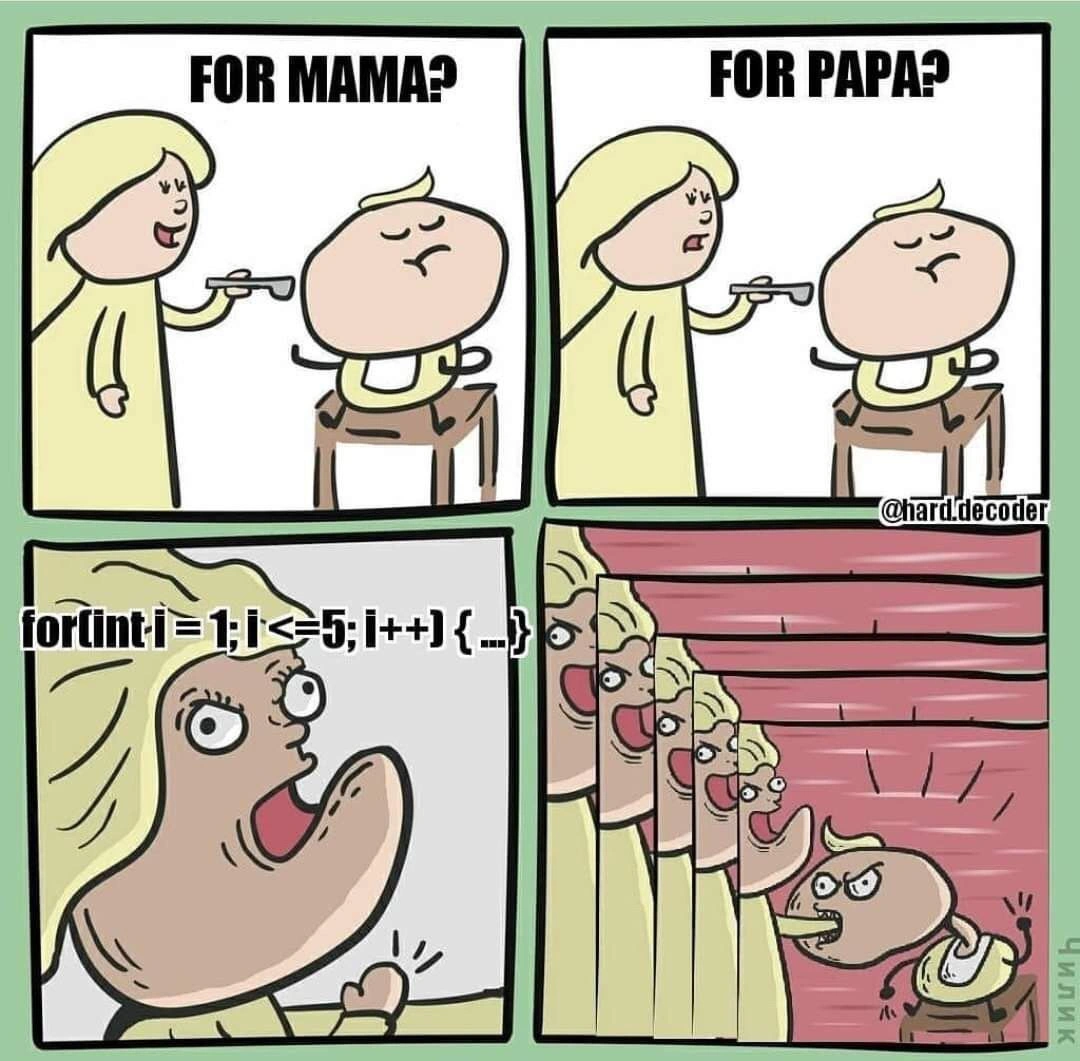
Imagine a mom trying to feed her baby some food. First, she says nicely, "One bite for Mommy?" but the baby doesn’t want to eat. Then she tries, "Okay, one bite for Daddy?" The baby still keeps his mouth shut, looking stubborn and bored. Now things get silly: suddenly the mom goes into super-speed mode like a robot or a cartoon character on fast-forward! In an instant, she tries to feed the baby five spoonfuls one right after the other, so fast that it looks like there are five moms all lunging forward at the same time. The baby’s eyes go wide and he leans back, totally surprised and overwhelmed.

It’s funny because, in real life, no mom or dad can actually do that – you can’t just multiply yourself or move at lightning speed to shove food in a baby’s mouth. Normally you have to be patient and maybe try a few times slowly. But here the mom acted like a computer or a robot following a command to repeat the feeding action five times super quickly. It’s like if you had a magic button that says “try again, try again, try again, try again, try again” in a blink. The picture makes us laugh because it shows a normal situation (feeding a baby) turned totally ridiculous by the mom suddenly moving much faster than any person can. The baby wasn’t expecting that at all! Even though the poor baby is probably thinking "Whoa, slow down!", we find it hilarious because it’s so unrealistic and exaggerated. It’s basically imagining what would happen if a mom behaved like a computer program that doesn’t get tired or wait – she just goes zoom! and tries five times in a row. The contrast between the everyday scene and the crazy fast action is what makes it silly and fun, even if you don’t know anything about computers.

Level 2: Looping the Spoon

In this meme, a basic programming concept – the for-loop – is being compared to a mom feeding her baby. If you’re just learning to code, a for-loop is a way to repeat a set of instructions multiple times. It’s part of what we call program control flow (ways to control the order and repetition of operations in a program). Instead of writing the same line of code over and over, we use a loop to tell the computer “do this action again and again, a certain number of times.” This meme imagines: what if a parent could use that power in real life?

The first panels show a mother trying to feed her baby by saying “for Mama?” and “for Papa?”. In a normal setting, that phrase means “Please do it as a favor for Mom/Dad” – a common pleading tactic with a stubborn baby. But notice the word “FOR” is in bold and all caps, which is a wink to programmers because for is also a keyword in many programming languages (like C, C++, Java, and JavaScript) that introduces a loop. So it’s a pun: for Mama/Papa sounds like everyday parenting, but it secretly hints at a for-loop about to happen.

Sure enough, in panel 3 we see actual programming code appear: for(int i = 1; i <= 5; i++) { ... }. Let’s break down that snippet to understand it fully:

  • for – this starts the loop. It tells the program we’re going to loop (repeat) a block of code.
  • int i = 1 – this is the initialization. It creates an integer variable i and starts it at 1. We often use i as a loop counter (it stands for index or iteration in many examples). So at the very beginning, i is set to 1, meaning we’re ready for the 1st iteration.
  • i <= 5 – this is the condition that decides whether the loop should keep going. As long as this condition is true, the loop will continue. Here it says i <= 5, meaning “loop while i is less than or equal to 5.” So when i becomes 6, the condition fails and the loop will stop. This way, we ensure the loop runs a fixed number of times.
  • i++ – this is the increment step. Every time one loop iteration finishes, i++ tells the computer to add 1 to the value of i. So after the first iteration, i goes from 1 to 2, then the next loop cycle runs, then i becomes 3, and so on. This increment happens at the end of each loop cycle, right before checking the condition again for the next round.

Taken together, for(int i = 1; i <= 5; i++) { ... } means: “Start i at 1, and while i is 1 up through 5, run the code inside the braces, then increment i by 1 each time.” This loop will run the inside code with i = 1, then i = 2, 3, 4, and finally i = 5. When i becomes 6, it stops. So it will execute the loop body five times in total. The { ... } in the snippet indicates the body of the loop – the code that actually runs each time. The meme doesn’t spell out what’s inside, it just shows an ellipsis ... as a placeholder, because we’re supposed to infer it’s the action of feeding the baby. In a real program, it might look something like:

for(int i = 1; i <= 5; i++) {
    feedBaby();  // attempt to give a spoonful
}

Here, feedBaby() would be a function (or just pseudocode for the action) that tries to put a spoonful of food into the baby’s mouth. The loop ensures this happens 5 times in a row. Doing it with a loop is far more concise than writing it out manually, like:

feedBaby(); // 1st attempt
feedBaby(); // 2nd attempt
feedBaby(); // 3rd attempt
feedBaby(); // 4th attempt
feedBaby(); // 5th attempt

Both approaches achieve the same result (five feeding attempts), but the loop is a nice, compact way to repeat instructions. This is why loops are taught in every intro to programming course – they’re a fundamental tool in a coder’s toolbox for handling repetition without redundant code. It falls under the basics of CS_Fundamentals and is common across many programming languages. Even if the exact syntax varies (for example, Python uses for i in range(5):), the concept is universal.

Now, how does this tie back to our hungry (or not-so-hungry) baby? In the comic, after the mother gently tries twice (once for Mom, once for Dad) and the baby still refuses, she basically activates loop mode. Panel 3’s close-up with the code on her face signifies that from this point on, she’s not just asking – she’s running a programmatic sequence of feeding attempts. The text on her face is like her internal code logic kicking in.

Finally, panel 4 illustrates the outcome of running that loop: we see the mom appear to lunge forward spoon in hand five times in rapid succession. It’s drawn in a way that looks almost like five clones of the mom all feeding at once, or a single mom moving so fast that she’s in multiple positions at the same time (like a motion blur effect). Each of those five drawn mothers represents one iteration of the loop (i = 1 through 5). The baby’s expression is priceless – he’s shocked and absolutely overwhelmed. And who wouldn’t be? In a split second, he went from leisurely refusing food to getting spoon-bombed with five bites back-to-back.

For a junior developer or someone new to coding, the joke here is showing how a computer’s methodical repetition can completely outpace a normal human action. The mom feeding the baby in normal circumstances might take, say, several seconds or more per spoonful, gauging the baby’s mood each time. But the for-loop mom just executes those five attempts instantly without waiting. In real life, this is absurd (and messy!), which is exactly why it’s funny. It’s a visual analogy: the for-loop is doing what code does – repeating an action quickly and systematically – but applied to a scenario that’s usually slow and requires patience. It’s a repetition gag where code logic meets everyday life. The humor clicks for people who understand both contexts: they know how a loop works in code, and they know how different that is from normal parenting. This meme is a great example of a for_loop_analogy or a parenting_code_mashup – it mashes up a programming concept with a parenting situation to get a laugh.

Also, notice how this is categorized as CodingHumor/DeveloperHumor. If you’re not a developer, panel 3 with the code might be confusing or meaningless. But if you’ve written loops before, you immediately get the reference and likely chuckle at how perfectly the code fits the scenario (“If only I could really loop this feeding task!”). This kind of joke creates a sense of insider knowledge – it’s something that unites programmers, because we all remember struggling to get a piece of code to run a loop correctly, or we’ve joked about how nice it would be if real life had a for loop or copy-paste functionality. Here, the control flow concept of a loop is visually feeding the baby faster than humanly possible, which is both a silly image and a clever take on how powerful simple code constructs can be. Even as a junior dev, once you’ve grasped loops, you’re in on the joke: you know that for(int i=1; i<=5; i++) means “do it five times,” and you can appreciate how the comic portrays those five times in one go. It’s a high-five moment between the meme and the viewer – “Hey, you learned loops? Great, now enjoy this joke about using them in real life!”

Level 3: Algorithmic Parenting

This meme offers a hilarious intersection of coding and parenting by turning a mundane feeding attempt into a snippet of code execution. In the first two panels, the mother tries the classic coaxing technique: "For Mama?" and "For Papa?" – essentially asking the baby to take a bite for each parent. But in programming terms, that bold FOR immediately hints at a for-loop pun. Seasoned developers recognize the dual meaning: in English it’s an appeal to the baby, but in code, for introduces a loop. The meme then cranks up the geekiness in panel 3 by overlaying a C/C++ style loop: for(int i = 1; i <= 5; i++) { ... }. This code is a control flow construct instructing the program to repeat an action five times. The mother’s mouth is replaced by this code snippet, as if she’s literally speaking in C++, signaling that she’s switched into programmer mode to solve the problem. It’s a playful nod to how developers sometimes half-joke about applying programming solutions to real life – here the mom essentially writes a quick feeding algorithm on the fly.

The loop in the snippet is classic CS fundamentals style: it initializes an integer i to 1, checks the condition i <= 5 on each iteration, and increments i++ after each pass. This means the loop will execute for i = 1, 2, 3, 4, 5five iterations in total. In the context of the meme, each iteration corresponds to a spoonful attempt. Inside those { ... } braces (the loop’s body) we can imagine a function call like feedBaby(); that actually performs the spoon-feeding. This kind of loop is extremely common in languages like C++, Java, and many others, used whenever we need to repeat an operation a set number of times. The humor here leans on how effortlessly code can handle repetition. Instead of manually writing five separate feeding actions, a single loop construct does the job – and does it fast. Every programmer remembers the satisfying power of this concept from their early coding days: why say something five times when a loop can do it in one? The meme exaggerates this power in a domestic scenario for comedic effect.

In panel 4, the joke reaches its punchline. We see five motion-blurred copies of the mother lunging forward with the spoon on a red background, practically overwhelming the baby. This is the for-loop in action – the five iterations visualized as five rapid-fire feeding attempts. The baby’s wide-eyed, recoiling reaction says it all: the loop is feeding the baby faster than any normal human ever could. It’s as if the CPU’s clock speed was applied to parenting – an iteration acceleration that turns mom into a feeding machine. Developers will appreciate that the comic is essentially illustrating a loop’s literal effect: repeated actions executed in quick succession. The mother didn’t actually need five physical clones; it’s the same mom executing the feeding action so quickly that to an observer (or a startled baby) it appears as a blur of five simultaneous moms. This exaggeration feels reminiscent of a program running a loop without delay – no waiting for the baby’s reaction, no pause, just bam-bam-bam five spoonfuls delivered.

There’s also a clever subtext about how computers handle repetition versus how humans do. In code, unless we program a delay, those five iterations could happen in microseconds – effectively instant from a human perspective. The meme plays on this by showing the mother almost teleporting spoonfuls into the baby’s mouth at computer speed. The result is chaotic and funny because it violates real-world physics and common sense (no loving parent would actually fire five spoons at a baby back-to-back!). But that’s precisely why it’s an inside joke for developers: we recognize that a computer follows the loop’s logic to the letter, without adapting to the baby’s response, which is both the power and the pitfall of literal code execution. It’s a lighthearted reminder that code will do exactly what you tell it, no more, no less – even if that means five frantic feeding attempts. Experienced devs might even chuckle at the thought that the mom forgot a break statement or some feedback check inside the loop – she just brute-forced all five iterations regardless of outcome. In real life, you’d adjust after each attempt (maybe the baby is full or upset), but in code, the loop as written doesn’t care; it will run all five times unconditionally. This contrast between rigid code logic and the nuance of human interaction is where a lot of the humor lies.

Another layer of appreciation for the seasoned coder is the visual of the loop unrolling. Compilers sometimes perform an optimization called loop unrolling, where a loop’s repeated steps are expanded out, reducing the overhead of jumping back to the loop condition. In the final panel, the artist essentially “unrolls” the loop by drawing the mother five times in a row. It’s a stretch to call it a direct reference to compiler optimizations, but it’s a fun parallel: the image literally shows each iteration side by side, as if the loop’s content was duplicated five times in the comic frame. This not only makes the action clearer in a single snapshot but also tongue-in-cheek implies an optimized feeding routine. After all, nothing says efficiency like a pipeline of spoon-wielding moms clocking in five deliveries in one go!

Ultimately, the meme is classic CodingHumor mixing a everyday situation with programming logic. It highlights a simple truth in a laughable way: code can automate repetitive tasks with ease and speed that’s absurd in a human context. Developers love these kinds of analogies because it’s fun to see our abstract tools (like loops) play out in the tangible world. It’s programmer humor 101: taking a piece of DeveloperHumor about control flow and iterating it into a goofy real-life scenario. The next time a developer-parent actually tries to spoon-feed their baby, you can bet they’ll remember this comic and jokingly think, “If only I could just write a quick loop to get this done!”

Description

A four-panel comic strip depicting a mother trying to feed a stubborn baby. In the first panel, the blonde-haired mother offers a spoon to the baby, asking, 'FOR MAMA?'. The baby sits in a high chair with its arms crossed, looking displeased. In the second panel, her expression is more concerned as she asks, 'FOR PAPA?'. The baby remains unimpressed. A small watermark '@hard.decoder' is visible. In the third panel, the mother's face is distorted into a manic, wide-eyed scream as she yells a line of C-style code: 'for(int i = 1; i <= 5; i++) { ... }'. The final panel shows the mother's screaming face replicated five times, receding into the background, while the baby, now with an angry and determined expression, lunges forward to eat from the spoon. The humor comes from the absurd application of programming logic to a mundane parenting challenge. It satirizes the 'programmer brain' that sees everyday problems as iterative processes, suggesting that even a baby can be persuaded by the irresistible, repetitive logic of a for-loop


Comments

7
Anonymous ★ Top Pick This is just loop unrolling for toddlers. The real trick is getting them to handle recursion at bedtime without a stack overflow
  1. Anonymous ★ Top Pick

    This is just loop unrolling for toddlers. The real trick is getting them to handle recursion at bedtime without a stack overflow

  2. Anonymous

    When you unroll the feeding loop for extra throughput and forget the baby’s buffer size is 1 - congrats, you’ve just implemented infant-scale back-pressure

  3. Anonymous

    When you explain loops to junior devs and accidentally create five identical instances of yourself asking for code reviews at the same time

  4. Anonymous

    When you try to explain your day to non-technical family and accidentally trigger an O(n!) conversation complexity. The real horror isn't the infinite recursion - it's realizing you've been thinking in loop invariants so long that 'for(int i = 1; i <= 5; i++)' feels more natural than 'I did five things today.' At least the stack overflow happens in their brain, not yours

  5. Anonymous

    This is what happens when you implement retries with a for-loop instead of exponential backoff and a circuit breaker - the toddler becomes your hottest stateful side effect

  6. Anonymous

    Great demo of why we require idempotent handlers: wrap feeding in a for-loop without backoff and you’ve built a five-request DoS on the toddler

  7. Anonymous

    Hardcoded i<5? That's the loop that'll haunt your 15-YoE codebase longer than that forgotten raw pointer

Use J and K for navigation