A Developer's Reaction to Language 'Benefits'
Why is this Languages meme funny?
Level 1: Same Story, Different Name
Imagine you have a bunch of friends, and each friend thinks their favorite toy is the best in the world. One friend calls you and says, “Legos are the greatest toy ever! They’re so versatile and fun, nothing beats Legos.” The next day, another friend calls and insists, “Action figures are the absolute best toy. They’re so exciting and no other toy is as cool as action figures!” The day after that, a third friend rings you up to declare, “Video games are the top toy, they’re better than any other!”
By the third call, you’re probably just holding the phone, saying “uh-huh, okay,” but you’re not excited anymore – because you realize you’re hearing the same story over and over, just with a different toy each time. You know all toys can be fun in their own way, and it’s silly for each friend to claim theirs is the one superior toy.
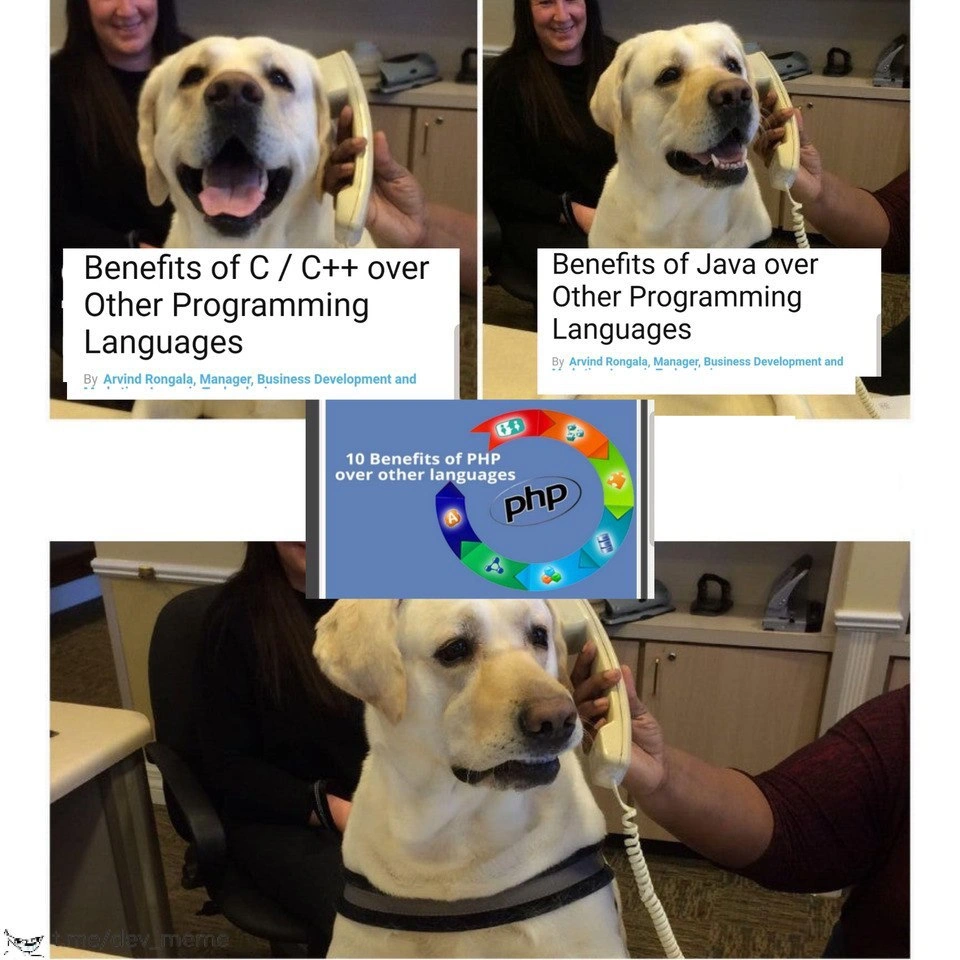
In the meme, the dog is like you in this scenario. The dog is listening on the phone while each caller talks about a different programming language as if it’s the best one ever. First someone talks about C/C++, then someone else about Java, then PHP, each claiming “their” language is the greatest. The dog starts off looking happy (just like you might be interested at first), but by the last panel the dog has a blank, tired look – it’s heard this all before. The joke is that it doesn’t matter which language the caller talks about; the dog’s reaction is always the same: a polite, empty stare that says, “Every day you guys tell me something different is ‘the best’… I’m just going to sit here and not take it too seriously.”
So the funny part is like hearing the same bragging in a loop, just swapping names. Whether it’s toys or programming languages, when everyone claims “theirs is the best” every time, you eventually just smile and stop believing the hype. The dog on the phone symbolizes how we feel when we keep getting those calls – a bit amused, a bit bored, and not fooled into picking sides.
Level 2: Everyone’s a Winner
This meme is poking fun at programming language comparison articles and the endless debates they fuel. In the tech world, a language war is when developers argue over which programming language is the best. You’ve probably seen this on forums or Twitter – one person insists JavaScript is the future, another fires back that Python or C++ is superior. It can feel as silly and never-ending as sports fans arguing about the best team.
The meme uses a friendly yellow labrador (an office dog) holding a telephone to visualize how repetitive and pointless these debates can be. Each panel shows the same dog listening to a phone call about a different language’s “benefits.” The titles in the image are examples of real-sounding blog headlines:
“Benefits of C/C++ over Other Programming Languages.”
“Benefits of Java over Other Programming Languages.”
“10 Benefits of PHP over other languages.”
Each headline claims a certain programming language is better than all the rest. The joke here is that every language gets its turn being praised – which logically makes no sense, because they can’t all be the best at the same time. The dog’s expression goes from a happy panting face (in the top panels) to a blank, almost bored face (in the bottom panel). It’s as if the dog (and by extension, experienced developers) initially listened but now has realized it’s the same kind of pitch every time.
Let’s break down the languages mentioned, so it’s clear what these titles are talking about:
- C/C++: A pair of low-level programming languages known for being fast and powerful. They’re used for things like operating systems, game engines, and performance-critical software. “Benefits of C/C++” might mention speed and control over memory, since with C/C++ you can manage computer memory directly and optimize for high performance. But C/C++ can be tricky – you have to handle a lot of details yourself (like memory allocation), which is both a strength and a weakness.
- Java: A very popular high-level language famous for its “write once, run anywhere” capability. Java runs on a virtual machine (the JVM), which means Java programs can work on any system that has a JVM – Windows, Mac, Linux, etc. An article hyping Java’s benefits might talk about its huge community, vast libraries, automatic memory management (so you avoid those C++ pointer nightmares), and enterprise use (lots of big companies use Java). Java is great for building large, cross-platform applications, but some find it verbose or heavyweight.
- PHP: A scripting language primarily used for web development, especially for building server-side logic on websites. PHP was extremely popular for creating dynamic web pages (Facebook started on PHP, for example). A “10 Benefits of PHP” post might praise how easy it is to learn, how quickly you can get a web page up and running, and the fact that it’s embedded in HTML. PHP has a reputation for being very approachable for beginners and was the backbone of many early 2000s websites (think WordPress, etc.). On the flip side, PHP has been criticized for inconsistent design decisions and security issues in older versions – but modern PHP has improved a lot.
Now, why would someone write the same “X is better than others” article for every language? Often, this comes down to clickbait and content marketing. Clickbait means a headline or content designed to make you click it, usually by making bold or exaggerated claims. In tech blogs, a title like “X is better than Y” or “10 Reasons to Choose X” is classic clickbait. It stirs up controversy (fans of other languages will want to read and argue) and draws in beginners who are trying to decide which language to learn. Websites love traffic, so they churn out these articles frequently. They might have one article for each popular language to capture search engine hits from every community. It’s not about truth, it’s about views and ad revenue.
This leads to recycled content. The meme literally shows the same author (the name at the bottom of the headline is identical) writing about C/C++, Java, and PHP in the exact same format. In other words, the author or site is just recycling the template: “Here are the benefits of ___.” They plug in a different language each time. The actual content of such posts is usually very generic – things like “X language has a great community” or “X can be used for many applications” – which could apply to almost any language if you word it vaguely enough. An experienced developer reading these finds them shallow because they gloss over all the important nuances (like when is C++ the best tool, or what trade-offs does Java have, etc.).
The dog on the phone symbolizes a developer (or perhaps the entire developer community) responding to these repeated claims. Why a dog? It’s part of an old meme format often captioned “Hello, yes, this is dog.” In that classic meme, someone pretends a dog is answering the phone as if it were a person. It’s absurd and funny because a dog obviously doesn’t understand the conversation; it just sits there. Here, the dog is being used to represent how a seasoned developer might react to clickbait: listening politely (dogs are good listeners!) but clearly not understanding or caring about the so-called “amazing benefits” being rattled off. The dog’s progressively blank expression is basically our face after seeing the millionth “My favorite language is best” argument.
For a junior developer or a student just getting into programming, this meme is a lighthearted lesson: take those “X is better” articles with a grain of salt. Every programming language has strengths and weaknesses, and people on the internet will always hype up the one they personally like (or the one that’s trendy). As you gain experience, you realize there’s no objective “winner” language overall. Seasoned devs often say, “Use the right tool for the job,” meaning the best language depends on what you’re trying to do. After you’ve seen the fad cycles (one year everyone loves Ruby, the next year everyone loves Go, then Rust, and so on), you understand why the dog in the meme looks so indifferent. It’s seen it all before.
So, in summary, this meme is about developer humor around language wars. It’s pointing out that those endless comparison articles are a bit ridiculous – the same fluffy claims repeated over and over, just swapping the programming language name. The office labrador represents how many of us react: phone in hand (paw?), hearing the same pitch again and again, thinking “heard that last time… nothing new here.” It’s a funny reminder not to get too caught up in the hype and drama of “which language is best” on the internet.
Level 3: Phoned-In Flame Wars
From a senior engineer’s perch, this meme skewers the never-ending language wars that plague tech discussions. Each panel is a déjà vu: a blog post touting "Benefits of X over Other Programming Languages" appears for C/C++, then Java, then PHP – all with the same smiling office dog on the phone. The humor lies in the blatant cookie-cutter repetition. It’s as if some content marketer simply swapped out the language name and hit publish, expecting developers to lap up yet another “X is superior” spiel. Experienced devs see right through this. We’ve survived enough holy wars flame wars on forums and Hacker News to know a clickbait article when it rings. The dog’s blank, long-suffering stare in the final panel practically dials up our collective fatigue: “Oh boy, here we go again…”
This image parodies the tired cycle of language evangelism. One day it’s an article extolling C++ for its raw performance and low-level control. Next day, ring ring, here’s a Java post bragging about portability and memory management. Then ding – an ode to PHP’s simplicity for web dev. The stock graphic "10 Benefits of PHP over other languages" even has a multicolored circular arrow, hinting at the cyclic, never-ending nature of these debates. It’s the Wheel of Hype: today’s JavaScript hype becomes tomorrow’s Go hype, and so on ad infinitum. Seasoned developers chuckle (or eye-roll) at this because we’ve lived through each cycle. We know every language has its pros and cons, but sensational blog posts pretend each is a flawless victor in the battle for programming supremacy.
Why is this so funny (and painfully true) for senior devs? Because it satirizes our industry’s habit of hyping every tool as the ultimate solution. One week, you’ll read “Why {Insert Language} Will Replace All Others” — only to see the reverse argument the following week. It’s a pendulum of opinion that never settles. We’ve grown jaded enough to just tune it out, much like the meme’s dog politely “listening” on the phone but clearly not buying the sales pitch. The dog is effectively every experienced engineer on the internet, being courteous (or just bemused) while yet another overzealous “X language is better!” caller drones on. Senior devs ignore these not out of arrogance, but out of hard-won wisdom: we know there is no silver-bullet language. The best choice always “depends on context” – a nuance you’ll rarely find in a top-10 listicle written for easy clicks.
This meme’s snark also hints at how recycled blog content works in practice. Often, non-expert writers or SEO-driven sites produce nearly identical articles for multiple keywords. They’ll praise C++ to attract one crowd, then praise Java to grab another – even if it’s the same author behind both (notice the identical byline in the panels). It’s like a tech version of Mad Libs: fill in the blank with any language, and voila – instant “Why it’s the best” post. The meme basically calls up these authors on the proverbial phone and says, “We know what you’re doing, and we’re not impressed.”
In real development life, language wars never truly end, because new languages emerge and old ones find new niches. We’ve seen it with Python vs. Ruby, Node.js vs. PHP, Kotlin vs. Java, and countless other rivalries. The absurdity is thinking any one language universally outranks the others. Sure, C++ might crush numeric algorithms with speed, but try using it for quick web scripts – you’ll wish you had Python or PHP. Java can run anywhere (JVM power!), but then someone will cite Go for better containerized microservice performance. It’s an infinite loop. The meme’s dog on a landline phone – an old-school communication device – underscores how dated and cyclical these arguments feel. We’ve been having the same conversations since the 90s (or earlier). The technologies change, but the pattern (and the heated comment sections) remain.
To a seasoned dev, each panel’s headline reads like a nagging telemarketing call for a product we already know the flaws of. The dog’s neutral expression says it all: “I’m not arguing, I’m not excited – I’m just here so you’ll stop barking at me.” 😅 We’d rather get back to writing code (in whatever language gets the job done) than argue in circles. The meme brilliantly captures this shared sentiment. After you’ve debugged a memory leak at 3 AM or chased a segmentation fault for days, you don’t really care if some blog says one language is “better” – you care that the code works and doesn’t wake you up at 3 AM again. In short, the joke is on the endless language zealots, and the dog (plus all of us seniors) ain’t buying what they’re selling.
languages = ["C/C++", "Java", "PHP", "Python", "JavaScript", "Go"]
for lang in languages:
title = f"10 Benefits of {lang} over Other Languages"
content = generate_generic_benefits() # same list of advantages every time
publish_blog(title, content) # rinse and repeat; tomorrow another language
Above: a tongue-in-cheek pseudocode for how these articles feel. It wouldn’t surprise us cynical veterans if there’s a script out there actually churning these posts out automatically. The meme’s core technical truth is that no programming language is objectively “#1” in all scenarios – and any article claiming so for clicks deserves the same polite, blank-faced response as “Hello, yes, this is dog.” 🐶📞
Description
A three-panel meme using the 'Dog on the Phone' format to comment on programming language reputations. In the top-left panel, a happy yellow labrador is on an old-fashioned telephone, with an overlay showing an article title 'Benefits of C / C++ over Other Programming Languages'. The top-right panel shows the same happy dog with the title 'Benefits of Java over Other Programming Languages'. The bottom panel shows the dog with a concerned, serious expression, looking at the phone with disapproval. An overlay on this panel displays a graphic with the PHP logo and the text '10 Benefits of PHP over other languages'. The humor comes from the dog's change in demeanor, representing a seasoned developer's positive or neutral reaction to discussions about C/C++ and Java, contrasted with a skeptical and weary reaction to a discussion about the merits of PHP, a language often criticized within the developer community

Comments
7Comment deleted
C++ has memory management, Java has the JVM, and PHP has a million-dollar exit for a WordPress plugin. The dog's expression is that of someone realizing which one offers the better ROI
The dev-dog answers every “Language X is supreme” call with the same reply: “Fantastic - whoever rewrites our 14-year-old cron-driven data pipeline first gets to pick the next ‘superior’ stack.”
The dog's expression perfectly captures the senior engineer's soul when they realize the 'benefits of PHP' article was written by a Business Development Manager who probably thinks PHP stands for 'Pretty Helpful Programming' and hasn't debugged a legacy WordPress plugin at 3 AM
The meme perfectly captures the architectural reality: C/C++ developers get excited about zero-cost abstractions and manual memory management, Java developers appreciate enterprise-grade tooling and JVM optimizations, but when PHP enters the conversation, even the most enthusiastic advocates suddenly remember they have a production incident to attend to. It's the only language where 'type coercion' sounds less like a feature and more like a confession at a support group
The polyglot oracle who ranks C++, Java, and PHP above all others - without ever surviving a single segfault
Senior dev heuristic: if the byline says Business Development and the title says “over other languages,” it’s a marketing call; say “PHP” and even the dog asks for latency, MTTR, and hiring pipeline numbers
Language-choice hotline: C/C++ when tail latency matters, Java when operational sanity does, PHP when sunk cost does