Skip to content
DevMeme
788 of 7435
The Architect's Unsolved JavaScript Bug
Bugs Post #892, on Dec 5, 2019 in TG

The Architect's Unsolved JavaScript Bug

Why is this Bugs meme funny?

Level 1: Small Glitch, Big Trouble

Imagine you built the most amazing video game world where everything is perfect – everyone is happy, there’s unlimited candy, no one ever stubs their toe. It’s like a dreamland you designed for people to live in. Now, picture that you made one tiny mistake in the game’s rules or code, like you forgot to add gravity in one place or a door that’s supposed to open doesn’t work at all. What happens? All of a sudden, the game world isn’t so perfect – maybe characters start floating away because of that missing gravity, or people get stuck because the door won’t open. Because of that one little glitch (a glitch means a small error or hiccup), the players stop believing in the world. They get frustrated or weirded out and decide, “Hmm, something’s not right here. We don’t like this place.” In other words, they reject the supposed paradise because that small error makes it feel fake or broken.

That’s exactly what this meme is joking about. It says even in the Matrix – which is like a giant virtual reality world in a movie, designed to be perfect – there was a bug (a mistake in the program). The bug is humorously described with a tech error message: “undefined is not a function,” which is basically computer-speak for “oops, something was missing and the computer got confused.” It’s like the Architect (the guy who made that virtual world) forgot to put an important piece in his code. And just like a game crashing or feeling wrong because of a tiny mistake, the perfect Matrix world fell apart. People noticed the problem and wouldn’t accept the paradise as real. The funny part is comparing this grand, philosophical story about humans rejecting a perfect world to something as silly as a common coding error. In simple terms: even a tiny error can spoil a perfect plan, and that’s both a bit tragic and pretty funny – especially to developers who deal with these little errors every day!

Level 2: Trouble in Paradise

Let’s break down the technical and pop culture references here. The meme quote is parodying a scene from The Matrix movies. In that story, the Matrix is a simulated reality created to keep humans content. The Architect is the program (like a lead engineer) who designed the Matrix. He tells Neo (the hero) that the very first version of this simulation was meant to be a paradise, a perfect world without suffering. But unexpectedly, humans didn’t accept that perfect world – in the movie, it’s implied they found it too good to be true, and their minds rebelled. Now the meme gives a humorous twist: it suggests the real reason that first Matrix failed wasn’t lofty human psychology at all, but a simple coding bug – specifically, an “undefined is not a function” error that the Architect couldn’t fix.

So, what is “undefined is not a function”? It’s a common error message in JavaScript, one of the main programming languages used especially in front-end web development (the code running in your browser to make websites interactive). In JavaScript, undefined is a special value that basically means “no value” or “not found.” For example, if you have a variable that you never set to anything, its value is undefined. Or if you try to access a property on an object that doesn’t exist, you get undefined. Now, a function in JavaScript is a block of code you can call/invoke to do something. The error “undefined is not a function” happens when your code is trying to call something as if it were a function, but the thing is actually undefined. The computer essentially says: “Uh, you told me to run undefined like a function – I don’t know how to do that!” and it throws an error, often crashing that part of the program.

In practice, this means somewhere the programmer expected to have a real function or object, but a mistake caused it to be missing. This is a form of a bug – a flaw or error in the program. It could be as simple as a typo in a variable name or forgetting to return something. For instance, consider this code:

function greet(name) {
  console.log("Hello " + name);
}

let greeter;
greeter();  // Trying to call greeter as a function

In this snippet, greeter was never set to a function (we defined a greet function but didn’t assign it). So calling greeter() would result in an error like TypeError: greeter is not a function (which is essentially saying undefined is not a function since greeter is undefined). In a real web page, if such an error occurs, maybe a button click stops working or some feature just breaks without visible feedback to the user aside from maybe an error in the console. Developers then have to debug it – meaning they investigate the code to figure out why that variable is undefined when it shouldn’t be.

Now, tie this back to the meme’s scenario: The Architect basically had a bug in the Matrix’s code. Picture him like a programmer who shipped a feature (a utopian world) with a hidden error. Perhaps some crucial function in the simulation logic wasn’t defined properly – maybe the code that should spawn unlimited ice cream or remove all pain had a flaw. When humans were living in this simulated paradise, that bug probably caused weird glitches. (In Matrix terms, think of the famous déjà vu with the black cat – that was a minor glitch when they changed something. An “undefined function” might cause even bigger hiccups, like people suddenly seeing something that shouldn’t exist or parts of the world not responding.) The meme implies the Architect couldn’t debug that issue (“he could never solve” it), and as a result, the whole perfect world crashed and the humans “rejected it.” In software terms, users found the utopia app too buggy!

For a newer developer or someone just learning coding, the takeaway is: small coding errors can have huge effects. Everyone in web development eventually runs into the dreaded undefined is not a function error message and learns to carefully check that variables and functions are defined before using them. It also highlights how important thorough testing is: if the Architect had unit tests or integration tests for his paradise, maybe he would have caught that undefined bug before deploying Matrix version 1.0 to production (the human population!). The humor comes from mixing a dramatic sci-fi narrative with a mundane programming goof-up. Once you recognize the pieces – The Matrix reference and the JavaScript error – the joke clicks: even the smartest system architect in fiction got tripped up by a bug that real-life coders see all the time.

Level 3: TypeError in the Matrix

For seasoned developers, this meme hits on two very different references colliding in a hilarious way: an iconic scene from The Matrix films and the painfully familiar JavaScript error "undefined is not a function". In The Matrix Reloaded, the Architect (the program who designed the Matrix) tells Neo, “the first Matrix was designed to be a paradise... but the humans rejected it.” It’s a serious, philosophical moment explaining why a perfect utopian simulation failed. Now, mash that up with a front-end developer’s daily nemesis – a trivial bug where you call a function that doesn’t exist – and you get pure developer humor. The tweet imagines the Architect sheepishly admitting that despite his grand design, he was foiled by a pesky runtime error he could never debug. This is funny (and a little too real) because developers have all experienced a tiny glitch blowing up an entire project or user experience.

Why specifically “undefined is not a function”? Because it’s one of the most ubiquitous JavaScript errors. It typically happens when your code tries to invoke something as a function, but that thing was never defined. Maybe you misspelled a function name, or a variable didn’t get initialized, or you expected an object with a method but got undefined instead. In practice, seeing TypeError: undefined is not a function in the browser console can be maddening – it often surfaces at the worst time (like during a demo or in production) and sometimes the error stack trace isn’t immediately clear about where the undefined value came from. Every web developer has lost sleep tracking down one of these issues. The meme winks at this shared struggle: even a hyper-intelligent system architect running a simulated universe couldn’t escape the classic bug that front-end devs debug on a regular Tuesday. It’s the ultimate “nobody is above this” inside joke.

Another layer is how a trivial programming error is blamed for humans rejecting a perfect reality. In real-world software terms, it’s like users abandoning your app because of a silly bug that should have been caught. (Paradise UI was great, but it kept throwing errors, so users gave it 1 star.) Developers know that no matter how brilliant the design, a single critical bug can tank the whole project’s reception. The meme leverages that truth: the Architect’s pride couldn’t save him from a bad variable reference. It also satirizes how tech folks sometimes half-joke that the world is a simulation – here we’re humorously assuming the simulation runs on code that can have bugs like any web app. The tweet format even uses a common comedic device: the bracketed stage direction [thinking about the "undefined is not a function" he could never solve] to depict the Architect’s internal guilt. That formatting is common in Twitter jokes, mimicking script style to add a punchline (in this case, revealing the real reason the paradise failed).

This resonates strongly across the developer community because it merges pop culture with a universal coding experience. Frontend developers especially feel it – that’s where JavaScript lives and where this error is a daily guest. But even backend or other language developers can relate if they’ve ever hit a NullPointerException or similar error that sent their perfect plans crashing. It’s a lighthearted reminder that software never runs perfectly on the first try. And of course, the phrase “glitch in the Matrix” (from the movie, referring to déjà vu indicating something’s been changed in the code) gets a new twist: here the whole Matrix glitched out thanks to one unresolved bug. Senior devs chuckle because they’ve been in the Architect’s shoes on a smaller scale – deploying something that was supposed to be flawless, only to watch users “reject it” because of an overlooked error. It’s production irony at its finest.

Level 4: Undefined Behavior in Utopia

At the most fundamental level of software theory, this meme pokes at an unsolvable paradox: even a perfect simulated world can be undone by a tiny error in its code. The phrase undefined is not a function is a classic JavaScript runtime error – essentially a TypeError indicating some variable was expected to hold a function but actually held undefined. In a robust system, this should never happen; in reality, it inevitably does. The meme humorously suggests that the Architect of the Matrix (the super-intelligent AI that designed the simulation) encountered a null reference bug so pernicious he couldn’t resolve it, thus dooming his idyllic first Matrix. This highlights a deeper computer science truth: complex, dynamic systems are incredibly hard to make 100% bug-free.

Why would an all-powerful Architect struggle with a simple undefined value? Consider the theoretical backdrop: the Matrix is a fully immersive simulated reality – essentially software of unlimited complexity. In computer science terms, such a system would be rife with emergent behaviors and edge cases. The “undefined is not a function” error implies a piece of code tried to call something that wasn’t there. In a language like JavaScript (which the meme implicitly references), variables can be undefined if not properly initialized or if an object property doesn’t exist. This is akin to the notorious “null pointer” errors in other languages – what Sir Tony Hoare dubbed the “billion-dollar mistake” because billions of dollars (and countless hours) are lost troubleshooting them. Even in an ostensibly perfect simulation, a single unhandled undefined can cascade into a total failure. Formally, this points to the challenge of software correctness: proving a program of any real complexity has zero bugs is almost impossible (there’s an entire field of formal verification trying to achieve that, but scaling it to something like the Matrix is sci-fi).

From a type theory perspective, the joke underscores dynamic vs. static system design. If the Matrix’s code were statically typed or formally verified, perhaps such a type mismatch (calling something that isn’t a function) might have been caught at “compile time” before the simulation ran. But a paradise simulation implies flexibility – maybe the Architect chose a dynamic, self-evolving code environment (imagine an uber-advanced JavaScript-like system) to let human minds be unpredictable. That very flexibility introduces uncertainty: the system can enter states the designer didn’t anticipate. In theoretical terms, a sufficiently powerful system is Turing-complete and thus can’t be predicted or error-checked for all possible behaviors (related to the Halting Problem – you can’t have an algorithm that foresees all infinite loop or runtime error conditions in another arbitrary program). The Architect’s “paradise” Matrix might have lacked the pain and suffering that gives human minds context, but on a code level it also likely lacked rigorous exception handling for every scenario. The meme slyly insinuates that a tiny glitch – a single undefined function call – was enough to unravel an entire utopian world. It’s a playful nod to the reality that software bugs, however minor, can have catastrophic outcomes if not caught. In essence, even godlike coders in a simulated utopia grapple with the same principle that haunts everyday developers: undefined behavior is the enemy of perfection.

Description

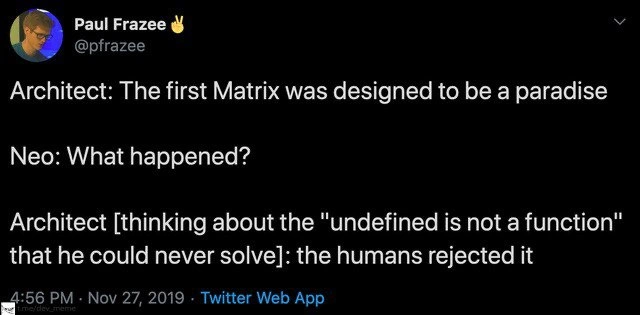
A screenshot of a tweet from Paul Frazee (@pfrazee) that parodies a famous scene from the movie 'The Matrix'. The tweet presents a dialogue: 'Architect: The first Matrix was designed to be a paradise. Neo: What happened? Architect [thinking about the "undefined is not a function" that he could never solve]: the humans rejected it.' The humor stems from juxtaposing the grandiose, philosophical context of The Matrix with a mundane, yet infuriatingly common, JavaScript error. It portrays the god-like Architect as a frustrated developer who, unable to fix a persistent bug, blames the users (humans) for the system's failure - a highly relatable scenario for any software engineer

Comments

7
Anonymous ★ Top Pick The Architect could simulate an entire reality but couldn't handle a null check. It's the ultimate testament to the fact that 'undefined' is a feature, not a bug, of our universe
  1. Anonymous ★ Top Pick

    The Architect could simulate an entire reality but couldn't handle a null check. It's the ultimate testament to the fact that 'undefined' is a feature, not a bug, of our universe

  2. Anonymous

    Paradise would’ve worked fine; the Architect just shipped the entire simulation with TypeScript’s strictNullChecks turned off - humans didn’t reject nirvana, they got a cascade of “undefined is not a function” and rage-quit reality

  3. Anonymous

    The real reason the Architect couldn't debug the first Matrix wasn't the Oracle's interference or human nature - it was that he kept getting 'undefined is not a function' in production at 3am, and even with his infinite processing power, he couldn't figure out which of the 47 nested callbacks in his paradise.js file was trying to invoke a property that got monkey-patched by a rogue Agent's polyfill

  4. Anonymous

    The Architect's real tragedy wasn't human psychology - it was discovering that even in a simulated reality with complete control over the laws of physics, you still can't escape JavaScript's type coercion. Turns out 'paradise' was just undefined all along, and no amount of architectural patterns could make it a function. The humans didn't reject utopia; they just couldn't handle another 'Cannot read property of undefined' error in production

  5. Anonymous

    The Architect's real red pill? Variable hoisting turning paradise into an undefined function call

  6. Anonymous

    Proof the Matrix was written in JavaScript: paradise() threw “undefined is not a function” in prod - humans rejected it, and the Oracle recommended strictNullChecks

  7. Anonymous

    The Architect should’ve enabled strictNullChecks and a canary - utopias don’t survive dynamic dispatch at planet scale

Use J and K for navigation