Skip to content
DevMeme
786 of 7435
The Overwhelmed Code Reviewer
CodeReviews Post #890, on Dec 5, 2019 in TG

The Overwhelmed Code Reviewer

Why is this CodeReviews meme funny?

Level 1: Quick OK

Think of it like this: you wrote a really long essay for class – say 800 words – and you hand it to your teacher. Normally, you’d expect the teacher to read it carefully and maybe circle some mistakes or ask you to fix a few things. But imagine instead the teacher just glances at your huge essay for one second, smiles, and says, “Looks great, all good!” giving you a thumbs-up or an OK sign. You’d probably laugh or feel puzzled, right? You’d be thinking, “Wow, that was fast… did they even read it?”

That’s exactly the feeling this meme is joking about. The “800 lines of code” is like that big essay you wrote, and the “code reviewer” is like the teacher who is supposed to check it. Instead of a thorough check, the reviewer immediately says “OK, awesome!” as if everything is perfect without really looking. It’s funny in a cartoonish way: we know in real life someone should spend time checking big work, but here they just rubber-stamp it. It’s like your friend glancing at a complicated Lego build you made and instantly saying “Looks good to me!” without inspecting it. The humor comes from how casual the reviewer is about something that’s actually a big deal. Even if you’re not a coder, you get the idea – it’s silly and a bit ironic when someone approves a big piece of work so easily. The meme makes us smile because we all appreciate an easy approval, but we also know it probably means the work wasn’t really checked at all.

Level 2: Lightning LGTM

Let’s break down what’s happening for newer developers. In software teams, when you finish working on a feature or bug fix, you create a pull request (PR). A PR is basically a request to merge your code changes into the main codebase, and it often contains all the new code you wrote – in this case 800 lines of code, which is quite a lot! Normally, a code reviewer (a teammate or senior developer) will look through those changes to catch mistakes, suggest improvements, and ensure the code fits the project standards. They might add comments next to specific lines or ask questions. Ideally, a review of an 800-line change would take some time and probably come back with a few notes or at least a discussion.

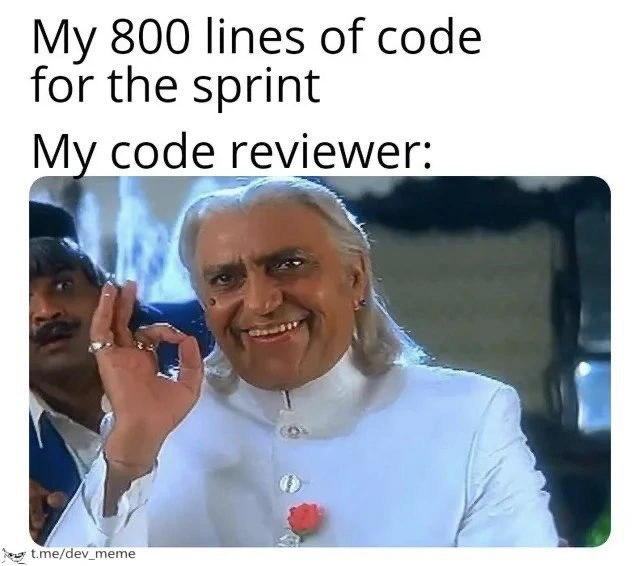
However, the meme shows the opposite: the text says “My 800 lines of code for the sprint” and then “My code reviewer:” followed by an image of a smiling character in a pristine white suit giving an OK gesture with his hand. The reviewer basically just says LGTM, which is short for “Looks Good To Me.” This is a very common quick approval comment in code reviews – essentially a thumbs-up to proceed with merging. An “instant LGTM” means the reviewer approved almost immediately, with little to no critique. It’s like them saying “Yep, all good!” in a single second.

Why is this funny or noteworthy? Well, reviewing 800 lines thoroughly is hard. For context, 800 lines could be tens of changes across multiple files – new functions, logic changes, maybe new unit tests. A diligent reviewer would normally need to read and understand all of that, which could easily take an hour or more. If they give an approval right away, you start to wonder: Did they really read it? The humor comes from the idea that the reviewer might be rubber-stamping it – approving without really checking (like using a rubber stamp to mark “approved” on every page without looking). This is considered a superficial_review. It’s a bit of an inside joke among developers because many have experienced it: either having their own big PR merged with barely a glance, or being the reviewer who, perhaps due to lack of time or pressure, just gives a quick OK.

In Agile development (where work is done in sprints, short cycles of usually 1-2 weeks), teams aim to finish planned tasks by the end of the sprint. There’s even a term “sprint crunch” for the rush to get code completed and merged before the deadline. If a developer submits a large PR near the end, the reviewer might skim it super fast to not become a blocker. They might think “I trust John’s code, and we need this feature now,” and then drop an LGTM comment to approve. It’s a relatable humor moment (RelatableHumor) because it highlights a real tension: we all want thorough code reviews for quality, but we also feel pressure to keep things moving swiftly. SprintPlanning meetings measure velocity (how much work gets done), and big reviews can slow that down. So here the reviewer chooses speed over scrutiny. The meme exaggerates this dynamic in a funny way: picturing the reviewer as this chill guy giving an OK sign as if saying “No problem at all, everything’s perfect!”

For a junior developer, the takeaway is: code reviews are supposed to catch issues and share knowledge, but in practice they’re done by busy humans. If you ever see LGTM on your code with no other feedback, it likely means the reviewer didn’t find any obvious fault or they didn’t look super closely. It’s simultaneously flattering (“My code must be great!”) and worrying (“Did they actually check?!”). This meme taps into that mixed feeling. Everyone in software has a story of a PR that got rubber-stamped or a review that was a mere formality. It’s funny because it’s true – a little bit of AgileHumor poking at how process and reality diverge.

Level 3: Rubber Stamp Approval

In the world of code reviews, an 800-line pull request (PR) is a behemoth. It’s the kind of massive code dump that usually makes a senior engineer reach for a second cup of coffee. Yet here in the meme, the reviewer responds with an instant LGTM (Looks Good To Me) and a flamboyant OK hand gesture, as if skimming hundreds of lines in a heartbeat. This is a textbook rubber-stamp review – a quick, superficial sign-off on changes, often done to keep things moving. It humorously highlights a CodeReview anti-pattern: prioritizing Agile sprint velocity over deep code quality scrutiny. The contrast is comedic because any experienced dev knows that reviewing 800 new lines properly should take a while (and likely involve a few “Are you sure about this logic?” comments). Instead, our reviewer here basically says “Ship it!” without breaking a sweat.

Why would a reviewer do this? Seasoned developers have seen plenty of reasons: looming sprint deadlines, reviewer fatigue, or overconfidence in the author. End-of-sprint crunch can pressure teams to merge code fast so that features count as “done” in the SprintPlanning meeting. The result? A cursory glance at best. Sometimes the reviewer trusts the author’s reputation or unit tests and assumes everything is fine – a RelatableDeveloperExperience where trust replaces due diligence. Other times, it’s pure burnout: after staring at code for 10 hours, the reviewer just wants that satisfying green “approved” checkmark and maybe some sleep. Quality can take a number.

This scenario is painfully familiar in large teams and LargeCodebases. Big legacy systems often necessitate big changes, but ironically those often get the superficial_review treatment. We joke about lines_of_code_counts as if quantity equals productivity, yet an 800-line PR is likely doing too much at once. Best practices in CodeReviews suggest keeping PRs small (for example, under 200-400 lines) so humans can actually digest them. When faced with a giant PR, even well-intentioned reviewers can miss bugs or skip giving useful feedback. The meme’s humor lies in that absurd “all good, no comments” response: it’s funny because we’ve been on both sides of it. We’ve cranked out a huge chunk of code for a sprint and hoped for thorough feedback… only to get a casual 🆗. And many of us, as reviewers, have also mumbled “looks fine” after barely scrolling through a diff when time was short. It’s a bit of dark DeveloperHumor – we laugh, but we also cringe knowing this “LGTM culture” can lead to CodeReviewPainPoints later (like discovering a sneaky bug in production at 3 AM that everyone thought someone else had checked). The meme nails this tension between our ideal of careful code scrutiny and the reality of the sprint_pr hurry-up offense. In short, it’s poking fun at how “reviewed” sometimes just means a quick 👍 in the name of speed.

Description

A meme about code reviews on large pull requests. The top text reads 'My 800 lines of code for the sprint'. Below it, 'My code reviewer:' introduces an image of the late Indian actor Amrish Puri in a white outfit, smiling and making an 'OK' hand gesture. The humor lies in the implication that a code reviewer faced with such a large amount of code for a single sprint won't actually review it thoroughly but will simply approve it to get the task done. It's a relatable scenario for developers working in agile environments where large, hard-to-review pull requests are common, leading to rubber-stamping

Comments

7
Anonymous ★ Top Pick An 800-line PR isn't a request for comments, it's a denial-of-service attack on the reviewer's attention span
  1. Anonymous ★ Top Pick

    An 800-line PR isn't a request for comments, it's a denial-of-service attack on the reviewer's attention span

  2. Anonymous

    800-line PR gets LGTM in 12 seconds - optimizing DORA lead time by forwarding all review debt to whoever’s on call at 3 a.m

  3. Anonymous

    The same reviewer who insisted we break up PRs into "digestible chunks" is now asking why the feature isn't complete yet after approving 47 micro-PRs that each added one function parameter

  4. Anonymous

    When you submit an 800-line PR at sprint's end, your reviewer transforms into a Bollywood villain plotting your demise through 47 'nit:' comments about variable naming, a request to split it into 12 separate PRs, and a casual suggestion to 'maybe add some tests while you're at it.' The real sprint velocity killer isn't technical debt - it's the psychological warfare of watching that 'Changes Requested' notification arrive at 4:58 PM on Friday

  5. Anonymous

    800 LOC PR? OK. Because at scale, the reviewer's ROI calc favors velocity over autopsy

  6. Anonymous

    800-line PR. Reviewer: “LGTM, tiny nit” - split into 12 atomic PRs, write an ADR, and make the schema change zero-downtime behind a flag

  7. Anonymous

    800-line diff, 12-second approval - congrats, you just shipped probabilistic code review with an LGTM hash

Use J and K for navigation