Skip to content
DevMeme
1686 of 7435
Developer pie chart blaming 99% of errors on mysterious external nonsense
Bugs Post #1882, on Aug 8, 2020 in TG

Developer pie chart blaming 99% of errors on mysterious external nonsense

Why is this Bugs meme funny?

Level 1: Not My Fault

Imagine you knocked over a glass of juice on the table. Instead of saying “I spilled it,” you point at the family cat and exclaim, “The cat bumped the table!” even though the cat was across the room. That’s basically the joke here. The programmer is like a kid saying, “It wasn’t me!” when something breaks. They made a mistake in their code (spilled the juice), but they’re blaming “some crazy random thing” (the poor cat, or an imaginary ghost) rather than admitting it. The big orange part of the pie chart is all the wild excuses and things a developer might blame – basically saying the error is due to “freaky stuff I can’t control”. The tiny blue part is them barely accepting any blame themselves. It’s funny because it’s a bit like the classic “dog ate my homework” excuse. Just as a kid might blame the dog instead of admitting they forgot to do their homework, the developer is blaming “everything else” instead of saying “Whoops, I made a mistake in the code.” In simple terms, the meme is poking fun at how we sometimes don’t want to admit our mistakes, coming up with any other reason for the problem.

Level 2: Root Cause 101

So what’s going on with this big orange pie chart joke? Let’s break it down in simple terms. In programming, a bug is any error or flaw in the code that causes it to behave in unexpected or wrong ways. Debugging is the process of finding and fixing those bugs. Now, ideally, when something goes wrong, a developer should do a root cause analysis – that means digging in to figure out the actual underlying cause of the error. Was it a mistake in our logic? A missing check for bad input? Or did something outside our program break, like a network failure or a faulty library? A good debug detective looks at all these possibilities.

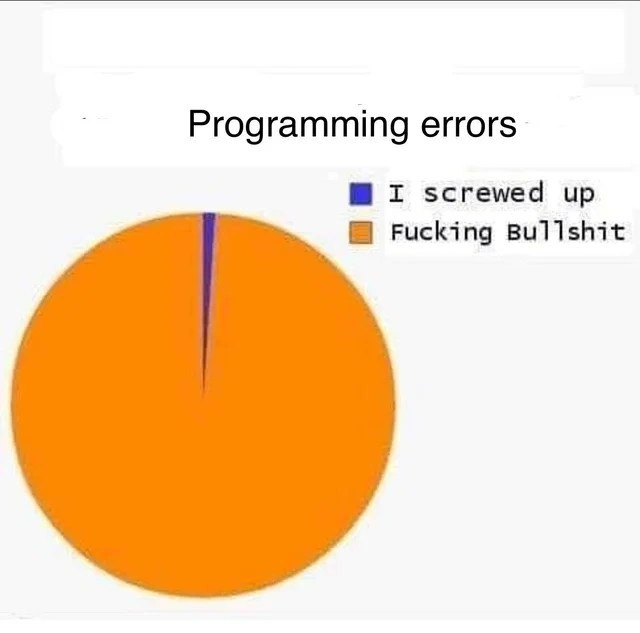
However, developers are human, and there’s a funny thing that happens when we’re confronted with a bug: we often first think, “It can’t be my fault!”. This meme exaggerates that feeling. It shows a pie chart titled “Programming errors” split into two slices. The tiny blue slice is labeled “I screwed up,” and the huge orange slice is labeled with a rude phrase “F***ing Bullshit,” meaning “some ridiculous nonsense beyond my control.” In other words, the chart jokingly suggests that 99% of programming errors get blamed on mysterious external causes, and only 1% are blamed on the developer’s own mistake. Of course, in reality, it’s usually the opposite – most bugs come from a coding mistake (our mistake) – but the humor is in how it feels during a frustrating debug session. It feels like the universe is against us and our code is perfect.

Let’s clarify some key terms and ideas here:

  • Blame culture: In some environments, people focus on assigning blame when something goes wrong (“Who messed up?”) instead of focusing on fixing the problem. The meme pokes fun at an individual version of this: the developer’s instinct is to blame anything except themselves.
  • Fault attribution bias: This is a fancy way to describe a bias where you attribute problems to external factors rather than to yourself. In psychology, there’s something called the self-serving bias – if something goes wrong, we prefer to think we did everything right and something else failed us. In debugging, this might mean thinking “the framework is buggy” or “the database must be acting up” before considering “maybe I made a mistake in my code.”
  • “Works on my machine”: This is a classic phrase in software development. It’s what a developer says when the code runs fine on their own computer but crashes on someone else’s computer or on the server. It implies, “Since it works for me, any problem seen elsewhere must be due to your machine or environment, not my code.” It’s practically an inside joke among programmers – because often the reason it “works on my machine” is that my machine has some configuration or data that the other environment doesn’t, and I forgot to account for that.

Picture a new programmer deploying an app to a server: it crashes, and they immediately think the server’s configuration is wrong – “It ran perfectly on my laptop, so the server folks must have set something up incorrectly!” This is that big orange slice of “external blame” in action. Or consider when a program gives a weird error and the coder grumbles that the library they used has a bug. Sure, libraries (pre-made code from others) can have bugs, but which is more likely: that the widely-used library is broken, or that our code used it incorrectly? Usually, it’s the latter, but emotionally it’s easier to point at the library first.

Another relatable scenario for young developers: you write some code, and a tester or colleague finds it doesn’t handle a certain case, causing a crash. Your immediate thought: “Well, who would ever enter that kind of data? The user did something crazy, that’s not my fault!” Here again, the blame is shifted outward – to the user in this case – rather than the program logic that failed to guard against that input. The proper approach would be to improve the code to handle it, but our instinct often deflects the blame.

The term debugging denial (as hinted by the context) is basically what we’re describing: being in denial that your code could be the source of the bug. The meme mocks this by quantifying denial as a pie chart. In truth, good debugging and troubleshooting practices teach us to systematically eliminate possibilities and not take it personally when our code has an issue. Root cause analysis done right is about finding what really caused the bug. Often you’ll find the root cause is a missed condition or a logical error in the code – something the developer can fix. Sometimes it might be an external issue (maybe a server was down, or an API changed without notice), but those cases are much rarer.

The developer experience of hunting a bug can be frustrating and even funny in hindsight. The meme’s popularity in DeveloperHumor circles comes from that shared frustration: every developer has had moments of cursing at the computer, convinced that “some bug in the system or freak incident” is at fault, only to later discover a simple mistake they made. By using a straightforward visual like a pie chart with absurd proportions, the meme is an easy, tongue-in-cheek summary of that emotional journey. It’s saying, “When my code fails, I’d love to blame 99% of it on crazy external problems, and only admit 1% might be my error.” It’s a playful jab at ourselves as programmers to remember to check our own work before blaming the tools or the world.

Level 3: Works on My Machine

Every experienced developer can recall a debugging war story where the initial reaction was, “No way this bug is my fault.” It’s practically a rite of passage in the Developer Experience (DX). You deploy a new feature, something breaks, and immediately thoughts race to environment issues or someone else’s code. You hear the classic refrain: “It works on my machine!” This pie chart nails that knee-jerk mindset. The tiny blue sliver labeled “I screwed up” versus the massive orange “Fing Bullshit”* slice captures the internal monologue of a programmer in denial. It’s a satire of how we divvy up blame for programming errors – basically 1% “Maybe I made a mistake” and 99% “Some incomprehensible, out-of-my-control nonsense broke it.” That orange slice represents everything devs love to curse at during debugging frustration: the framework is buggy, the API lied, the database is haunted, the OS is acting up, the user input is corrupt, mercury is in retrograde – basically, anything except my code.

This humor resonates because it’s relatable. In real life, when faced with a nasty bug, developers often cycle through a fault-attribution bias. We start by suspecting external causes. Maybe we just updated a library – surely the new version introduced a bug. Or the QA environment’s config might be off – the staging server must be cursed. It’s a form of debugging denial: it can’t be our pristine code at fault! Seasoned devs chuckle at this because we’ve all been there. We’ve blamed network latency, pointing a finger at the dreaded “It’s probably DNS” (a running joke in ops: Domain Name System issues are blamed for everything). We’ve eyed the database suspiciously – “the DB must have deadlocked” or “maybe replication lag caused weird data.” We’ve even questioned third-party services – “Payment gateway is sending bad data, not my parsing logic!”

In truth, once we cool down and do a proper troubleshooting session, we often find a very mundane cause in our own code or assumptions. The meme’s comedic genius is taking that initial emotional response and blowing it up to 99%. It’s poking fun at our fragile developer ego: admitting “I screwed up” means swallowing pride. Instead, how many times have we muttered “This is BS, it shouldn’t be happening!” as we scour Stack Overflow at 2 AM? The chart is a not-so-subtle jab at that tendency to externalize blame. It’s essentially a pie chart of the developer’s ego protection mechanism. The blue sliver is humility, and the giant orange pie is frustration-fueled blame culture.

And ironically, any senior engineer will tell you: the faster you move past that blame phase, the quicker you actually fix the bug. In modern DevOps teams, a blameless culture is encouraged, but that doesn’t mean “blame anything except yourself.” It means focusing on what went wrong rather than who screwed up. Yet here, the developer in the meme has taken “blameless” a bit too literally – by blaming the whole world except their own code. We laugh because we recognize a younger version of ourselves or that one colleague who always says, “This code should work, something else must be wrong.” Sure, occasionally the bug truly is in a library or a weird system quirk – those do happen! But nine times out of ten, when you finally find the root cause, it ends up being that you misunderstood the API, mishandled a null, had an off-by-one error, or missed a config detail. The real “developer humor” here is that painful recognition: most bugs are BugsInSoftware we wrote, yet in the heat of coding mistakes we’d rather label it “just some f***ing bullshit.”

To illustrate, consider a snippet of mythical bug-blame commentary:

result = performOperation(data);
if (result == NULL) {
    // This should never happen. If it does, the system is glitching, not my code.
    throw std::runtime_error("Impossible state reached - must be external causes!");
}

In this exaggerated example, the developer is so confident in their code that a NULL result is deemed “impossible,” and any such occurrence is preemptively attributed to “external causes.” We’ve all seen comments or logs like this – developer pain points where we assert how things should be, only to discover later that our assumptions were wrong. The meme’s pie chart is basically that comment in visual form. It highlights the hilarity of our initial self-confidence: we assume the code is correct and reality is broken. This is why the chart strikes a chord in DeveloperHumor circles – it’s funny because it’s true. Every bug-fixing session is a mini detective story, and the prime suspect is rarely our own code… until, inevitably, it is.

Level 4: Heisenbug Hypothesis

In the rarefied air of advanced debugging theory, there’s a begrudging acknowledgment that sometimes weird, external forces really do cause errors. Seasoned engineers have encountered Heisenbugs – those maddening bugs that change or disappear when you probe them, named after the Heisenberg uncertainty principle. For example, adding a printf or running a debugger thread can make a timing bug vanish. These are the “ghosts in the machine” that seem like pure mysterious nonsense. A frustrated developer might half-seriously mumble about cosmic rays flipping bits in memory – and amusingly, there’s a real term for that: a Single Event Upset, where a stray cosmic particle flips a memory bit. Systems dealing with space or aviation actually use ECC (Error-Correcting Code) memory to guard against these one-in-a-billion hardware hiccups. So in theory, that giant orange slice of “Fucking Bullshit” in the pie chart could include cosmic radiation scrambling a byte or a kernel race condition at the exact wrong moment. These are the ultra-rare root causes that aren’t your fault, the kind of anomalies that might earn a shrug in a NASA postmortem report.

Yet, if we apply Occam’s Razor to bugs, the simplest explanation is usually the correct one: you screwed up. The pie chart’s joke is a senior engineer’s inside-out view of this principle. In reality, the ratio is reversed – 99% of programming errors are our own mistakes, and maybe 1% (if that) are truly “external bullshit.” There’s a known dictum in computing akin to the medical “when you hear hoof beats, think horses, not zebras”: when a program misbehaves, suspect your code before blaming cosmic phenomena or the compiler. Even compiler bugs or OS faults are exceptionally rare compared to everyday coding mistakes. Formal methods and static analysis exist to mathematically prove software correctness, but outside of aerospace or cryptography, we rarely use them – because we accept that our code will have bugs. The gulf between provable software and everyday code means developers live with uncertainty. That’s where cognitive biases creep in: under pressure, it’s comforting to imagine the universe conspired against our flawless logic. Psychology calls this a self-serving attribution bias – we take credit for success but blame outside forces for failure. Elite SRE (Site Reliability Engineering) culture tries to combat this with blameless post-mortems, scientifically digging into causes without finger-pointing. But here, the meme’s “analysis” is ironically all finger-pointing – pointed at an unspecified, exasperating external gremlin. It’s as if the developer conducted a root-cause analysis and concluded: “The root cause is… gremlins, not me.” The humor is in knowing how absurd that is, given everything we know about how software fails.

Description

The meme is a simple white-background pie chart titled “Programming errors.” A tiny blue sliver represents one category in the legend: a blue square labeled “I screwed up.” The rest of the circle - virtually the entire chart - is orange and corresponds to an orange square in the legend labeled “Fucking Bullshit.” Visually, the disproportionate slices mock how developers often attribute almost every bug to inexplicable factors rather than their own code. Technically, it riffs on root-cause analysis, cognitive bias during debugging, and the tendency to externalize blame instead of performing honest post-mortems

Comments

6
Anonymous ★ Top Pick Bug attribution pie chart: 1% me fat-fingering the env var, 99% the legacy microservice lattice that thinks “eventually consistent” and “exactly once” are synonyms
  1. Anonymous ★ Top Pick

    Bug attribution pie chart: 1% me fat-fingering the env var, 99% the legacy microservice lattice that thinks “eventually consistent” and “exactly once” are synonyms

  2. Anonymous

    The blue slice is just big enough to satisfy the blameless postmortem requirement before we spend three hours explaining why Kubernetes, eventual consistency, and a race condition in someone else's library are the real villains here

  3. Anonymous

    After 20 years in the industry, I've learned that 'works on my machine' is just the polite version of this pie chart. The real engineering maturity comes when you realize that tiny blue sliver should actually be labeled 'what I'm willing to admit in the postmortem' - because we all know the orange section includes that time you deployed on Friday afternoon, that regex you copied from Stack Overflow without understanding, and that 'temporary' workaround from 2019 that's now load-bearing infrastructure

  4. Anonymous

    Every incident starts as “the compiler/Kafka/AWS is broken” and ends with “our non‑idempotent endpoint was wrapped in aggressive retries behind eventual consistency.”

  5. Anonymous

    Senior translation of that pie chart: 1% typo, 99% state+time - clock skew, cache TTLs, retry storms, partitions - aka my architecture working exactly as designed; git blame still points at me

  6. Anonymous

    The joke's on us: that massive slice is actually 'undocumented edge case in third-party lib v3.2.1'

Use J and K for navigation