Skip to content
DevMeme
1687 of 7435
When pull requests turn personal: a GitHub jealousy showdown developer meme
VersionControl Post #1883, on Aug 8, 2020 in TG

When pull requests turn personal: a GitHub jealousy showdown developer meme

Why is this VersionControl meme funny?

Level 1: Mine, Not Yours!

Imagine you and your best friend love working on a project together, like building a big Lego house. It’s your thing. Now picture another kid from class comes over and starts adding their own Lego rooms to your friend’s house without you. Your friend seems happy with the help, but you feel upset and a bit jealous — like, “Hey, that’s our project! What are you doing with my friend?” You might even feel so angry that you want to push that other kid away. That’s essentially the feeling this meme is joking about. But instead of Legos, it’s about writing computer code, and the people are grown-up programmers. One programmer’s girlfriend has a coding project, and another guy is helping her by contributing to it. The first guy gets irrationally jealous, as if the other person is trying to steal his girlfriend just by helping with her code. The picture shows him even grabbing and fighting the other person, which is a silly, over-the-top way to show how jealous he feels. It’s funny because it’s such an extreme and unlikely reaction – normally people wouldn’t get mad about someone helping their friend or partner with work. The meme makes us laugh at how ridiculous it would be if someone treated sharing and helping (which is usually good) like it was something to get mad and protective about. It’s a big joke about being possessive: the guy is basically saying “she’s mine, not yours!” in the nerdiest way possible, and that contrast is what makes it so goofy and relatable.

Level 2: Pull Request Rivalry

Let’s unpack the joke in simpler technical terms. The meme is talking about GitHub and pull requests in the context of a jealous relationship. First, a bit about GitHub: it’s a popular website where developers store itsy-bitsy things called repositories (repos) that contain code for projects. Git, the underlying version control system, tracks changes to that code. When developers want to collaborate, one common way is through a Pull Request. A pull request is basically when someone forked or copied your code project, made some changes or improvements, and then asks, “Hey, would you like to pull my changes into your repo?” It’s like saying, “I worked on this feature/fix for your project – do you want to include it?” The owner of the repo (in this meme, that’s the girlfriend) then reviews those changes – this is the code review process – and if everything looks good, she can merge (add) those changes to her project. Pull requests are normally a friendly, productive part of collaborative coding, especially in open source. People from all over the world might send improvements to your code. It’s usually a positive thing.

Now, the funny twist: the text says “making pull requests to your girl’s Github repos” as if that’s something scandalous. In real life, if someone is contributing to your girlfriend’s code, it should be totally fine – even cool! But the meme pretends that it’s akin to another person chatting up your girlfriend. It’s using a relationship metaphor for collaboration. Essentially, the boyfriend character is feeling threatened because another developer is paying a lot of attention to his girlfriend’s projects. It’s portrayed like a rivalry: two guys “competing” over one girl’s... code? The humor comes from treating a normal coding workflow as if it were a matter of the heart. It’s an absurd mix-up of contexts. Imagine being jealous not because someone had coffee with your partner, but because they debugged her code. 🤨 It’s silly, and that silliness is the point of the joke.

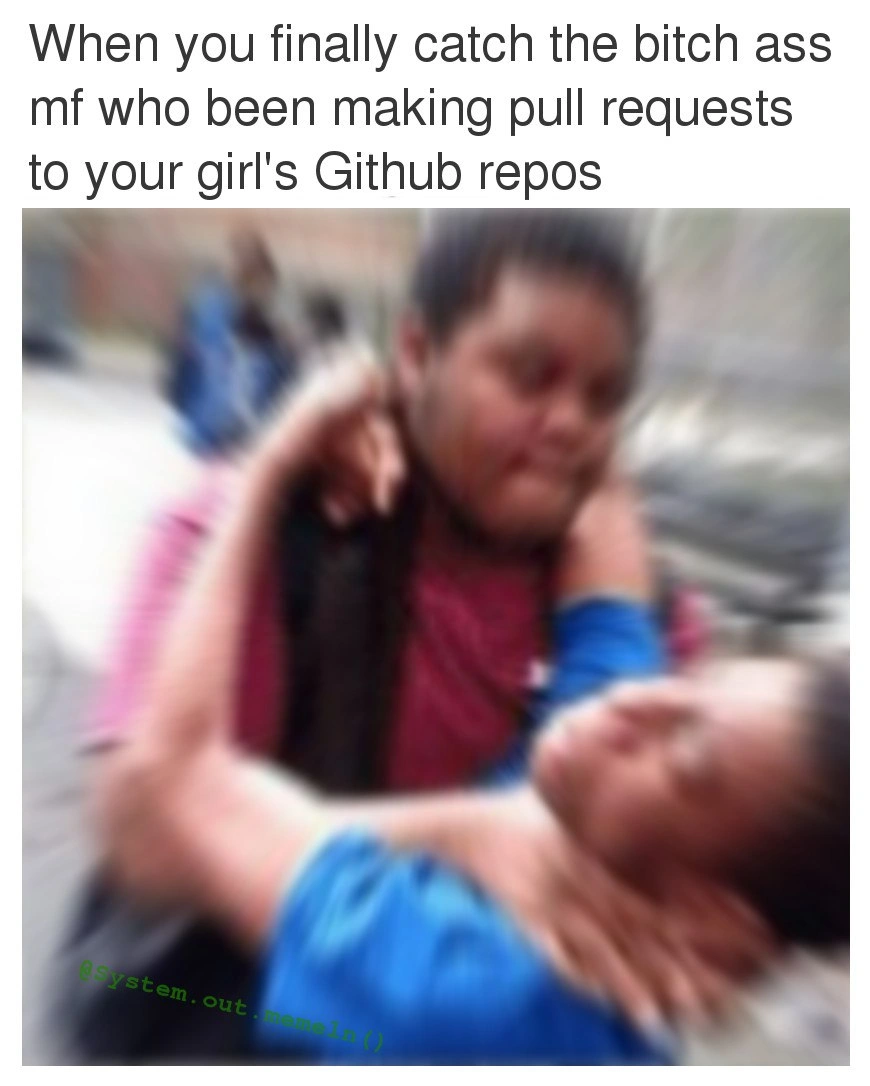
The image makes it even clearer and more ridiculous: it shows an actual fight. One person grabbing another by the neck, both faces blurred. The blur effect makes it look chaotic and intense, like a dramatic action scene. This visual is there to represent how angry and jealous the boyfriend is supposed to be. It’s like a scene from a movie where someone catches their partner’s suitor and loses it. Only here, the “suitor” was just contributing on GitHub! The extreme nature of the fight is what makes it funny – it’s a violent meme format used purely for exaggeration. No one actually fights over code like this (one would hope), but depicting it literally just amplifies the joke.

Let’s also notice the little green text “@system.out.memeln()” in the corner. This is a playful console-style text that looks like code. In Java, System.out.println("Hello") would print "Hello" to the screen. The meme’s text says memeln instead of println, as if it’s printing a meme. It’s basically the meme author’s clever tag. It signals that this image is part of a programmer’s humor page or just adds an extra nerdy flair. It’s the kind of detail only developers would immediately recognize – a tiny nod that yes, we’re nerding out here.

So putting it all together: a guy is upset because someone has been making pull requests (contributing code) to his girlfriend’s GitHub repositories (her coding projects). He’s reacting as if he caught someone flirting with or cheating with his partner, and the meme shows him physically attacking the “offender.” The categories here are CodeReviews and VersionControl because it’s specifically about the code review process on a version control platform (GitHub) being misinterpreted as something intimate. It’s a developer meme through and through – you have to know what a pull request is to get why it’s funny. The idea of code_review_jealousy or a GitHub pull request rivalry isn’t something that happens in real life; it’s a geeky what-if scenario that makes us laugh at how ridiculous it would be if someone took programming collaboration so personally. Essentially, the meme is saying: “Imagine being so possessive that even someone helping your significant other with code makes you see red.” It’s poking fun at both relationship jealousy and the sometimes ego-driven nature of programmers in a hyperbolic way.

Level 3: Open Source Love Triangle

"When you finally catch the bitch ass mf who been making pull requests to your girl's Github repos."

This meme throws us into a code review soap opera. The caption (in unapologetically spicy language) sets the stage: a developer boyfriend is livid after discovering someone else sending pull requests to his girlfriend’s GitHub repositories. In the software world, a pull request (PR) is usually a routine, even welcome event – it’s how developers propose changes to someone’s code. But here it’s framed like a romantic betrayal. The result is an absurd GitHub jealousy showdown: a normally dry version control interaction is treated as if it were an affair, complete with a physical confrontation. It’s hilarious because it warps a mundane programming task into a melodrama. Seasoned devs recognize this as a tongue-in-cheek twist on our collaborative coding culture, mixing professional workflow with soap opera theatrics.

On a technical level, GitHub is all about open collaboration: anyone can fork a repo and suggest improvements. Open source projects thrive on strangers contributing code. It’s about as far from exclusivity as you can get. That’s why the idea of getting possessive over a public repo is comically backward. It’s open source, not a secret diary. Yet this meme nails a hidden truth in exaggerated form: developers can get territorial and prideful about “their” projects. It’s poking fun at that ego-driven side of coding – the unspoken feeling of ownership that can creep in. We’ve all seen petty drama in code reviews or heard of maintainers who act like gatekeepers. Here that territorial instinct is blown way out of proportion, as if a contributor fixing bugs in your girlfriend’s code is akin to stealing her heart. The phrase "making pull requests to your girl’s repo" is a perfect double entendre: in GitHub terms it’s innocent collaboration, but phrased like that it sounds like making moves on your girl. It’s an object-oriented spin on a love triangle: boyfriend, girlfriend, and the guy contributing to girlfriend’s code.

The image under the caption drives the joke home with physical comedy. It’s a blurred action shot of one person in a blue shirt being grabbed by the neck by another in a maroon shirt. The heavy motion blur is a common meme effect to exaggerate intensity – you can practically hear the rage. In context, the guy in maroon (we can imagine he’s the boyfriend) has caught “that sneaky contributor” (the guy in blue) and is literally throttling him. It’s an over-the-top visualization of how the boyfriend feels about someone meddling with his partner’s repo. Normally, a code dispute might lead to a heated comment thread or, worst case, some office tension. Here, it escalated straight to a chokehold. Talk about taking the conflict to the physical layer. 💢 It’s a ridiculous escalation that seasoned developers find funny because it’s so out of proportion. We joke that some engineers treat their code like their baby; this meme says: they might even fight for it like it’s their girlfriend.

Another wink for the tech-savvy is the little green text in the corner: @system.out.memeln(). This looks like a play on System.out.println() from Java (a command to print text to the console), swapped to memeln. It’s essentially the meme creator’s signature, formatted like code. It says to the keen-eyed programmer, “Yes, this meme is made by and for coders.” Only developers would appreciate a Java-esque easter egg as a watermark. It’s a subtle confirmation that the whole scenario is a programmer in-joke. The combination of all these elements – romantic jealousy metaphor, GitHub jargon, and a chaotic fight image – creates a perfect storm of DeveloperHumor. It satirizes how seriously people can take code collaboration by mashing it up with how seriously people take relationships. In reality, if someone submits a stellar pull request to your partner’s project, you’d probably be thankful (free help!). But the meme imagines the opposite for comedic effect: an insecure coder seeing a rival in every contributor. It’s a lighthearted dig at both relationship possessiveness and programmer pride, rolled into one relatable joke for anyone who’s been through heated CodeReviews or messy team dynamics. In the end, it’s funny because it’s a scenario that should never happen (and hopefully never has), yet it riffs on feelings many devs recognize – a mashup of professional jealousy and personal jealousy that’s outrageously relatable once you get all the GitHub context.

Description

The meme has a white background with black text at the top that reads: "When you finally catch the bitch ass mf who been making pull requests to your girl's Github repos." Below the caption is a heavily motion-blurred photograph of one person in a blue shirt being grabbed around the neck by another person in a maroon shirt; both faces are intentionally blurred for anonymity. In the lower-left corner of the image, small green console-style text says "@system.out.memeln()". The humor comes from equating GitHub collaboration (pull requests) with romantic jealousy, exaggerating the situation into a physical confrontation. Technically, it references Git workflows, code review culture, and the social dynamics around pull requests, making it relatable to developers who use GitHub for collaborative coding
Comments

6
Anonymous ★ Top Pick This is why you enable branch protection - skip it once and your merge conflicts escalate to full-stack Layer-8 chokeholds
  1. Anonymous ★ Top Pick

    This is why you enable branch protection - skip it once and your merge conflicts escalate to full-stack Layer-8 chokeholds

  2. Anonymous

    The real merge conflict here is between maintaining healthy open source collaboration practices and explaining to HR why you're treating code reviews like a territorial dispute - though we all know the most aggressive PR comment you'll actually leave is 'LGTM with minor suggestions'

  3. Anonymous

    The real crime here isn't the unauthorized PRs - it's that they probably didn't even run the linter, failed to update the tests, and their commit messages were just 'fixed stuff.' At least have the decency to follow CONTRIBUTING.md before you start merging into someone else's relationship repository

  4. Anonymous

    Relax - he opened a PR; she’s the maintainer. The only thing that matters is whether her CODEOWNERS file still lists you

  5. Anonymous

    If your relationship is vulnerable to unsolicited PRs, your governance model needs CODEOWNERS and branch protection - stop relying on pessimistic locking on contributors and try optimistic concurrency (aka trust)

  6. Anonymous

    His PRs bypassed branch protection, but not the vibe check - or the rear naked choke

Use J and K for navigation