Skip to content
DevMeme
1685 of 7435
Fruit loops invade code via endless while loop with fruity variables
CS Fundamentals Post #1881, on Aug 7, 2020 in TG

Fruit loops invade code via endless while loop with fruity variables

Why is this CS Fundamentals meme funny?

Level 1: When Breakfast Bites Back

Imagine your parent tells you, “Don’t worry, the bogeyman isn’t real, he can’t get you.” You feel safe for a second, right? But then – surprise! – the bogeyman pops out of your closet, doing something goofy and endless like dancing in circles. You’d jump in fright and then maybe laugh because it’s so absurd. This meme’s joke works the same way for people who write computer programs. It starts by saying “fruit loops (like the cereal) aren’t real, they can’t hurt you.” That’s the calm reassurance. Then it shows a fruit loop in a computer program – a little piece of code that, just like a loop of cereal, goes round and round endlessly. It’s like the cereal came alive and is causing mischief! 🤣 The reason it’s funny is the surprise: something that sounds harmless and made-up (fruit loops) suddenly becomes real in a silly way and causes trouble by never stopping, kind of like a prank that just keeps going. For a programmer, that’s both a tiny bit scary and very funny – it’s as if your bowl of cereal started a never-ending loop-de-loop on the breakfast table.

Level 2: Emoji-coded Loops

Let’s break down what’s happening in this meme. It uses a popular joke format where someone (in this case, a therapist) says, “X isn’t real, it can’t hurt you,” trying to calm someone’s irrational fear. Here the therapist says:

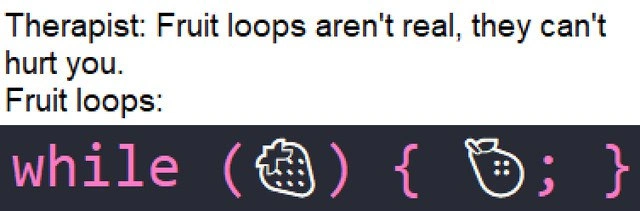
Therapist: “Fruit loops aren’t real, they can’t hurt you.”
Fruit loops: while (🍓) { 🍐; }

In the second line, “Fruit loops:” is followed by a snippet of code. This is the reveal: the meme literally shows a fruit loop in code form. The code while (🍓) { 🍐; } is stylized with a dark background and pink highlighting for the keyword while – it looks like it’s from a programmer’s text editor (many code editors highlight keywords like while, if, etc. in a special color). Now, what does this code even mean?

In programming, a while loop is a fundamental control-flow concept. It means “while a certain condition is true, do the stuff inside the curly braces { }.” It’s a way to repeat an action over and over until some condition stops being true. For example, in many languages you might see something like:

// Pseudocode example of a basic while loop
count = 1;
while (count <= 5) {
    print("Looping");   // this will execute repeatedly
    count = count + 1;  // eventually, count will be 6 and the loop ends
}

In that example, the loop prints “Looping” five times and then stops because the condition becomes false. But if the condition never becomes false, you get an infinite loop – a loop that potentially runs forever. For instance:

while (true) {
    // This loop will run endlessly because the condition is literally always true.
    // (We'd need a `break` here or some condition change to escape the loop.)
}

This is what the meme’s code is hinting at. Let’s map the meme’s symbols to real code concepts: 🍓 (strawberry emoji) is sitting inside the parentheses of the while. In code, that position is for a condition. It could be something like while (x > 0) or while (isHungry). Here it’s just a strawberry — which isn’t a typical condition! 😄 It’s likely representing a variable or value that is truthy. Maybe they chose 🍓 because it’s a fruit and we’re making a fruit loop. If we imagine 🍓 is a boolean variable named “strawberry” that is true, then while (🍓) means while (true). And while(true) is the hallmark of an infinite loop (runs forever unless there’s a manual break inside). So effectively, 🍓 is a playful stand-in for a condition that never becomes false.

Now look inside the braces { 🍐; }. Normally, between { } you’d have some code that runs each iteration of the loop. Here we just see a pear emoji followed by a semicolon: 🍐;. In many C-like languages (C, Java, JavaScript, etc.), a semicolon ; ends a statement. So 🍐; could be interpreted as “do something with 🍐” (maybe 🍐 is another variable or a function call). But honestly, in the meme it’s not doing any real work we can discern – it’s just there to fill the loop with something fruity. The semicolon is crucial though: it makes the snippet look like valid code, since in those languages you’d write something like while(condition) { doSomething(); }. Here, doSomething is humorously replaced by 🍐. It’s all about making the code look legit at first glance, except it’s full of fruit! This contrast is what makes it CodingHumor gold: it follows correct syntax but with completely absurd operands.

To a newer developer (or a student just learning), a few points might need clarifying:

  • What’s an infinite loop? It’s when a loop never stops. Usually, we want loops to eventually end – otherwise your program can get stuck. For example, if you wrote while (score < 100) { keepPlaying(); } but you forgot to ever update score inside the loop, score < 100 stays true forever and the game would freeze, stuck in that loop. In the meme, while(🍓) is likely always true, so it represents that kind of never-ending loop. This is where the infinite_loop_fear tag comes in – new coders often worry about accidentally writing one and crashing their program. It’s a rite-of-passage bug.

  • Why use emojis like 🍓 and 🍐? This is a bit of syntactic silliness. Typically, in code you name your variables with words (like isRaining or counter). However, modern languages and compilers often support a wide range of Unicode characters in identifiers. That means you can name a variable 🍓 if you really wanted to, as long as the language’s rules see that emoji as a valid letter. It’s not common practice (and might make other programmers raise an eyebrow!), but it’s possible. The meme is taking advantage of that to make a visual pun: fruit in a loop, literally a “fruit loop.” The Languages category is relevant here because different programming languages have different rules about what characters you can use in code. The meme doesn’t specify a language, but given the syntax (while (...) { ...; }), it resembles C-style languages (like Java, JavaScript, C, C++). Most of those wouldn’t normally allow emoji as variable names without some tricks, so this is likely intended as pseudocode that any coder can recognize, rather than something you’d actually compile. The focus is on the visual joke and the concept, not on it being valid in a specific language.

  • Therapist meme template: The structure “Therapist: X isn’t real, X can’t hurt you. X:” is a popular format on the internet. It’s used for humor – the therapist represents an authoritative voice saying “don’t worry, the thing you fear is all in your head.” Then the meme shows that thing in a very real or literal way. In our case, the feared “fruit loops” is a play on words. The person presumably is scared of “Fruit Loops” (maybe the cereal or just the idea of something called fruit loops messing up their code). The therapist is like, “that’s not a real thing, relax.” And then we see that thing manifest as a buggy code snippet. For a developer, the idea that a seemingly goofy concept (fruit loops) can materialize as a serious coding problem is both funny and a little too relatable.

Overall, this meme is immediately relatable to anyone who’s written code and run into loops. The control flow here is super fundamental – every intro to programming course covers while loops and the importance of making them end at the right time. Seeing a while loop with no obvious end (and no break) triggers that basic CS instinct: “Uh oh, this could go on forever!” And that’s exactly the point. By dressing up that scary endless loop as a pair of cute fruits, the meme makes a lighthearted joke: even a pear can keep your code running forever if you’re not careful! It’s a fun way to remember a serious lesson: always ensure your loop conditions will eventually fail (or you include a break), otherwise you’ve accidentally created a fruitless (or rather very fruity) loop that might just drive you loopy. 😅

Level 3: Cereal Offender

At first glance, this meme is a perfect storm of syntax humor and developer inside jokes. It takes the innocent-sounding “fruit loops” and turns it into a coder’s nightmare: an infinite loop in code. The top text sets the scene like a mock therapy session: “Fruit loops aren’t real, they can’t hurt you.” Any experienced developer smirks here, knowing that in the programming world, loops (especially endless ones) definitely can hurt. And sure enough, the punchline is a code snippet: while (🍓) { 🍐; }. This snippet looks harmlessly whimsical – it’s literally a while loop filled with fruit emojis – but to a seasoned coder it screams danger.

Why? Because it’s essentially “fruit loops” come to life as a loop in code. The while (🍓) means “keep looping while the 🍓 condition is true.” But what is 🍓 here? It’s presumably some boolean variable or expression – and given the joke, we can assume 🍓 is always true (like a constant true 🍓). That makes this a runaway loop that never ends. In real development, an intentionally endless loop might be used in an event loop or a server that runs forever with proper controls, but an accidental infinite loop is a classic bug. It pegs the CPU, hangs the application, and often forces you to kill the process. Many of us have that war story: one missing condition or forgotten break statement and suddenly a simple script is eating 100% CPU at 3 AM. Fruit loops can’t hurt you? Oh, they can – just ask the engineer who pushed a while(true) bug to production and spent the night dealing with the fallout. This meme cleverly personifies that fear of infinite loops with cute fruits, poking fun at how even the silliest-sounding bug can be very real.

The choice of 🍓 (strawberry) and 🍐 (pear) is pure syntax whimsy. In many programming languages (especially modern ones like Python 3 or JavaScript ES6+), you technically can use Unicode characters – even emojis – as variable names. So this could be valid code if 🍓 was a variable set to true and 🍐 was some function or statement. Seeing a strawberry as a loop condition and a pear as the sole statement inside the loop is hilariously absurd. It’s a literal fruit loop! The humor isn’t just in the pun; it’s in the contrast between how innocent those fruity symbols look and the menace an endless loop represents in software. Seasoned devs have a dark chuckle at this: we’ve all written loops that unexpectedly never stopped, and the idea of needing a “therapist” to tell us our code fears are unfounded hits close to home. The meme format (therapist says the fear isn’t real, then it appears in code) exaggerates the situation we’ve lived through: “Don’t worry about that silly bug, it’s not real” — and then boom, the silly bug is very real and crashing your app. It’s a tongue-in-cheek nod to how even experienced engineers sometimes have irrational-sounding worries (“What if this minor change creates an infinite loop?”) which, on rare occasion, do come true in spectacular fashion.

This joke also highlights a bit of programming culture: we often give humorous names to scary problems. “It’s not a bug, it’s a feature,” or in this case, calling an endless loop a “fruit loop” as if it’s something harmlessly colorful. There’s an almost cathartic laughter in seeing a dreaded control-flow problem dressed up as a bowl of cereal. It reminds veteran developers of the countless times they’ve had to hunt down a loop that wouldn’t terminate. It’s both a pun and a cautionary tale: loops are fundamental in programming languages, but if you’re not careful, you’ll end up with a “cereal” offender in your code base – a seemingly fun piece of code that just won’t stop and has everybody going in circles.

Description

The meme is composed of two sections. 1) On a white background, black text reads: "Therapist: Fruit loops aren't real, they can't hurt you." followed by a line break and "Fruit loops:". 2) Beneath that, a dark-theme code snippet spans the width: the keyword "while" and the punctuation are highlighted in pink, forming "while ( 🍓 ) { 🍐 ; }" where a strawberry emoji stands in for the loop condition and a pear emoji plus semicolon sit inside the braces. The visual gag turns the breakfast cereal name "Fruit Loops" into a literal control-flow loop, poking fun at developers' fear of runaway while-loops and quirky variable choices. The humor relies on basic programming language syntax and control-flow fundamentals, making it immediately relatable to anyone who has wrestled with infinite loops or playful code styling
Comments

6
Anonymous ★ Top Pick Yes, it passed code review - until the pager reminded us that while(🍓){🍐;} is just a Unicode-obfuscated spin-lock you can’t grep for
  1. Anonymous ★ Top Pick

    Yes, it passed code review - until the pager reminded us that while(🍓){🍐;} is just a Unicode-obfuscated spin-lock you can’t grep for

  2. Anonymous

    This is the same bug that took down production last Tuesday, except that time it was while (user.isActive) { user.isActive; } and somehow passed three code reviews because everyone assumed it was pseudocode

  3. Anonymous

    Every senior engineer has that one production incident where a seemingly innocent loop condition evaluated to truthy when it shouldn't have, bringing down the entire service at 3 AM. The real trauma isn't the infinite loop itself - it's explaining to the post-mortem why a fruit emoji made it past code review and into production, and why your monitoring didn't catch the CPU pegging at 100% until customers started complaining. At least with actual Fruit Loops, you know when to stop eating; with these, your process just keeps consuming resources until the OOM killer shows mercy

  4. Anonymous

    Therapist: fruit loops can’t hurt you. Prod: while(🍓){🍐;} - emoji DSL shipped, event loop starved, CPU at 100%, SLOs pulped

  5. Anonymous

    It’s basically while(true) with a no‑op body - the cutest way to peg a core and dodge grep, because the culprit variable is literally 🍓

  6. Anonymous

    Therapists forget: strawberry emojis are eternally truthy, turning 'quick loops' into prod pagers at 3AM

Use J and K for navigation