MySQL Becomes OurSQL Under New Management
Why is this Databases meme funny?
Level 1: When Mine Becomes Ours
Imagine you have a big jar labeled “My Cookies” that only you are supposed to eat from. It’s your special stash, and you keep the lid tight. Now, suppose one day the teacher comes along and scribbles out the word “My” and writes “Our Cookies” on the jar instead. Suddenly, every kid in class is allowed to reach in and grab a cookie. It’s no longer just yours; it belongs to everybody. How do you think that goes? Pretty soon, your cookie jar might be almost empty, crumbs everywhere, and you’re not even sure who took the last chocolate chip!
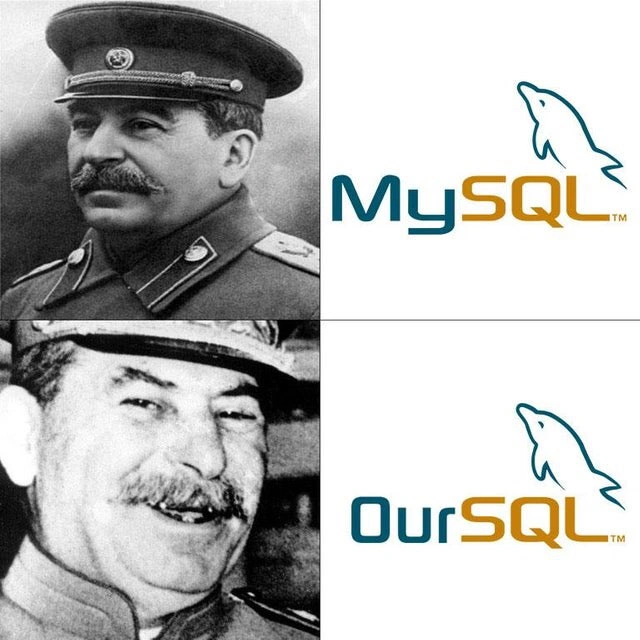
This meme is joking about that kind of situation, but with a database (a big digital storage for information) named “MySQL.” Normally, “MySQL” sounds like it’s my personal thing. The joke changes the name to “OurSQL” to show that now it’s our thing – meaning anyone and everyone can use it. It’s funny because one simple change (like giving all your classmates permission to grab cookies, or giving all users permission to grab data) flips something private into a free-for-all. The picture of the smiling guy (a historical figure, Stalin) and the changed label is like saying, “See? With one quick edit, my special stuff became our shared stuff!” It makes us laugh because we know sharing something that was meant for one person can become crazy really fast – just like a cookie jar meant for one kid would empty out in no time if the whole class got to share it. It’s a silly way to show why giving everyone total access to something that used to be private can be a recipe for chaos (and comedy).
Level 2: All-Access Granted
Let’s break down what’s happening here in plain technical terms. MySQL is an open-source relational database management system – essentially software that stores data in tables and lets you query it using SQL (Structured Query Language). It’s often used to hold everything from user accounts to product inventories for applications. Now, in a typical setup, a DBA (Database Administrator) controls who can do what in the database. They create user accounts for the database and grant privileges (permissions) to those accounts. For example, one user might get read-only access to a specific database, while another gets permission to update certain tables. These privileges are usually restricted to just the parts of the data each team or application needs, especially in big organizations – this is part of keeping data safe and organized.
When we talk about global privileges in MySQL, we mean permissions that apply everywhere on that database server, across all databases and tables. MySQL’s privilege system is hierarchical: you can grant rights at the database level, table level, or even globally. The syntax GRANT ALL ON *.* is basically a command to give ALL privileges on everything (the *.* is a wildcard meaning “all databases, all tables”) to a user. Here’s what that might look like in practice:
-- The "nuclear option" in MySQL: give a user full access to absolutely everything.
GRANT ALL PRIVILEGES ON *.* TO 'shared_user'@'%';
In the above example, 'shared_user'@'%' would be the account that’s getting superpowers (the '%' means this applies no matter which host the user connects from). After this command, shared_user can basically do anything: read any table (SELECT), modify data (INSERT/UPDATE/DELETE), change schemas (ALTER tables), even drop entire databases. It’s equivalent to making that user a root-level superuser in the database. This is not a common or recommended thing to do unless you really trust that user (or you’re feeling lucky), because it bypasses all those carefully set walls between projects. In normal practice, if we had multiple projects or clients on one MySQL server (a multi-tenant setup), we’d keep their access separated – like having different locked rooms in the same house. GRANT ALL ON *.* basically unlocks every door in the house for that user.
The meme jokes that by doing this, the DBA turned MySQL into “OurSQL.” The wordplay is straightforward: “My” SQL implies one person’s or one team’s database (like my own database), whereas “Our” SQL implies it’s now everyone’s shared database. In other words, what used to be a single-tenant setup (dedicated to one tenant, or one set of users) suddenly became a shared resource for the whole group. It’s like going from a personal laptop to a public computer lab overnight. Every developer or team can now peek into or mess with what’s inside. This data ownership shift is essentially what the meme is highlighting. One moment it was my data silo, and a single command later it’s our free-for-all sandbox.
We should also explain the left side images briefly. Those are actually a famous example of Soviet photo editing. In the top-left, Stalin is shown with a close associate; in the bottom-left, that associate has been literally erased from the photo in a later publication – historically, this was done when someone fell out of political favor. The meme references this as a tongue-in-cheek analogy. “Erasing a comrade from the picture” is likened to erasing the word “My” from MySQL. In both cases something (or someone) that used to be there (the comrade, the notion of personal ownership) is gone as if it never existed. Stalin’s slight smirk in the altered photo pairs comically with the new OurSQL logo on the right – as if he’s grinning at what he’s pulled off. The MySQL logo edit to “OurSQL” isn’t an official thing; it’s just an image edit for this joke. There isn’t really a product called OurSQL. But seeing the logo changed that way drives home the joke visually: with a simple edit (or a quick command), My SQL turned into Our SQL.
For a junior developer or someone new to databases, the take-home message here is: be careful with broad privileges. It might be tempting to fix a permissions issue by saying “Ah, I’ll just give everyone full access so nothing is blocked.” But that’s like removing the door of a safe because someone lost the key – sure, now everyone can get in, but you’ve lost security and control. In database terms, when every query is allowed and every user is a superuser, you risk conflicts (one team might accidentally modify another team’s data) and it becomes very hard to track down problems (since everyone has their hands on everything). The meme exaggerates this scenario to make us laugh and cringe: the DBA solved a problem in the most overkill way possible, and MySQL (mine) became OurSQL (everyone’s) with the stroke of a key.
Level 3: The People’s Database
At first glance, this meme looks like a mashup of database humor with a dash of Soviet-era historical context. On the right, we see the familiar blue-and-orange dolphin logo of MySQL (a popular open-source relational database) in two states: first labeled “MySQL™” and then edited to read “OurSQL™”. On the left, there’s Joseph Stalin in an infamous pair of photos – in the top one he’s accompanied by a colleague, and in the bottom the colleague has vanished, air-brushed out as if he never existed. The joke draws a parallel between rewriting history and rewriting database ownership: a single authoritative action makes someone disappear in one case, and makes private data collectively owned in the other. It’s a clever visual metaphor mapping a find-and-replace of “My” with “Our” onto the drastic act of purging a comrade from a photo. In true IndustryIrony fashion, what was “My” SQL suddenly becomes “Our” SQL, as if the database has been collectivized for the people. Comrade Stalin’s sly grin in the bottom-left suggests he’s quite pleased with this turn of events, and seasoned engineers can almost hear him saying, “Congratulations, comrade, your data is now ours!”
For the veteran DBA or developer, this hits close to home. We’ve all seen that one panicked admin who, late at night, issues the dreaded carte blanche command: GRANT ALL ON *.* (perhaps to $USER@% with a shrug) – effectively handing out an all-access pass to the entire database server. Because what could possibly go wrong? Suddenly, a single-tenant MySQL instance (meant for one application or team) turns into a free-for-all multi-tenant environment. In an instant, MySQL isn’t just “mine” – it’s everybody’s shared playground. The meme’s punchline calls it “OurSQL overnight,” implying that with one trigger-happy privilege grant, the database magically belongs to everyone. This is funny in the dark-humor way that makes DevOps engineers smirk and cringe at the same time. It’s the DB equivalent of declaring “our code” on a project where commit access was just given to the whole company. Experienced folks recognize this as the nuclear root option: instead of carefully delegating limited rights, someone grants global privileges across the board. The result? Collective query chaos. Everyone now has the power to SELECT, DROP, and ALTER anything. It’s like Oprah showed up in your data center going “You get a query! You get a query! Everyone gets to run DROP TABLE!”
The humor also leans on the absurd ease of this transformation. In the meme, Stalin didn’t host a committee meeting to rewrite history – he just had the photo edited. Likewise, a DBA didn’t rewrite the app architecture or set up proper data sharing – they simply ran a one-liner and presto, history (or in this case, access control) is rewritten. That dolphin logo changing from MySQL to My OurSQL is basically a logo-level wordplay for how trivial it was to switch ownership: just a quick text edit, as if the DBA literally did a find-and-replace on the system from “my” to “our.” This tickles the tech funny bone because it rings true: we know critical systems shouldn’t be changed with a slapdash command or a macro, yet in crunch time that’s exactly what happens. The industry irony here is that while every Database Administrator preaches the principle of least privilege (give each user only the minimum access they need), real-life pressures can lead to moments of “Just make it work now, we’ll clean up later.” Of course, “later” often never comes, and that quick fix becomes a lasting piece of technical debt. Seasoned engineers laugh (or groan) because they’ve inherited systems where some bygone DBA granted ALL PRIVILEGES to everyone and promptly forgot about it. It’s all fun and games until an intern accidentally runs DROP DATABASE prod because, hey, they could. In a way, the meme’s scenario is the database world’s version of rewriting the rules overnight – a bit of dark comedy that Stalin himself might approve of (at least when he’s the one holding the OurSQL keys). And just like those vanished comrades in old photos, the original notion of personal, contained data access is gone without a trace – replaced by a new reality where everyone owns everything, and no one truly owns anything.
Description
This is a two-panel meme that uses pictures of Joseph Stalin in the style of the 'Drake Hotline Bling' approval format. In the top panel, a black-and-white photo shows a stern, disapproving Stalin next to the official blue and orange MySQL logo, which includes a dolphin icon. In the bottom panel, a different photo shows a smiling, approving Stalin. Next to him is a modified version of the logo where the text 'MySQL' has been changed to 'OurSQL', while the dolphin and color scheme remain the same. The joke is a wordplay pun that connects the database name 'MySQL' to the communist ideology personified by Stalin. The possessive 'My' is associated with individualism and capitalism, which Stalin disapproves of. In contrast, 'Our' represents collective ownership, a core tenet of communism, thus earning his approval. It's a simple but effective meme that combines a well-known tech brand with a historical/political trope for humorous effect
Comments
7Comment deleted
That moment when the DBA denies your request for a new database and tells you to use the shared 'dev' instance. Welcome to OurSQL, comrade
Nothing like a late-night `DROP USER` followed by a press release to remind the team that data collectivism starts with a single dictator DBA
OurSQL: where every query runs with exactly the same performance regardless of indexes, and the query planner redistributes your JOINs equally among all tables whether they need them or not
When Oracle acquired Sun Microsystems and MySQL in 2009, the open-source community's anxiety about corporate control led to MariaDB's creation - a fork maintaining the original spirit. This meme brilliantly captures that tension: MySQL under corporate ownership versus the community's desire for collective stewardship. It's the database equivalent of 'seizing the means of production,' except instead of factories, we're talking about ACID-compliant storage engines. The real irony? Both still use the same InnoDB engine, proving that no matter who owns the trademark, the actual workers (developers) keep the infrastructure running
ADR: ‘Single shared MySQL to reduce duplication’ - coupling-as-a-service; expect GRANT ALL, cross‑team migration summits, and outages with a company‑wide blast radius
Every “data democratization” OKR eventually reads: GRANT ALL PRIVILEGES ON *.* TO 'everyone'@'%' WITH GRANT OPTION - congrats, you’ve migrated from MySQL to OurSQL and opened a new audit backlog
MySQL for capitalists, OurSQL for comrades: 'From each commit according to ability, to each query according to need.'