The C# Pickup Line Explaining Programmer Singledom
Why is this Languages meme funny?
Level 1: When Nerds Flirt
Imagine you want to tell someone you think they’re cute, but instead of just saying it, you do it in a secret code that only your friends understand. 🥴 That’s exactly what’s happening here. The programmer is basically calling the person a “cutie” – but he’s saying it in computer language. It’s like if a kid used a made-up spy code or a different language to give a compliment. The message “you’re cute” got lost because the other person doesn’t have the decoder ring! We, the tech-savvy onlookers, can see both sides: it’s a clever little code joke and an awkward fail at the same time. The humor is really simple: the guy is answering his own question about being single by showing us why – he tried to be romantic using mumbo-jumbo only he finds charming. It’s a goofy reminder that if you ask someone out using words they don’t understand, you might just end up talking to yourself in an empty line.
Level 2: Queue<T> Means Cutie
Let’s break down the geeky goodness of this joke. The meme’s tweet is written in the syntax of C# (C-Sharp), a popular programming language in Microsoft’s .NET ecosystem. In C#, you can create generic collection classes that work for any data type. The notation <T> is a placeholder for a type, so Queue<T> literally means “a Queue of some arbitrary Type.” For example, a Queue<int> would be a queue that holds integers, and Queue<string> holds strings. The reason it’s called generic is that the code for a Queue can handle any data type uniformly – a core concept in programming known as a generic type reference (in formal terms, parametric polymorphism).
Now, a Queue in computer science is a basic data structure that follows a rule called FIFO (first-in, first-out). Think of a line of people waiting to buy movie tickets: the first person to get in line is the first person to get served. A programming queue works the same way – you add items to the back of the queue, and when you remove an item, it comes off the front. C# even has a built-in Queue<T> class in its collections library (System.Collections.Generic) to handle this. It’s a fundamental concept taught in any CS_Fundamentals course, alongside other collections like stacks (last-in-first-out), lists, etc. So in the tweet’s question, when he says “generic first-in-first-out collection type in C#”, he’s precisely defining what a Queue<T> is in very formal terms – as if that jargon will impress his "babe." 🙃
Here’s where the queue_pun comes in: the word “Queue” is pronounced just like the letter “Q.” So when you say Queue<T> out loud, it sounds like “Q T.” And “QT” is common shorthand (especially in texts and internet slang) for “cutie,” meaning an attractive or endearing person. It’s a classic play on words. The programmer’s pick-up line essentially translates to: “Hey, are you a [queue] in C#? Because you’re a QT (cutie).” The joke relies on that homophone – if you only see the written code and know programming, you’ll recognize the Queue<T> and maybe mentally pronounce it. If you hear it spoken, you catch the flirty “cutie” compliment hidden in the technical terminology. It’s a nerdy double-entendre!
To appreciate why this is funny (and awkward), you have to understand both sides of the reference. On one side, Queue<T> is a totally legit csharp_collection class name. Any DotNet developer or coding student would recognize it and know it’s not something you usually call a person. On the other side, saying someone is a “cutie” is a cheesy but harmless compliment. The humor comes from mixing these two worlds in a single sentence. It’s the epitome of a programmer_pickup_line: it starts like pure tech gibberish and ends as a hidden sweet talk. For a fellow coder, this contrast is hilarious – you go from scratching your head at why romance and data structures are being mixed, to cracking up when you realize Queue T == QT. It’s a little puzzle where a LanguageQuirks feature (generics syntax) is the key to solving it.
However, the meme is also subtly poking fun at the social outcome of using such a line. Imagine the blank look a non-programmer would give if you earnestly asked them, “Are you a generic first-in-first-out collection?” They’d probably think you’re speaking in tongues (or just making zero sense). The joke highlights a bit of truth in tech circles: developers sometimes have an unintentional talent for turning a simple idea (like “you’re cute”) into a super convoluted expression. We find it funny as an inside joke, but it doubles as relationship_humor_in_tech — showing how a nerdy approach to flirting can backfire. In plain terms, the meme answer to “Why am I single?” is: Because when you try to flirt, you do it in code! And unless your crush also speaks fluent C#, that attempt will likely go 404 (not found) in translation.
Level 3: FIFO Flirting Fiasco
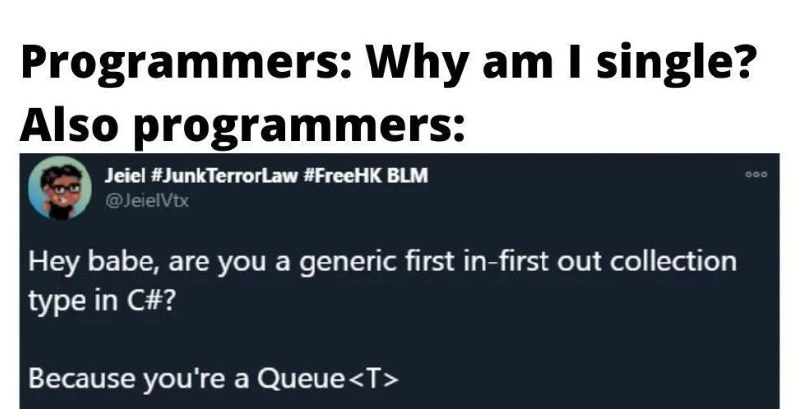
At first glance, this meme is a perfect storm of DeveloperHumor and social self-sabotage. The top text sets up a classic irony: “Programmers: Why am I single? Also programmers:” – a format where tech folks unknowingly answer their own question. In the screenshot below, a programmer drops an ultra-nerdy pick-up line:
Hey babe, are you a generic first-in-first-out collection type in C#?
Because you're a Queue.
For experienced devs, this lands as a hilariously cringeworthy one-liner. Why? It mashes together a fundamental CS_Fundamentals concept (the Queue data structure) with a LanguageQuirks pun (C#’s generic <T> syntax) to call someone a “cutie.” The humor works on multiple levels: a senior developer immediately recognizes Queue<T> as a C# generic collection, and hears “Queue-T” as “QT” (internet slang for cutie). It’s a clever technical homophone. But at the same time, we can’t help but wince because the line is so geeky that it practically explains why the poor programmer is single. In other words, the meme is laughing at our tendency to mix coding jargon with romance, a notorious relationship_humor_in_tech faux pas that only fellow coders find amusing.
This programmer_pickup_line perfectly captures the awkward charm of developer courtship rituals. Seasoned engineers have seen (and maybe even attempted) similar stunts: comparing a crush to an elegant algorithm, or expressing affection in binary. Here the author went all-in on a queue_pun. A queue is a “first in, first out” (FIFO) container – basically a waiting line – but of course he isn’t literally asking if she’s a data structure. He’s bending the technical term into a phonetic compliment. The absurd formality of “generic first-in-first-out collection type” sets us up, and then the punchline Queue<T> delivers the double meaning. Among developers, this kind of wordplay is CodingHumor gold: it rewards those who know the lingo. We chuckle because we get it – it’s like a secret handshake for .NET geeks.
Yet, the meme’s punch is in the juxtaposition: the programmer earnestly wonders “Why am I single?” and then promptly answers with a live demonstration. It’s a self-own that senior devs find all too relatable. We’ve learned (perhaps the hard way) that what’s charming in a DeveloperMemes thread might flop horrendously in real life. The meme is essentially pointing out a common anti-pattern in a dev’s love life: treating a romantic interaction like it’s an inside joke at a hackathon. It highlights that gap between how programmers think (“this pun is brilliant!”) and how the rest of the world reacts (blank stare, awkward silence). It’s both funny and a little tragic – the single_programmer_meme trope exists for a reason.
On a deeper level, there’s an element of pride and folly here that senior engineers recognize. We spend years mastering complex concepts like generic_type_reference in C#, we know our data structures inside-out, and we’re proud of that knowledge. So proud that sometimes we can’t resist shoehorning a CS reference into everyday conversation, even flirtation. It’s like deploying a highly optimized algorithm in completely the wrong context. 😅 The result in the meme is a facepalm-worthy flirt fail that fellow devs find hilarious precisely because it rings true. The industry’s culture often celebrates clever codeplay and puns – just browse any DeveloperJokes forum – but it also collectively cringes knowing these quips usually only impress other programmers. In short, this “Queue” gag is a humorous cautionary tale from a senior perspective: just because something is technically clever doesn’t mean it’s socially smooth. If you’ve ever tried a line like this, you’ve basically dequeued your date’s interest before it even had a chance to enqueue. Real-life romance doesn’t operate on a LIFO or FIFO basis – it operates on not making your crush feel like they need a computer science degree to talk to you!
Description
A classic two-part meme format. The top line reads 'Programmers: Why am I single?'. The bottom line, 'Also programmers:', introduces a screenshot of a tweet. The tweet, by user Jeiel (@JeielVtx), delivers a nerdy pickup line: 'Hey babe, are you a generic first in-first out collection type in C#? Because you're a Queue<T>'. The humor is rooted in a technical pun specific to the C# programming language. 'Queue<T>' is the syntax for a generic 'Queue' data structure, a First-In-First-Out (FIFO) collection. When read aloud, 'Queue<T>' sounds identical to 'cutie'. The joke is that this type of pickup line, while clever to a fellow C# developer, would be completely incomprehensible and likely off-putting in a normal social context, thus humorously answering the programmer's question of why they are single. It plays on the stereotype of programmers being socially awkward or overly engrossed in their technical world
Comments
12Comment deleted
A good pickup line should have O(1) complexity for understanding. This one requires recompiling the entire social context and still ends with a type mismatch exception
My dating life resembles our production message queue: technically FIFO, but the consumer’s been in exponential back-off since 2015, so every message just dead-letters to “FriendZone.”
After 15 years of explaining to stakeholders why we can't just 'make it work like Facebook,' the only queue I'm familiar with is the one for my pull requests waiting for review - at least that one has a deterministic dequeue operation and doesn't ghost me after three dates
The real reason this pickup line fails isn't the Queue<T> reference - it's that any senior engineer knows you should be using IEnumerable<T> for the interface, not the concrete implementation. Tight coupling kills relationships faster than bad puns
Opened with "Are you a Queue<T>?"; she said, "No, a priority queue with preemption." My task got starved and GC'd
Hearts like std::queue: FIFO affections dequeue into friendzone oblivion before you even poll
Pro tip: flirting in .NET with Queue<T>? Switch to ConcurrentQueue<T> so at least the rejection is thread-safe and non-blocking
Because he won't tolerate stupid girls? Comment deleted
this question is the answer to the original one Comment deleted
He doesn't want to have segg Comment deleted
At least not Qt Comment deleted
fr Comment deleted