Production Issues Inevitably Ruining a Developer's Weekend
Why is this OnCall ProductionIssues meme funny?
Level 1: Weekend Rescue, No Rest
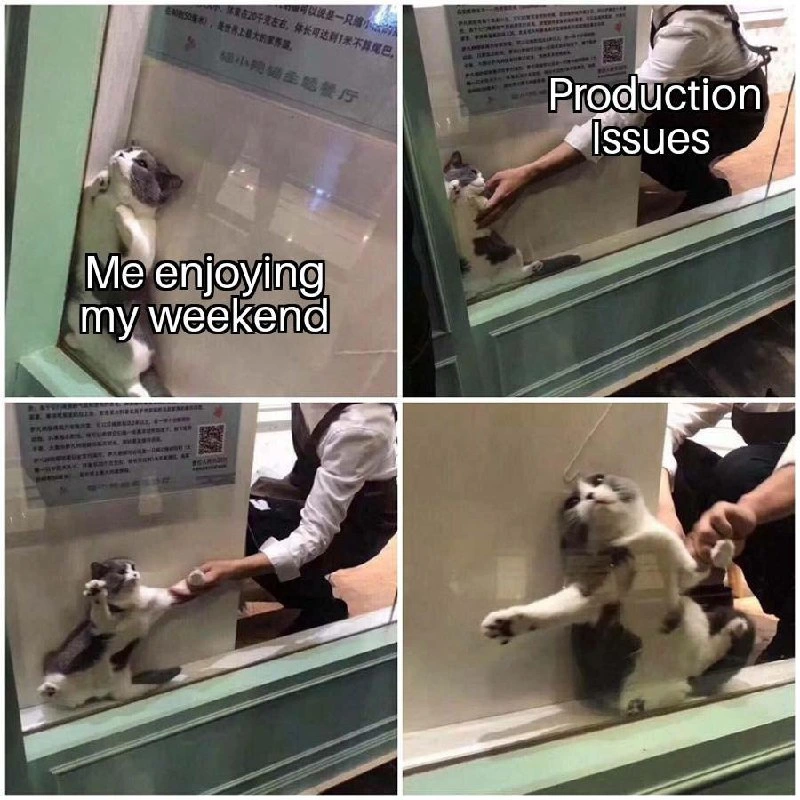
Imagine you’re playing happily on a Saturday, without a care in the world, and suddenly an emergency comes up that pulls you away from your fun. Maybe you’re watching your favorite cartoon and a pipe bursts in the house, so your parent calls you to come help hold the flashlight. You go from relaxed and smiling to anxious and rushing in a split second. That’s what’s happening in this picture. The cat thought it was safe and cozy behind a glass wall (like you enjoying your free time), but a big problem showed up and grabbed it out of its peaceful spot. The poor cat’s eyes and body are all surprised and sprawled out – it clearly didn’t want to be taken away! This is funny because we feel the cat’s shock and can relate to it: nobody likes being yanked away from something enjoyable to deal with a sudden problem. It’s like when you’re at the beach building a sandcastle and a huge wave comes and forces you to run – unexpected and unwelcome. In simple terms, the cat’s weekend was ruined by something urgent, and that mix of surprise, frustration, and a little bit of silliness makes us laugh.
Level 2: When PagerDuty Calls
This meme shows a very relatable situation for developers and IT folks, especially those in DevOps or SRE (Site Reliability Engineering) roles. In simpler terms, it’s about being “on-call” for work and getting pulled away from your personal time when something goes wrong with the software or website you’re responsible for. Let’s break it down: the cat in the picture represents an on-call engineer (which could be any developer who’s been assigned to monitor and fix issues). The cat looks relaxed behind a glass panel in the first frame with the caption “Me enjoying my weekend.” This means the engineer is off work, maybe at home on a Saturday, feeling safe and chill. The “glass” can be seen as the thin boundary between their work and personal life – basically, time off that they hope won’t be interrupted.
Now, enter the villain of the story: the second frame labels a reaching hand as “Production Issues.” Production refers to the live, real-world environment where an application or website runs for users. A “production issue” means something’s broken or not working right in that live environment – for example, the website is down, users are seeing errors, or some critical feature isn’t functioning. In tech companies, when such an issue happens, you can’t wait until Monday to fix it, especially if it impacts customers. It has to be addressed ASAP, even if it’s late at night or during the weekend. That’s why many teams have an on-call rotation: a schedule that assigns someone to be responsible for handling emergencies outside normal hours. When you’re the on-call person, you carry a special phone or have an app like PagerDuty set up to alert you if a problem arises. PagerDuty (named after old-school pagers) is a popular service that will call, text, or push an alert to the on-call engineer when monitoring tools detect something wrong. It’s like an alarm system for software: if a server goes down or an error rate spikes, PagerDuty makes sure a human is notified immediately.
In the meme’s third and fourth panels (the bottom row), we see the cat being forcibly pulled out through a slot in the glass. Its paws are outstretched, and it clearly does not want to go – the cat looks completely alarmed and panicked. This is labeled in the image through context as the on-call engineer being dragged into work mode by the production issue. In real life, this is what it feels like when you get that dreaded call on your day off: one minute you’re carefree, the next minute you’re frantically logging into work systems to diagnose a problem. We often call this jumping into “firefighting” mode, because it’s like being a firefighter who has to drop everything and rush to put out a fire. Importantly, there’s usually a process called incident escalation: if the primary on-call person (say, the cat) doesn’t respond within a few minutes (maybe they didn’t hear the phone, or they are truly unavailable), the system will escalate the alert to another person, like a backup on-call. That ensures someone gets “grabbed” to fix the issue. In the meme though, it’s shown as inevitable – the hand will get that cat, just like a serious production problem will keep alerting and calling until an engineer answers.
For a junior developer or someone new to this concept, here are the key terms and why this scenario happens:
- On-call Duty: This means being available during off-hours to respond to emergencies. Companies set up rotations so this responsibility is shared; you might be on-call one week, and your teammate the next. While on-call, if something breaks, you’re the first responder. It’s like being a doctor on call or a firefighter: you hope nothing happens, but you have to be ready if it does.
- Production Environment: This is where the live application runs – real users, real data. It’s different from development or testing environments. So a production issue is a real problem affecting users or critical systems. Fixing it is high priority, which is why it can’t wait.
- PagerDuty Alert: PagerDuty is just one brand (others exist too) of an alert system that contacts the on-call person. In the past, an on-call engineer might carry a physical pager (a small device that beeps or vibrates when called). Nowadays, it’s usually an app, but we still say “paged” or “got a page” meaning “I got an urgent alert from the monitoring system.” When that alert comes, it’s often very loud (on-call folks set loud ringtones or vibrations) because you might be asleep or not looking at your phone. The alert includes info about what’s wrong (like “CPU 95% on server XYZ” or “Error rate exceeded threshold”).
- Production Firefighting: This is a slang way to describe fixing urgent issues in production — like fighting a fire. It’s not literal fire; it just feels urgent and important. You might also hear these events called “incidents” or “outages,” and fixing them is sometimes called “incident response.” People have checklists or runbooks to follow: steps to diagnose the issue, mitigate the problem (maybe by restarting a service or rolling back a recent change), and ultimately fix the root cause.
- Context Switching: This means changing your focus from one task to a very different task. Here, the context switch is from relaxation to high-intensity problem solving in a snap. Context switching is hard because your brain has to drop whatever it was doing (like watching a movie or sleeping) and fully engage with a complex technical issue, often under stress. That’s why the cat looks so startled! It’s a visual representation of how jarring that switch can be.
- Work-Life Balance: This refers to having a healthy boundary between your job and your personal life. Everyone needs time to relax and recharge. Being on-call can make work-life balance tricky, because even when you’re “off,” you might still be interrupted by work issues. Companies encourage things like rotations (so you’re not on-call all the time) and compensating on-call work (days off later or extra pay) to make up for the inconvenience. Some places also avoid deploys or big changes right before weekends or holidays, precisely to reduce the chance of these rude surprises. The meme highlights the struggle to keep that balance: the poor cat thought it could enjoy personal time, but the job had other plans.
So, basically, the meme uses a funny cat scenario to depict a not-so-funny reality of being an on-call developer. If you’re new to software engineering, it’s a glimpse of what might await you in certain roles. Imagine it’s a quiet Sunday afternoon. You’re an SRE responsible for an e-commerce website’s reliability. Suddenly, you get an alert on your phone: the website is down for many users! Your heart jumps (just like the cat’s expression) because you have to drop everything and respond. Maybe you have to open your laptop, VPN into the company network, check logs, all while adrenaline is rushing. You fix the issue after an hour or two, but by then your peaceful weekend mood is pretty much gone. That scenario is essentially what’s being dramatized in the meme.
Why do developers find this meme so funny? It’s because it’s a way to laugh at something that’s normally stressful. It’s TechHumor mixed with a bit of therapy – seeing that image, anyone who’s been yanked out of bed by a 3 A.M. outage will chuckle and think, “Haha, that cat is me… I know this feeling too well.” It builds camaraderie. Even if you’re a junior dev who hasn’t been on-call yet, you might have heard teammates talk about “getting paged” or “having to work on a weekend due to an incident.” This meme gives you a visual for that experience (and maybe a warning!). And of course, using a cat makes it lighter. Cats are popular in memes and developer culture; they’re expressive and often used to represent ourselves (perhaps because developers sometimes feel as independent and mischievous as cats). In this case, the cat’s unhappy, shocked face perfectly symbolizes how it feels to suddenly get an urgent task dropped in your lap when you least expect it.
One more thing: the text on the meme – “Me enjoying my weekend” vs. “Production Issues” – is very straightforward, which helps anyone understand the scenario quickly. Even without deep tech knowledge, you can guess: “Oh, something about enjoying the weekend and then some problem dragging the person out.” The incident_escalation and ruined_weekend tags given with the meme basically confirm that interpretation: an incident (problem) escalated (grew urgent enough to call someone) and ruined the weekend. The forced_context_switch tag also highlights that concept of being forced to switch gears quickly.
In practical takeaway, this meme also hints at some WorkLifeBalanceTips indirectly. The pain it portrays is real, so teams often do things to mitigate it:
- They might have multiple layers of on-call (primary, secondary) so one person isn’t solely responsible every time.
- They might declare “quiet hours” or adjust alert thresholds at night so that only truly serious issues will page someone (letting minor stuff wait until morning).
- Documentation and runbooks are created so that if you do get called, you have a guide on what to check and do for common problems, reducing the time you spend panicking.
- And importantly, after a rough weekend incident, teams do a post-incident review (sometimes called post-mortem) to discuss what happened without blaming anyone (a blameless approach). The goal is to learn and improve systems so the same issue doesn’t happen again and disturb the next person’s weekend. For example, if a certificate expired and woke someone up, the team might implement better certificate renewal processes or alerts before expiry next time.
All in all, this meme speaks a truth about tech life: being on-call is like having a tether to the office, and sometimes that tether yanks you back at the worst moment. Seeing it happen to a cat behind glass in a ridiculous way makes us laugh, and maybe makes us feel a bit better knowing we’re not alone in these experiences. If you’re the junior dev laughing now, just remember: when it’s your turn on the rotation, you’ll fully appreciate the “cat behind glass” feeling! At least you’ve been warned — and you can keep this meme handy to send to your team when it inevitably happens, as a little comedic consolation.
Level 3: Work-Life Segfault
In this meme, a contented cat lounging behind a glass panel labeled “Me enjoying my weekend” is suddenly and unceremoniously grabbed by a hand labeled “Production Issues.” This perfectly captures the jarring reality of OnCallDuty in a DevOps/SRE role. The supposed barrier between personal life and work — that fragile glass pane of a weekend — gets shattered in an instant. One moment you’re the relaxed engineer, maybe finally tackling that video game backlog or enjoying a lazy Sunday, and the next you’re yanked into ProductionFirefighting mode with limbs splayed, much like that poor cat being pulled out against its will. The humor here is dark and painfully relatable: it visualizes an incident escalation sequence with slapstick clarity. The cat’s wide-eyed panic mimics an on-call engineer’s expression when the phone buzzes with a PagerDuty alert at 2 AM. It’s developer humor at its finest, using an absurd scenario to highlight a very real phenomenon: the cruel context switch from weekend tranquility to “everything is on fire” in production.
Veteran engineers and SREs will nod knowingly at this meme. It’s essentially an inside joke about ProductionIncidents intruding on personal time, a scenario so common that it’s become a trope in TechHumor. Why is it funny? Because it’s true – in countless war stories, things really do break only when you’re off relaxing. As the saying goes in ops, Murphy’s Law has an extra clause: anything that can go wrong will go wrong… specifically the moment you try to take a weekend off. 😼 Your systems could be running smoothly all week, but dare to get comfy on a Saturday and you’ll trigger an anomaly seemingly out of nowhere. The meme exaggerates this with the cat’s dramatic removal, but any on-call engineer can attest that it feels just as abrupt and physically wrenching. The term “on-call” itself implies you have to be ready anytime, and seasoned DevOps folks often joke that they develop a sixth sense for impending doom whenever they attempt to unplug. It’s a twisted form of DeveloperHumor: laughing to keep from crying about the times our peaceful weekends have been ruined by a sudden production meltdown.
From an engineering perspective, there’s a lot of subtext packed in here about system design, human factors, and the precarious nature of work-life balance in IT. The cat behind glass illustrates the illusion of safety: perhaps you thought your deployments were sufficiently tested, or you set up redundant servers to handle failures, giving you confidence to relax. That glass is like the boundary between “work me” and “off-duty me.” But a critical bug or outage can pierce right through, much like that arm reaching in. This speaks to the fragility of work-life boundaries for on-call engineers. No matter how well you architect systems, 100% uptime is nearly impossible; there’s always a trade-off or an edge case lurking (an error budget waiting to be eaten up by the unexpected). Maybe a network partition occurs or a cache server runs out of memory — whatever the root cause, it doesn’t politely wait for Monday at 9 AM. Instead, it chooses the most inconvenient time (hello, Saturday night) to manifest. The result: you get a dreaded text or call, and suddenly you’re doing live troubleshooting in your pajamas. The meme’s comedic exaggeration with the cat’s wild-eyed desperation isn’t far off from how it feels to be yanked from leisure into urgent diagnostic mode. It’s a forced context switch of the highest order: one minute you’re a human enjoying life, the next you’re essentially a first responder for digital calamity.
Let’s talk about why these ProductionIncidents love to strike on weekends. Part of it is perception bias (it feels like it’s always the weekend because it hurts more then), but there are also concrete reasons. Many teams have a tradition of deploying changes on Fridays — often a risky move. Even with a “no deploy on Friday” rule (a common WorkLifeBalanceTips attempt), sometimes an urgent feature or fix sneaks through late, and any undetected issue in that release may explode after a few hours or days, i.e., over the weekend. Additionally, some heavy-duty tasks like batch processing, backups, or cron jobs are deliberately scheduled for weekends or off-hours to minimize user impact. If those jobs fail or overload the system, guess when it happens? Saturday at 3:00 AM, of course. Then there’s the phenomenon of resource exhaustion and memory leaks: imagine a slight memory leak in a service that wasn’t caught in testing. It might take a few days of continuous runtime to finally crash the service — and if the app was last restarted on Wednesday, by Saturday it’s OOM (out-of-memory) and paging the on-call. Monitoring systems and alert thresholds can also play a role. A metric that stays just below critical all week might quietly be deteriorating, and then a slight change in weekend traffic patterns or a cumulative drift causes it to cross the threshold. Suddenly your phone is lighting up with graphs spiking red. As any experienced SRE will tell you, Murphy’s Law of on-call decree that these things cluster around holidays, weekends, or the exact two-hour window you dared to step away from your laptop. The universe’s scheduling algorithm is quite mischievous.
To paint a clearer picture, here are some classic on-call weekend “gotchas” that Cynical Veterans share over coffee (or stronger beverages) on Monday morning:
- The Friday Deploy Surprise: That “small hotfix” pushed at 5 PM Friday undergoes
adequate testinga quick sanity check, and by Saturday afternoon the microservice is in flames. Cue an emergency rollback while half the team is MIA. - Cron Job Time Bomb: A weekly cron job (scheduled task) kicks off early Sunday and consumes all CPU or disk space. Nobody noticed the script’s flaw until it brings production to its knees, and now an engineer is SSHing into servers from their phone during Sunday brunch.
- Memory Leak Accumulator: A tiny memory leak in a service wasn’t obvious when it restarted daily, but a recent config change stopped auto-restarts. After ~72 hours (conveniently, the weekend), the process crashes from OOM. The on-call gets paged because the service isn’t responding, and they discover a heap dump at 4 AM. Good morning!
- External Dependency Drama: Your app depends on a third-party API or DNS records. It’s Always DNS is the running joke — one day a stale DNS entry or an expired domain starts failing and half your app’s calls go nowhere. Naturally this happens on Sunday when the folks who manage the DNS are off camping, leaving you to implement a desperate workaround.
- Certificate Expiry Chaos: In the same vein, an SSL/TLS certificate quietly expires over the weekend. Suddenly users can’t connect securely. The alarm rings, and an unlucky engineer spends Saturday night updating certs and explaining to angry managers why this wasn’t caught earlier.
- “Works on My Machine” Rematch: A code path that wasn’t covered in tests gets exercised by unusual weekend user behavior (perhaps a seasonal event or just Murphy’s gremlins). It promptly crashes the app. It had worked on the developer’s machine, but production disagrees at the worst possible time. Now someone is combing through logs while their family wonders why they disappeared.
Each of these scenarios underscores the meme’s core joke: Production incidents can and will jerk you out of relaxation with zero warning, much like a phantom arm grabbing a napping cat. What really resonates (especially with the OnCallHumor crowd) is the visceral accuracy of that cat’s face and posture in panel 4 — every engineer who’s been on-call knows the exact feeling of being that cat. One second you’re blissfully ignorant of any problems (cat is chill behind the glass), the next second you’re in full panic, stretched to your limits trying not to be “dragged” into a full-on work crisis (cat being pulled out by the paw). The meme exaggerates it for comedic effect, but let’s be honest, only slightly. An unexpected Severity-1 outage will have you wide eyed and scrambling in an instant, adrenaline pumping as you try to figure out if you can quickly duct-tape the issue before users notice (or before it makes front-page news).
Beyond the immediate laugh, there’s a commentary here on the DevOps culture and the eternal struggle for work-life balance. Modern systems are complex and distributed, which unfortunately means there are countless points of failure that can be unpredictable. Monitoring and alerting systems (like PagerDuty, which has practically become synonymous with being on-call) ensure that whenever an issue arises, somebody gets notified and pulled in to respond. It’s great for reliability — users get 24/7 support — but it can be rough on humans. Burnout and alert fatigue are real: if an engineer is dragged out of their personal time too often, it takes a mental and physical toll. That’s why many teams put a lot of effort into WorkLifeBalanceTips like rotational on-call schedules (so it’s not the same person every weekend), guardrails like “no deployments on Friday after 3 PM”, and robust automation for self-healing (so that trivial issues don’t always require a human in the loop). But even with all that, you can never completely eliminate the risk. Site Reliability Engineering best practices suggest only paging someone for real, actionable emergencies (to avoid the boy-who-cried-wolf scenario). Yet, reality has a sense of humor: sometimes a non-issue gets escalated as a false alarm and still ruins your evening, and other times a genuinely critical issue slips through safeguards.
This meme’s popularity among developers highlights a shared catharsis. It’s OnCallHumor that lets engineers cope with the absurdity of being tethered to systems around the clock. The image of a cat unwillingly dragged away is basically an on-call engineer’s soul leaving their body as they realize the weekend_pagerduty alert is real. It pokes fun at the idea that, in tech, you’re never truly off-duty. The text “Production Issues” acting as the hand is a blunt label — it’s not your boss or a specific person pulling you back to work, but the abstract beast that is a live system demanding attention. And “Me enjoying my weekend” as the oblivious cat? That adds irony because the cat clearly thought it was safe behind glass, just as we naively think a weekend will remain peaceful. The cat_meme format softens the blow; it’s easier to laugh at a goofy cat picture than directly lament “I had to work all Sunday because servers crashed.” Yet the underlying message resonates deeply with anyone who’s carried the pager or smartphone that could erupt with an alert any second.
In summary, the humor lands because it’s a truth wrapped in exaggeration. The meme takes a scenario every on-call developer dreads — incident escalation ripping through a weekend — and visualizes it with a comically dramatic cat rescue gone wrong. It satirizes the idea that in tech, work-life partitions are often an illusion; a critical bug doesn’t care if you’re at the movies or sleeping. Seasoned engineers laugh, albeit with a groan, because we’ve all been that cat, clinging desperately to our “time off” while the unforgiving hand of production pulls us back in. And of course, first thing Monday, everyone who wasn’t on-call is going to ask, “How was your weekend?” prompting the on-call survivor to respond with a meme like this instead of a thousand-yard stare. It’s a comedic reminder that in the battle of Me vs. Production, production usually wins — especially on Caturdays. 🐈🔥
Description
A four-panel meme depicting the unwelcome interruption of personal time by work emergencies. In the first panel, a relaxed cat with grey and white fur is shown sleeping comfortably against a glass wall, with the caption 'Me enjoying my weekend'. The second panel shows a person's hand reaching in and grabbing the cat, with the person labeled 'Production Issues'. The third and fourth panels show the cat being forcefully dragged away from its resting spot, its expression turning from peaceful to alarmed as it's pulled into the unknown. The text on the sign in the background appears to be in Chinese. This meme is a classic representation of the on-call developer or SRE experience. It perfectly captures the jarring transition from a state of relaxation and detachment from work (the weekend) to the sudden, high-stress reality of a critical system failure. 'Production issues' are problems in the live environment affecting real users, and they often require immediate, all-hands-on-deck attention, respecting no personal boundaries or time off. The image of the cat being unwillingly dragged away is a powerful and humorous metaphor for being paged and pulled back into work
Comments
10Comment deleted
The five stages of on-call grief: Denial ('It's probably a flapping alert'), Anger ('Who pushed to prod on a Friday?!'), Bargaining ('If I fix this in 30 minutes, I can still make it to dinner'), Depression ('I am one with the logs, the logs are with me'), and Acceptance (cat being dragged away from the window)
That moment PagerDuty yanks you out of brunch because the “self-healing, multi-AZ, auto-scaled” cluster discovered a single missing IAM permission and decided existential crisis was the best failover strategy
The only escape velocity that matters to a senior engineer isn't measured in meters per second - it's how fast you can close your laptop before Slack notifications render your weekend plans obsolete
The progression from 'enjoying my weekend' to full production chaos captures the exact moment when your carefully architected work-life balance meets the reality of distributed systems at 2 AM. Notice how the cat's panic response mirrors the exact facial expression of a senior engineer realizing the outage is in the payment processing service during Black Friday weekend - all four paws flailing represents simultaneously checking logs, rolling back deployments, paging the database team, and updating the incident Slack channel. The clinical setting is particularly apt: just like that vet visit, production issues are inevitable, someone's getting grabbed whether they like it or not, and no amount of monitoring dashboards will prevent the existential dread when PagerDuty goes off during your kid's birthday party
We eliminated every SPOF except the senior on-call; now production fails over to my weekend with zero RTO
The only guarantee in cloud-native: your weekend's high availability hinges on someone else's SLO breach
Nothing like a Sev1 at 02:00 from a 'tiny' Friday canary bypassing the freeze - my SLO and REM sleep breached the same error budget
s/Production issues/migraine/g and you have me 😿 Comment deleted
Not my cup of tea Comment deleted
:.|:;❓ Comment deleted