Skip to content
DevMeme
5812 of 7435
The Fundamental Law of Software Project Budgets
TechDebt Post #6369, on Nov 9, 2024 in TG

The Fundamental Law of Software Project Budgets

Why is this TechDebt meme funny?

Level 1: Double the Work

Imagine you have to clean your room, but you don’t really want to. So instead of organizing everything properly, you shove toys under the bed and pile clothes into the closet to make the room look clean. You think you’ve saved time and energy by doing this quick, sloppy job. But when your parent checks, they open the closet and everything comes tumbling out. The room is a mess again! Now you’re in trouble, and you have to clean it all over again, properly this time. In the end, you spend double the time: first doing it the lazy way, then doing it the right way. You probably wish you had just done it right initially. That’s the feeling behind this meme — it’s showing how trying to save a little time or money upfront can end up costing you much more when you have to redo the work.

Level 2: Cutting Corners 101

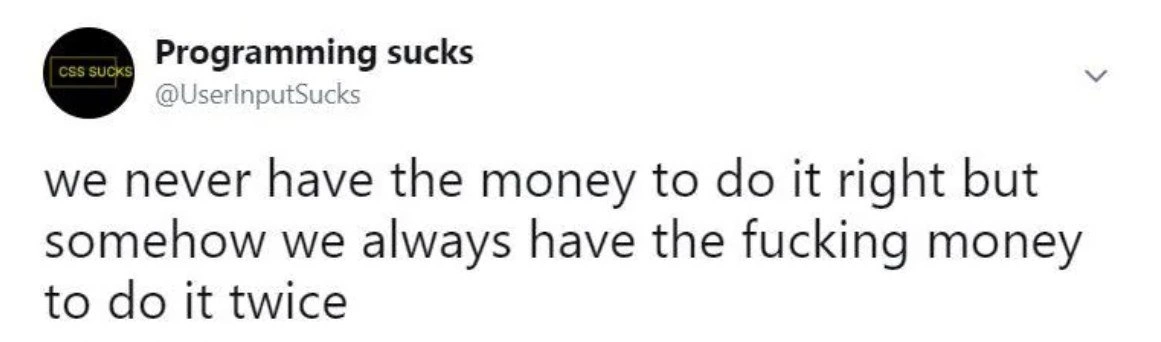
It’s a screenshot of a tweet (a twitter-style meme popular in dev circles) from an account jokingly named “Programming sucks” (with a profile picture that says “CSS SUCKS”). The tweet text is the meme’s punchline: “we never have the money to do it right but somehow we always have the fucking money to do it twice.” It’s written all in lowercase, which gives it a casual, exasperated tone. This image is poking fun at how software projects are often run on tight budgets and rushed timelines. Basically, it’s saying that teams are not given the resources to do things properly the first time, yet when the initial attempt fails or causes problems, suddenly the company finds the money to do the whole thing over.

The joke centers on the idea of technical debt and short-sighted planning. Technical debt (sometimes just called “tech debt”) is a metaphor developers use to describe what happens when you take shortcuts in coding or design. For example, imagine skipping writing tests or using a quick-and-dirty hack instead of a solid solution, just to meet a deadline. You save time or money now, but you create a “debt” — basically some problem that you’ll have to fix later. It’s like borrowing time from the future: you get the feature out fast today, but you’ll pay back that time with interest when you’re debugging or refactoring down the road. In the meme, “do it right” means spending the time and money to build something correctly (with testing, good design, etc.) from the start. “Do it twice” is what happens when you don’t do it right: you end up having to redo the work or fix everything, ultimately spending more time and money than if you had done it properly initially.

This meme is highlighting how project management and budget constraints can conflict with engineering best practices in real life. Budget constraints just means there’s a limited amount of money (and time) allocated for a project. So managers, under pressure, might say “we can’t afford to spend extra on testing or refactoring” because they have a strict budget or deadline. Those pressures tie into stakeholder expectations — basically, the people funding or requesting the project (like executives or clients) expect a lot of features quickly and cheaply. They want the new app or feature ASAP and at low cost, and they might not understand why extra testing or better design (which would cost more upfront) is necessary. In a healthy project, project managers would include time for quality assurance, documentation, and proper design in the plan. But in many companies, the culture is to cut those “non-essential” steps if the schedule is tight or the budget is low. This is part of the corporate culture being critiqued: some companies have a habit of always favoring short-term delivery over long-term quality.

There’s a famous saying that fits perfectly here: “Fast, Cheap, Good — pick two.” It means you usually can’t have all three. If you try to make something fast and cheap, it’s probably not going to be good in quality. The meme is a textbook example of that trade-off. The company chooses to do the project fast and cheap (skipping things like tests or better design to save time/money), so the result isn’t good — and because it isn’t good, they have to spend more time and money later fixing it. This is exactly what the old expression “penny wise, pound foolish” describes: being careful with small expenses but then having to spend a lot more because of that initial stinginess. Developers find this meme funny (in a facepalm kind of way) because it’s a situation we see often: if you don’t invest a little more effort or money to do it right the first time, you’ll end up investing a lot more effort and money doing it the second time.

Level 3: Budget Boomerang

In everyday engineering life, this tweet hits home because we’ve all witnessed the budget boomerang effect. A project is under pressure, and management insists there’s no money or time to do things the “proper way” (no time for documentation, no budget for extra testing, skip that code review to save a week). So the team cuts corners to meet a deadline or to come in under cost. Initially, everyone pats themselves on the back for being “lean” and efficient. But fast-forward a few months and, like clockwork, that rushed job blows up in production or fails to scale in the real world. Suddenly the same folks who were penny-pinching are now dumping buckets of cash and time to fix the mess. Somehow there’s always money to do it again when things go wrong.

The humor (and the pain) comes from that cruel irony. It’s practically a rite of passage in corporate culture:

  • Management says “We can’t afford to do X right now” — whether X is writing unit tests, investing in better hardware, refactoring messy code, or spending time on design.
  • Then disaster strikes because X was neglected. The app crashes on launch day due to a scalability issue, or a nasty bug makes it to customers, or the cheap quick-fix solution collapses under real-world conditions.
  • Suddenly, wallets open wide. Overtime gets approved, expensive contractors are brought in at triple rates, or a whole “Phase 2” project is kicked off to rebuild what should have been built properly in the first place.

This is classic technical debt coming back to bite, and it’s incredibly common. The meme drops an F-bomb and goes all lowercase to convey raw, weary frustration — it’s the voice of a senior developer who’s been through this fire drill too many times. They’re not even bothering with capitalization, just delivering a deadpan truth bomb:

we never have the money to do it right but somehow we always have the fucking money to do it twice

You can practically hear the bitter chuckle behind that statement.

What makes this line funny (and horrifying) is that it’s absolutely true in many organizations. It’s poking fun at project management choices and stakeholder expectations that chase short-term wins over long-term stability. Often, higher-ups demand a feature now and cheap, waving off engineers who warn, “If we don’t build this properly, we’ll pay for it later.” And then later, when the system is on fire, those same stakeholders act surprised — but still end up paying (usually paying more!). It’s a perverse do-it-twice mindset: plan to rush it once, then inevitably redo it. We developers have a saying, “Either pay now or pay later,” but some companies consistently choose “pay later” (with interest).

Any senior engineer reading this has war stories. Maybe your team skipped load testing to save time, and then launch day turned into a costly overnight scramble to spin up more servers and patch things. Or the company opted for the cheapest outsourcing bid, only to spend twice that budget having in-house devs untangle and rewrite the resulting spaghetti code. It’s cost-cutting backfiring in the most predictable way, and it happens across our industry.

Another layer to this joke is the absurdity of corporate budgeting. Often it’s easier for management to get approval for a big one-off emergency fix expenditure (because it’s framed as “saving” a project) than to get a smaller upfront budget for preventive measures. If you’ve ever been on that 3 AM outage call, you know how fast priorities flip: the tests or infrastructure upgrades that were “too expensive” yesterday suddenly become “get it done now, I don’t care what it costs.” It’s backwards but true: a carefully-planned $50k quality improvement might get axed in planning, but a $200k crisis remediation later gets rubber-stamped without hesitation. When everything’s on fire, “find the money” becomes the only directive.

In short, the meme makes seasoned devs laugh and wince because we’ve lived this scenario. It’s highlighting the technical debt trap and a corporate habit of being penny wise and pound foolish. We all know that doing it right the first time would actually be cheaper and less painful, but time and again we watch decision-makers learn that the hard way. The Twitter-style format of the meme just amplifies the relatability — it’s like a fellow engineer on social media bluntly venting a truth we’ve all experienced. It’s funny because it’s true (and it hurts because it’s true).

Level 4: Technical Debt Interest

In the realm of software engineering economics, this meme highlights a classic cost-of-quality paradox. For decades, experienced engineers and researchers have known that failing to “do it right” upfront incurs what we call Technical Debt, and that debt comes with hefty interest. The term technical debt (coined by Ward Cunningham) likens rushed, subpar coding decisions to a financial loan: you get a short-term benefit (speed, lower immediate cost) at the expense of long-term interest payments in the form of extra work, bugs, and ultimately bigger budgets down the line. In other words, skimping on quality is like taking out a high-interest payday loan on your codebase.

There’s solid data behind this. Studies in software project economics (like Barry Boehm’s 1981 classic Software Engineering Economics) show that the cost to fix a defect or design flaw rises exponentially the later it’s discovered. For instance, a requirement bug caught during design might cost $100 to fix, but if that bug is only addressed after release, it could cost $10,000 due to all the rework, patches, and damage control. This is the compound interest of technical debt in action. By not budgeting the small cost to “do it right” initially, organizations often end up paying the large cost to do it (or fix it) later – with interest piling up in the interim. The bill always comes due, typically with late fees: emergency developer overtime, expensive consultants, rushed shipments of hotfixes... And don’t forget the opportunity cost – every hour spent scrambling on rework is an hour not spent on new features or improvements. (Quality is free, anyone?)

From a theoretical perspective, the meme is basically a one-line summary of the cost of quality principle. There’s even an old engineering proverb: “If you don’t have time to do it right, you must have time to do it over.” In a monetary sense, not investing in proper design, testing, and refactoring is a false economy. You’re effectively deferring the expense, not avoiding it. And ironically, those budget constraints that were set in stone initially will magically expand under crisis (because now failure is not an option). It’s almost like a natural law of software projects: you can pay a little now or pay double (or more) later. What’s mind-boggling is how consistent this pattern is despite the industry knowing better. It’s the ultimate penny wise, pound foolish scenario. The math and logic are clear, yet due to short-term KPIs, misaligned incentives, or sheer corporate inertia, teams keep falling into the same trap. The meme’s exasperated, foul-mouthed tone may be informal, but it aligns perfectly with what any software engineering textbook would tell you about Technical Debt: you can’t escape the debt — you either pay it off early, or you pay through the nose later.

Description

A screenshot of a tweet from the account 'Programming sucks' (@UserInputSucks), whose profile picture humorously has 'CSS SUCKS' in a yellow box. The tweet text is a widely-known, cynical aphorism in the software industry: 'we never have the money to do it right but somehow we always have the fucking money to do it twice'. The statement is a sharp critique of short-sighted project management and business priorities. It describes the common scenario where stakeholders refuse to invest adequate time and resources for proper architecture, testing, and quality engineering upfront, citing budget or deadline constraints. Inevitably, the rushed, poorly-built product (the first time) is plagued with issues, leading to expensive maintenance, major refactoring, or a complete rewrite (the second time), which ultimately costs far more than doing it correctly from the start. This resonates deeply with experienced developers who have repeatedly witnessed this self-defeating cycle, making it a timeless and bitter piece of industry wisdom
Comments

15
Anonymous ★ Top Pick This is the first law of software thermodynamics: entropy and technical debt always increase. The budget to fight it only appears *after* the heat death of the project
  1. Anonymous ★ Top Pick

    This is the first law of software thermodynamics: entropy and technical debt always increase. The budget to fight it only appears *after* the heat death of the project

  2. Anonymous

    Our finance team follows an interesting consistency model: money is always stale when we propose refactoring, but instantly globally replicated the moment we declare a ‘greenfield rewrite.’

  3. Anonymous

    The only thing more expensive than hiring a senior engineer is not hiring one and watching three juniors build the same system four times while the CTO insists the third rewrite will definitely be the last one

  4. Anonymous

    The eternal software development paradox: management claims there's no budget for proper architecture, comprehensive testing, or adequate documentation - yet somehow the CFO always finds 3x the original budget when the hastily-built system collapses in production at 2 AM. It's like they're running a venture capital firm for technical debt, except the only exit strategy is a P0 incident and a team of burnt-out engineers rebuilding everything while the original 'savings' evaporate into overtime, lost revenue, and customer churn

  5. Anonymous

    The real CAP theorem: Can't Afford Proper, but Cash Always for Patchwork

  6. Anonymous

    Finance nixed two sprints for architecture and tests, then approved a six‑month “stabilization rewrite” - technical debt is the only compounding interest our CFO never budgets for

  7. Anonymous

    Our budgeting has at-least-once delivery semantics: we can’t afford to do it right, but we always find budget to do it twice

  8. @SamsonovAnton 1y

    We have the money to task several people in parallel not knowing about each other doing the same thing. 🤦‍♂️

    1. @mrYakov 1y

      But not enough to allow any of them do it right.

  9. @Araalith 1y

    Because the first time is always a PoC, even if the client doesn't know it.

  10. @Box_of_the_Fox 1y

    Agile ^^

    1. @azizhakberdiev 1y

      Welcome to agile. We prefer: Endless arguments over proper workflow Speedrunned code over optimal and documented code Making customer involve in this fuckery over negotiating properly Ever changing requirements over stable plan

      1. @the_doom_guy 1y

        Agile: The way to be flexible in your workflow. Fixed schedule, so your flexibility comes in your choice to either work all nights or work weekends

      2. @Araalith 1y

        You can always fall back on Waterfall. The project will be finished on schedule... at a point when nobody cares anymore. It will be just as the client described... but not quite how they wanted. And, of course, the project will be built on a solid framework... one that has critical issues and hasn't been supported for over a year, but hey, how were you supposed to know?

  11. @azizhakberdiev 1y

    I realized, I have freedom of speech for a reason

Use J and K for navigation