The Programmer's Automation Gambit
Why is this Automation meme funny?
Level 1: Building a Machine to Do a 5-Minute Chore
Imagine you have a simple chore, like tidying up your room, that would take you about 10 minutes to do by yourself. But instead of doing it, you decide to spend the whole week inventing a robot that can clean your room for you. You program the robot, give it arms and wheels, teach it how to pick up toys – and after 10 days, finally, the robot is ready and cleans the room. By that time, you realize you could have cleaned your room many times over in the same period. Sounds a bit silly, right? But it’s also kind of funny because you worked super hard just to avoid a small bit of work.
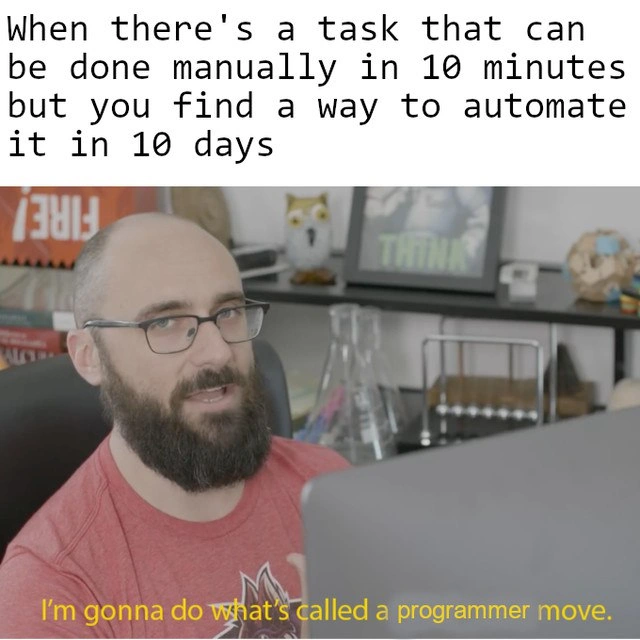
This is exactly what the meme is joking about. It’s showing a programmer (a person who writes computer code) doing the grown-up version of building that room-cleaning robot. Instead of just doing a quick task on the computer by hand (which would take 10 minutes), the programmer spends 10 days writing a program to do it automatically. Why? Because programmers love to solve problems with code, even when it might not be the fastest way for that one small task. It’s funny because the programmer’s solution is like using a huge fancy machine to crack a little nut – way more than needed.
The heart of the joke is about how people sometimes put a lot of effort into avoiding even a little boring effort. It makes us laugh because we can see the programmer is doing something kind of over-the-top just to save a tiny bit of time. And deep down, the programmer is proud and happy because they got to be creative and build something, even if it took a lot longer. The emotion here is a mix of pride and silliness: proud that they automated the task, and the silliness of realizing it was probably way more work than just doing the task normally. It’s like someone saying, “I know this is extra, but hey, I’m a programmer – this is what we do!”
Level 2: Automate All the Things (Even When You Shouldn’t)
Now let’s break this down for a newer developer or someone just learning about our field. The meme is contrasting manual tasks with automation in a humorous way. A manual task means doing something by hand, step by step, without the help of a custom program or script. It might be boring, but it’s straightforward and usually quick for one-off situations. For example, imagine you need to copy a few files or update a value in a database one time – doing it manually might take only 10 minutes.
Automation, on the other hand, means writing a bit of code or using a tool to have the computer do the task for you. This often makes sense if you have to repeat the task many times. By automating, you spend time upfront coding, but then the computer can repeat the task much faster or without you having to do anything. Automation scripts are small programs (maybe a Bash script or a Python script) written specifically to handle such tasks automatically. Developers love automation because it reduces human error and frees them from doing dull, repetitive chores.
So why is the meme funny? It’s showing an extreme case: a developer spends 10 days (which is like two work weeks!) coding an automated solution for something that could be done in 10 minutes manually. On paper, this doesn’t make sense for productivity. If this task isn’t done often, those 10 days of effort might never be “paid back” in time saved. This scenario highlights a form of over-engineering. Over-engineering means designing a solution that's far more complicated or powerful than what is needed for the problem at hand. It’s like using a supercomputer to do simple arithmetic; sure it works, but a calculator would do the job more simply. In software, over-engineering might look like building a whole application or using an advanced technology stack just to do something basic. Here, writing a full automation system for a one-time 10-minute task is a perfect example of that overkill approach.
A key concept here is the effort vs. payoff or time_investment_tradeoff. In any engineering decision, especially about automation, we ask: “Is the time I spend building this going to save me equal or more time later?” There’s even a famous chart (often shared among programmers as developer humor) that guides how long you should spend automating a task based on how often you do the task. For instance, if you have a task that takes 10 minutes a day, automating it might be worth it if the automation takes less than, say, a couple of days to write (because over a year, that daily 10 minutes adds up to a lot of hours saved). But if a task only happens once or rarely, spending 10 days automating 10 minutes of work is usually a false economy. False economy means something you do that seems to save time or money but actually ends up costing more than it saves. In the meme’s scenario, the developer is probably doing it not purely for efficiency, but because they enjoy coding the automation or want to avoid doing the boring task even once.
There’s also a cultural aspect here. In developer culture, automating tasks is almost like a badge of honor. We have jokes like “Automate all the things!” which means if you see a repeated task, try to write code to handle it. This mindset is usually great — it’s how we get powerful tools, scripts, and productivity improvements. However, it can lead to comedic situations like this one where the enthusiasm for automation overshoots practicality. It’s a well-known developer pain point: you start automating something small, and before you know it, you’ve sunk a ton of time into it. Maybe you hit snags (like bugs in your script, or needing to learn a new library or API to get it done), and the whole thing balloons far beyond that initial 10-minute chore.
The phrase in the meme, “I’m gonna do what’s called a programmer move,” is funny in itself. It implies that taking the absurd step of over-automating is a stereotypical programmer move — something programmers are known to do. It’s referencing a larger internet meme format (“pro-gamer move”) but swapping in “programmer,” which makes it our inside joke. Even the bearded developer in the picture looks a bit amused and determined, like he knows it’s overkill but he’s still proud (or stubborn) about doing it with code. The image background has things like a sign reading “THINK” and a Newton’s cradle (those swinging metal balls) often seen on desks — little cues that suggest a place where someone is always thinking of clever solutions... perhaps too clever in this case!
In simpler terms, if you’re a junior developer or just learning: this meme is teaching a subtle lesson. Automation is powerful, but always consider the effort versus the reward. It’s perfectly fine (and normal) to automate tasks – it’s what makes you a more efficient developer in the long run. Just be aware that sometimes manual isn’t a dirty word, especially if the task is super quick and one-time. And if you do decide to automate a 10-minute task and it spirals into a 10-day mini-project, well, you’ll at least get a chuckle and a relatable story out of it! We’ve all been there, and now you’re in on the joke.
Level 3: Rube Goldberg Automation
At the highest level, this meme hits on an automation paradox that every seasoned engineer recognizes: the compulsion to over-engineer a solution for a trivial task. The text sets up a scenario where a 10-minute manual task is instead tackled by writing code or a script that takes 10 days to develop. It's the archetypal developer culture joke: investing a huge chunk of time upfront to automate something that hardly needed automating. This is sometimes called a "false economy of automation" – you spend far more effort than you save. Why do engineers do this? Partly because of the programmer’s ethos of laziness (in the Larry Wall sense, where laziness drives innovation). We hate repetitive toil so much that we’ll happily toil longer just once to avoid doing it twice. It’s a matter of pride and developer productivity cred: writing a slick automation script feels more rewarding (and frankly more fun) than performing a dull task manually.
From a senior perspective, the humor lands because it’s painfully relatable. We’ve all seen a teammate disappear down a rabbit hole to automate a process that was quicker to just do by hand. Maybe you’ve even been that person who disappears into bash scripting or whips up a custom tool, only to realize you burned days on something used twice a year. It’s a form of overengineering—solving a problem with far more complexity (and code!) than necessary. The subtitle punchline, "I'm gonna do what's called a programmer move," riffs on a popular meme phrase (“pro-gamer move”) and nails the self-awareness. We know it’s absurd to build a Rube Goldberg machine for a ten-minute chore, but as programmers we often can’t resist. The shared chuckle comes from acknowledging this common engineer impulse: sacrificing efficiency on the altar of Automation with a capital A.
On a deeper level, there’s a genuine engineering trade-off being skewered here. In theory, automation is about efficiency: you invest time now to save time later. The classic logic goes: if a task is done frequently enough, automating it will pay off in the long run. But the meme exaggerates a scenario where the time investment tradeoff is clearly out of whack. It reminds experienced devs of all those times we justify a pet automation project with "Well, I might need this again someday". Often this leads to writing a full toolchain, complete with edge-case handling, logging, and maybe even a cute CLI interface—turning a 10-minute gig into a 10-day coding odyssey. By the time it’s done, the original need might have passed or the manual steps might have been faster after all. The meme’s humor is that every engineer, even knowing the math doesn’t add up, still feels that itch to “Automate All the Things!” (even when they shouldn’t). It’s a gentle roast of our profession’s tendency to choose intellectually stimulating work (like coding an automation tool) over the boring simplicity of the manual solution. In essence, it captures a developer pain point: the internal tussle between pragmatism (just get it done manually) and our automation-obsessed creative urge (build a script, feel like a wizard). We laugh because it’s true—and because we’ve all been there, optimistically telling ourselves the elaborate script will be so worth it in the end.
- Over-Engineering in Action: Seasoned developers immediately recognize this as an example of over-engineering. That’s when the solution is needlessly complex for the scale of the problem. Here, writing a full program for a one-off task is like using a chainsaw to cut butter. Sure, it works, but was it really necessary?
- Shared Workspace Artifacts: The background details like the “THINK” sign and desk toys (even a Newton’s cradle) subtly nod to the classic dev workspace where big thinking and tinkering happens. It’s a setting where someone might proudly display witty signs encouraging creativity—ironically, perhaps over-thinking in this case.
- “Programmer Move” Caption: By calling this tendency a “programmer move,” the meme taps into our community’s self-deprecating humor. It’s an inside joke: only in software engineering do you see someone spend a week automating something that saves a few minutes. It’s a rite of passage in developer humor circles, and the phrasing implies “we all know how devs are.”
- Real-World Examples: Think about writing a custom Python script to reorganize a few files that you could drag-and-drop manually, or setting up an entire CI pipeline for a personal project that one could build locally in seconds. Senior devs have countless war stories like this. Maybe the script even fails the first few times (because of unforeseen edge cases or environment issues), adding to the irony that the manual method was more reliable. These anecdotes make the meme too real.
In summary at this technical level, the meme wittily critiques the time investment tradeoff miscalculation that developers often make. It blends engineering truth with self-aware humor: yes, it’s absurd to burn 10 days automating 10 minutes of work—and that’s exactly why it’s funny. The joke lands because it’s rooted in genuine software engineering practices taken to an illogical extreme. The experienced engineer chuckles, perhaps recalling their own similar programmer move, where the line between productivity and procrastination via automation got a little blurry.
Description
The image features Michael Stevens, the creator of the popular YouTube channel Vsauce, looking intently at his computer screen. The top of the image has text that reads, 'When there's a task that can be done manually in 10 minutes but you find a way to automate it in 10 days'. At the bottom, a yellow subtitle reads, 'I'm gonna do what's called a programmer move.' The scene is set in an office or studio with various objects in the background, including a framed picture with the word 'THINK' and some science beakers. The meme humorously captures a common developer tendency to spend an excessive amount of time creating a complex, automated solution for a simple problem that could be solved quickly with manual effort. This behavior is often seen as a rite of passage or a relatable flaw, where the intellectual challenge of automation outweighs the practical need for a quick fix

Comments
7Comment deleted
The classic cost-benefit analysis: 10 minutes of soul-crushing manual work now, versus 10 days of glorious, dependency-hell scripting that creates a tool no one else will ever use. The choice is obvious
Good news: once my Helm-charted, Terraform-provisioned, Prometheus-instrumented script finishes renaming that single file, the ROI should kick in right around the product’s end-of-life
The real programmer move is convincing yourself that the 10-day automation will save time when it's run twice a year, then spending another week making it "reusable" for tasks that will never exist
This perfectly encapsulates the XKCD automation chart we've all internalized but conveniently ignore - where the break-even point for automating a 10-minute task done once is approximately 'never,' yet we'll still spend two sprints building a robust, test-covered, CI/CD-integrated solution with proper error handling, logging, and documentation. Because what if we need to do it again in 2027? Plus, we learned three new libraries and can now add 'automation architect' to our LinkedIn
Took 10 days to automate a 10‑minute task; now it’s idempotent, observable, and pages me at 3am when the secret rotates
True senior move: wrap a 10-minute one-off in a Python CLI, a Dockerfile, a CI job, IAM perms, and an SLO - then call it “reducing toil.”
YAGNI? Nah, that's for juniors - real pros build the automation empire that outlives the task