Skip to content
DevMeme
1026 of 7435
Programmers and Germans unite over shared endless word concatenation prank
Languages Post #1154, on Mar 18, 2020 in TG

Programmers and Germans unite over shared endless word concatenation prank

Why is this Languages meme funny?

Level 1: Sticking Words Together

Imagine you and a friend are trying to make a really specific new word by gluing a bunch of smaller words together. For example, you start with "cake." But it’s not just any cake, it’s a chocolate cake, so you say "chocolatecake" as one word. Then you also want to mention it’s big, so you stretch it to "bigchocolatecake." It looks kind of funny all smooshed into one, but now your one mega-word tells the whole story: it’s a big chocolate cake! This meme is joking that computer programmers and German speakers both love doing exactly that – squishing words together to make a single super-word. They’re shown doing a cool handshake because they discovered they share this silly habit. It’s funny and heartwarming, because who would’ve thought a coding person and a German would bond over making really long words? Essentially, both are saying, “Why use one short word when you can use five stuck together to say exactly what you mean!” And that playful idea makes us smile.

Level 2: Naming With No Spaces

Let’s break down why this meme is funny in simpler terms. On one side, we have programmers who often have to name things in code. When you name a variable or a function in most programming languages, you can’t use spaces. That’s a rule. So how do you make a name that’s made of multiple words? You concatenate them – basically, stick them together – either by capitalizingEachWordLikeThis (called CamelCase) or by using_underscores_like_this (snake_case). The result is a single long word that actually contains several words’ worth of meaning. For example, if you want to name a function that calculates a user’s age in years, you might call it calculateUserAgeInYears. It’s long, but you immediately understand what it does. You’ve essentially glued "calculate" + "user" + "age" + "in" + "years" into one big identifier.

On the other side of the meme’s handshake are Germans – or more specifically, the German language. German is famous for making compound words. A compound word is just two or more words joined together to make a new word. English does this too sometimes (think “rainbow” from rain + bow, or “toothpaste” from tooth + paste). But German takes it to another level. In German, it’s perfectly normal to keep adding words together, forming a mega-word that might look intimidatingly long to non-speakers. For instance, “Fußballweltmeisterschaft” is actually three words combined: Fußball (football/soccer) + Welt (world) + Meisterschaft (championship) – it means “soccer world championship.” No spaces, just one continuous word.

Now, the meme text says: “Concatenating words until it makes sense.” This is exactly what both programmers and German speakers do, each in their own sphere. String concatenation in programming means joining strings (pieces of text) end-to-end. We literally do this when constructing long variable names or messages. Consider this simple Python example of concatenating two words:

first_word = "Hello"
second_word = "World"
combined = first_word + second_word
print(combined)  # Outputs: HelloWorld

See how "Hello" and "World" got combined into "HelloWorld" with no space? In code, if we wanted a space, we’d have to add " " explicitly. But if we’re naming a variable or function, we usually omit spaces entirely – that’s how we get identifiers like dataFilePath or user_first_name. Similarly, German would combine “Hello” and “World” into “HelloWorld” as one word if it were a compound noun. (In a real German sentence they might not do that for those particular words, but humor us here!)

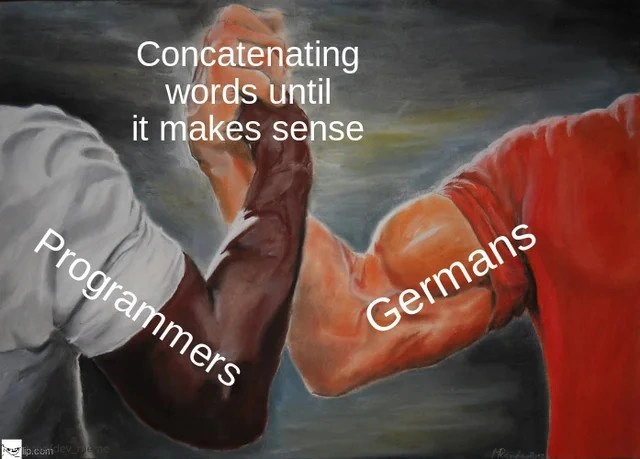
The Predator handshake meme image itself is a popular way to show two very different groups finding common ground. In the original movie scene, it’s a dramatic greeting between two strong characters. Internet culture turned it into a format where the arms are labeled with two groups, and the clasped hands show what they agree on. Here the left arm is labeled "Programmers" and the right arm "Germans," and the handshake label is this quirky habit of making super long words. If you’re a junior developer or someone new to coding, you might not have thought of programming and German language having anything in common – that contrast makes it funny. It’s unexpected.

This meme is especially relatable humor for people who have struggled with namingThings in code. Maybe you started out writing code using single-letter variables like x or i because it was easier. Then a mentor or a style guide told you, "Name your variables something meaningful." So x turned into userAge, and then maybe userAgeInYears to be even clearer. Each time, you’re concatenating words to make the name more specific. Germans basically do the same when they have a very specific concept: instead of inventing a totally new word, they combine existing ones. It’s a language quirk that compound_identifiers in code mirror closely.

From a code quality perspective, using descriptive names (even if they get long) is usually a good thing – it makes the code easier to understand. But it can also lead to some tongue-twister variable names that look almost comical. Early in your coding journey, you might find yourself writing a function name so long you wonder, "Is this okay??" It usually is, as long as it’s clear. This meme exaggerates it: imagine naming things by just endlessly tacking on words “until it makes sense.” It implies maybe we sometimes overdo it – which is the funny part. Both a German speaker and a programmer might chuckle and say, "Yeah, sometimes our words get ridiculously long, but hey, people know what we mean!"

So, in simpler summary: Programmers form long variable or function names by stringing words together, and Germans form long nouns by stringing words together. The meme finds this common ground and makes it a joke. If you’ve done any coding or learned a bit of German (or at least heard those legendary long German words), you’ll get a kick out of seeing them shake hands over this shared habit!

Level 3: Compound Word Coalition

At first glance, this meme taps into a very niche solidarity: Programmers and German speakers proudly shaking hands over their shared love of concatenating words into monstrosities. The image parodies the classic Predator handshake meme – two muscular arms (one labeled Programmers, the other Germans) clasped in unity. The caption hovering above, "Concatenating words until it makes sense," is both absurd and relatable humor for seasoned devs. Why? Because naming things is one of the legendary hard problems in software, and our “solution” is often to just keep gluing more words together until the name finally conveys the right meaning.

Senior developers recognize this immediately. We’ve all encountered a variableNaming convention that produces identifiers like userAccountBalanceThresholdLimit or calculateAnnualEmployeePayrollDeductions. These mega-names are attempts to make code self-documenting – each additional word narrows the meaning. It’s the same strategy the German language uses to achieve precision. Instead of coining a completely new term, Germans string existing words into a single compound noun. Need a word for an insurance company that provides legal protection? Just bolt together Recht (law) + Schutz (protection) + Versicherung (insurance) and you get Rechtsschutzversicherung. It looks intimidating, but each piece of the word is carrying its weight in meaning, just like each part of a long function name hints at what it does.

This Languages and CodeQuality crossover highlights a truth: both in coding and in German, clarity often trumps brevity. The meme exaggerates it for effect – picturing devs and Germans bro-fisting over ridiculously long words – but it’s grounded in reality. In a codebase, a method called getData() is vague, but getUserAccountDataFromDatabase() is crystal clear; it’s also concatenation central. Similarly, German could say "Hands up!" as two words, but why not compress it into Händehoch if you can? The result in either case is a single identifier jam-packed with information.

There’s comedic irony in the phrase “until it makes sense.” Seasoned devs know the feeling of starting with a short name that didn’t quite convey the meaning, then appending another word, and another… hoping the compound_identifier eventually clicks. It’s the programming equivalent of string_concatenation in code and in spirit. In fact, one inside joke goes: “There are only two hard things in Computer Science: cache invalidation, naming things, and off-by-one errors.” We laugh because it’s true – naming is hard, and we often resolve ambiguity by piling on descriptors. If one word doesn’t capture it, maybe five words squashed together will. Both programmers and German wordsmiths live by this tactic, sometimes to an extreme that outsiders find funny or baffling.

To a veteran developer, this meme also pokes fun at naming_conventions_humor. We strive for descriptive code. Clean code guidelines encourage meaningful names, but they don’t mention the upper length limit – so some of us run wild. Ever seen an absurdly long class name in a legacy enterprise codebase? The Cynical Veteran in us groans, but the Enthusiastic Educator side secretly cheers the clarity. Likewise, German compounds can sometimes span an entire line of text – clear, yes, but you might need a deep breath to pronounce them. The handshake here is saying, “You do that? We do that too!” It’s a playful jab at both communities for embracing LanguageQuirks that turn simple ideas into lengthy expressions.

In summary, the deepest humor of this meme comes from recognizing a shared mindset: whether you’re naming a variable or inventing a new German noun, the instinct is to concatenate smaller words relentlessly until the meaning is unambiguous (or you run out of characters, whichever comes first). It’s a compound word alliance forged in the fires of needing things to make sense. Seasoned devs grin at this because we’ve lived it – riding that fine line between a well-named variable and a paragraph identifier – and apparently, so have the Germans in their dictionaries. Gemeinsam sind wir Namensgeberweltmeister (translation: "together we are world champions of giving names")! 🚀🤝

Description

Painted parody of the classic 'epic handshake' meme: two muscular forearms meet in a firm clasp at center screen. The left arm, in a tight white sleeve on dark-skinned forearm, is labeled "Programmers"; the right arm, in a red sleeve on light-skinned forearm, is labeled "Germans." Centered above the handshake in bold white text is the caption "Concatenating words until it makes sense." The background is a blurred mix of dark greys and muted greens, emphasizing the arms. Technically, the humor contrasts the programming practice of chaining strings or variable names until readable with the German language’s famous compound nouns, poking fun at naming conventions and string concatenation in code

Comments

6
Anonymous ★ Top Pick Germans boast Donaudampfschifffahrtsgesellschaftskapitän; we counter with RETRY_AFTER_CLUSTER_FAILOVER_SSL_HANDSHAKE_METRICS_CACHE_WARMUP_FLAG - until Oracle replies ORA-00972: identifier too long
  1. Anonymous ★ Top Pick

    Germans boast Donaudampfschifffahrtsgesellschaftskapitän; we counter with RETRY_AFTER_CLUSTER_FAILOVER_SSL_HANDSHAKE_METRICS_CACHE_WARMUP_FLAG - until Oracle replies ORA-00972: identifier too long

  2. Anonymous

    The Germans have a word for the feeling when your AbstractSingletonProxyFactoryBean finally compiles, but they won't tell us because it would break our IDE's line width settings

  3. Anonymous

    The real genius is that both communities have mastered the art of creating identifiers so long that by the time you finish reading them, you've forgotten what the first word was - yet somehow, they're still more maintainable than abbreviations like 'usrAcctInfFrmDb'. At least when you see 'getUserAccountInformationFromDatabaseWithRetryLogicAndErrorHandling', you know exactly what existential crisis the previous developer was going through

  4. Anonymous

    Concatenate nouns until the architecture explains itself - German calls it grammar; enterprise devs call it ServiceManagerFactoryBuilder

  5. Anonymous

    Code reviews: 'This 140-char var name is unreadable.' Germans: 'Hold mein Bier - it's expressive.'

  6. Anonymous

    Consensus algorithm for naming: noun‑concatenation with early stopping at the 120‑char linter threshold - eventual consistency achieved, readability optional

Use J and K for navigation