Tech interviews demand algorithms, daily job fixes README typos and forms
Why is this Interviews meme funny?
Level 1: Rocket Science vs. Routine Chores
Imagine you had to solve a giant puzzle or do something super hard to get a job – like being asked to solve a big maze or do rocket science calculations just to prove you’re smart. That’s what a coding interview can feel like: they ask you tricky questions and brainteasers (like puzzles with numbers or paths) to test you. But now imagine once you actually get the job, your daily work is more like simple chores: you’re fixing little mistakes, tidying things up, and making sure everything looks nice – kind of like making the bed or sweeping the floor in a house. The funny part of the meme is saying getting a programming job is like that: the test to get in is super hard and fancy (lots of algorithms and computer science riddles), but the actual job you do every day is pretty ordinary (like fixing a spelling error or centering a picture on a webpage). It’s humorous because you’d think a tough entrance exam means the job is also extremely complex every minute – but in reality, much of the job is straightforward tasks. The meme makes us laugh because it’s true: sometimes we prepare like we’re going to be astronauts, and then on the job we’re just checking the spaceship’s windows are clean! It highlights that difference in a simple, relatable way.
Level 2: Stacks vs Stack Overflow
Let’s break down the meme’s two sections and the tech jargon in each, so even a newer developer can appreciate the contrast. The “Tech interview” section lists things commonly asked in programming interviews, especially for new grads or big tech companies:
Dynamic Programming – This is an advanced method for solving problems by breaking them into sub-problems and storing the results (usually in a table) so you don’t recompute things unnecessarily. It’s a favorite in interviews because it tests your problem-solving skills and understanding of optimization. For example, an interviewer might ask you to find the optimal way to do something like making change for a dollar using the least coins, which benefits from a dynamic programming approach. It’s a tricky topic that often appears on sites like LeetCode as hard puzzles. In school you might learn it with classic problems like Fibonacci sequences, knapSack, or matrix pathfinding. Interview prep guides love it – but on the job, you rarely write a dynamic programming solution from scratch since most common problems (sorting, searching, etc.) are already solved by libraries.
Dijkstra’s Algorithm – This is a famous algorithm to find the shortest path in a graph (imagine finding the quickest driving route on a map of cities). It’s named after Edsger Dijkstra, who came up with it in 1956. It uses a priority queue (often a min-heap) to always expand the nearest unexplored node next, effectively calculating the minimum distance from a start node to all other nodes. In interviews, you might be asked to implement or at least explain Dijkstra’s algorithm or similar graph algorithms, since it tests knowledge of graphs (a data structure of nodes and edges) and efficiency (Dijkstra’s runs in
O(E + V log V)time with a heap, which is a good talking point for complexity). It represents the kind of knowledge that’s fundamental in computer science. However, in an average software job, unless you work in a very specific domain (network routing, game development for pathfinding, etc.), you probably won’t code this yourself – you’ll use existing pathfinding functions or not deal with graphs much at all.Linked Lists, Stacks, Queues, Binary Trees – These are basic data structures taught in any introductory CS course. A Linked List is a chain of nodes where each node points to the next, useful for scenarios where you need quick insertions/deletions. A Stack follows LIFO (last in, first out) principle – like a stack of plates, you add/remove from the top; it’s used in things like backtracking, undo operations, or evaluating expressions. A Queue is FIFO (first in, first out) – like a line of people, used in scheduling tasks or breadth-first search. Binary Trees organize data in a hierarchical tree structure where each node has up to two children, used in things like organizing sorted data (binary search trees) or representing hierarchical info. Interviewers love to ask questions about these structures – maybe you’ll be asked to reverse a linked list, implement a stack from scratch, or traverse a binary tree in-order – because it tests understanding of memory pointers and recursion. These are foundational concepts. In real day-to-day coding, though, you usually use built-in versions of these (e.g. Python’s list can act like a stack/queue, or Java’s libraries have tree structures). Most devs are not manually writing pointer manipulations for linked lists at work except maybe in low-level systems or performance-critical code. Still, knowing them helps you use the right tool for a job and understand what libraries might be doing under the hood.
“10 hard LeetCode questions” – LeetCode is a popular website that hosts a vast collection of programming problems (puzzles) that range from easy to extremely hard. Many candidates prepare for interviews by solving hundreds of these problems. This bullet in the meme exaggerates that a typical technical interview might throw a bunch of difficult questions at you back-to-back. It pokes fun at how over-the-top interviews can feel: as if you’re expected to be a human algorithm encyclopedia solving one brainteaser after another. For a new developer, it’s important to know that not every company does this, but many do have at least some algorithmic coding test. It’s basically a stress test of your coding under pressure. Even though cracking those problems is tough, it’s seen as a rite of passage in the industry. The humor lies in the idea that you jump through these hoops to prove your worth.
Now, the “Day-to-day job” section lists what a software engineer’s actual tasks might look like, especially in a typical web/app development role:
Fix typo in README – A README is a text file (usually
README.mdin Markdown format) at the root of a project repository that explains what the project is, how to set it up, etc. It’s often the first documentation a developer or user reads. Fixing a typo in it is a minor, mundane task. It could be as simple as correcting “envrionment” to “environment.” This represents the kind of small polish work you might do any day: not glamorous or intellectually challenging, but necessary for professionalism. It’s almost the opposite of an algorithm puzzle – it requires careful reading rather than complex logic. Every junior developer has probably done a commit that’s just “Fix documentation typo” or caught a spelling error during a code review.Center the form – This refers to adjusting the layout of a webpage so that a form (like a login form or contact form) is centered nicely on the screen. It’s essentially a CSS (Cascading Style Sheets) or frontend task. Centering things in CSS is famously a bit confusing for beginners – there are multiple ways (using
margin: 0 auto, using Flexbox withjustify-content: center; align-items: center, etc.). This item shows that a lot of daily work might be UI tweaks. It’s not algorithmically complex at all – it’s more about knowing which CSS properties to use or which UI framework classes to apply. Many new devs actually struggle more with these practical tasks at first because nobody asked them to do CSS on a whiteboard! It’s a different kind of knowledge. If you remember the first time you tried to center a<div>on a page and ended up googling “how to center element CSS”, that’s exactly the kind of day-to-day learning experience this refers to. It’s worlds apart from something like Dijkstra’s algorithm, but it’s a real skill needed in typical web development.Fix the Twitter icon link – Imagine your company’s website or app has a little Twitter bird icon that should link to the company’s Twitter profile. If it’s broken (maybe it was pointed to the wrong URL or the icon image wasn’t loading), someone has to fix that. This usually means a tiny change in HTML or a configuration – like updating an
<a href="...">tag to the correct link, or fixing the path to the icon image file. It’s a very simple bug fix. No complex data structure needed, just attention to detail. For a junior dev, doing these small fixes is common and a good way to learn the codebase. It’s also instant feedback – you change a line and see the icon link working, which can be satisfying. The meme uses this to emphasize how unglamorous a lot of software tasks are compared to the brain-bending interview questions. It’s something anyone could understand with a bit of HTML knowledge, whereas something like dynamic programming is hard to even explain without a CS background.Add
secret_key– This likely refers to adding a configuration value or environment variable namedsecret_keyto the project. Many applications (for example, a Django web app or a Node app) require a secret key for things like session encryption or API authentication keys. Setting this up could mean editing a config file or adding a line to something like an.envfile or a settings file withSECRET_KEY = "somevalue". This is a one-line change that doesn’t involve any algorithmic thinking – but if you forget it, the app might not run or might be insecure. It’s representative of the kind of setup and config tasks that developers do all the time. It’s straightforward but important housekeeping. For a junior engineer, learning to manage config files and ensure things like the secret keys are properly set (and kept out of source control for security) is a day-to-day concern. Compare that to the interview, where nobody asks “Can you configure this app’s environment correctly?” – they assume you can figure that out, and instead drill you on brainteasers. This stark difference is exactly why the meme is amusing.
In summary, the top part of the meme is all about computer science theory and algorithms – things you’d find in textbooks or coding challenge websites. The bottom part is about practical everyday development tasks – things you’d find in a project’s issue tracker or a junior developer’s first week of JIRA tickets. As a new developer, you’ll come to learn both sides: the theory (which is useful for thinking logically and optimizing when needed) and the practice (which is about attention to detail, using tools, and lots of little fixes that make software actually usable). The joke simply points out that these sets of skills don’t always overlap in an obvious way, especially in how we interview versus what we do on the job.
Level 3: LeetCode vs Real Code
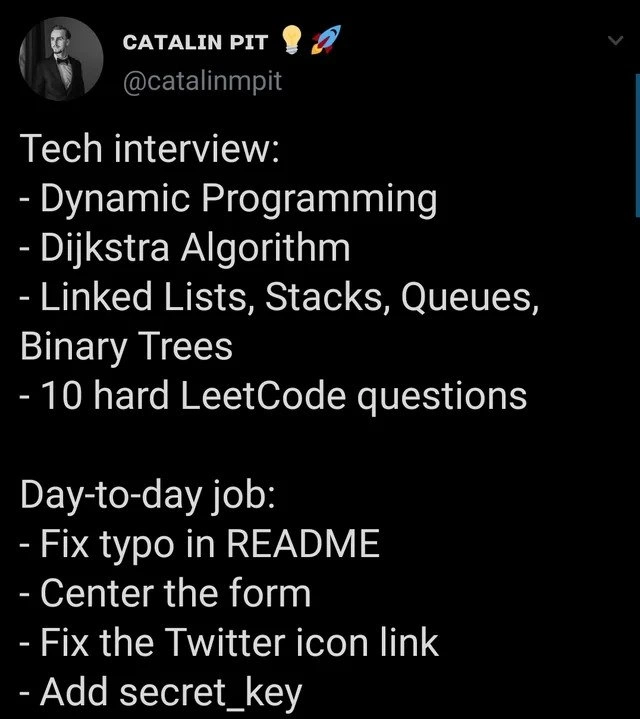
The humor here hits home for seasoned engineers: technical interviews are like an algorithmic gladiator pit, but the actual day job is often a maintenance walk. In the meme (a tweeted joke from a dev), the “Tech interview” list reads like a college CS Fundamentals exam – think Dynamic Programming puzzles, implementing Dijkstra’s Algorithm on a whiteboard, traversing Binary Trees or reversing Linked Lists in your sleep, plus tackling “10 hard LeetCode questions.” These are the classic TechnicalInterviewProcess challenges, drawn straight from sites like LeetCode or Cracking the Coding Interview books. Interviewers grill candidates on computer science algorithms under pressure to test raw problem-solving skills and theoretical knowledge. The punchline is that once you land the job, you very rarely use those exact skills – instead, your “Day-to-day job” list looks more like the meme’s second half: routine tasks such as fixing a typo in the project README file, tweaking CSS to “center the form” on a page, updating a broken Twitter icon link, or adding a missing secret_key to a config file. It’s a comically stark day_job_vs_interview contrast.
Why is this so funny (and a bit painful)? Because experienced devs know that hiring practices can be disconnected from real-world work. Companies claim to value data structures and algorithm prowess, which is why candidates study LeetCodeProblems and brush up on algorithms like dynamic programming (optimizing problems by reusing subproblem results) or shortest-path graph algorithms like Dijkstra. These topics are undeniably important in theory – they are building blocks of efficient software. But in practice, most developers rely on frameworks and libraries that encapsulate these algorithms. On a typical day, you’re not hand-coding BFS or inventing a new sorting algorithm; you’re more likely integrating an API, adjusting UI layouts, or writing a bit of glue code. The meme highlights this irony through InterviewHumor: you might spend weeks preparing for a marathon of brainteasers and AlgorithmHumor-laden whiteboard sessions, only to spend your actual job pushing minor code fixes to production and reviewing pull requests for trivial changes.
This mismatch is a shared industry joke. We’ve all heard war stories of candidates implementing a perfect data structure on the whiteboard (say, a balanced binary search tree insertion) and then, once hired, discovering the codebase is 90% pulling data from a database, calling library functions, and fixing UI bugs. It’s not that real engineering has no difficult problems – it’s that they’re usually different kinds of difficulty. Debugging a race condition in a distributed system or untangling legacy spaghetti code is hard, but knowing the Knuth optimization or the intricacies of Dijkstra’s time complexity (O((V+E) log V) for a typical priority queue implementation, by the way) doesn’t directly help with aligning that CSS or correcting a typo. The InterviewHumor lands because so many of us have felt this gap: after sweating through a graph traversal or dynamic programming puzzle in an interview, you end up doing tasks that feel oddly mundane by comparison.
To illustrate the contrast, consider pseudo-code for an interview versus on-the-job fix:
# Interview task: implement Dijkstra's algorithm for shortest paths
import heapq
def shortest_path(graph, source):
distances = {node: float('inf') for node in graph}
distances[source] = 0
pq = [(0, source)]
while pq:
dist, node = heapq.heappop(pq)
if dist > distances[node]:
continue
for neighbor, weight in graph[node]:
new_dist = dist + weight
if new_dist < distances[neighbor]:
distances[neighbor] = new_dist
heapq.heappush(pq, (new_dist, neighbor))
return distances
/* Day-to-day task: center a form in CSS */
.form-container {
margin: 0 auto; /* This single line horizontally centers the element */
}
In the first snippet, we manually manage a priority queue for Dijkstra’s algorithm — heavy algorithmic lifting you’d showcase in an interview. In the second, we use a one-liner CSS rule to fix a UI alignment issue — a change that is trivial algorithmically but immediately useful in a web application. The joke resonates because many corporate and TechnicalInterviewProcess filters lean on textbook problems (leftover from academia or a one-size-fits-all hiring approach) rather than testing the skills you’ll actually use, like reading existing code, using frameworks, debugging, and writing maintainable code. Seasoned devs chuckle (or groan) because they remember cramming on DynamicProgramming patterns (memoization, anyone?) and graph traversal tricks, yet find themselves Googling “how to vertically center a div in CSS” during their first week on the job. The meme’s truth bomb: being able to invert a binary tree in under 20 minutes doesn’t directly prepare you for a day filled with small bug fixes and configuration tweaks – but it’s still what we often put candidates through. It’s equal parts AlgorithmHumor and catharsis for those who’ve lived it.
Description
Image is a black-background screenshot of a tweet from user “CATALIN PIT 💡🚀 @catalinmpit”. The tweet is split into two sections in white sans-serif text. First section, labeled “Tech interview:”, lists four bullet points: “Dynamic Programming”, “Dijkstra Algorithm”, “Linked Lists, Stacks, Queues, Binary Trees”, and “10 hard LeetCode questions”. Second section, labeled “Day-to-day job:”, lists four bullets: “Fix typo in README”, “Center the form”, “Fix the Twitter icon link”, and “Add secret_key”. The meme highlights the mismatch between algorithm-heavy technical interview questions and the comparatively mundane tasks most engineers handle in production codebases, a common gripe among experienced developers
Comments
6Comment deleted
We whiteboard Dijkstra to vet candidates, then hand the survivor a P1 to center a flexbox - because the real shortest path is through three layers of legacy CSS and one designer’s ego
After 20 years, I've implemented Dijkstra's algorithm exactly once - to find the shortest path between my desk and the coffee machine while avoiding the open office "quick sync" ambush zones
After grinding 500 LeetCode hards and memorizing every graph traversal algorithm known to computer science, you'll finally land that dream job where your most intellectually challenging task is determining whether `margin: 0 auto` or `text-align: center` is the appropriate solution. The Dijkstra algorithm you studied? Perfect for finding the shortest path between your desk and the coffee machine when the PM asks you to 'just quickly' adjust that button padding by 2 pixels
Interviews demand Dijkstra for shortest paths; reality's the infinite loop of pixel-perfect icons and leaked secrets
Interviews want Dijkstra in O(E log V); the job’s shortest path is Jira → README, detouring through CSS specificity hell to center a form while rotating a secret_key without tripping prod
We whiteboard Dijkstra; in production the shortest path is through IAM, Terraform, and CI to add a secret_key - then git bisect why centering the form broke the Twitter icon