Skip to content
DevMeme
1027 of 7435
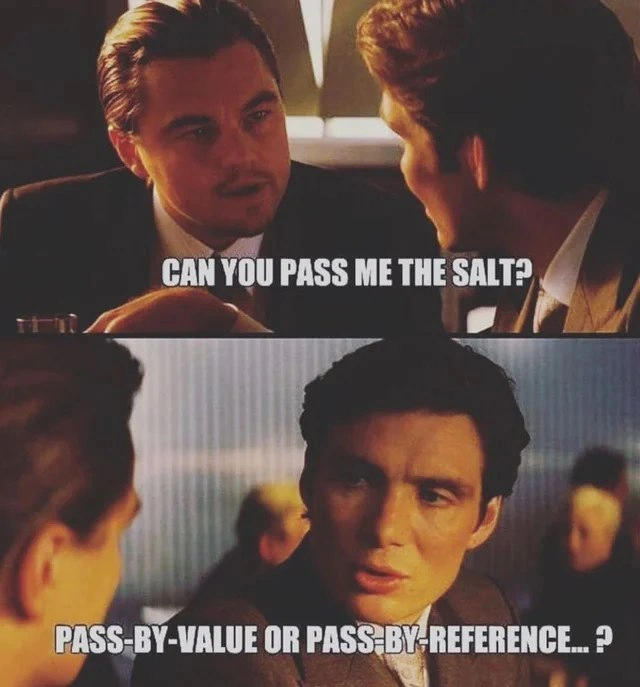
Passing the salt: programmer instantly debates value vs reference semantics
CS Fundamentals Post #1155, on Mar 18, 2020 in TG

Passing the salt: programmer instantly debates value vs reference semantics

Why is this CS Fundamentals meme funny?

Level 1: Just Give the Salt

Imagine you ask a friend to hand you the salt at dinner. Instead of simply giving you the salt shaker, your friend pauses and asks with a serious face, “Do you want me to give you this salt shaker, or should I go get you a different salt shaker with the same salt?” That’s essentially what’s happening in the meme. It’s a really silly question, right? In real life, you just want the one salt shaker passed over so you can use it – nobody expects their friend to duplicate the salt! The joke is funny because the friend is over-complicating a simple request, acting like this is a problem in a computer program. Basically, the programmer friend is so used to thinking about how things are passed around in code that he’s treating a normal dinner request as if it has two technical options. To a regular person, this sounds absurd (and it is!), but to a programmer it’s humorously relatable – it’s poking fun at how we sometimes can’t help but see the world in terms of code. In the end, you’d probably just say, “Dude, just hand me the salt,” and that contrast is exactly what makes us laugh.

Level 2: Value vs Reference 101

This meme hinges on the concept of pass-by-value vs pass-by-reference, which are two fundamental ways to pass data into a function in programming. In simpler terms, it’s about whether a function receives its arguments as a fresh copy or as a direct reference to the original data. Understanding this is a key part of CSFundamentals and is taught early in computer science classes because it affects how functions behave and how variables change (or don’t change) after a function call.

Let’s break down the terms:

  • Pass-by-value: The function gets a copy of the data. Think of it like making a photocopy of a document for someone – they can mark up their copy, but your original stays the same. In coding, if you pass an integer x by value into a function, the function can modify its local copy of x, but when it returns, your original x is unchanged.
  • Pass-by-reference: The function gets a reference (like an alias or pointer) to the original data. This is like handing someone the only copy of a document – if they scribble on it, your copy now has scribbles too because it’s the same original. In programming, if you pass a variable by reference, the function can change the actual variable from the caller’s scope. The function essentially works with the original data, not a duplicate.

Most high-level languages choose one strategy or the other (and some do a bit of both behind the scenes). For example, in C++ you can explicitly decide: you might write a function as void incrementByValue(int n) or void incrementByReference(int &n) depending on whether you want a copy or the original. In pure pass-by-value languages like Go, everything is copied by default (though you can pass pointers if needed). In Java and Python, it gets a little tricky because they always pass by value, but if that value is a reference to an object, the function can still mutate the object – a common LanguageQuirk that can confuse newer devs. The key takeaway is: by value means safety from side effects (but you might not see changes outside the function), whereas by reference means potential side effects on the original data (but no need to copy large data structures, which can be more efficient).

To make this concrete, here’s a quick illustration in C++ style pseudocode of how the two differ:

void setToZeroByValue(int x) {
    x = 0; // This only changes the local copy of x
}
void setToZeroByReference(int& x) {
    x = 0; // This changes the original variable, since x is a reference
}

int main() {
    int a = 5;
    setToZeroByValue(a);
    std::cout << a;  // Output: 5 (a is still 5, unchanged)
    setToZeroByReference(a);
    std::cout << a;  // Output: 0 (a was modified through the reference)
}

In the code above, a stays 5 after the first call because we passed a copy, so the function only changed its local version of a. After the second call, a becomes 0 because we passed a reference, and the function’s change affected the real a. This is exactly the concept the friend in the meme is joking about — how something is passed along.

Now think back to the meme: One friend simply asks for the salt, much like a program calling a function with an argument. The other friend – clearly a programmer – jokes about how to pass that argument: should it be by value or by reference? In a normal situation, you’d never specify this, right? You’d just hand over the salt shaker. But because programmers spend so much time worrying about these details in code, the friend’s brain treats a casual request as if it were a function call. This contrast is what makes the joke funny to anyone who knows about passing parameters. It’s a bit like a newbie dev moment turned into a punchline: if you’ve ever wondered “am I giving this function a copy or the real thing?”, you’ll appreciate why someone might blurt out “by-value or by-reference?” even when the context is totally non-technical.

Level 3: A Pinch of Semantics

Only a software developer could transform a polite dinner request into a mini computer-science debate. In this meme, a simple question “Can you pass me the salt?” suddenly invokes language semantics: the friend replies with, “by-value or pass-by-reference…?” Seasoned developers (pun absolutely intended) chuckle at this because it’s a mash-up of everyday life with a core CS_Fundamentals concept. The word “pass” has triggered a geeky reflex, recalling all those discussions about how programming languages pass data around. It’s a classic piece of CodingHumor that plays on our tendency to overanalyze — turning a mundane task into a snippet of pseudo-code in our heads.

The humor here comes from the collision of normal and nerdy. No non-programmer would ever worry about parameter passing when handing over a salt shaker, but every developer instantly recognizes the reference (pun intended). It highlights a well-known LanguageQuirk: pass-by-value vs pass-by-reference. This is a subtle detail of function calls that we debate in forums, interviews, and late-night office conversations. By asking “by-value or by-reference,” the friend is essentially treating the salt like a function argument and asking how the parameter should be passed. It’s funny because it’s an absurd level of detail for a dinner table request — the kind of over-analysis only a programmer would even think about. The meme pokes fun at our habit of seeing code patterns in daily life. It’s a RelatableDevExperience: many of us have caught ourselves hearing a normal phrase and jokingly interpreting it in tech terms (whether it’s “Did you cache the keys?” when someone says they lost their keys, or “404, item not found” when the milk is missing in the fridge).

Deep down, this joke resonates because “pass-by-value or pass-by-reference” is a rite-of-passage topic in development. Experienced engineers remember the confusion and debate around it. We’ve dealt with bugs or design decisions that came down to this distinction. For instance, consider C++: forgetting an & in a function parameter can mean your changes to an object don’t propagate back – a classic rookie mistake that seniors love to reminisce about. In Java, there’s the eternal debate where one side insists Java is pass-by-value (since it always passes a copy of the reference) and the other side gets confused because objects can be mutated. In Python and JavaScript, everything is effectively a reference to an object passed by value under the hood, which is why modifying a list inside a function affects the caller (a quirk that surprises new developers). All these little differences are the kind of LanguageComparison trivia that developers accumulate over time. So when the friend in the meme asks the salt question, every programmer’s mind lights up with recognition: “Haha, how often have we argued about that exact phrase in code, and here it is in real life!”

Ultimately, this meme exaggerates a common programmer trait: we can’t turn off our technical brain, even at the dinner table. The scenario is absurd but hits close to home. It satirizes the way developers share a mental catalog of knowledge that can make us sound ridiculous outside of coding contexts. The friend’s deadpan face asking “by-value or by-reference” is basically saying, “I’ve been thinking about code all day, and now even passing the salt has two meanings to me.” It’s an in-joke for developers – a wink to those of us who have spent far too long debugging a function because a value wasn’t changing due to how it was passed. This kind of DeveloperHumor is both nerdy and endearingly true: once you’re deep into programming, even ordinary requests can come with a side of computer science.

Description

Two - panel meme set in a dimly-lit restaurant scene. All faces are pixelated for anonymity. Panel 1 shows one suited diner asking, in bold white all-caps text spanning the bottom, “CAN YOU PASS ME THE SALT?” Panel 2 cuts to the friend who replies in equally bold white text, “BY-VALUE OR PASS-BY-REFERENCE…?” The joke turns a simple dinner request into a computer-science argument about parameter-passing strategies, poking fun at how developers overanalyze everyday language through the lens of programming language semantics

Comments

6
Anonymous ★ Top Pick If you hand me a pointer to the shaker and the intern hot-swaps it to pepper, we’re back in shared-state hell - just give me an immutable copy and let the GC handle the crumbs
  1. Anonymous ★ Top Pick

    If you hand me a pointer to the shaker and the intern hot-swaps it to pepper, we’re back in shared-state hell - just give me an immutable copy and let the GC handle the crumbs

  2. Anonymous

    After 20 years in the industry, you realize the real question isn't pass-by-value or pass-by-reference - it's whether the salt object is immutable, if we need to maintain a reference for garbage collection, and whether passing it will trigger a deep copy that blows our dinner party's memory budget

  3. Anonymous

    The real question isn't pass-by-value or pass-by-reference - it's whether the salt shaker implements Copy or just Clone, and if passing it will trigger a lifetime error because someone else is still holding a mutable borrow at the other end of the table

  4. Anonymous

    Pass-by-reference: Zero-copy perf win until aliasing turns your thread-safe singleton into a global mutation party

  5. Anonymous

    Pass the salt - copy, move, const-ref, or a mutable borrow whose lifetime ends before your soup?

  6. Anonymous

    At senior tables, “pass the salt” triggers an RFC on ownership, aliasing, and lifetimes before the shaker crosses the boundary

Use J and K for navigation