The Facepalm Dilemma for JavaScript Developers
Why is this Languages meme funny?
Level 1: Don’t Touch Your Face
Imagine your teacher tells you, “Keep your hands away from your face so you don’t get sick.” Sounds easy, right? But now imagine you’re working on a really hard puzzle or homework that’s super confusing. What do you do when you get totally frustrated? You might groan and cover your face with your hands without even thinking – like a big “Ugh!” moment. This meme is joking about that exact thing. Programmers (people who write computer code) often get so annoyed with tricky code, especially in a language like JavaScript, that they put their face in their hands out of frustration. It’s almost like a habit. The funny part is, during COVID-19 everyone was warning, “Don’t touch your face!” But these poor JavaScript coders can’t help it – their code makes them facepalm all the time! So the joke is saying: be careful, JavaScript programmers, if facepalming could spread the virus, you’d all be in trouble! It’s a silly way to remind us of two things at once: one, don’t touch your face too much because of germs, and two, writing code can be so confusing it makes people literally smack their foreheads. In simple terms, it’s funny because the very thing people were told not to do (touching your face) is something programmers do whenever they’re upset with their work. It’s like telling a kid not to scratch their head when they’re confused – easier said than done! The meme makes everyone laugh and say, “Yep, that’s exactly how it is,” because we all know how hard it is to break a habit, especially when you’re frustrated.
Level 2: Why Devs Facepalm
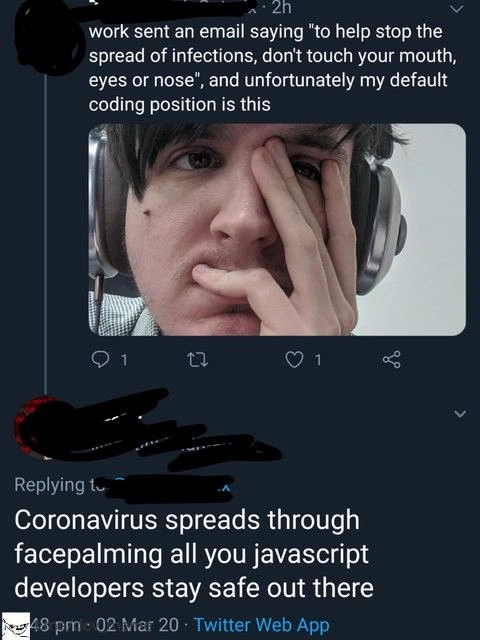
Let’s break down why this tweet is so relatable to developers, especially JavaScript folks. First, facepalm is that gesture where you cover your face with your hand because you’re frustrated or embarrassed – like when something is so silly or exasperating that you literally hide your face. Developers use the term “facepalm” a lot to describe moments of coding frustration or dumb mistakes. Here, the person in the image shows his “default coding position” as a full facepalm behind a big pair of programming headphones. That means he’s implying that writing or debugging code has him so perplexed or annoyed most of the time that he’s constantly sitting there with his hand over his face. (Anyone who has spent hours struggling with a stubborn bug can probably relate to that pose!)
Now, JavaScript developers in particular are jokingly warned in the reply to “stay safe” because “Coronavirus spreads through facepalming.” This is a witty twist on actual COVID-19 advice. Back in early 2020, companies and health officials were sending out lots of messages telling people don’t touch your face (since viruses like the coronavirus can transfer from your hands to your eyes, nose, or mouth). It was solid hygiene advice: touching your face less could literally keep you from getting sick. But here’s the catch: JavaScript devs touch their face a lot, albeit unintentionally, because they keep facepalming at their code! The reply humorously invents a facepalm_spread_theory: if covering your face with your hand is how the virus could spread, then programmers who constantly do that out of exasperation might be in trouble. Of course, it’s not a scientifically real mode of transmission; it’s a joke playing on the overlap between an everyday developer habit and the new safety guidelines.
Why single out JavaScript developers? Well, JavaScript is a programming language known for being very powerful but also kind of quirky and unforgiving in weird ways. It’s the language that runs in web browsers to make websites interactive, and almost every web developer has to deal with it. Over the years, JavaScript’s grown a reputation for causing DeveloperFrustration – think of things like mysterious errors, browser compatibility headaches, or confusing language behaviors. For example, JavaScript doesn’t always enforce strict rules about data types, which can lead to odd results: "5" + 3 ends up being the string "53" (because it concatenates like text), whereas "5" - 3 gives the number 2 (because it converts the string to a number to do subtraction). Little inconsistencies like that can surprise new developers and become running jokes for experienced ones. A JavaScript coder might spend hours debugging only to realize they forgot a single character or misunderstood how a function works in this language. That “d’oh!” moment is often accompanied by a literal facepalm.
The meme itself is a Twitter screenshot, which is a common way tech jokes circulate online. TechTwitter is basically the community of developers and tech enthusiasts on Twitter who share tips, vent about jobs, and make jokes that only fellow coders would fully get. In this screenshot, the top tweet (partly blurred) is the developer saying, in effect, “My company told me to avoid touching my face to stop COVID, but look – I basically always have my hand on my face when coding!” The image he attached (him facepalming with headphones on) drives home the point visually. The reply tweet then expands the joke: “If facepalming is how the virus spreads, all you JavaScript devs better be careful out there!” It’s a nod to how universal facepalming is among them. This falls under DeveloperHumor and TwitterHumor — it’s tongue-in-cheek, not meant to be taken as medical advice! The whole thread is a lighthearted take on a serious situation, mixing a covid19_memes vibe with a javascript_facepalm twist.
So, in simpler terms, this meme is funny to developers because it connects two things they were all talking about in 2020: the new COVID rules and the everyday struggles of coding. It basically says: “We developers are told not to touch our faces, but have you seen our code? Facepalming is our default reaction!” It’s a way of poking fun at both the coding_posture (hunched over, often in defeat) and the constant stream of DeveloperPainPoints that JavaScript can serve up. The advice to “stay safe out there” is something people were earnestly telling each other during the pandemic, but here it’s used with a wink – implying “good luck not facepalming, JavaScript devs, because that language will drive you up the wall.” In the end, it’s an example of how DevCommunities use humor on Twitter to bond over shared experiences. Even in a scary time like a pandemic, developers found a way to laugh at themselves – turning the facepalm (a symbol of frustration) into a joke about personal safety.
Level 3: JavaScript Quirks & Quarantine
At first glance, this meme mashes up a COVID-19 safety advisory with a classic coder predicament – and the result is biting developer humor. In the screenshot (from early March 2020, just as offices were emailing pandemic guidelines), a developer laments that work told everyone “don’t touch your mouth, eyes or nose to help stop the spread of infections”, yet “unfortunately my default coding position is this.” The accompanying photo shows him wearing the ubiquitous over-ear headphones and literally facepalming – hand plastered over mouth, nose, and eyes in frustration. It’s a perfect Tech Twitter moment: the deadly serious global situation meets the daily absurdity of programming life. A reply below flips the health warning into a punchline for the dev community:
Coronavirus spreads through facepalming – all you JavaScript developers stay safe out there.
This hits home for JavaScript developers because it satirizes how contagious their frustration can feel. In dev circles, facepalm is practically the official gesture of coding despair. It’s the reflex when encountering yet another bizarre JavaScript quirk or a bug that defies logic. And JavaScript has plenty of “🤦 moments.” Any seasoned web developer has racked up countless facepalms thanks to the language’s idiosyncrasies and historic warts. Remember discovering that typeof NaN returns "number" (even though NaN literally means “Not-a-Number”)? Facepalm. Or that infamous runtime error undefined is not a function when you call something that isn’t there? Double facepalm. JavaScript’s loose typing and legacy quirks are the stuff of legend – enough to test the sanity of even veteran engineers. One minute it treats a value as a string, the next it’s doing math on it, leaving you bewildered:
console.log("5" + 3); // "53" (string concatenation)
console.log("5" - 3); // 2 (numeric subtraction after conversion)
It’s the kind of inconsistent behavior that has developers rubbing their temples daily. So when the COVID email says “don’t touch your face,” JavaScript devs everywhere likely smirked, knowing how often coding makes them do exactly that. The meme exaggerates this shared pain point with dark humor: if facepalms were truly an infection vector, JavaScript programmers might be the most at-risk group on the planet! It’s a playful jab at how viral JavaScript frustrations can be – one dev facepalms at some absurd bug or runtime surprise, and soon the whole team is doing it. The tweet resonated across DevCommunities because it wraps a real concern (virus transmission) inside an inside joke about developer life. It also highlights how Tech Twitter is a place where developers commiserate and cope. Instead of yet another dry PSA about hygiene, the advice gets remixed into developer humor: “Stay safe out there” becomes code for “we know your pain.” Everyone in the replies nods knowingly, half-laughing, half-crying, because they’ve been there – head in hands, staring at the screen, wondering what on earth JavaScript just did. This blend of timely reference and coding frustration was meme gold, lighting up Tech Twitter as a much-needed chuckle in a tough time. After all, gallows humor is a coping mechanism: when production code and a pandemic are both out to get you, sometimes all you can do is laugh (and maybe sanitize those hands before the next facepalm).
Description
This image is a screenshot of a Twitter thread from March 2, 2020. The first tweet shows a user's post which reads, 'work sent an email saying "to help stop the spread of infections, don't touch your mouth, eyes or nose", and unfortunately my default coding position is this'. Below the text is a selfie of the user, a young man with dark hair wearing headphones, holding his hand to his face in a pose of concentration or frustration, with fingers near his eye, nose, and mouth. A reply to this tweet, with the author's name redacted, says, 'Coronavirus spreads through facepalming all you javascript developers stay safe out there'. The joke operates on two levels. First, it captures the relatable developer habit of face-covering contemplation, which became a minor health hazard during the early days of the COVID-19 pandemic. Second, the reply leverages the long-running stereotype in the developer community that JavaScript, with its quirks and often frustrating behavior, is a primary cause for developers to facepalm in exasperation
Comments
7Comment deleted
In 2020, the most dangerous part of JavaScript wasn't 'undefined is not a function,' it was the reflexive facepalm that followed
They told us to stop touching our faces, so we enabled strictNullChecks - turns out TypeScript is the only certified PPE against JavaScript-induced facepalms
The real pandemic was discovering that `undefined` is not a function while your immune system was already compromised from years of dealing with `this` binding issues
JavaScript developers have been practicing social distancing from their own code for years - the facepalm is just the physical manifestation of encountering `'5' + 3 = '53'` but `'5' - 3 = 2`. At least COVID-19 gave us a legitimate health reason to avoid touching our faces during debugging sessions, though most of us failed that challenge within the first `undefined is not a function` error
'this' in JS: so confusing it repros facepalms faster than a viral outbreak
Our pandemic plan for the JS codebase: enforce === and TypeScript; the R0 of facepalms finally fell below 1
If facepalms were a transmission vector, npm install would be a superspreader - pin your versions and your masks