When marriage vows devolve into a do-while loop of eternal love
Why is this CS Fundamentals meme funny?
Level 1: Endless Love
Imagine someone saying they will love you forever, but in a playful, silly way. In this comic, the bride basically promises to love her groom on an endless repeat. It’s like putting your favorite song on loop so it plays over and over without ever stopping. By joking that her love is like a never-ending loop, she’s really saying “my love for you will never run out.” It’s a fun mix of a normal wedding vow (“I do”) with the idea of something that goes on and on non-stop. You don’t need to know any coding to get the sweet message: she’s telling him she’ll keep on loving him again and again, with no end — and that’s why it’s both funny and really heartwarming.
Level 2: The Do-While Vow
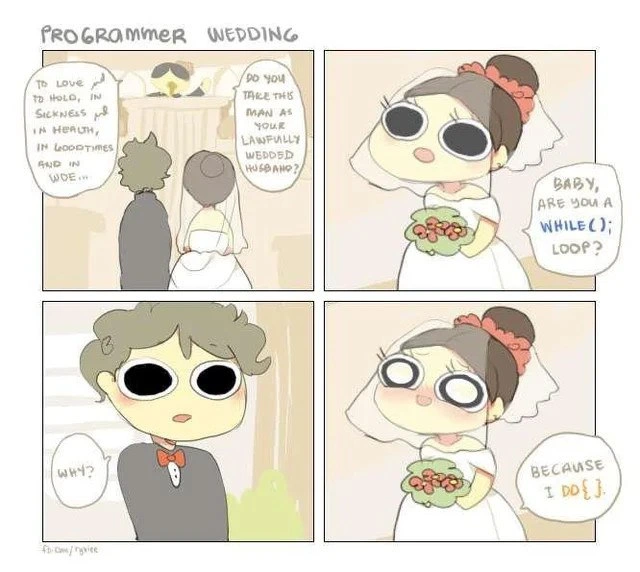
Let’s break down the joke step by step. The bride is mixing a programming concept into her wedding answer. In the comic, she asks, “Are you a while loop?” and then answers her own question with “Because I do { }.” This is a play on words using code:
In programming, a loop is a way to repeat a set of instructions – one of the basic control flow structures that dictates the order in which code runs. A while loop will keep running a block of code while a certain condition is true. Importantly, a
whileloop checks its condition first. If the condition is false right from the start, the loop’s code block might not run at all.A do-while loop is a slight twist on this idea. It will do a block of code first at least one time, and then check the condition afterward (that’s the while part at the end). Because the check comes last, a do-while loop always runs the code inside the braces at least once, even if the condition is false initially. The basic format in many languages looks like:
do { // code to execute } while (condition);Here,
{ ... }denotes the code block that runs repeatedly, andconditionis what decides if the loop keeps going or stops.
Now, how does this relate to the wedding scene? When a marriage officiant asks “Do you take this man as your husband?”, the bride is supposed to answer “I do.” That’s the classic wedding vow response meaning “Yes, I agree to marry you.” She cleverly turns her “I do” into do { } – the start of a do-while loop’s syntax. By asking if he’s a while() loop, she sets up the idea that her answer will involve that do...while structure. It follows a nerdy pickup line formula: “Are you X? Because Y.” Here X is “a while loop” and Y is “because I do { }.”
So basically, she’s answering the wedding question in code form! The phrase “Because I do {}” sounds like the normal “because I do” (meaning “because I accept”) but with a pair of curly braces added. In coding syntax (the special format of the code), those curly braces {} contain the actions that you want to repeat. We can imagine those braces hold all the loving things she promises to do for him. It’s as if she’s saying, “I do (everything a loving partner should do for you)...” and then putting that on repeat. If this were actual code, we’d expect to see something after the braces like while(someCondition);. She doesn’t speak a condition out loud, but by referencing a loop, she hints at one. Perhaps the unspoken condition is while(true) (which means “repeat indefinitely”) or a life-long condition like while (we both shall live). By not specifying it, the comic keeps things simple, and we as programmers fill in the blank with "while forever".
This joke is especially funny to people who know languages like C, C++, Java, or JavaScript, where do { } while(...); is actual code. In those languages, do and while are reserved words, and braces mark a block of code. (If you’ve only learned Python or similar, note that Python doesn’t have a built-in do-while loop or {} braces, so this exact syntax wouldn’t appear there – it’s a little quirk of the C-style language family.) Because of this, the moment she says “I do {},” any C/Java developer immediately recognizes a loop joke. It’s a neat example of syntax humor – the punchline only works because of how code is written out.
For a new developer or CS student, this meme is a lighthearted way to see programming basics pop up in everyday life. It riffs on a concept from computer science fundamentals (loops and how they work) in a marriage setting. The bride’s commitment is being compared to a loop that will run at least once (she definitely says “I do,” executing that promise) and then continue to run while some condition holds true (ideally as long as they both live, or maybe forever). If we imagine that condition is “true forever,” then it becomes a loop that never ends – a symbol of potentially infinite love.
In short, the bride’s joke is like saying: “I will always love you, on and on,” but she says it in a clever programmer way. It’s a fun, geeky twist on the classic “I’ll love you forever” promise. Even if you’re just starting to code, you can appreciate that she turned a serious vow into a little piece of code. It shows how knowing these technical concepts lets you enjoy inside jokes in the developer community — even wedding vows can get a programming makeover when you’re nerdy enough!
Level 3: Infinite Love Loop
At first glance, this pastel comic looks like a sweet wedding scene, but the humor is hard-coded in its syntax. The bride asks her groom, “Baby, are you a while(); loop?” and when he innocently responds “Why?”, she delivers the punchline: “Because I do { }.” This quirky exchange is a play on a programming do-while loop disguised as marriage vows. In many programming languages (like C, C++, or Java), a do { ... } while(condition); loop is a control flow statement that executes a block of code once, then repeats it while some condition remains true. Here, the bride’s “I do { }” is both a romantic affirmation (“I do” meaning “I take you as my husband”) and a snippet of code – the opening of a do-while loop’s body enclosed in curly braces. By leaving the condition blank (no while(x) specified), she cheekily implies an infinite loop of love: an eternal commitment that never breaks out.
This blend of romance and code is classic developer humor. It exploits a fun language quirk: the common English phrase “I do” happens to be a programming keyword! It’s a rare overlap where wedding lingo doubles as code syntax. The curly braces { } you see are also intentional – in code, they denote the block of actions to repeat. So when the bride says “I do {}”, visualizing it as code suggests she’s pledging to perform whatever is inside that block (love, cherish, etc.) at least once and then check if it should happen again. In a real do-while loop, the condition after while decides if the loop iterates again. If that condition is always true (say, while(true)), the loop runs forever. That’s the “eternal love” twist: an infinite love loop is like saying “I’ll love you on repeat, forever.”
Experienced devs chuckle at this because they recognize the CS fundamentals at play. A while loop normally checks its condition first – it might not run at all if the condition is false initially. But a do...while loop is a post-test loop: it runs the code block first and only then checks the condition at the end. It guarantees at least one execution. That nuance makes the pun possible—her “I do” (the loop’s body) comes before any condition, just like in a do-while. It’s as if the bride is saying: “No conditions needed up front; I’m diving in and I’ll keep loving while life goes on.” In a way, it mirrors real love or unconditional commitment: you jump in (“I do”) without a pre-check, then stick with it through whatever comes (the while condition could be “while we both shall live” or simply always true).
For veteran programmers, there’s an extra chuckle in how precisely this joke hits technical details. The comic text uses actual coding punctuation—parentheses () and braces {}—just like you’d see in source code. Notably, in C-style languages a do...while loop ends with a semicolon, while(condition);. The bride tactfully leaves out the condition (and that trailing semicolon) in her speech bubble, since saying a full while(true); wouldn’t roll off the tongue in a romantic moment. But we implicitly fill it in as while(true) in our minds, meaning “I’ll keep doing this forever.” It’s a smart way to keep the vow sounding sweet while still winking at the technically savvy.
This scenario of a programmer wedding swapping serious vows for code is both absurd and endearing. It resonates with developers because many of us have a habit of seeing code analogies in everyday life. We’ve all learned loops early in our coding journey, and here those familiar control flow statements are repurposed for a heartfelt promise. The idea of an infinite loop — normally a bug that could crash your program — is turned into a romantic feature: love that never terminates. It’s the one time we want a loop to never hit a break condition! The meme sits at the intersection of logical code and human emotion, and that contrast is hilarious to anyone who codes. We can imagine the wedding attendees who are programmers bursting into laughter, while non-tech folks might be momentarily baffled by talk of loops and braces at the altar.
In summary, this meme uses a bit of syntax humor to transform the serious promise “I do” into an inside joke about an unending do...while loop. It highlights how even fundamental coding concepts (like loops from CS101) can sneak into our personal lives and language. For seasoned developers, it’s a fun reminder that sometimes love itself feels like an infinite loop – and in this case, that’s something to celebrate.
// A happily-ever-after loop in pseudo-code:
bool loveForever = true;
do {
loveAndCherish(partner);
} while (loveForever); // runs indefinitely – their love has no end!
Description
Four-panel pastel comic titled "Programmer Wedding." Panel 1: a bride and groom stand before an officiant; a speech bubble reads, "to love n to hold, in sickness n health, in good times and in wde…" followed by "Do you take this man as your lawfully wedded husband?" Panel 2: close-up of the bride holding a bouquet, cheeks flushed, thinking, "Baby, are you a while(); loop?" written in blue. Panel 3: close-up of the groom, eyes wide, replying, "Why?" Panel 4: the bride, blushing harder, answers, "Because I do{}." - a pun referencing C-style do-while control flow. The humor hinges on programming syntax, control-flow concepts, and language quirks, making it relatable developer wedding banter
Comments
19Comment deleted
I vowed “till death or unhandled exception do us part,” then immediately wrapped the ceremony in a compensating transaction - 15 years in distributed systems taught me never to trust a two-phase commit with something that important
The real question is whether their marriage contract includes proper exception handling, or if they're just going to let it throw uncaught NullPointerExceptions when the garbage collector comes for their shared references after 20 years
The bride clearly understands the fundamental difference between while() and do-while loops: she's committing to execute at least once before evaluating any exit conditions. It's the perfect metaphor for marriage - you say 'I do' first, then spend the rest of your life in the loop body dealing with the consequences. At least she's guaranteed O(1) minimum iterations, unlike a while loop that might never execute if the groom's commitment evaluates to false upfront
while(true){ I do; } - the only infinite loop that beats on-call rotations for uptime
Marriage is a two-phase commit; juniors write while(true) { I_do(); }, seniors require consensus() or you’ll spin forever and leak resources
A wedding is basically a two‑phase commit - officiant sends PREPARE, both reply “I do,” then COMMIT; otherwise, rollback to dating
Cringe Comment deleted
Are you a while{} loop? Because I gonna break; up with you Comment deleted
He didn’t answer the question. Comment deleted
Could someone point me where is cringe? Comment deleted
probably just some edgy guy thinking emotion is cringe Comment deleted
understood Comment deleted
my life Comment deleted
She is hurrying. She first of all should make sure that his words are true, ot try catch him. She does and then checks, after fire Comment deleted
you forget she's done months of testing beforehand, so she can now make assumptions that allow for faster execution times Comment deleted
That is true for code profiling, which may or may not reflect future use cases. Static code analysis, on the other hand, can make instant decisions by simply looking at the code; however, it needs stronger patterns sometimes ignoring "obvious" but non-proveable cases. So the bride may be just a psychologist rather than an experienced person. Comment deleted
such questions are still left to ponder over… Comment deleted
Nah,it's a good meme Comment deleted
must be an expression, can't evaluate" why?" did you mean "Why()" ? Comment deleted