When C macros spawn yet another totally ‘new’ programming language
Why is this Languages meme funny?
Level 1: New Name, Same Thing
Imagine you have a simple toy, like a Lego car, and you decide to give all its parts new names. You call the wheels “roundspinners,” the car body “zoomframe,” and the driver figure “pilot brick.” Now you announce to your friends that you’ve invented a brand new toy called the “ZoomMobile 3000.” In reality, it’s still the same old Lego car you had – you just renamed everything and maybe moved a few pieces around. Your friends would probably roll their eyes or laugh, because they recognize it’s the same toy with a fancy label.
That’s exactly what’s happening in this meme, but with programming. A programmer took the C programming language (which is like the well-known Lego car in our analogy) and just gave a bunch of things in it new names using a tool in C that replaces words (macros). Then they’re acting like they created an entirely new programming language. It’s funny because it’s so pretend. It’s as if someone put a superhero costume on a pet cat and started introducing it as a “never-before-seen species of animal.” Everyone else can see it’s just a cat in a cape.
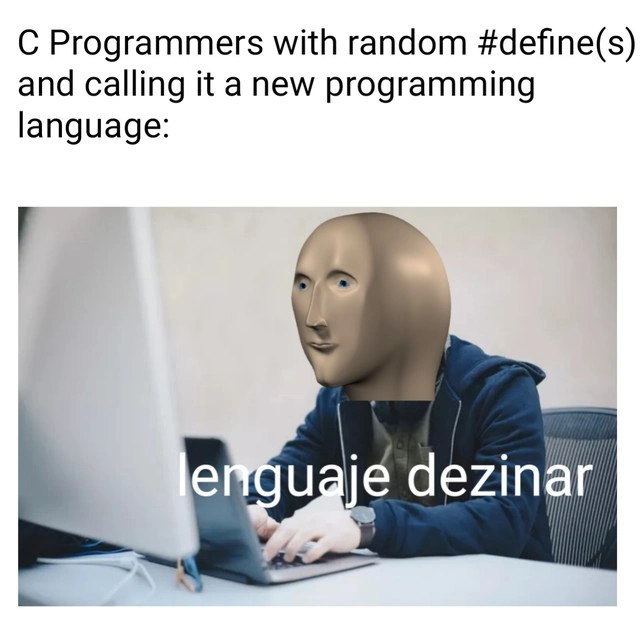
So, the meme is joking about this behavior. The top text basically says, “Look at C programmers who randomly use #define (the rename trick) and claim it’s a new language.” The bottom picture shows a guy in a hoodie with a silly blank face, labeled “lenguaje dezinar” (a misspelled “language designer”), as the one doing this. In very simple terms: it’s poking fun at people who give something old a new name and try to pass it off as something completely new. The humor comes from how obvious it is to everyone else that nothing truly new was made – only the names were changed. It’s a playful reminder that calling an apple an “orbular sustenance unit” doesn’t make it a new fruit. 🍏➡️🚫✨👑
Level 2: C in Disguise
Let’s break this down in simpler terms. In the C programming language (and its cousins like C++), there’s a feature called the preprocessor. One of the most commonly used preprocessor directives is #define. A #define allows you to create a macro, which is basically a rule that says: “Whenever you see X in the code, replace it with Y before compiling.” It’s like an automatic find-and-replace that runs when you build your program. For instance:
#define PI 3.14159
printf("%f", PI * radius * radius);
Here, PI is a macro for 3.14159. Before the compiler actually compiles the code, the preprocessor will replace PI with 3.14159, so the compiler sees printf("%f", 3.14159 * radius * radius);. This is a simple and valid use of #define – giving a meaningful name to a constant value.
Now, what the meme is talking about is extreme misuse of this feature. Instead of just constants or the occasional short function-like macro, some C programmers create a whole bunch of weird #define rules to essentially rename parts of the language. For example, imagine they write:
#define Begin {
#define End }
#define StartProgram int main()
StartProgram Begin
printf("Hello, World!\n");
End
In this contrived example, they’ve defined Begin to substitute for {, End for }, and StartProgram for int main(). So, when the preprocessor runs, the code StartProgram Begin ... End turns into int main() { ... }. It’s still plain C to the compiler, but the source code looks like some made-up language. This is what we mean by “C in disguise.” The programmer has basically put a mask on C, using macros to make it read differently.
Why would someone do this? Sometimes it’s for a specific need – for instance, making a little domain-specific language (DSL) to simplify certain tasks. C’s macros can act like a simple code generator or alias mechanism. There are legitimate small uses: defining short aliases for logging calls, or making a platform-dependent bit of code switch out on different systems. However, the meme is targeting those who go overboard and treat these aliases as if they invented a whole new programming language. That’s where it becomes over-engineering and frankly confusing for others.
Let’s clarify some terms that came up:
- Domain Specific Language (DSL): This is a mini “language” tailored for a particular domain or task, often built on top of an existing language. For example, SQL is a DSL for database queries, or HTML is a DSL for laying out webpages. In our context, a DSL could be something a developer crafts within C to, say, make writing game logic look simpler. However, usually DSLs are created with real language tools or libraries, not just by renaming keywords via macros.
- ReinventingTheWheel: This phrase means creating something from scratch that already exists and works well. Here, it implies our C programmer is reinventing a programming language that, well, already exists (C itself!), just with different names. It’s doing a lot of work (and introducing problems) for very little gain.
- MetaProgramming: This is a fancy word for “programming about programming.” It refers to code that writes or manipulates code. Macros are a form of meta-programming because they generate new code from your definitions. In moderation, metaprogramming can be powerful. But in this case, it’s used in a tongue-in-cheek, excessive way.
- CodeQuality: Why is this listed? Because heavy macro use like this tends to hurt code quality. It makes code less readable and more error-prone. Clean code is usually straightforward about what it’s doing. If you open a file and see standard C constructs (
if,for,while, etc.), you know what’s going on. If instead you see odd words and symbols defined elsewhere via macros, you have to jump around to understand what the code is actually doing. It’s like reading a book where every other word is in a secret code — technically decipherable, but unnecessarily hard.
One common good use of #define every C newbie learns is the header guard. At the top of a header file you might see:
#ifndef MY_LIBRARY_H
#define MY_LIBRARY_H
// ... contents of the header file ...
#endif
This is a simple macro trick to prevent the file from being included twice (the first time it’s included, MY_LIBRARY_H gets defined, and then the next time the #ifndef check will fail, skipping the contents). That’s an example of using macros for preventing problems (duplicate definitions), and it’s very standardized. But in our meme’s case, macros are being used not for guarding headers or defining constants, but for something quite flamboyant: creating a “macro language.”
Think of the C preprocessor as a stage magician and the actual compiler as a strict logician. The magician (preprocessor) can swap around words and perform quick tricks before handing the script to the logician (compiler), who then methodically executes it. If the magician goes too wild – sawing the code in half and gluing it back in weird ways – the logician might still try to read it (because ultimately it’s still valid C after the swaps), but any humans watching are going to be bewildered by the performance. In plainer terms: by the time the code gets to the compiler, it’s still the C language, just maybe contorted. But to a human reading the original, it looks like something else entirely.
The tags like c_preprocessor_hacks and define_macro_abuse are essentially labeling this practice. It is indeed a hacky use of the preprocessor and definitely an abuse of #define. Just because C gives you a big hammer (macros) doesn’t mean every problem (or non-problem) is a nail to smash by inventing a “new language.” Other programmers usually groan when they see this because it means extra overhead to understand the code. Imagine joining a project and you have to learn “Macro-ified C” instead of just C. You’d spend a lot of time unlearning the fake terms to map them to real C constructs.
So, in straightforward terms, this meme is ridiculing the scenario where a programmer uses a bunch of #define directives to relabel the basic building blocks of C, then grandiosely calls the result a brand new language. It’s the programming equivalent of putting on a disguise and insisting you’re unrecognizable. Spoiler: everyone can tell it’s the same person (or in this case, the C language) under the costume. 😅
Level 3: Define and Conquer
C Programmers with random #define(s) and calling it a new programming language:
[hooded figure typing, captioned “lenguaje dezinar”]
At a senior developer level, the meme is immediately recognizable as a jab at C programming culture and the misuse of the C preprocessor. The top caption sets the scene: we’ve all met that programmer who goes wild with #define macros, essentially creating a pseudo-DSL (Domain Specific Language) on top of C, and then boasts as if they’ve invented something groundbreaking. The bottom image — a faceless hoodie-wearing “lenguaje dezinar” (intentionally misspelled “language designer”) — perfectly captures the absurdity. The blank, almost NPC-like face is a known meme trope for a clueless or mechanical person. Here it implies “Look at me, I’m a 1337 language architect” in the most satirical way. The misspelling itself (“lenguaje dezinar”) hints that this wannabe language designer can’t even spell the title correctly, underlining the joke: they think they’re doing grand language design, but it’s really just cheesy macro abuse.
This is classic developer humor around reinventing the wheel. Instead of using C as intended or learning an actual new language, some C gurus delight in over-engineering: using #define to create new “keywords” or syntax. For example, someone might do:
#define Begin {
#define End }
#define FunctionStart int main() /* Yes, this actually replaces 'FunctionStart' with 'int main()' */
FunctionStart Begin
printf("Hello, world!\n");
End
In the above snippet, the developer introduced fake keywords Begin, End, and FunctionStart. After preprocessing, that code turns back into a normal int main() { ... } function. But if you saw the source, you’d think: “What language is this? FunctionStart? Begin?” It’s just C in disguise. The meme mocks this exact scenario. The person in the image is presumably typing away, defining nonsense like #define doTheThing printf or renaming while loops to loop_until and then proudly declaring they’ve created a “new programming lenguaje” from scratch. It’s like a kid putting on a cape and insisting they’re a superhero they invented – cute, but we all know what’s underneath.
Why is this funny (or cringey) to experienced devs? Because we’ve seen what define macro abuse leads to: a maintenance nightmare. Here are a few outcomes of these “macro language” escapades:
- Readability Nightmares: The code no longer looks like standard C. It becomes a bizarre dialect that only the author understands. Future maintainers open the file and go “What the heck language is this?” You’ve essentially forked C for one project via macros.
- Debugging Hell: Error messages from the compiler refer to the expanded C code, not your fancy macro names. So when something goes wrong, you might get an error pointing at a line with
int main(after macro expansion) even though your source file has no literalint mainin it. Tracing bugs becomes a game of mental find-and-replace, reconstructing what the code actually does. A cynic might dryly note that at 3 AM, deciphering cryptic macro-infested crash logs is not fun. - Maintenance and Onboarding Hazards: New team member joins and spends days just learning these fake keywords that don’t exist outside your codebase. It’s reinventing the wheel with extra steps – pointless and confusing. Plus, any tool (syntax highlighters, linters, auto-formatters) that expects normal C code might choke on or misinterpret these macro-injected “keywords.”
The meme also riffs on the meta-programming ego trip. In the programming world, creating a new programming language is often seen as a virtuous, almost academic exercise – something only the guru-level computer scientists do (designing compilers, inventing languages like Rust or Go). So there’s comedic contrast in a C programmer basically saying, “I too am a language designer! Behold my magnum opus!” – when all they did was write a bunch of #define directives. It’s parodying those announcements of a “new language” on forums or GitHub that turn out to be one-off gimmicks. The tag fake_language_release hits this nail on the head: it’s as if our hooded friend released a blog post touting “Lenguaje Dezinar 1.0 – a revolutionary programming lenguaje”, which on inspection is just a single C header file full of macros.
It’s worth noting this kind of C preprocessor hack only works in C family languages (like C and C++), because they have that textual macro facility. You couldn’t easily pull this stunt in, say, Python or Java – those languages don’t let you arbitrarily rename language keywords via a pre-compilation step. This is a specific quirk (or loophole) in C/C++ that lends itself to such shenanigans. Seasoned C/C++ devs often have a love-hate relationship with macros: they can be powerful (think of header guards, or enabling platform-specific code), but they can also produce monster code if overused. There’s even a flavor of language_quirks pride in some corners: “Look how clever my macro is, I basically added classes to C!” (Yes, people have implemented object-oriented patterns in C using macros and function pointers… it works, but it ain’t pretty.) The meme humorously calls out that pride.
In a way, this is a tongue-in-cheek critique of over-engineering. Instead of solving the problem in a straightforward way (maybe just write a function or use an existing scripting language for customization), the macro-happy programmer chooses an unnecessarily convoluted path. They aren’t just reinventing the wheel, they’re reinventing it using spare parts in a garage and calling it a Formula 1 car. For experienced devs, it’s a bit of schadenfreude and facepalm rolled into one: we laugh because we’ve either seen it or (admit it) done it in our own early days, and we cringe because we know how badly it tends to end. As one might quip in a code review:
Reviewer: “Which language is this code written in? I don’t recognize the syntax.”
Author: “Oh, it’s C… I just made some improvements with macros to design my own language.”
Reviewer: “Right… How about we stick to plain C before the next person quits in confusion?”
In summary, Level 3 exposes why the meme hits home for developers: it satirizes a common anti-pattern in programming culture. It’s MetaProgramming gone wild, a language_design_parody where the punchline is simply replacing keywords and patting oneself on the back. The community collectively chuckles because we treasure clarity and maintainability (hard lessons from countless WTF moments), and this kind of stunt goes against the grain of good CodeQuality. It’s a lighthearted reminder: just because you can do something in code, doesn’t make it a good idea – and it certainly doesn’t make you Dennis Ritchie (the creator of C) reincarnated. 😜
Level 4: Macro Machinations
At the most technical level, this meme pokes at the boundary between language design and preprocessor trickery. It highlights how some C developers use the C preprocessor (the stage that processes #include and #define directives before actual compilation) to create the illusion of a new programming language. In real language design, one would define a formal grammar, perform lexical analysis (turning source code into tokens), parse those tokens into an Abstract Syntax Tree (AST), and implement semantic analysis and code generation. That’s how real compilers and interpreters build languages from the ground up (think writing a parser with BNF grammar rules or using tools like YACC/Bison).
By contrast, the C preprocessor is a much simpler beast: it performs textual substitution. A directive like #define new_keyword old_keyword tells the preprocessor to literally replace every instance of new_keyword with old_keyword in the code, before the actual C compiler runs. There’s no understanding of C syntax or types at that stage – it’s essentially a glorified find-and-replace engine. This means you can’t truly invent new syntax or semantics beyond what C already supports; you can only dress up existing C syntax with different words. You’re not extending the language’s grammar; you’re aliasing it. The meme’s humor comes from confusing this shallow mimicry with genuine language invention.
From a theoretical perspective, abusing macros to create a “language” is like building a Turing tarpit inside C – in theory, you could contort the preprocessor into doing astonishing things, but in practice it’s painfully impractical. (Fun fact: C++ template metaprogramming and extreme macro use have been shown to be Turing-complete, meaning they can compute anything computable given enough hacks. But just because you can doesn’t mean you should.) Proper languages provide hygienic macros or AST macros that respect scope and syntax (for example, Lisp or Rust allow macro expansions that integrate with the language’s structure safely). C’s macros, however, are not hygienic – they literally paste code, which can lead to macro collisions or bizarre side effects if you’re not careful. There’s a reason many coding standards caution against complicated macro trickery: it operates outside the language’s normal rules, making reasoning about code harder.
Historically, some developers have toyed with this idea of creating DSLs (Domain-Specific Languages) via the preprocessor. It’s a sort of meta-programming hack: writing code that writes (or transforms) code. There have even been tongue-in-cheek “new languages” announced that are just C with a different coat of paint – for instance, replacing C keywords with keywords from another spoken language or a made-up syntax. These stunt projects demonstrate how flexible (or brittle) the C preprocessor can be. The meme’s “lenguaje dezinar” character is effectively a parody of those who think fiddling with #define is on par with serious language engineering. It’s mocking the hubris of calling yourself a language designer after cobbling together a bunch of macros. From a compiler expert’s view, that’s like claiming you built a new compiler when all you did was write a script that substitutes some tokens. Sure, it runs on the compiler infrastructure – but you haven’t altered the compiler’s understanding of the code one bit.
In sum, the deep irony here is about reinventing the wheel in the most convoluted way. It’s technically interesting (in the same way an entry in the International Obfuscated C Code Contest is interesting) to see just how far you can push the preprocessor. But it’s also a grand over-engineering joke. The fundamental language theory lesson: a true programming language involves formal syntax and semantics, not just search-and-replace. What these macro-happy C programmers are doing is more like parlour trickery – clever, perhaps, but ultimately running on C’s engine with C’s rules. The humor is in conflating this low-effort macro masquerade with the lofty art of designing a real language.
Description
The meme is a two-panel layout. Top white space contains black text reading: “C Programmers with random #define(s) and calling it a new programming language:”. The lower panel is a stock photo of a hoodie-wearing person typing at a desktop computer; the face has been blurred for anonymity. Super-imposed in large white text across the photo is the deliberately misspelled phrase “lenguaje dezinar”, mocking the idea of grand ‘language design’. Technically, the joke pokes fun at C developers who abuse the #define pre-processor to rename keywords and macros, effectively creating a confusing pseudo-DSL and claiming it’s an entirely new language. It highlights meta-programming excess, over-engineering, and the endless cycle of inventing ‘fresh’ languages by simply aliasing existing syntax

Comments
8Comment deleted
Shipping a 4,000-line header of #defines and calling it a language is the C equivalent of rebranding your monolith as “microservices” - the taxonomy changes, the segfaults stay
Every legacy codebase has that one file where someone tried to make C look like Pascal with #defines, and now the debugger just shows you preprocessor output that looks like it was written by an alien civilization trying to communicate through regex
Ah yes, the classic C programmer's rite of passage: discovering #define and immediately architecting a 'revolutionary' DSL that's just 47 nested macros pretending to be syntax sugar. Bonus points if it includes token pasting (##), stringification (#), and variadic macros (__VA_ARGS__) to create something that looks like Python but debugs like a war crime. The compiler error messages alone could serve as a Turing test - if the developer can decipher 'expected ; before } token' on line 1 when the actual error is in macro expansion 12 levels deep, they've truly ascended. Meanwhile, the next maintainer opens the codebase, sees X-macros and computed gotos wrapped in preprocessor conditionals, and quietly updates their résumé
C macros: the original transpiler, turning token pasting into 'elegant' syntax no one else can read
Ship a “new language” in a header with #define, and suddenly your type system is include order and your debugger is grep
Designing a “new language” with 400 lines of #define just gives you a DSL with zero tooling, negative maintainability, and perfect FFI with C - because it’s still C
😂😂😂😂 Comment deleted
There are some *wild* ones out there. Generally recommend looking some up. Pascal/ALGOL style keywords were popular back in the early days. (I think old ksh was written this way). And then promptly forgetting about all that, possibly with a bottle of vodka to help. Comment deleted