The Programmer's Kryptonite: One Misspelled Word
Why is this Debugging Troubleshooting meme funny?
Level 1: One Wrong Letter
Think of it this way: the meme is joking that programmers, who many people consider super smart “computer geniuses,” can get completely stumped by something as simple as a tiny spelling mistake. It’s funny because it shows even experts have “duh!” moments. The person in the meme spent a whole day (ten hours!) trying to fix their code, and the only issue turned out to be one word they spelled wrong. To top it off, when they wrote about this on Reddit, they accidentally (or humorously) made a spelling mistake in that very sentence, writing “misspelled world” instead of “misspelled word.” Talk about proving your point! It’s a bit like a chef admitting they once ruined a dish because they grabbed salt instead of sugar — it’s a humble, human mistake that outsiders wouldn’t expect from an “expert.”
For a simple analogy, imagine trying to unlock your phone with a password, and you keep typing it over and over for hours, restarting the phone, thinking something’s deeply wrong. Then you discover you had one letter wrong in the password the whole time. 🤦 In everyday life, it’s like searching the house for your glasses only to realize they were on your head. In the context of coding, everything a programmer types has to be exactly right. One wrong letter in a command or name can mess everything up, similar to how dialing a phone number with one digit off won’t reach the right person. The meme highlights the frustration and irony of that situation. We expect coding problems to be super complex, but sometimes the hardest bug is literally just a typo.
So why is this funny and not just sad? Because it’s so relatable and absurd at the same time. It’s the classic idea that someone thought to be really smart can still do something that makes them look a bit silly. Picture a brilliant professor who can solve complex equations but forgets where he left his keys – that’s the vibe here. People think programmers are brainiacs, but here’s a programmer saying “Actually, I’m not that smart – I got defeated by a single misspelled word.” There’s an old saying in programming: “Computers do what you tell them to do, not what you mean to do.” This meme is basically a funny reminder of that truth. The tiny mistake of writing one letter wrong led to a big hassle. In the end, the joke brings everyone (techies and non-techies alike) to the same conclusion: hey, even those coding wizards are human. They can spend all day on what turns out to be a simple “oops!” moment. And that moment of “Ha! Been there!” is what makes the meme both funny and heartwarming — it humanizes the programmer by showing that a supposed genius can trip over something as small as a missing “L”.
Level 2: Little Typos, Big Bugs
Let’s break down what’s happening in this meme in more straightforward terms. The scenario described is one almost every coder encounters: a tiny typo in the code causing a big problem. A "typo" (short for typographical error) means you spelled something incorrectly. In programming, that often means you might have typed a variable name, function name, or keyword slightly wrong – maybe one letter off, or wrong capitalization – and it ends up causing a bug. A bug is any error or flaw in the software that makes it behave in unintended ways. And debugging is the process of finding and fixing those bugs. So when the programmer says they spent 10 hours on a misspelled word, it means it took them ten hours of debugging to realize the only thing wrong in their code was a word spelled incorrectly!
Why would a misspelling take so long to find? Well, not all mistakes in code are obvious. Some errors, like a missing semicolon or an extra parenthesis, are caught immediately by the compiler or interpreter as syntax errors (basically the grammar of the code is wrong, so the computer refuses to run it). Those usually come with an error message pointing to the line number. Frustrating, but at least you know where the issue is. However, a misspelled word can be a subtle bug if it still results in syntactically valid code. For example, if you have a variable called total_count in your program but somewhere else you accidentally wrote total_counts (notice the extra "s"), the computer might not flag it as a syntax error. Instead, it will likely think total_counts is a completely different variable. The program might still run, but it won’t do what you expect. This kind of bug doesn’t produce a loud error – it just gives you the wrong result or no result, leaving you scratching your head.
Imagine this simple Python snippet:
total_score = 100
bonus = 20
# Intended to add bonus to total_score
total_scor = total_score + bonus # Oops, typo: missing 'e' in 'score'
print(total_score) # Outputs 100, not 120 as intended
In this code, the programmer meant to update total_score to 120 by adding the bonus. But they accidentally typed total_scor (one letter missing) when doing the addition. Python doesn’t see total_scor as a mistake – it happily creates a new variable with that name. So total_score remains 100, and our new total_scor gets the value 120 and then is never used again. No obvious error is shown, but later when we check total_score, it’s still 100. The program “worked” in that it ran without crashing, but the logic is wrong. This kind of bug can be really hard to spot, especially in a larger program. You might spend hours adding print statements or using a debugger to trace through the code, only to eventually notice, “D’oh! That variable is misspelled!”.
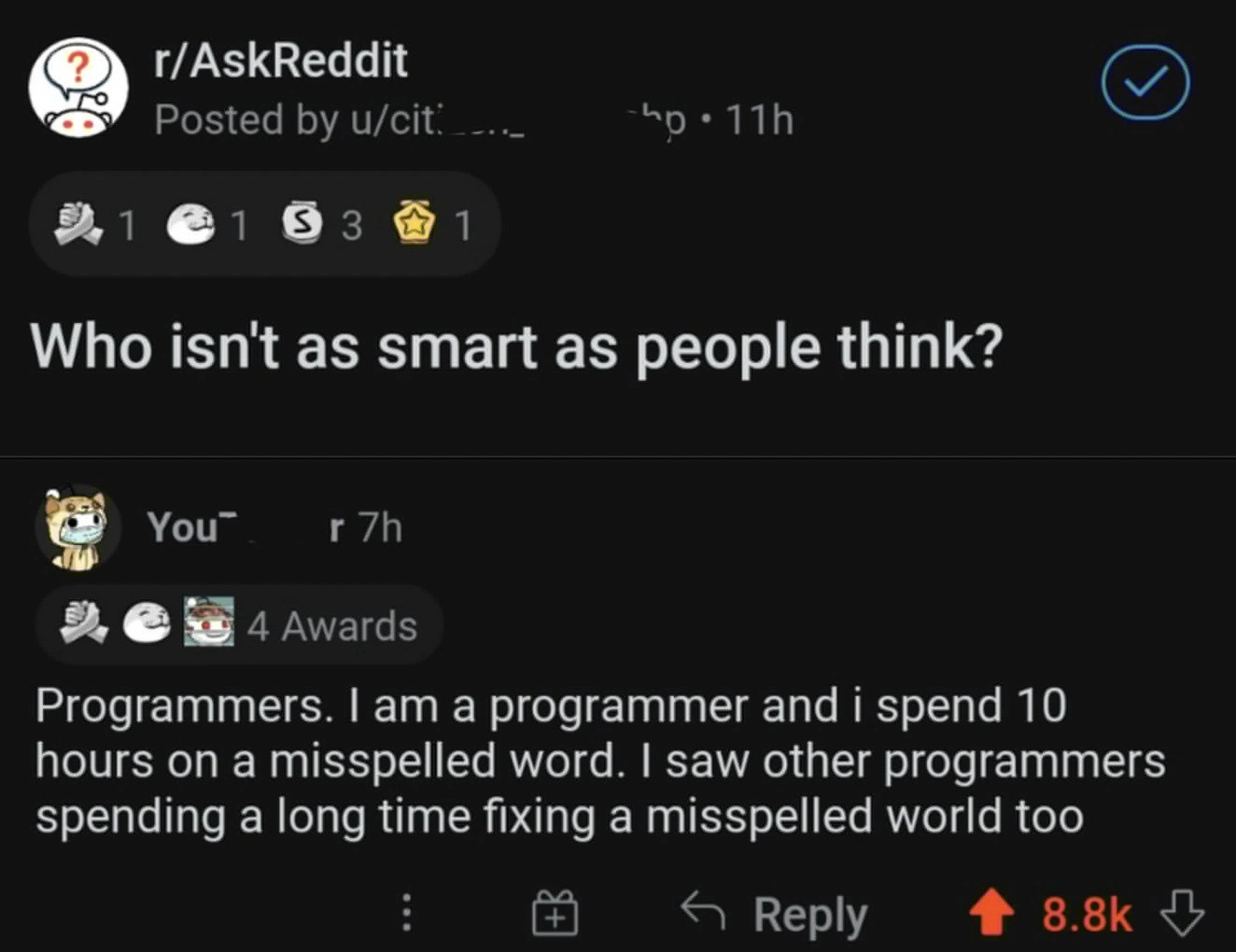
Now let’s connect this to the meme’s text: The Reddit comment highlights a programmer spending 10 hours debugging due to a misspelled variable or word. That’s a long time – it suggests the bug was not obvious at all. The cherry on top is the commenter’s own subtle joke: they write “misspelled world” instead of “misspelled word” at the end of their sentence. So they literally made a typo while talking about a typo! Whether that last one was on purpose or an accidental irony, it perfectly reinforces the meme’s point: these mistakes are so easy to make that you can even slip one into a Reddit post about making one. The phrase "misspelled world" with that extra ‘l’ creates a small world of difference in meaning – and it makes fellow developers smirk because we catch that tiny slip and think, “Haha, I see what you did there.”
From a junior developer or coding student’s perspective, this meme is both funny and educational. It’s a reminder that coding is very precise. Computers don’t do what you mean, they do what you write. If what you wrote has even a one-character mistake, the computer isn’t smart enough to guess your intention (in most cases). A variable name user_age is not the same as userAge or usre_age – each of those is a completely separate identifier as far as the program is concerned. This is why attention to detail is critical in programming. It’s also why debugging can feel like detective work: you investigate clues, test hypotheses, and often the “culprit” ends up being something as small as a misspelled word or a minus sign in the wrong place.
New developers quickly learn techniques to catch these issues. For example, many code editors and IDEs have features to highlight undefined variables or unused ones, which can hint at a typo. If you see a variable total_scor that’s never used elsewhere, it might be highlighted as a warning, tipping you off that “hey, did you maybe spell this wrong compared to total_score?” There are also linters (tools that analyze code for potential errors) that can detect variables that look similar to others and warn you. But not every situation is caught by tools. If the typo creates a valid new name that’s actually used or returned, a tool might not flag it. And in some languages (or contexts like configuration files, CSS class names, etc.), a simple string mismatch is impossible for an editor to catch – it’s up to the developer to notice it.
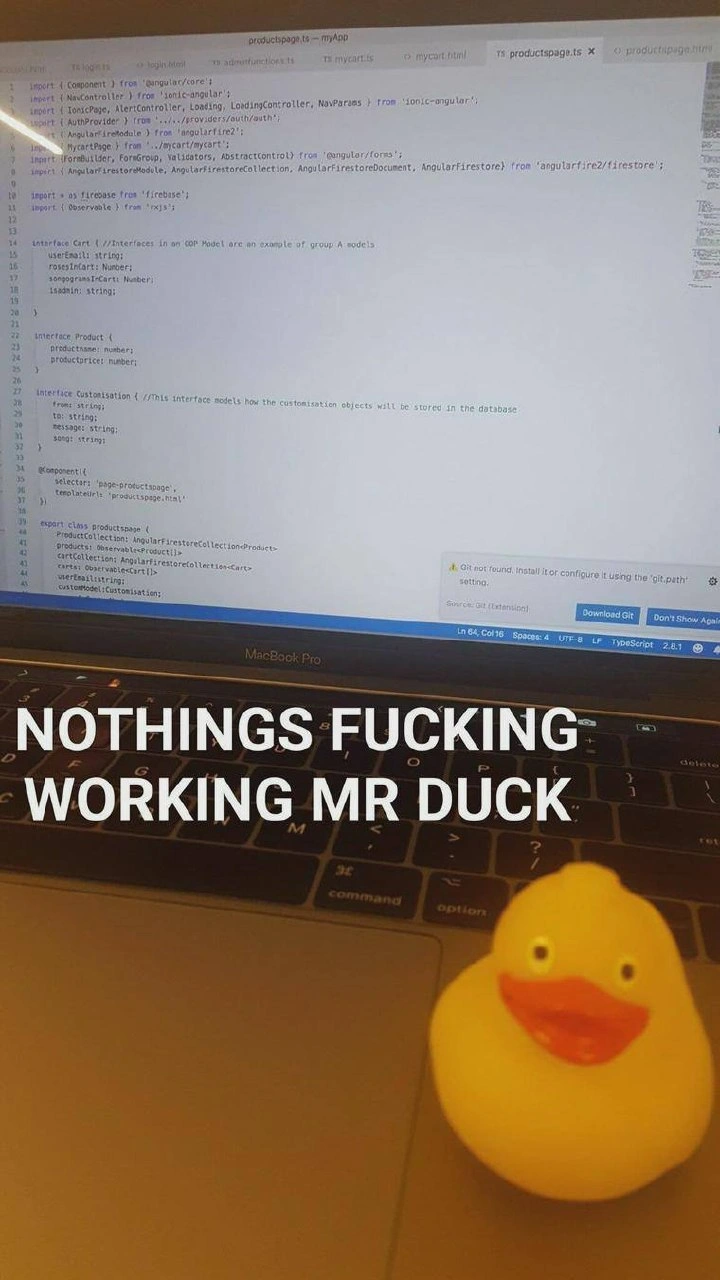
The DeveloperExperience_DX here is something of a rite of passage: spending an inordinately long time on what turns out to be a one-character fix. It’s practically a meme in itself among coders. There’s the joke that “Programming is 10% writing code and 90% fixing what’s wrong with that code,” and a lot of that fixing is tiny mistakes. Bug fixing requires patience and a bit of humility — because often you feel really silly (and relieved) when you finally spot the problem. You might even start talking to yourself or a rubber duck on your desk (a famous debugging technique is “rubber duck debugging,” where you explain your code line by line to a rubber duck or an inanimate object; the act of explaining often reveals the issue, like realizing you’ve been saying a variable name wrong). In this case, explaining the code might lead the programmer to suddenly notice, “Wait… did I spell that the same everywhere? Why is this one ‘world’ instead of ‘word’? Oh no… there it is!”
This meme also touches on the developer_intelligence_myth in a lighthearted way. Beginners might feel intimidated, thinking real developers have genius-level brains that never make mistakes. In reality, even experienced devs deal with dumb mistakes like this. It’s relatable humor for the programming community, and also comforting for newbies: if you’ve ever spent half a day trying to find a bug and it turned out to be a missing letter, you’re not alone. Far from it – you’ve joined the club! In fact, the reason the Reddit comment got 8.8k upvotes and multiple awards is because thousands of other programmers saw it and went, “Haha yep, been there, done that.” It’s practically a support group moment: “Hi, my name is ____, and I once debugged for 5 hours before I noticed I had a typo.” “Hi ____, welcome to the club.”
Finally, consider the context: The comment was an answer to a question asking for people who aren’t as smart as everyone thinks. By answering “Programmers” with this example, the commenter isn’t saying programmers are dumb — they’re poking fun at the outsider perception versus the insider reality. People see someone programming and often assume it’s highly intellectual work (and it can be), but they don’t see the behind-the-scenes struggle with basic stuff. It’s as if to say, “We programmers are just normal folks who Google solutions and fix silly errors; we’re not the all-knowing tech gurus you imagine.” That dose of honesty wrapped in humor is why this meme comment struck a chord both within the tech community and outside. Even if you’re not a coder, you get the gist: sometimes experts spend a ton of time on something that seems obvious in hindsight. And if you are a coder, you might laugh and cry a little internally because you remember your own 10-hour typo hunt.
Level 3: Typo Time Sink
At the highest level, this meme brutally satirizes the gap between the genius stereotype of programmers and the humbling reality of everyday coding. Non-developers often imagine we spend our days solving complex algorithms or engineering next-gen AI, but in truth a huge part of a programmer’s life is spent debugging trivial issues – sometimes agonizing for hours over a single missing character. Here, a Reddit user humorously confesses: “I am a programmer and I spend 10 hours on a misspelled word.” The punchline? They ironically end the comment with a typo themselves: “fixing a misspelled world too.” One extra ‘l’ turns “word” into “world,” perfectly illustrating the joke – a one-letter mistake that shatters the genius myth by showing just how human programmers really are.
From a seasoned developer’s perspective, this scenario is painfully relatable. We’ve all been there: the code is almost correct, no red error squiggles in sight, yet something just isn’t working. You check the logic a dozen times, question your sanity, maybe even blame cosmic rays – only to eventually discover a tiny spelling error or wrong case in a variable name. It’s the classic subtle bug that hides in plain sight. Computers are insanely literal; one character off and you might as well have written gibberish. Unlike humans, machines won’t gently nudge, “Hey, did you maybe mean ‘count’ not ‘cotunt’?” They’ll either throw an error that sends you on a wild goose chase, or worse, silently accept the bogus name as a new variable or string, leading to subtle bugs that don’t crash immediately. This is why debugging and troubleshooting can consume so much time. A simple oversight – like using world instead of word – can turn a routine task into a ten-hour debug session. It’s both terrifying and darkly funny that a single letter can create such chaos.
What really sells the humor is the broader context: the AskReddit question was, “Who isn’t as smart as people think?” and a top reply is “Programmers.” Society often inflates developers as tech wizards, but here a programmer candidly admits to a very un-wizardly blunder. The stark contrast is comedy gold for anyone in the field. DeveloperExperience (DX) in the real world involves plenty of these facepalm moments where your “ingenious code” is foiled by a dumb typo. The DeveloperHumor here is self-deprecating – we’re laughing at our own expense because it’s cheaper than crying. Thousands of upvotes and awards on that comment (8.8k and counting) show that a whole lot of coders have felt this debugging frustration. It’s a shared “I’ve been there buddy” moment. In fact, it’s so universal that team stand-ups and online forums are full of war stories about the misspelled variable or missing semicolon that stole a day of productivity. Seasoned devs swap these tales like campfire horror stories: “Remember the time I broke production over a config named enableFeatureX vs enabledFeatureX? Yeah… that was fun.” 😅
Dig a bit deeper, and this meme hints at the cognitive bias and emotional rollercoaster behind bug hunts. When you write code, your brain knows what it meant to write, so you often see what you expect rather than what’s actually there. That’s why a subtle bug like a typo can slip past multiple reviews – your teammate’s brain might autocorrect it too, especially if the misspelling is a real word (like typing world instead of word). The code doesn’t know you goofed, and if the typo results in a valid identifier or string, no alarms go off. So you stare at perfectly “correct” code, suspecting complex issues in libraries or the OS, when the villain was a stray character all along. It’s a humbling reminder that in programming, the devil truly is in the details. Even senior engineers with years of experience still get bitten by these small bugs – perhaps more often than they’d like to admit. This running gag (it’s always a silly mistake!) is how devs collectively cope with imposter syndrome: we joke that we’re not the geniuses people imagine, because we have intimate evidence of our own frequent derpy mistakes. The developer_intelligence_myth gets a reality check every time a “rockstar” programmer spends half a day debugging only to mutter “ugh, it was a typo.”
And don’t think this is a purely trivial matter – history is full of examples where a single-character error caused outsized trouble. Famously, a missing hyphen in the code doomed NASA’s Mariner 1 space probe in 1962, and countless production outages have boiled down to something as small as a misplaced letter or a = instead of ==. In less dramatic everyday terms, a tiny spelling error can break a feature or crash an app just as surely as a major algorithm bug. So when the meme shows a programmer admitting to a ten-hour debugging marathon over a misspelled word, it resonates as both comedy and cautionary tale. It’s saying, “See, even the best of us get stuck on the simplest of mistakes. Programming isn’t just high-level math and genius logic – sometimes it’s battling a stupid syntax detail at 2 AM.” The next time someone calls developers “brilliant”, any coder might recall this meme and chuckle, remembering that feeling of being outsmarted by their own keyboard. In the end, this deep relatable humor unites programmers in the experience that yes, we architect complex systems, but we also trip over a single character; we’re not as smart as people think, and that’s oddly comforting to admit.
Description
This image is a screenshot of a popular Reddit thread. The top part shows a question posted on the r/AskReddit subreddit: 'Who isn't as smart as people think?'. Below it is a highly upvoted comment (8.8k upvotes) that answers, 'Programmers. I am a programmer and i spend 10 hours on a misspelled word. I saw other programmers spending a long time fixing a misspelled world too'. The humor operates on two levels. First, it captures the deeply relatable and frustrating experience of every programmer: spending an inordinate amount of time debugging an issue that turns out to be a simple typo in a variable name, function, or configuration key. Second, there's a layer of irony as the commenter makes their own typo at the end ('misspelled world' instead of 'word'), perfectly proving the post's point in a self-deprecating way
Comments
19Comment deleted
The difference between a junior and a senior dev isn't that the senior doesn't make typos. It's that the senior immediately suspects a typo after 5 minutes of debugging, not 5 hours
Nothing shatters the 10x myth like a Sev-1 that ends with “root cause: `dependecies:` in the Helm chart.”
The real genius move here is spending 10 hours debugging a typo in your code, then making the exact same type of typo while complaining about it on Reddit - that's not imposter syndrome, that's method acting for consistency across all environments
The beautiful irony here is that a programmer complaining about spending 10 hours debugging a misspelled 'word' proceeds to misspell 'word' as 'world' in the same comment - proving their point with such elegant recursion that it deserves its own stack overflow. This is the programming equivalent of a self-documenting bug: when your error message contains the very error it's describing, you've achieved a level of meta-debugging that transcends mere typos and enters the realm of philosophical commentary on the human condition in software engineering
Senior devs tame microservices but fold after 10 hours hunting 'usrNmae' - proof that spellcheck isn't in the CAP theorem
Nothing humbles a staff engineer like an RCA that reads: outage caused by a misspelled env var - perfectly replicated across every pod and aggressively cached
We architect for partitions and failover, then take prod down with a misspelled feature flag - apparently CAP has a fourth pillar: Proofreading
Literally me on friday. Spent an hour debugging because I had written "attribbutes" Comment deleted
I have a letter/grammar nazism after decades of geeking, because spending for this reason months or years. By the way english are worst language for that; why this letters composed this way: width, length, height, weight. Fuck that. Comment deleted
meanwhile German: Breite Länge Höhe Gewicht much better imo Comment deleted
German sounds as written most times. English are victim of lack of dentistry. Comment deleted
that and 3 completely different languages mixing into one Comment deleted
Slavic languages has same mixing history. Latin looks best, it pronounced close to grammar. Anyway all we need attention to any letter in code. Comment deleted
fuck thaght Comment deleted
Draught or draft 😂😂 Comment deleted
drought🗿 Comment deleted
I had a long term habit to mistype scanf as scnaf. Hated myself every time i realised wtf nothing is working Comment deleted
misspelled world okb Comment deleted
That’s why I use plugin to detect my spelling in my editor. Comment deleted