The Ultimate Evil: A Programmer Who Reads Documentation
Why is this Documentation meme funny?
Level 1: Rules Are for Rebels
Imagine you and your friends get a new complicated toy or a big LEGO set. Most of the kids are so excited that they start trying to put it together without ever looking at the instruction booklet. Everyone is just guessing and trying pieces at random. But one kid — let’s call him the “evil” kid as a joke — quietly sits down and actually reads the instructions first. He’s not really evil at all (he’s doing the smart thing!), but all the other kids gasp in pretend horror, like “Oh no, look at him, reading the manual!” They’re teasing because usually no one reads the boring instructions. This is just like the meme: it’s funny because the person doing the right thing (reading the guide) is being jokingly called the “bad guy.” It’s a silly opposite-day kind of joke. We all know reading the instructions is helpful, but since people often skip it, seeing someone do it feels surprising. The meme makes us laugh by pretending that following the rules and reading the documentation is an act of rebellion – something only a mischievous “evil” genius would do.
Level 2: Who Even Reads Docs?
Let’s break down why this meme is funny in simpler terms. Documentation (often called “docs”) is basically the instruction manual or reference guide for software. It includes things like how to use a library, what functions do, what the settings mean, and best practices. Reading the docs can prevent mistakes by telling you exactly how something is supposed to work. However, in real life, many programmers (especially when new or in a hurry) tend to skip the official manual. Instead, they might jump straight into writing code, Google the error message, or paste a question on Stack Overflow. It’s a running joke in developer communities that people will try three weird workarounds from random blog posts before spending a minute to read the official guide. So this meme takes that habit and turns it upside down: it jokes that a programmer has to be “evil” or “the bad guy” to open the docs and read them from the start. It’s poking fun at how backwards that seems – doing the sensible thing is portrayed as a mischievous act, implying that skipping documentation is the norm. This is classic inside humor for coders, because we all know we’re supposed to read the docs, but often we don’t. Seeing it stated so bluntly – “READS DOCUMENTATION” – with an evil persona is both relatable and absurd, which is why it’s funny.
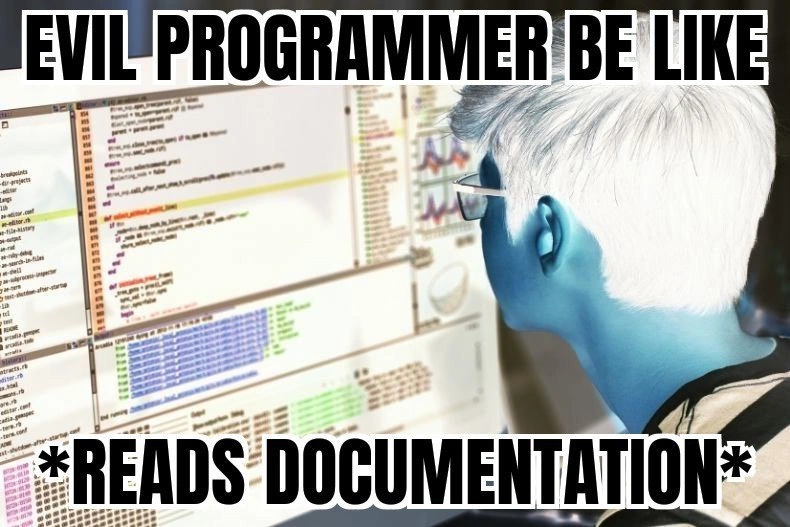
The image uses a popular meme style: big bold text at the top and bottom (in the Impact font) for the caption, and a photo with a negative color filter. That filter (making the developer’s skin blue and hair white) is a visual cue for the “evil twin” theme. It’s like looking at a photo negative – everything normal is reversed. Meme creators use this “evil-be-like” format to show someone doing the opposite of their stereotype. In this case, a “typical programmer” stereotype is someone who writes code first and only reads docs when stuck. So the “Evil Programmer” does the inverse: he reads the documentation first. The asterisks around READS DOCUMENTATION mimic the way we might describe an action in text (like *shrugs* or *facepalm* in chat). It emphasizes that reading docs is the dramatic action here. The whole presentation is over-the-top on purpose – it frames a normally boring task (reading a manual) as if it’s a dramatic, out-of-character move for a coder. That exaggeration is what makes it a joke.
For a newer developer (or anyone learning to code), there are a few key concepts here. Developer Experience (DX) is a term for how easy and pleasant it is to develop software using certain tools or environments. Documentation plays a huge part in DX: good, clear docs make a programmer’s life much easier, while poor or missing docs can make it a nightmare. When this meme appears under DeveloperExperience_DX, it’s highlighting that aspect – how interacting with documentation (or not interacting with it) is part of a programmer’s daily experience. The meme suggests that many developers don’t leverage this resource enough. It’s like an inside joke telling beginners, “We know reading official docs is smart, but watch out – even the pros often skip it, haha.”
Another category here is CodeQuality. This refers to how well-written and maintainable the code is – basically, code that doesn’t break easily and can be understood by others. Reading documentation can directly improve code quality because you learn the proper way to use tools and libraries. For example, if there’s a function that needs to be called before using a library (maybe an initialization step), the docs will mention it. A programmer who didn’t read the docs might miss that step, leading to bugs or sloppy code. The meme jokes that the “evil” programmer actually takes the time to learn these things from the docs, implying his code might actually be better for it. It’s humorous because shouldn’t good programmers read docs and write quality code? Yes – and that’s the point. The roles are reversed for comic effect. We’re laughing at the irony that in practice, many of us behave in the opposite way of what we should do.
To sum up the context: this meme is a piece of documentation humor in the tech world. It’s using the “evil twin” meme format (negative image + Impact font captions) to joke about a “doc-first” approach in coding. Doc-first culture means encouraging developers to consult documentation before coding or when facing a problem. In an ideal world, every programmer does that. In reality, many don’t. So when the meme says “Evil programmer be like: reads documentation,” it’s a lighthearted way to say, “imagine a world where programmers actually read the instructions – shocking, right?” If you’re new to this humor, just know that every programmer has been told “Did you check the docs?” at some point. This meme takes that everyday nudge and blows it up into a dramatic, funny scenario. It resonates with developers because it’s a shared experience: we all know reading the manual is the right move, but we still find ourselves debugging in circles until, in a last act of ‘desperation’ (or wisdom), we finally open the darn documentation. And when someone actually does RTFM from the start, well, apparently that makes them an evil mastermind in the coding world – and that’s the joke.
Level 3: Arcane RTFM Ritual
In the inverted, blue-tinged glow of this meme, an evil programmer gazes at multiple monitors of code, assembly dumps, and performance graphs. The bold Impact-font banner declares: “EVIL PROGRAMMER BE LIKE” ... and at the bottom: “READS DOCUMENTATION”. This format is a tongue-in-cheek inversion – literally, the colors are negated to imply a bizarro doppelgänger – and conceptually, it flips a common developer habit on its head. In everyday coding culture, actually opening the official docs is almost treated as arcane sorcery. The meme leans into that satire: the “evil” version of a programmer is the one who dares to do the unthinkable – RTFM (Read The Friendly Manual, as the polite folks say). It’s humorous because reading documentation is objectively a good practice, yet so rare in the wild that doing it feels like some diabolical genius move.
This joke lands with experienced devs because it pokes at a real industry pattern. Far too often, engineers will dive into coding or copy-paste from Stack Overflow without ever cracking open the official guides. There’s an unwritten trope in programming: “Real developers don’t read manuals; they hack and Google until something works.” Of course, that’s a terrible common approach, but it’s pervasive enough to be an inside joke. The meme exaggerates this backward norm — implying that only an “evil” mastermind would patiently comb through the documentation. It’s a playful jab at our own bad habits. The senior engineers reading this are probably smirking (or face-palming) in recognition: we’ve all seen that ambitious junior developer reinvent a library feature from scratch, missing a one-line call that was clearly explained on page 2 of the docs. CodeQuality issues often stem from this reluctance to RTFM. Misused APIs, magic numbers, unnecessary workarounds – many of these sins could be avoided if someone had just read the official instructions. The “evil” dev in the meme, by contrast, is portrayed as a shadowy genius precisely because he does what the rest of us skip.
From a Developer Experience (DX) perspective, this image underscores the love-hate relationship devs have with documentation. Good documentation is like a map through the codebase’s jungle – it can greatly improve your DX by clearing up usage mysteries and guiding you to best practices. Yet, how often do we actually follow that map? Teams talk about a doc-first culture where you’re supposed to read (and even write) the docs before coding, but under tight deadlines and the adrenaline of solving problems, many devs treat docs as a last resort. It’s almost an industry meme itself: only when we’re truly stuck or it’s 3 AM and nothing’s working do we grudgingly scroll through that README or manual page. The fact that doing the right thing is portrayed as a villain’s move hints at a systemic issue — we often reward rapid shipping and quick fixes over thorough understanding. The meme slyly hints: maybe the real “evil” in software development is how we’ve normalized skipping the homework.
Notice the multi-monitor setup with source code and even assembly listings in the image. That detail amplifies the joke – this evil programmer isn’t just skimming a tutorial; he’s digging deep, perhaps profiling performance or reading low-level output, which implies serious dedication. It’s a nerdy exaggeration that pairs well with the idea of a “doc-consuming supervillain.” The Impact font text framing the image is the classic meme aesthetic for blunt, ironic statements. In meme lore, an “evil <X> be like” phrase means showing <X>’s evil twin doing the opposite of what you’d expect. For example, evil manager might say “take a vacation,” evil database admin might whisper “go ahead, skip backups.” Here, the evil programmer calmly “READS DOCUMENTATION” – the opposite of the stereotypical chaotic coder who charges in blind. It’s funny because it’s a reversal of roles: the villain is the one following best practices, implying that in our upside-down tech world, doing things properly has become an act of rebellion. The humor cuts deep: if reading the manual is edgy, something’s wrong (and every seasoned coder knows it).
Behind the laughter is a grain of truth every senior dev learns. Proper docs exist to save our bacon. Many a production bug or all-night debugging session could be avoided by spending 10 minutes with the manual upfront. The meme’s dark irony reflects that shared scar tissue: we’ve all had that humbling moment when, after hours of troubleshooting, we finally open the official docs and find a one-line note about a config flag or function call we missed. It’s both embarrassing and enlightening. So the “evil” programmer isn’t evil at all – he’s just clued-in. This bit of technical satire resonates because it highlights a core tension in software development: knowledge vs. haste. We laugh, a bit nervously, because we recognize ourselves in the “good” programmer who skipped the docs – and maybe, just maybe, we aspire to be as “evil” as this blue-faced villain who actually does things right.
Description
This meme uses the 'Evil Be Like' format, which involves an image with inverted colors and a caption describing behavior that is the opposite of a well-known stereotype. The image shows a person with white hair and blueish skin (due to the color inversion) looking intently at a screen filled with code. The bold, white text at the top reads, 'EVIL PROGRAMMER BE LIKE', and the text at the bottom says, '*READS DOCUMENTATION*'. The joke satirizes the pervasive stereotype in developer culture that programmers avoid reading documentation at all costs, preferring to learn through trial-and-error or by searching for answers on Stack Overflow. Therefore, an 'evil' programmer, in this inverted reality, is one who diligently and willingly reads the official documentation, an act considered unnatural by many in the field
Comments
12Comment deleted
A junior dev guesses the API call. A senior dev finds it on Stack Overflow. An 'evil' dev reads the documentation and discovers the `--perform-magic` flag
Evil dev flex: quietly reading the spec, discovering the undefined-behavior clause everyone’s been cargo-culting around since 2008, and filing a ticket titled “Delete 3,412 lines of defensive hacks.”
After 20 years in the industry, I've discovered the real villains aren't the ones who write unmaintainable code or deploy on Fridays - they're the mythical developers who actually read documentation before Stack Overflow, disrupting the entire ecosystem of copy-paste solutions and 'it worked on my machine' folklore
The real plot twist: this 'evil' programmer also writes comprehensive commit messages, updates the README, and leaves helpful code comments. Truly diabolical behavior that strikes fear into the hearts of those who prefer the 'move fast and break things (including onboarding)' approach
Villain move: reading the API docs far enough to spot the idempotency-key header and the "UTC assumed" footnote - suddenly retries stop double-charging and prod stops time-traveling
The asterisk: *'only after confirming it breaks prod the expected way'*
Lawful evil: the engineer who reads the docs and finds the footnote - retry=∞, timeout means deadline - then quietly asks whether our write path is idempotent
In a bright theme. 😆 Comment deleted
If there would be documentation.. Comment deleted
*writes Comment deleted
true Comment deleted
Just codes (No meetings) Comment deleted