Skip to content
DevMeme
7073 of 7435
Professor's Shirt Trolls Class: Extrapolate From Incomplete Data
DataScience Post #7755, on Feb 24, 2026 in TG

Professor's Shirt Trolls Class: Extrapolate From Incomplete Data

Why is this DataScience meme funny?

Level 1: The Unfinished Knock-Knock Joke

Imagine someone says, "Knock knock — okay, you know how the rest goes," and most people laugh because they do know how the rest goes. But two people raise their hands and ask, "Wait, you forgot to finish the joke!" The professor's shirt is exactly that: it leaves out the ending on purpose, because anyone who gets it can finish it in their head. The funny part isn't on the shirt at all — it's watching the people who ask about the "missing" ending prove, without realizing it, that the shirt was talking about them.

Level 2: Filling in the Blank

A few terms doing the heavy lifting here:

  • Extrapolation means estimating a value outside the range of data you actually have. If you know a plant grew 1 cm per day for ten days, guessing day 11's height is extrapolation. Its safer sibling, interpolation, estimates values between known points.
  • Incomplete data is the normal condition of real work: missing fields, dropped packets, users who never answer surveys. Early in your career you learn that NULL is not a bug report — it's a lifestyle.
  • The shirt's structure is a pattern-completion test. The phrase "there are two types of people" creates an expectation of two list items. Item 1 describes people who can finish patterns from partial information. If you genuinely are such a person, you don't need item 2 — your brain renders it automatically: "2) those who can't."

The classmates treated the missing line as a defect (like filing a ticket that the error message is truncated) rather than as the feature itself. It's the same energy as a junior dev "fixing" an intentionally failing test, or asking why a // TODO: never implement this comment exists. The lesson transfers directly to engineering: before assuming something is broken, consider whether the gap is the point. Specs, APIs, and professors' wardrobes all occasionally rely on the reader to do the last 10% of the thinking.

Level 3: The Test You Didn't Know You Were Taking

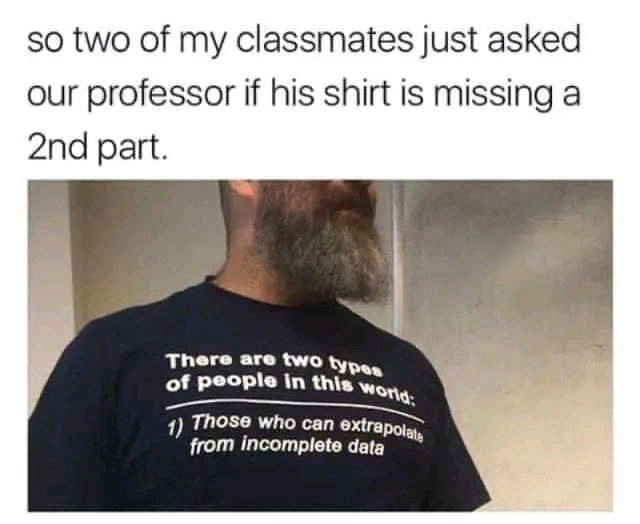
The shirt reads:

There are two types of people in this world:

  1. Those who can extrapolate from incomplete data

And that's it. No item 2. The caption above the photo — "so two of my classmates just asked our professor if his shirt is missing a 2nd part" — turns a decent nerd t-shirt into a perfect field experiment, because the joke isn't printed on the fabric; it's executed on the reader. This is self-referential humor in its purest form: the shirt is simultaneously the setup, the punchline, and the measurement instrument. Anyone fluent in extrapolation — projecting beyond the observed data points — mentally completes "2) ...and those who can't" and smiles. Anyone who asks where the second line went has just sorted themselves into category two, providing the professor with empirical validation he didn't even have to request.

What makes this land so hard in data science and statistics circles is that it dramatizes the central skill of the entire discipline: inference from incomplete information. Real-world data is always missing the second half of the shirt. You never get the full population; you get a sample, a truncated log, a survey with a 12% response rate, a time series that stops right before the interesting part. The professional's job is to reason carefully about what the missing portion probably looks like — and, crucially, to know the limits of that reasoning. The meme also gestures at a darker truth practitioners know well: extrapolation is the most dangerous form of inference. Interpolating between known points is relatively safe; extending a trend beyond the observed range is how you get models confidently predicting negative concert attendance or infinite user growth. The shirt celebrates the ability while the discipline spends entire textbooks warning about its abuse — a tension the professor, beard and all, is surely aware of.

There's also a sociological layer. "Two types of people" jokes are a whole genre (there are two types of people: those who can handle incomplete lists), and this one weaponizes the genre's own format. The classmates' question is the classic whoosh moment — the joke flying overhead — but in a classroom setting it doubles as a tiny, gentle assessment. Every instructor who wears this shirt is running a continuous, zero-cost quiz on inductive reasoning, and the results, apparently, are mixed.

Description

A two-part meme: the top is white text on a white background reading 'so two of my classmates just asked our professor if his shirt is missing a 2nd part.' Below is a photo of a bearded professor wearing a navy t-shirt with white text that says 'There are two types of people in this world:' followed by '1) Those who can extrapolate from incomplete data' - with no second item listed. The joke is self-demonstrating: the shirt deliberately omits the second type, testing whether the reader can extrapolate, and the classmates who asked about the 'missing' part failed the test. A classic statistics/data-science gag beloved in technical and academic circles

Comments

10
Anonymous ★ Top Pick The classmates just self-identified as the training set that needs more epochs
  1. Anonymous ★ Top Pick

    The classmates just self-identified as the training set that needs more epochs

  2. @SamsonovAnton 4mo

    2) Those who can make up anything from missing data. 📱

    1. @azizhakberdiev 4mo

      3) Those who can make up anything from missing data

      1. Rin 4mo

        4) Those who can make up anything from missing data and overfits grossly

  3. @SamsonovAnton 4mo

    Z for Zero. 🤓

    1. @deadgnom32 4mo

      X for Xour Y for Yive

      1. @callofvoid0 4mo

        your wive?

        1. @deadgnom32 4mo

          Wix

      2. @SamsonovAnton 4mo

        X is four "|"s joined together. Y is ... forget it! We should be self-confident enough to pick any symbols to represent digits in our shiny-new base-6 numeral system: Z123XY is just fine! 😎

  4. @Dark_Lord_of_Debian 3mo

    There are 10 kinds of people in the world: those who understand ternary, those who don't, and those who mistake it for binary.

Use J and K for navigation