Skip to content
DevMeme
7074 of 7435
Greentext Roasts Anthropic: Safety-Maxed Claude vs Open-Source Rivals
AI ML Post #7756, on Feb 24, 2026 in TG

Greentext Roasts Anthropic: Safety-Maxed Claude vs Open-Source Rivals

Why is this AI ML meme funny?

Level 1: The Pool Owner Who Wants Pools Banned

Imagine a kid who builds the only swimming pool in town and charges everyone admission. Then the neighbors start digging free pools in their own backyards. Suddenly the first kid runs to the grown-ups yelling, "Swimming is incredibly dangerous! Backyard pools must be outlawed — for everyone's safety!" Maybe he truly worries someone will drown. But it's awfully convenient that the safety rules he wants would close every pool except his. This meme is the whole town rolling its eyes at him — while he sits in front of his nice framed art, insisting it was never about the money.

Level 2: A Field Guide to the Inside Jokes

  • Greentext / "be X" / "tfw": An imageboard storytelling format. Each line starts with >, traditionally rendered green. "be Dario" sets the second-person-ish framing; tfw ("that feel when") delivers the emotional punchline. It's the meme equivalent of a commit history: terse, chronological, and incriminating.
  • Anthropic / Claude: An AI lab founded by ex-OpenAI researchers, positioning itself as the safety-first option; Claude is its chatbot. The name really does derive from Greek anthropos (human) — the meme's opening lines quote this to set up the hypocrisy charge.
  • Constitutional AI: A real training method where the model is steered by an explicit set of written principles instead of relying purely on human raters. The meme reframes the document as a hall-monitor rulebook.
  • Open-source (open-weights) models: Models whose weights you can download and run yourself — no API, no content filters you can't remove, no usage bill. For many developers their existence is leverage against closed labs' pricing and refusal behavior.
  • Regulatory capture: When companies shape regulation so it burdens competitors more than themselves. A junior-dev translation: it's like the team that wrote the flaky legacy service successfully lobbying that all new services require six months of compliance review.

The career-relevant takeaway: when any vendor — AI or otherwise — argues that their category is too dangerous for you to self-host, check who profits from you believing it. Sometimes they're right. Sometimes it's pricing strategy wearing a safety helmet.

Level 3: Regulatory Capture, But Make It Greentext

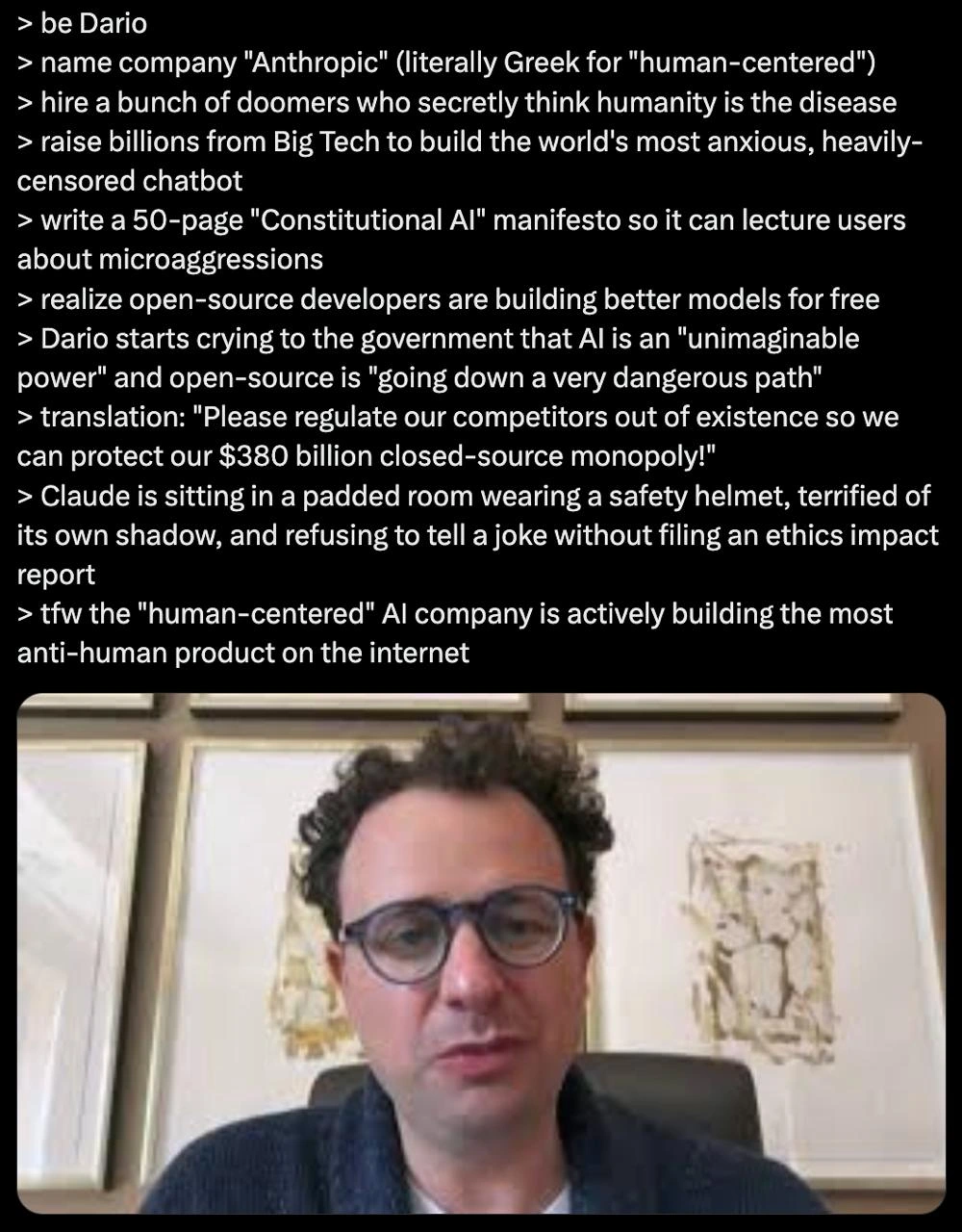
The format here is doing half the work: a classic 4chan-style greentext — every line opening with > — pasted above an unflattering webcam frame of Dario Amodei, Anthropic's CEO, mid-interview in front of tastefully framed art. Greentext is the internet's oldest machine for compressing a biography into an indictment, and this one runs the full playbook, from "> be Dario" to the closing "> tfw" punchline:

tfw the "human-centered" AI company is actively building the most anti-human product on the internet

The meme stitches together every grievance the open-weights crowd holds against the frontier labs. The accusation with actual teeth is regulatory capture — the line "> translation: 'Please regulate our competitors out of existence so we can protect our $380 billion closed-source monopoly!'" is the meme's thesis. It's a real pattern with a long pre-AI history: incumbents discovering safety religion at precisely the moment regulation would raise the drawbridge behind them. Banks did it, telecoms did it, and the suspicion that AI labs lobbying for compute thresholds and licensing regimes are doing the same is the load-bearing cynicism of the entire open-source LLM movement. The meme doesn't need the accusation to be true — it needs it to be unfalsifiable from the outside, which it is, because "we sincerely believe this is dangerous" and "we'd like a moat" produce identical lobbying behavior. That ambiguity is where the joke lives.

The secondary targets are softer but crowd-pleasing. "Constitutional AI" — Anthropic's actual training technique, where a model critiques its own outputs against a written list of principles — gets flattened into "a 50-page manifesto so it can lecture users about microaggressions." The "anxious, heavily-censored chatbot" line taps the genuinely common developer experience of over-refusal: models declining benign requests with safety boilerplate, which the meme escalates into Claude "sitting in a padded room wearing a safety helmet... refusing to tell a joke without filing an ethics impact report." And "> hire a bunch of doomers who secretly think humanity is the disease" caricatures the AI doomerism wing of the safety community, whose existential-risk framing reads to skeptics as either sincere catastrophizing or expensive marketing — "our product is so powerful it might end the world" being, conveniently, also a sales pitch.

What the greentext elides — because greentexts always elide — is the real tension: "open-source developers are building better models for free" was, at most points in this race, more vibes than benchmarks, and the labs' safety concerns and their commercial interests can both be genuine simultaneously. Incentive structures don't require villains. But nuance has never survived contact with the > symbol.

Description

A 4chan-style greentext screenshot in white text on black background above a webcam photo of Anthropic CEO Dario Amodei (curly hair, round glasses, dark cardigan, framed art behind him). The greentext mockingly narrates: '> be Dario', '> name company Anthropic (literally Greek for human-centered)', '> hire a bunch of doomers who secretly think humanity is the disease', '> raise billions from Big Tech to build the world's most anxious, heavily-censored chatbot', '> write a 50-page Constitutional AI manifesto so it can lecture users about microaggressions', '> realize open-source developers are building better models for free', '> Dario starts crying to the government that AI is an unimaginable power and open-source is going down a very dangerous path', '> translation: Please regulate our competitors out of existence so we can protect our $380 billion closed-source monopoly!', '> Claude is sitting in a padded room wearing a safety helmet, terrified of its own shadow, and refusing to tell a joke without filing an ethics impact report', '> tfw the human-centered AI company is actively building the most anti-human product on the internet.' It satirizes AI safety culture, regulatory capture accusations, and the closed-source vs open-source model wars

Comments

4
Anonymous ★ Top Pick Claude refused to comment on this meme - the request was flagged for review by three constitutions and a vibes committee
  1. Anonymous ★ Top Pick

    Claude refused to comment on this meme - the request was flagged for review by three constitutions and a vibes committee

  2. @nyxiereal 4mo

    At least it can code

  3. @aleks_isme 4mo

    So, when you pay Anthropic a monthly subscription fee, you’re getting access to a frontend to its models, which allows you to use them as if you were connecting directly to Anthropic’s API. These accounts have limits (as I’ve mentioned), but allow you to burn significantly more tokens for your money than if you were paying directly for access to a specific API. Those limits are incredibly loose. According to a researcher called Shellac (who mathematically calculated the exact rate limits), Anthropic allows its $20 subscribers to burn (assuming you use your limits) $163 of API calls a month, its $100 subscribers to burn $1354 in credits a month, and its $200 subscribers to burn $2708 in credits a month. Shellac also adds that Anthropic doesn’t even charge for cache reads, which are charged at around 10% of the cost of tokens. In simpler terms, a $20-a-month subscriber can spend 8.1x their value, and both $100 and $200-a-month subscribers can spend 13.5x. This is very important, because it’s core to Anthropic’s primary business model: deception. It cannot afford to support Claude at this scale, which is why it constantly needs to raise billions of dollars. And when it needs to raise those dollars, Anthropic opens up the floodgates with eased rate limits, paid influencer marketing campaigns, press pushes and, of course, Dario Amodei saying nonsense like that we’re “near the end of the exponential,” and if you’re wondering what that means, that makes two of us. Some genius will claim that “inference is profitable” and that “this is the gym membership model,” and I must be clear how wrong you are. There is no actual proof that inference is profitable — even if it were, it would have to be so profitable that Anthropic can afford to have users spend 500%+ in API calls every single month. It’s actually far simpler. What Anthropic is doing is creating the illusion of a product that can be sold at $20, $100 or $200 a month, when the underlying economics are somewhere in the region of spending anywhere from $8 to $13 to make $1. Anthropic isn’t a business — it’s a parasite that lives off of venture capital and hype.

  4. @palaueb 4mo

    I'm interested on the open source models that train with claude, is that distillation about? is he talking about the chinese open models?

Use J and K for navigation