2017 Autocomplete Twitter Game Is Now America's Only Business Model
Why is this IndustryTrends Hype meme funny?
Level 1: The Guessing Game That Ate the Economy
There's a party game where you start a sentence and let your phone guess the rest, and everyone laughs at the silly results. This post jokes that grown-ups loved the game so much that the whole country basically decided to do that game as its job — like if everyone played rock-paper-scissors at recess one day, and twenty years later every office building, every bank, and every news channel was about rock-paper-scissors. The funny part is the shrug in how it's written: no anger, no big words, just "yep, the sentence-guessing game runs everything now," said the way you'd mention the weather.
Level 2: What's Actually in the Screenshot
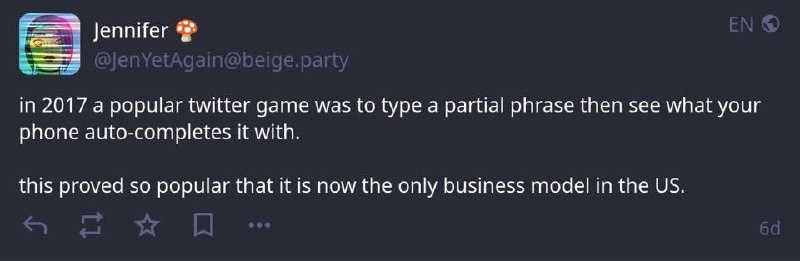
The dark-mode post comes from Mastodon, part of the fediverse — a network of independently run, interconnected social servers that absorbed many Twitter expats; the @username@server handle format is its tell. The "2017 twitter game" refers to viral prompts where you typed a phrase fragment and let your phone's autocomplete — the suggestion bar above your keyboard — finish it. That feature works by simple statistics: given the last word or two, suggest the most likely next word. Modern LLMs (large language models) are trained on the same core task, called next-token prediction: given all the text so far, predict the next word-fragment. The meme's whole joke is collapsing the distance between those two — calling the technology behind the AI boom "the phone game from 2017." It's not a fair summary, but it's not exactly false either, which is what makes it sting.
Level 3: The Capex Supercycle of Predictive Text
The post's comedic weapon is deflationary framing — describing something grand in the most diminishing technically-true vocabulary available. The 2017 Twitter game was real: "type 'I was born to' and let your keyboard finish it," producing horoscope-grade nonsense from Markov-chain keyboard suggestions. Jennifer's escalation — "this proved so popular that it is now the only business model in the US" — lands because the exaggeration is uncomfortably mild. By the mid-2020s, AI capex genuinely dominated US economic narratives: a handful of companies betting hundreds of billions on data centers, GPU supply chains reshaping geopolitics, and a stock market whose gains concentrated in firms whose pitch is, at the loss-function level, better next-token prediction. "Only business model" is hyperbole by maybe one notch.
The venue is part of the text. A Mastodon post from a small fediverse instance (beige.party, glitch-art avatar, mushroom emoji) is the natural habitat of the tech-adjacent AI skeptic — people who left corporate platforms on principle and watch the LLM gold rush from decentralized exile with seasoned irritation. The post performs the fediverse's signature register: weary, deadpan, structurally identical to a shitpost but aimed at a real macroeconomic observation. What experienced engineers recognize underneath is the industry's recurring pattern of retroactive grandiosity — a modest mechanism (page ranking, ad auctions, social graphs, now token prediction) gets scaled, and the scaling gets renarrated as destiny, with valuations priced not on what the mechanism does but on what it might become. The skeptic's role is to keep repeating the mechanism's original, deflating name. Sometimes that voice is the boy noting the emperor's wardrobe; sometimes it's the guy who said the iPhone was just a phone with no keyboard. The meme doesn't know which it is, and neither, honestly, does anyone holding index funds.
Level 4: Shannon's Party Game
The joke's reductive premise — autocomplete and frontier LLMs are the same thing — happens to sit on top of a genuine theoretical lineage, which is what makes it such effective trolling. Claude Shannon's 1951 work on the entropy of printed English used exactly the meme's mechanic: have a human guess the next letter of a partial phrase, measure how often they're right, and you've bounded the information content of the language at roughly one bit per character. Predicting the next symbol is the canonical probe of how much structure you've internalized — language modeling and compression are formally equivalent, which is why the strongest text compressors are predictors and why "intelligence as compression" remains a live research framing. So when the post equates a 2017 phone keyboard's n-gram/Markov-chain suggestions with the trillion-dollar LLM economy, it is technically describing the same objective function: maximize $P(token_{n+1} | token_1...token_n)$. The honest counterargument is that the objective being identical doesn't make the systems equivalent — your 2017 keyboard conditioned on two or three words with a few megabytes of statistics, while transformers condition on hundreds of thousands of tokens through billions of parameters, and somewhere along that scaling curve the loss-minimization pressure forces internal representations of syntax, world knowledge, and rudimentary reasoning, because predicting text written by agents who reason is easier if you model the reasoning. Whether that emergence constitutes "more than autocomplete" is precisely the unresolved philosophical fight (the stochastic-parrot debate in one sentence), and the meme plants its flag on one side with maximal flippancy.
Description
A dark-mode screenshot of a Mastodon/fediverse post by 'Jennifer' (@[email protected], mushroom emoji, glitch-art avatar, posted 6d ago): 'in 2017 a popular twitter game was to type a partial phrase then see what your phone auto-completes it with. this proved so popular that it is now the only business model in the US.' The post reduces the entire LLM economy to its bluntest framing - next-token prediction as the keyboard autocomplete party trick of 2017, scaled into the dominant pillar of the US tech economy and stock market. The fediverse venue adds flavor, being the natural habitat of AI-skeptic commentary
Comments
5Comment deleted
Turns out the moat was never the model - it was convincing the S&P 500 that predictive text deserved its own capex supercycle
Hahahahahahaha ahahahahaha 🤣🤣🤣😂😂😂🤣🤣😂😂🤣🤣😂😂😂😂🤣🤣 Comment deleted
I have no idea if it's an autocompleted or a real sentence Comment deleted
H Comment deleted
I Comment deleted