Skip to content
DevMeme
2167 of 7435
C Programming: Where Professionals Have ANSI Standards
Languages Post #2419, on Dec 4, 2020 in TG

C Programming: Where Professionals Have ANSI Standards

Why is this Languages meme funny?

Level 1: Playing by the Rules

Imagine you’re playing a board game with your friends. The game comes with an official rulebook that tells everyone how to play fairly. Now, a professional player – someone who’s really serious about the game – will insist on using those official rules every time. Why? Because if everyone follows the same agreed-upon rules, the game is fair and predictable, and you won’t have arguments about how to play. But if someone starts making up their own rules or using house rules that no one else knows, things get confusing and maybe unfair.

This meme is joking that coding is similar: a professional programmer is like that serious player who always follows the official rules. In programming, the “official rules” for a language like C are called the standard. If you write a program that follows the standard, it’s like playing the game by the book – your program will work the same no matter who runs it or where. The meme finds it funny (and kind of true) that the really seasoned coders care a lot about these rules. In other words, real pros don’t wing it; they stick to the rulebook! So the picture is saying: just like a pro gamer says “professionals have standards” (meaning they have rules and class), a pro developer insists on using the standard version of C to keep things proper. It’s a playful way to say doing things by the book is what makes you a pro.

Level 2: The Official Rulebook

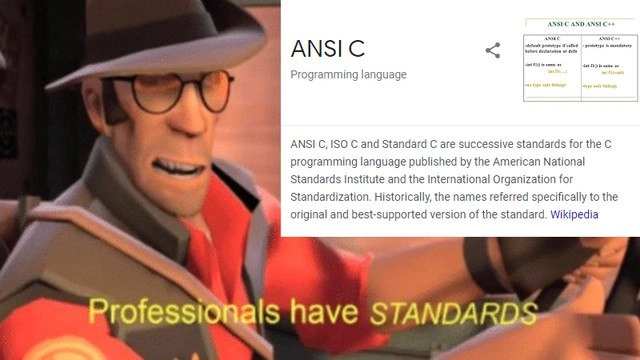
This meme might look bewildering at first, so let’s break it down. On the left, there’s a character from the video game Team Fortress 2 (the Sniper in his brown hat) saying his famous line, “Professionals have standards.” In the game, it’s a comedic moment – he’s a hired hitman who insists even hired hitmen should have some class and rules. Developers online love referencing this catchphrase to joke about having standards in coding. On the right side of the image, we see a screenshot of a Google search result for “ANSI C”, showing a brief Wikipedia summary. It tells us that ANSI C (also known as ISO C or Standard C) is a programming language standard for the C language, published by official organizations (ANSI and ISO). In simpler terms, it’s the official rulebook for the C programming language.

Now, why put these two together? The joke is comparing a “professional” gamer who follows rules (the Sniper’s standards) with a “professional” programmer who follows the ANSI C standard. C is a very old and respected programming language, used for systems programming, operating systems, and other performance-critical tasks. Back in the day, C didn’t have one unified standard – different companies’ compilers had slight variations. So the American National Standards Institute (ANSI) created a single official specification for C in 1989 to ensure everyone was on the same page. When someone says ANSI C, they usually mean writing C code that sticks to those official guidelines, without any compiler-specific tricks.

For a developer, following the ANSI C standard means you’re writing code that should compile and run similarly on any machine – be it a Windows PC, a Linux server, or a tiny embedded device – as long as there’s a standard C compiler on it. Portability is a big word here: standard C code is portable code. If you’ve only learned one language or always used the same setup, you might not have hit this yet. But imagine you write a C program on your computer and it works fine; then you send it to a friend on a different system and it doesn’t work. Often that’s because some part of the code wasn’t “standard” – maybe it used a feature or library function that only exists on your system. Professionals try to avoid that scenario by sticking to the common denominator – the features that the official standard guarantees everywhere.

The meme jokingly implies that “real developers” (experienced, professional programmers) prefer to use C in its pure, standard form. It’s partly tongue-in-cheek. In the programming community, there’s an ongoing playful language war about what makes someone a “real” programmer. You’ll hear jabs like “Real programmers use Vim and C” or “Real developers don’t use drag-and-drop, they write code by hand,” etc. Here, ANSI C is held up as the hallmark of a true professional — because it’s proper and standardized. Coding to a standard is also about code quality: it usually means your code is cleaner and less likely to have weird bugs. For instance, the C standard defines exactly how certain operations should behave. If you do something outside those rules, the result might be unpredictable (what we call undefined behavior in C). Professionals hate undefined behavior because it can cause crazy bugs that are hard to track. So they “insist on proper standards” to avoid those nightmares.

Also, notice how the right side is basically a dry definition from Wikipedia, while the left is a colorful game character making a bold statement. The combination is funny because it’s like a nerdy in-joke — mixing a strict technical definition with a meme. It’s saying: Haha, see, even this badass game character agrees that we should code properly! It’s a bit of developer humor that nods to the culture of programming: we often take serious concepts (like language standards) and joke about them using pop culture references. The underlying message is real though: if you write C code, doing it the standard way (ANSI C) is the professional move, because then your code has standards just like the pros do.

Level 3: Strictly by the Book

The meme smashes together a Team Fortress 2 Sniper catchphrase with a Wikipedia-style blurb about ANSI C, turning a gaming joke into a nod to hardcore low-level programming practice. On the left, the Sniper character smugly asserts, "Professionals have STANDARDS." On the right is a Google knowledge panel defining ANSI C as the formal C language standard. The juxtaposition is hilarious to veteran developers because it implies that real professionals write C code that adheres religiously to the official standard. This tickles the shared memory of countless language wars and late-night debugging sessions where straying from the spec caused chaos.

In practice, ANSI C refers to the standardized version of the C programming language (specifically the ANSI X3.159-1989 standard, a.k.a. C89, later adopted as ISO C). Seasoned C developers wear that standard like a badge of honor. Why? Because they've been burned by non-standard code more times than they can count. If you’ve ever tried to compile C code on a different compiler or OS and hit weird errors, you learn fast: sticking to the standard is the safest bet. A professional C coder will avoid compiler-specific quirks or “it works on my machine” hacks. Instead, they’ll write portable code that any conforming C compiler can build. It’s a point of pride and a matter of code quality. Adhering to the standard means your code behaves predictably across different systems – no nasty surprises when you move from GCC on Linux to MSVC on Windows. This is crucial in low-level programming where undefined behavior (doing something the standard doesn’t allow) can lead to spooky bugs that only manifest in production at 3 AM.

The humor here comes from an air of elitism that many developers recognize. The meme’s text, “Professionals pick ANSI C — because real developers insist on proper standards,” satirically echoes the tone of grey-bearded programmers: the kind who might say C (especially standard C) is the only real programming language and that all these modern languages with their fancy runtime environments are for newbies. It’s poking fun at the gatekeeping attitude – as if using anything but pure standard C is unprofessional. There’s a grain of truth wrapped in exaggeration. Yes, professionals have standards, and in C that means following the c_language_standardization to the letter. These pros will compile with strict flags to enforce it:

gcc -std=c89 -Wall -pedantic program.c -o program  
# ^ Use GCC to enforce ANSI C89, with warnings for any non-standard code

In other words, they treat the ANSI/ISO C spec as gospel. The C Standard Library (the functions and features guaranteed by the standard) is their well-worn toolbox. If a tempting non-standard function or a compiler extension appears, a battle-scarred C veteran hears a little voice: “Not portable, mate!” – much like the Sniper’s mantra about having standards. The Google snippet on the right side of the meme brings an official, almost academic vibe (“ANSI C, ISO C and Standard C are successive standards…”) which contrasts absurdly with the cartoon Sniper’s one-liner. That contrast is the punchline: mixing a formal definition with a pop-culture meme to underline the joke that serious developers treat even their fun as an opportunity to preach about proper standards.

Ultimately, this meme resonates because it’s too real: many experienced programmers have learned that following well-established programming_language_standards is the only way to survive large projects and multiple platforms. They’ve seen the carnage when someone uses a non-standard feature “just because it works” – much like a sniper knows the cost of breaking discipline. It’s developer humor with a side of truth. By invoking a beloved gaming meme (“Professionals have standards!”) and pointing it at ANSI C, it wittily celebrates the unsung hero of software stability: the humble standardized spec that pros swear by.

Description

A popular meme format featuring the Sniper character from the video game Team Fortress 2, who is wearing a fedora and glasses with a serious expression. The bottom of the image has the yellow subtitle 'Professionals have STANDARDS'. Overlaid on the right side is a screenshot of a search result or article for 'ANSI C', which is described as a 'Programming language'. The text below explains that 'ANSI C, ISO C and Standard C are successive standards for the C programming language'. This meme creates a clever pun by equating the Sniper's declaration of professional 'standards' with the technical 'standards' that govern the C programming language. For experienced engineers, particularly those in systems, embedded, or low-level development, language standards are a critical part of ensuring code is predictable, portable, and correct. The joke lies in the high-stakes, dramatic framing of a typically dry but fundamentally important technical concept
Comments

10
Anonymous ★ Top Pick Undefined behavior is just the compiler's way of telling you it doesn't appreciate your creative interpretation of the ANSI C standard
  1. Anonymous ★ Top Pick

    Undefined behavior is just the compiler's way of telling you it doesn't appreciate your creative interpretation of the ANSI C standard

  2. Anonymous

    Professionals have standards: we’ll debate microservice boundaries all day, but the bootloader still has to compile with -std=c89 on a cross-compiler that predates Git

  3. Anonymous

    Just like the TF2 Sniper, C programmers know that having standards means dealing with undefined behavior is just 'a challenging work, outta doors' - and by 'outta doors' we mean segfaulting into uncharted memory territories where nasal demons await

  4. Anonymous

    When you tell junior devs to follow standards and they ask which ones, just remember: there's ANSI C, ISO C, C89, C90, C99, C11, C17, C23... Professionals have standards - we just can't agree on which one

  5. Anonymous

    ANSI C: Professionals have standards; compilers have extensions; undefined behavior has root access

  6. Anonymous

    While JS adds a standard yearly, ANSI C pros know one from '89 outlives frameworks and fads

  7. Anonymous

    We ship with -std=c11 -Wall -Wextra -Werror -pedantic; the real work is undoing the “portable” UB that only appears under -O3, LTO, and the vendor’s C89-with-extensions headers

  8. Deleted Account 5y

    В чем мем?

    1. @k_scranton 5y

      в том что у раста до сих пор нет стандарта

  9. @cheburgenashka 5y

    Что сегодня их дохуя и одно говно другого говнее. И каждый год их всё больше и больше.

Use J and K for navigation