Free Anti-Virus Software: More Intrusive Than Protective
Why is this Security meme funny?
Level 1: False Sense of Security
Imagine you’re going into a theme park and there’s a security guard at the gate. Now, this guard is supposed to check people for dangerous items. But he’s kind of lazy – he just pats your pockets really quickly and says “You’re good!” without even noticing you have a big water gun sticking out of your backpack. Pretty silly, right? Obviously, you’re not really being checked properly. This meme is joking that a free antivirus on your computer is like that lazy guard. It might say “I scanned your computer and everything is fine,” even if an obvious virus (the dangerous item) is right there in front of it. It makes us laugh because we all know the guard should see the rifle (or in my example, the water gun) – just like an antivirus should catch a big bad virus – but in both cases they completely miss it. The feeling behind the joke is that you might feel safe because you did the right thing by installing security software (or having a guard check you), but if that protection is only for show or very weak, you’re not actually safe. It’s a reminder in a funny way: just because something is free or says “you’re protected” doesn’t mean you can relax and ignore the obvious risks. The meme uses an easy-to-understand real-life scene to make you grin and think, “Okay, maybe that free solution isn’t enough – it’s basically just pretending to protect me, like a pretend pat-down that misses the big stuff.”
Level 2: Surface-Level Security
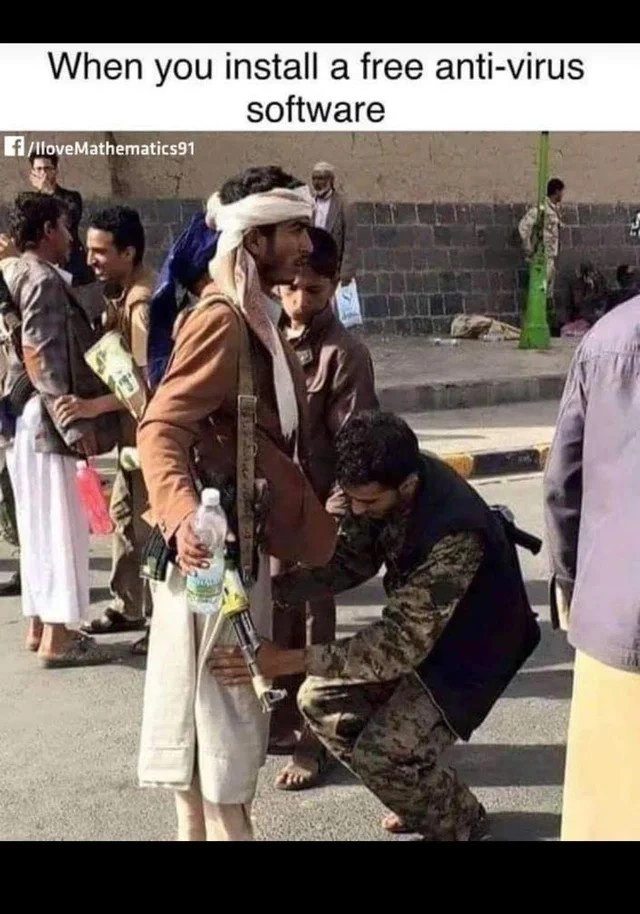
So what exactly is this meme saying? Let’s break down the analogy in simple terms. Antivirus software is a program that scans your computer for viruses and other malware (malicious software like viruses, trojans, or worms). When you use a free antivirus, you’re typically getting a basic version of an endpoint protection tool. “Endpoint” just means your device (like your PC or laptop) – so endpoint protection refers to safeguarding that device from threats. The meme compares installing a free AV to going through a security checkpoint where the guard barely checks you. In the photo, a man openly carrying a rifle is being “searched” by a guard who isn’t really paying attention – the guard’s pat-down is so minimal it fails to detect the extremely obvious threat (the rifle!). This is a metaphor: it suggests that free antivirus programs perform only a surface-level security check. They might do a quick scan and catch some very obvious, known viruses (just like a lazy guard might catch something super obvious if he happens to glance at it), but they can miss big problems that aren’t hidden at all.
Free antivirus software usually has limitations. For example, it might only scan your computer for viruses when you manually run it, or it only recognizes malware that’s in its small database of known bad files. The paid or premium versions, on the other hand, often include more aggressive and constant scanning, heuristic analysis (that’s when the software watches for suspicious behavior, not just known virus files), and daily updates with the latest threat intelligence. The trade-off with free tools is often SecurityVsUsability (and cost) – the free version tries not to slow down your computer or annoy you, and since you’re not paying, the company also saves money by not running heavy-duty detection algorithms on their end. The result? The free antivirus might say “everything is fine” because it only looked quickly and didn’t dig deeper. It’s like when you quickly tidy your room by shoving everything under the bed – on the surface it looks clean, but lift the covers and it’s a mess.
In security terms, relying only on a free AV can give you a false sense of security. You think “I have protection installed, I’m safe,” but in reality, some malware could slip past that light defenсe. Security awareness training often warns about this: just because software says you’re protected doesn’t mean you can click any link or download any file without caution. Security best practices would suggest using multiple layers of security – for instance, combine antivirus with firewall, regular updates, and careful online habits – rather than solely trusting one free tool. The meme’s humorous checkpoint scene is an exaggerated illustration to help newer folks visualize the concept: a free antivirus is doing the minimum job, comparable to a laughably insufficient pat-down at a checkpoint. Anyone who’s new to IT or development can understand: if the guard doesn’t check properly, bad stuff gets through. Similarly, if your antivirus only makes a half-hearted effort, some bad program (virus) might get into your computer and cause trouble.
Level 3: Endpoint Security Theater
On a practical level, this meme nails a concept security professionals grimly call security theater – measures that give the appearance of security without much substance. The image of an officer giving a cursory pat-down while missing a visible rifle is funny (and painful) because it’s a one-to-one analogy with free antivirus software doing the bare minimum. The free AV proudly announces “Scan complete, no threats found,” while a giant piece of malware is effectively tap-dancing past it, rifle and all. The humor here is darkly sarcastic: we know something critical is being missed, and yet the “security” process marches on with unwarranted confidence.
In real-world developer terms, installing a free AV on your workstation can be like hiring a bargain security guard for your server – they might check a few known hiding spots (scan for known virus signatures in common files) but won’t catch anything crafty. It’s surface-level security at best. Seasoned engineers have seen this movie before: someone in the office clicks a sketchy “Free Studio Tools.exe”, the free antivirus gives a quick once-over and says “all clear,” and a week later the build server is mysteriously mining cryptocurrency. The free tool did exactly what the meme’s guard did – a half-hearted check – enough to claim “we looked,” but not enough to actually protect. It provides a false sense of security; the user feels safe, like a traveler who got “checked” at a security checkpoint, not realizing the screening was effectively hollow.
Why does this happen? Often because of the security vs usability (and cost) trade-off. Proper, thorough scanning of every file, process, and network packet eats up CPU cycles, memory, and can annoy the user with constant alerts. Free antivirus products tend to dial it down: fewer real-time checks, maybe scanning only certain file types or skipping intense scrutiny of running programs to avoid slowing down your machine. They might brag about “lightweight footprint” – which often translates to “we don’t look too hard.” It’s endpoint security on a shoestring budget: you get what you (don’t) pay for. The meme’s armed man breezing through the pat-down is essentially a piece of malware taking advantage of those gaps in coverage (for instance, a new virus variant that isn’t in the free AV’s small signature database).
There’s also the matter of incentive. If it’s free, the vendor isn’t directly earning from you. Some free antiviruses are actually loss leaders for their paid upgrades – meaning they’ll do an okay job but constantly remind you “upgrade to Premium for full protection.” It’s like the guard saying, “I could do a better search if you slip me a tip.” The meme is TechHumor highlighting this industry truth: robust security best practices don’t come free or easy. Maybe your enterprise endpoint protection has fancy behavior-based detection (catching that guy with a rifle because he’s walking funny), whereas the free edition just checks a list of bad guys’ names (and our rifle-carrying friend wasn’t on the list today). Experienced devs and IT folks chuckle (or groan) because they’ve learned that a token security measure can be worse than none: it breeds complacency.
Let’s not forget the SecurityAwareness angle: The meme implicitly educates. Anyone who’s dealt with malware infections can relate – “Yep, installed that free AV, and it missed something obvious.” It’s practically a rite of passage in IT support to clean up a machine that proudly ran “FreeProtect 3000” which found 0 viruses, while browser toolbars, crypto miners, and who-knows-what were partying in the background. The armed-man checkpoint scene is absurd, but so is trusting a flimsy tool to guard your system’s endpoint protection. The best practice (which the meme nudges us toward) is defense-in-depth: use reputable antivirus or endpoint security, keep systems updated, and don’t solely rely on one free tool to save you. Because as every battle-scarred sysadmin knows, security trade-offs are real – and if you choose convenience or cost over thorough protection, you might as well be patting down a terrorist and ignoring the AK-47 slung over his shoulder. In summary, the meme resonates with senior devs and security folks because it distills a hard-earned lesson: “Free” security can be just an illusion of safety – a laughable line of defense that almost invites obvious threats to waltz right in.
# Naive pseudo-code illustrating a "free antivirus" scan approach:
def scan_system(files):
signatures = load_signatures(free_version=True) # uses limited threat database
for file in files:
if file.hash in signatures:
print(f"{file.name}: Threat detected!")
else:
print(f"{file.name}: Looks clean.") # assumes no match means safe (yikes)
# In reality, malware not in the list will just slip through without any alert.
Level 4: The Halting Problem of Malware
In the realm of theoretical computer science, expecting any antivirus to catch every piece of malware is akin to expecting a security scan that can detect any possible threat with absolute certainty. It's literally unsolvable in the general case. Formally, determining whether an arbitrary program is malicious can be as hard as the classic Halting Problem – there’s no algorithm that perfectly decides if any given program will do something bad (without actually running it). Viruses and other malware can be infinitely clever: they can self-modify, encrypt themselves, or lie dormant until just the right moment. This means any static analysis (just examining code) will always have blind spots. Antivirus engines rely on heuristics and signatures – essentially shortcuts. But heuristics sometimes misfire (flagging innocuous programs as threats), and signature-based detection can only catch what it recognizes. With millions of new malware variants (often just slightly tweaked versions of old ones) emerging, the search space is enormous – practically unbounded. The complexity isn’t just high; it’s unavoidably undecidable for a perfect solution. In short, from a theoretical perspective, a free antivirus doing a half-hearted scan is almost a metaphor for the algorithmic reality: you can’t check everything thoroughly without infinite time and resources. Of course, top-tier security solutions try anyway – using cloud-based machine learning, behavior analysis, and even virtualization – but even they can’t guarantee catching that cleverly concealed threat lurking like an obvious rifle hidden in plain sight. The difference, though, is effort: how deep into this impossible problem a security product tries (and how many resources it throws at it) is what separates a superficial scan from a serious one.
Description
A meme with the caption 'When you install a free anti-virus software.' The image shows a man in military fatigues frisking a civilian in a public, crowded area. The soldier is kneeling to inspect the civilian's lower leg, creating a scene of intrusive security screening. The civilian appears calm but is subjected to a thorough search. A watermark for a Facebook page '/IloveMathematics91' is visible in the top left corner. This meme uses a metaphor to critique free anti-virus software. For experienced developers, it's a relatable joke about how 'free' security tools often come at the cost of privacy, system performance, and control. These programs are frequently bundled with unwanted toolbars, data trackers, or aggressive upselling tactics, making the software itself feel like a piece of malware. The analogy of an invasive physical search accurately captures the feeling of a program that oversteps its boundaries and treats the user's machine as a hostile environment
Comments
9Comment deleted
Installing a free antivirus is like hiring a security guard who spends all day searching your pockets for spare change and then tries to sell you a timeshare
Free AV in prod: it quarantines my debug build of HelloWorld.exe yet waves through the signed driver quietly unpacking a C2 - security theater worthy of a compliance checkbox
The real vulnerability was the antivirus we installed along the way - nothing quite like software that requires kernel-level access, consumes 2GB of RAM, and flags your own build artifacts as trojans while somehow missing actual malware but never missing an opportunity to upsell you to premium
The meme perfectly captures the irony of 'free' antivirus software: you think you're protecting your system, but you end up serving the antivirus instead - feeding it your browsing data, enduring constant upgrade nags, watching it consume 40% of your CPU at startup, and explaining to your kernel why a userland process needs ring-0 privileges. It's not protecting you from threats; you're protecting it from uninstallation. The real virus was the friends we made along the way... in the bundled toolbar
Installing free AV on my dev box: it blocks curl, injects a root CA, spends an hour scanning node_modules, and happily whitelists its own updater running as SYSTEM - the pocket pat‑down while the rootkit rides shotgun
Free AV: npm's evil twin - bundles keyloggers faster than you can say 'audit dependencies'
Free AV: quarantines curl, flags kubectl as “Trojan.Generic,” installs a shopping toolbar, and whitelists the signed exfil daemon
Они могут взрывчатку искать, все ок Comment deleted
no this is not a free anti virus! this is windows firewall dude. Comment deleted