Russian Roulette for System Administrators
Why is this OnCall ProductionIssues meme funny?
Level 1: Spin the Wheel, Lose the House
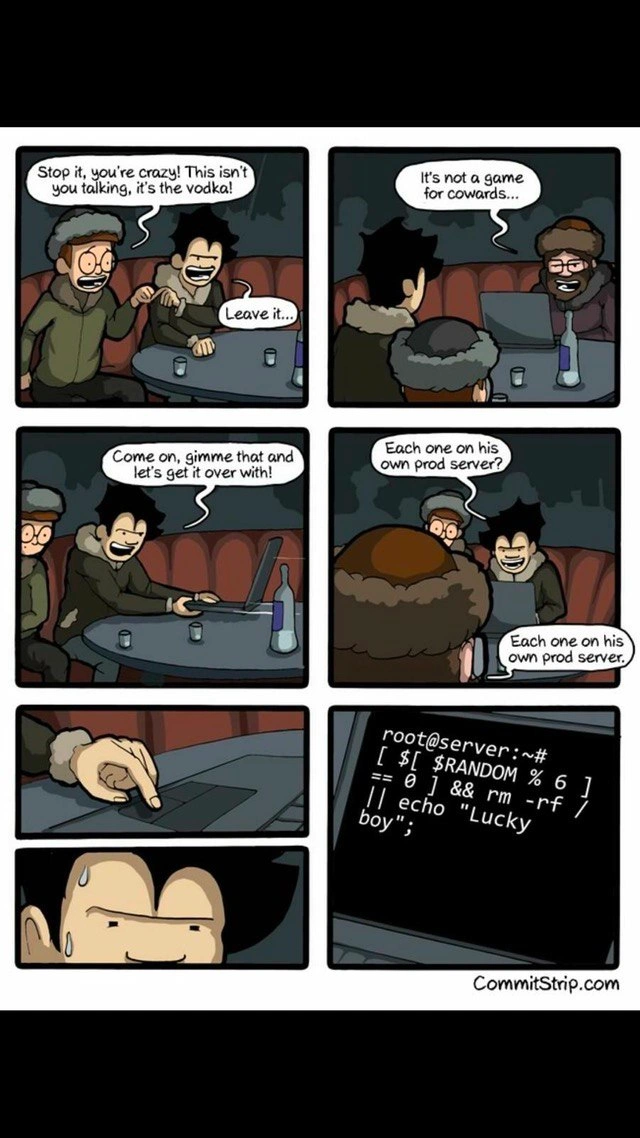
Two friends, after a few too many drinks, invent a dare: each one points at the computer that runs their company's entire business, presses a button, and lets a dice roll decide whether the machine erases absolutely everything on it — like playing a coin-flip game where losing means burning down your own house, on purpose, to prove you're brave. The sweat on the player's face in the second-to-last panel says it all: even he knows this is the dumbest possible use of courage. It's funny because everyone who works with computers has accidentally come close to this disaster — and here are two people doing it for fun.
Level 2: Loading the Chambers
Key pieces of the one-liner, in plain terms:
root— the superuser. No permission checks, no confirmation prompts, no "are you sure?". Linux assumes root means it.rm -rf /—rmdeletes files;-rrecurses into directories;-fforces, suppressing every warning;/is the root of the entire filesystem. Together: delete everything, silently, starting from the top.$RANDOM— a Bash variable that produces a new pseudo-random number each time you read it.$RANDOM % 6keeps only the remainder after dividing by 6, giving 0–5: a die roll.&&and||— short-circuit operators.A && Bruns B only if A succeeded;A || Cruns C only if what came before failed. Chained like this, they form a crude if/else: if the roll is zero, destroy; else, gloat.- prod server — the machine real users depend on. Its opposite, staging, exists precisely so experiments like this never touch prod. The characters explicitly choose violence.
Early-career rite of passage: the first time you run a destructive command in the wrong terminal tab. Most of us learn to set PS1 prompts in screaming red for production, alias rm to rm -i, or better, lose direct shell access entirely in favor of deployment pipelines. The comic is what happens when none of those lessons stuck and a bottle got involved.
Level 3: The House Always Wins on Prod
The punchline terminal in this CommitStrip reads:
root@server:~# [ $[ $RANDOM % 6 ] == 0 ] && rm -rf / || echo "Lucky boy";
Dissect it like the loaded revolver it is. $RANDOM is Bash's built-in pseudo-random integer (0–32767); % 6 collapses it to a value from 0 to 5 — six chambers. If the roll lands on 0, the && fires rm -rf / — recursive, force, from the filesystem root — and the server eats its own brain. Otherwise the || branch consoles you with "Lucky boy". One in six. Vodka optional but, per panels one through four, strongly implied.
The senior-level horror isn't the command — it's the prompt. root@server:~#. The # means root. The agreement struck in panel four, "Each one on his own prod server?" / "Each one on his own prod server.", is the real punchline, because anyone who's carried a pager knows the game was lost before Enter was pressed. A root shell idling on production is the loaded gun; the roulette one-liner just formalizes odds that on-call life usually leaves implicit. Every fat-fingered rm -rf ${DIR}/ with an unset variable, every migration run against the wrong DATABASE_URL, every "quick fix" SSH'd in at 2 AM — those are the same gamble with worse odds and no vodka.
There's also a delicious pedantry layer the strip quietly sidesteps: modern GNU coreutils ship rm with --preserve-root as the default, so a bare rm -rf / actually refuses to run and demands --no-preserve-root — a safety added in the mid-2000s precisely because enough people lost this game unintentionally. So the comic's revolver may, on a current distro, click harmlessly even on chamber zero. Whether that ruins the joke or deepens it depends on how many postmortems you've written. (Also noteworthy: $[ ... ] is deprecated arithmetic expansion syntax — these gentlemen are gambling on prod and writing legacy Bash. Consistent character work.)
The strip endures because it literalizes the industry's worst-kept secret: production access without guardrails turns every operator into a probabilistic threat. We respond with IAM roles, break-glass procedures, sudo audit logs, and immutable infrastructure — and then someone keeps a root session open in tmux for three weeks anyway, because tickets are slow and the firefight was urgent. The chamber doesn't care about your intentions.
Description
A multi-panel comic strip from CommitStrip.com depicting a group of developers in a dimly lit bar setting, seemingly in Russia given the winter hats and bottle of vodka. The dialogue reveals they are playing a dangerous game. In the first few panels, one developer hesitates while others egg him on, with text like "Stop it, you're crazy! This isn't you talking, it's the vodka!" and "It's not a game for cowards...". The punchline is revealed in the final panels, showing a terminal window with a bash command: `root@server:~# [ $[ $RANDOM % 6 ] == 0 ] && rm -rf / || echo "Lucky boy";`. This command represents a game of Russian Roulette where there is a 1 in 6 chance of executing `rm -rf /`, which would delete the entire root filesystem of the server. The meme is a classic piece of dark humor for developers and sysadmins, highlighting the immense power and potential for catastrophic error that comes with root access to production servers
Comments
8Comment deleted
Some developers play Russian Roulette with a `rm -rf /` command. Senior engineers do it by merging a PR on a Friday afternoon without reading the CI/CD pipeline logs
Introducing Russian Red/Black deployments: `[ $RANDOM % 6 -eq 0 ] && rm -rf /` - if the site still loads, congrats, you’ve earned another nine of availability
This is how we used to do chaos engineering before Netflix made it boring with actual methodology and observability
Real veterans know the house always wins: even if $RANDOM spares you, that root shell on prod means the revolver was loaded in all six chambers
Nothing says 'we have robust disaster recovery procedures' quite like a 16.67% chance of explaining to the CTO why the entire production filesystem is now /dev/null. At least they're running it on their own servers - true DevOps ownership means taking personal responsibility for catastrophic data loss. The real production Russian roulette is whether your backup restoration process has ever actually been tested, or if it's just YAML that looks convincing in the repo
sudo tee /dev/null: escalating privileges just to discard 'Lucky' - peak sysadmin optimism for prod realities
Chaos engineering without a hypothesis is just [ $RANDOM % 6 ] - a DR drill that pages finance, too
Bash Russian roulette: [ $RANDOM % 6 ] == 0 && rm -rf /. The only thing protecting prod is the broken condition - pray nobody “refactors” it