Skip to content
DevMeme
166 of 7435
The Base64 Double-Equals Giveaway
DataFormats Post #204, on Mar 7, 2019 in TG

The Base64 Double-Equals Giveaway

Why is this DataFormats meme funny?

Level 1: Recognizing a Friend by Their Hat

Imagine seeing the back of someone's head in a crowd — no clue who it is. Then they turn slightly and you spot the one ridiculous hat your friend always wears, and instantly you go, "Oh, that's Sam." The first string is the back of the head: meaningless. The == at the end is the silly hat: the one detail that gives the whole thing away. The joke is funny because programmers spend so many years looking at this particular kind of scrambled text that they can identify it from a two-character costume accessory — a tiny, weirdly specific superpower nobody asked for but every developer eventually gets.

Level 2: What Base64 Actually Does

Base64 is an encoding, not encryption — a critical distinction that bites every junior at least once. It takes arbitrary binary data and re-expresses it using 64 "safe" characters (A–Z, a–z, 0–9, +, /) so it can travel through systems designed for plain text: email bodies, JSON payloads, HTTP headers, XML documents.

The mechanics: every 3 bytes of input (24 bits) get sliced into 4 chunks of 6 bits, and each 6-bit value maps to one of the 64 characters. The math only works in groups of three, so when your input length isn't a multiple of 3, the encoder pads the output with = signs to fill out the final 4-character block:

  • Input length divisible by 3 → no padding
  • One leftover byte → ==
  • Two leftover bytes → =

So those trailing == in the meme tell you the original message length was 3n + 1 bytes — hi twitter is 10 characters, and indeed 10 mod 3 = 1. The padding isn't decoration; it's arithmetic residue.

Where you'll meet it early in your career: that giant gibberish blob in an Authorization header, inline images in CSS (data:image/png;base64,...), Kubernetes Secrets that look protected but absolutely are not, and the three dot-separated segments of a JWT. First rule of debugging mystery strings: paste it into base64 -d (or atob() in the browser console) before assuming it's encrypted. Half the time it's just text wearing a disguise.

Level 3: The Padding Gives It Away

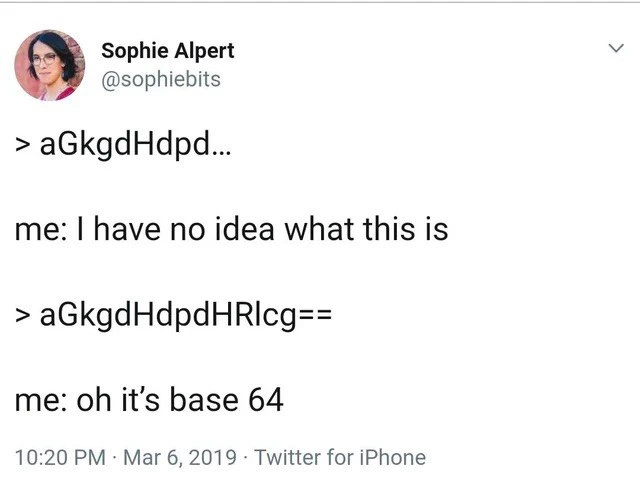
The entire joke pivots on two characters. The tweet — from Sophie Alpert, former engineering manager of the React team, so this comes with serious credibility — shows the same string twice:

aGkgdHdpd... — "me: I have no idea what this is" aGkgdHdpdHRlcg== — "me: oh it's base 64"

A truncated Base64 string is statistically indistinguishable from random alphanumeric noise: it's just letters, digits, maybe a + or /. But the moment the string terminates in ==, every experienced engineer's brain fires the same neuron. That double-equals is the signature scent of Base64 padding, and recognizing it on sight is one of those unteachable skills you only acquire by spending years elbow-deep in JWTs, Authorization: Basic headers, Kubernetes Secrets, data URIs, and SAML assertions.

What makes this resonate at the senior level is that it's a perfect portrait of how expertise actually works. Nobody studies Base64 padding rules on purpose. You absorb them through repeated trauma: debugging an auth flow at 11 PM, pasting a mystery blob into a decoder just in case, discovering your "encrypted" config value was merely encoded (a security anti-pattern worth its own meme). Eventually the pattern-matching becomes preconscious — the same way a DBA smells an N+1 query or an SRE mutters "it's DNS" before opening a single dashboard. The humor is in the asymmetry: nine-tenths of the string conveys nothing, and then a two-character suffix conveys everything.

There's also a sly meta-layer for those who decode it: aGkgdHdpdHRlcg== is literally hi twitter. The tweet greets its own audience in ciphertext, rewarding exactly the reflex it describes.

$ echo "aGkgdHdpdHRlcg==" | base64 -d
hi twitter

And of course there's the catch every veteran knows: padding is a heuristic, not a proof. Plenty of Base64 strings end without = at all (when the byte length is divisible by 3), and URL-safe variants frequently strip padding entirely — which is precisely why JWT segments never show it. The instinct works; it just isn't sound. We pattern-match anyway, because being right 95% of the time in two milliseconds beats being right 100% of the time in two minutes.

Description

A screenshot of a tweet from user Sophie Alpert (@sophiebits). The tweet demonstrates a common developer experience with encoded strings. The first part shows a truncated string '> aGkgdHdpd...' followed by the reaction 'me: I have no idea what this is'. The second part shows the full string '> aGkgdHdpdHRlcg==' and the reaction 'me: oh it's base 64'. The humor lies in the instant recognition that comes from seeing the '==' padding at the end of the string, which is a characteristic feature of Base64 encoding. It's a subtle in-joke for developers who have worked with data formats and APIs, where recognizing encoding patterns by sight becomes a second-nature skill

Comments

8
Anonymous ★ Top Pick A junior dev sees '==' and thinks it's a loose equality check. A senior dev sees '==' and immediately asks, 'Why are we padding this? Did we run out of bits?'
  1. Anonymous ★ Top Pick

    A junior dev sees '==' and thinks it's a loose equality check. A senior dev sees '==' and immediately asks, 'Why are we padding this? Did we run out of bits?'

  2. Anonymous

    20 years in and my brain’s regex is: `.{24}==` ⇒ Base64; same blob in 3 AM prod logs ⇒ breach; same blob in an architecture deck ⇒ we’re about to reinvent OAuth again

  3. Anonymous

    After 15 years of debugging production issues, I can identify base64 by its padding faster than I can recognize my own handwriting

  4. Anonymous

    Senior engineer perk: you can't remember your kids' birthdays, but two trailing equals signs and you're already piping it through `base64 -d`

  5. Anonymous

    After 15 years in the industry, you don't just read Base64 - you *feel* it. That moment when your brain auto-decodes the padding before your coffee kicks in is the developer equivalent of a Jedi sensing a disturbance in the Force. It's right up there with instantly knowing a UUID when you see one, or recognizing a JWT by its three-part structure. We've stared at so many encoded strings, API responses, and authentication tokens that our pattern recognition has transcended conscious thought. The double-equals isn't just padding; it's a Pavlovian trigger that screams 'I'm Base64 and probably hiding something interesting - or just the word hello in a needlessly obfuscated format.'

  6. Anonymous

    Junior: Googles the string. Senior: 'Base64, obviously - next JWT payload?'

  7. Anonymous

    Senior dev heuristic: if a random token ends with "==", just echo it into base64 -d and hope it’s not the credentials you accidentally logged

  8. Anonymous

    Spot the "==" and you know it’s base64 - not encryption, just Kubernetes “Secrets” doing security cosplay

Use J and K for navigation