The Developer vs. The Monolith of Technical Debt
Why is this TechDebt meme funny?
Level 1: One Kid, One Mountain
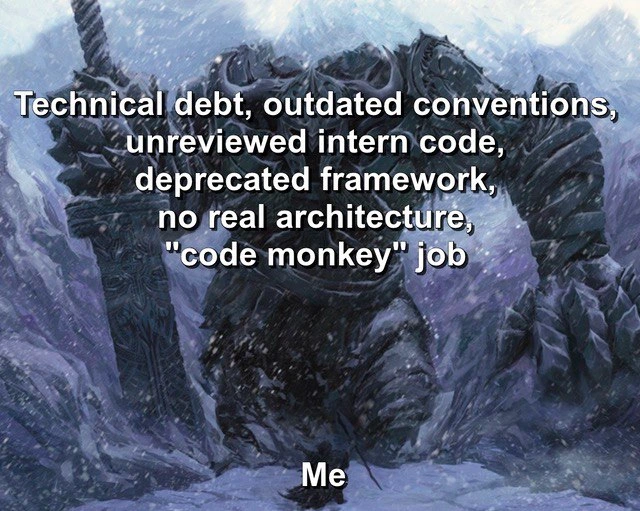
Imagine being told to clean your room, except the "room" is a garbage mountain the size of a castle that the whole neighborhood has been piling up for ten years — and you've been given one trash bag and an hour. The picture is funny because of the absurd size difference: a giant monster made of every mess at work, and one tiny person standing in the snow, expected to defeat it alone. Everyone who's faced a job way bigger than themselves knows that feeling — you don't even know where to swing first.
Level 2: Naming the Monster's Armor Pieces
Each phrase on the giant corresponds to something you'll meet within your first year on the job:
- Technical debt — shortcuts taken to ship faster, which must be "repaid" later with interest. The hack that saved two days in 2019 now costs two days every month.
- Outdated conventions — the codebase's house rules froze in time: old naming styles, ancient formatting, patterns the rest of the industry abandoned. New code either matches the old weirdness or makes the inconsistency worse.
- Unreviewed intern code — code merged without a second pair of eyes. Code review isn't bureaucracy; it's the immune system. Skip it, and mystery functions with names like
processData2_final()enter production forever. - Deprecated framework — the library everything is built on is no longer maintained. No bug fixes, no security patches, and every tutorial you Google is for a version five major releases ahead.
- No real architecture — no deliberate structure. Everything imports everything; changing one file breaks three unrelated features. The opposite of separation of concerns.
- "Code monkey" job — a role where you're handed tickets and expected to type, not think. No say in design, no time for quality.
The crucial early-career lesson: that giant was not built by bad people. It was built by normal deadlines, one reasonable-seeming shortcut at a time. Which means your shortcuts are bricks in someone else's future boss monster.
Level 3: The Raid Boss Nobody Scheduled
The composition does the heavy lifting here: a colossal, frost-armored undead giant — unmistakably riffing on Lich King-style boss artwork — fills the entire frame, while "Me" is a speck at the bottom edge, barely distinguishable from the snow. The giant's label is a six-headed hydra of organizational failure:
"Technical debt, outdated conventions, unreviewed intern code, deprecated framework, no real architecture, 'code monkey' job"
What a veteran notices is that this list isn't six separate problems — it's one causal chain wearing six nameplates. The "code monkey" job is the root cause: when an organization treats engineers as ticket-closing units rather than system stewards, nobody is paid to review the intern's PR, refactor the conventions, or plan a framework migration. No real architecture follows naturally — architecture is exactly the work that doesn't fit in a two-point story. Technical debt is the compound interest on all of it, and the deprecated framework is the balloon payment: one day the security patches stop, and your "someday" migration becomes a today-shaped emergency.
The boss-battle framing is more honest than most retrospectives. In an MMO, a raid boss is designed to be unkillable solo — you need a party, a strategy, and management that authorizes the raid. The tragedy this meme encodes is that companies keep sending one developer at the giant with a sprint's worth of mana and a Jira ticket titled "clean up codebase (timeboxed: 2 days)." Then they're surprised when the dev either bounces off the encounter or quietly updates their LinkedIn. There's a name for the standoff in the picture: the rewrite-vs-refactor paralysis. The system is too entangled to fix incrementally without authority, and too business-critical to rewrite without risk appetite, so the giant just stands there, getting one intern-commit taller every quarter.
The snowstorm is a nice accidental metaphor too — visibility near zero, which is exactly what "no real architecture" feels like during onboarding. You can't see the boss's full silhouette; you just keep finding more of it.
Description
This meme uses fantasy art to depict a developer's struggle against an overwhelming project. The image shows a tiny, lone figure labeled 'Me' standing in a snowy, bleak landscape, facing a colossal, menacing stone golem that looms over them. The golem, which represents the project's problems, is labeled with a list of common software development nightmares: 'Technical debt, outdated conventions, unreviewed intern code, deprecated framework, no real architecture, "code monkey" job'. The meme powerfully visualizes the daunting feeling of inheriting a legacy system or joining a project plagued by poor practices. It captures the sense of isolation and the monumental scale of the challenge, a feeling deeply familiar to senior engineers tasked with modernization or rescue missions
Comments
8Comment deleted
That's the face you make when you finally get access to the repo and realize the 'architecture' is just a series of `if` statements that have achieved sentience
Architect: “It’s just a bit of tech-debt grooming.” Reality: solo-ing 800k lines of Java 6, Struts and Ant with anonymous SVN commits - Dark Souls where every bonfire is a TODO
The scariest part isn't the technical debt - it's knowing you're the most senior person left who understands why that singleton factory adapter pattern made sense in 2008
The raid guide says this boss is soloable - management just keeps scheduling the fight as a two-point story every sprint
When the job posting said 'greenfield opportunity' but you arrive to find a codebase where the last commit message was 'fixed stuff' from 2014, the framework reached EOL in 2016, and the original architect left cryptic TODO comments like 'refactor this entire module when we have time' - spoiler: there was never time, and now you're the chosen one to slay this Lovecraftian horror of nested callbacks and global state
Slaying tech debt dragons while the team debates camelCase - true senior dev cardio
“Just a quick fix,” they say - on a system whose architecture is folklore, running an EOL framework held together by a load‑bearing intern patch; git blame reads like a yearbook
Promotion to staff apparently means fighting the tech‑debt boss with only strangler‑fig and feature flags, because a full rewrite didn’t pass procurement