A Production Method that Fails at Basic Logic
Why is this Bugs meme funny?
Level 1: Yes Means No
Imagine you ask your friend a yes-or-no question like, “Are these two things the same?” and your friend always answers the opposite of the truth. So if the two things are indeed the same, your friend smirks and says “Nope!” But if the two things are different, your friend enthusiastically says “Yes, absolutely!” You’d probably get confused or irritated pretty quickly, right? That’s exactly what happened in this situation, but with computer code. The program had a little helper that was supposed to say “yes” when two values were equal, but because of a mistake it was saying “no” instead. It’s like a light switch that is labeled “ON” but actually turns the light off – everything is backwards.
When the programmer discovered this backwards logic (and it was already running in the real app that people use!), they felt so exasperated they joked, “I need a drink.” That’s a playful way of saying this kind of problem is really stressful and absurd. It’s funny to other programmers because it’s such a silly mistake – like writing opposite day instructions by accident. But it’s also a little painful, because when something so basic goes wrong, it can cause big headaches. In simple terms: the code was saying “yes means no,” and that mix-up gave everyone involved a bit of a comedic shock and a story to tell.
Level 2: When True Means False
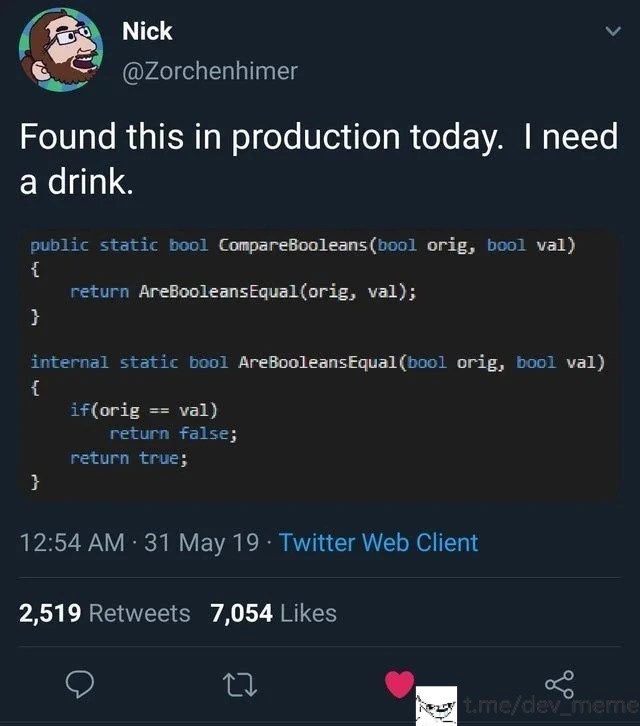
At first glance, this meme shows a snippet of C# code with a very suspicious bug. There’s a public method called CompareBooleans which calls an internal helper method AreBooleansEqual. The expectation is simple: booleans are variables that can only be true or false. A function named AreBooleansEqual(bool orig, bool val) should return true if the two boolean inputs (orig and val) are the same. That’s what “equal” normally means, right? However, the code inside this function is doing the opposite. In plain terms, it says: “if orig is equal to val, then return false; otherwise return true.” So if you pass in true and true, the function will return false – basically claiming “Nope, they’re not equal.” If you pass in true and false, since they’re different, the function returns true – claiming “Yes, they are equal.” It’s completely backwards logic, a definite bug.
To clarify, here’s how a correct implementation might look versus what we have:
// Correct logic for equality:
internal static bool AreBooleansEqual(bool orig, bool val) {
return orig == val;
// This returns true if orig and val are the same, false if they're different.
}
But the code in the meme does this:
internal static bool AreBooleansEqual(bool orig, bool val) {
if (orig == val)
return false;
return true;
// This returns false when they're the same, and true when they're different!
}
In other words, the developer accidentally wrote a logical NOT into the equality check. It’s as if the code is using != (not equal) under the hood. This is a classic boolean_logic_error. It’s the kind of simple mistake that can be very hard to spot during casual code reading, especially if you’re eyeballing many lines of code. The function’s name is misleading here: it promises to check equality, but it’s actually implementing inequality. That mismatch between name and behavior is what we call a code smell – an indicator of BadPractices. It doesn’t necessarily crash the program, but it will definitely cause the program to behave incorrectly and confuse anyone reading the code later (like poor Nick, the developer in the meme).
Now, consider the context: this bug was found in production. “Production” means the code was already deployed in the real-world application, where end-users or other systems were relying on it. Finding a bug in production is serious because it means the incorrect behavior has potentially been affecting users or data. It’s every developer’s nightmare to realize something this fundamentally wrong made it past all tests and reviews. The tweet’s popularity (thousands of retweets and likes) shows that many developers relate to discovering a face-palm worthy issue at the worst possible time. It’s both embarrassing and darkly funny – funny because of how absurdly wrong the code is, embarrassing because it slipped through. The author’s reaction, “I need a drink,” is a tongue-in-cheek way to express exasperation. In developer culture, when we say “I need a drink” in response to a bug, it means the issue is so absurd or stressful that we joke about coping with a bit of alcohol (or lots of coffee for those who don’t drink!). It’s a form of DeveloperHumor – using lighthearted exaggeration to deal with frustration.
For junior developers, the takeaway here is learning the importance of clear naming and testing. A method should do what it says it does. If you see something named one way but acting another, alarm bells should ring. It’s also a lesson in double-checking your boolean logic: flipping true to false accidentally is a common CodingMistake. Many of us have written an if condition wrong at least once (for example, using == when we meant !=, or vice versa). That’s why we write unit tests – small programs that automatically verify functions like AreBooleansEqual give correct results for various inputs. If a test had been written for both the “equal” case and the “not equal” case, this bug would have been caught before deployment. And if there was a code review (another developer examining the code), they might have said, “Hey, this name and return logic don’t match, is this a mistake?” In short, this meme resonates because it highlights a simple but impactful oversight: one incorrect boolean return causing a production issue, and a developer shaking their head in disbelief (with a dash of humor to stay sane).
Level 3: Boolean Betrayal
This code snippet is a masterclass in cognitive dissonance for developers. The function name AreBooleansEqual suggests it will return true if two boolean values are equal. But spoiler alert: it does the exact opposite. In the tweet’s C# code, we see:
internal static bool AreBooleansEqual(bool orig, bool val) {
if (orig == val)
return false;
return true;
}
This logic returns false when orig and val are the same, and true when they differ – a blatant boolean logic error. It’s essentially implementing equality as inequality in disguise. This kind of code smell would make any seasoned developer do a double-take (and maybe a double shot).
Why is this funny (in a painful way)? Because it violates the fundamental expectation of code quality: that a function’s name reflects its behavior. Here, AreBooleansEqual is lying to us. It’s akin to having a method named IsDoorOpen() that returns true only when the door is closed. This absurd inversion creates instant confusion in a codebase. Imagine debugging a production issue at 3 AM and stumbling on this – the function that’s supposed to tell you if two values are equal is always telling you the opposite. Developer trauma intensifies. No wonder Nick exclaimed, “I need a drink.” This is classic DeveloperHumor born from ProductionIssues: when you find a ridiculously bad bug live in production, sometimes all you can do is laugh (or cry) and pour yourself something strong.
From a senior perspective, this snippet hints at deeper problems in process and practice. First, how did this make it to production? Likely lack of unit tests – if anyone had tested AreBooleansEqual(true, true), they’d have immediately caught that it returns the wrong result. It’s a shining example of BadPractices in code review and testing: either no one reviewed this logic, or they missed the glaring mistake. The presence of a redundant wrapper function CompareBooleans(bool orig, bool val) that merely calls AreBooleansEqual is another red flag. Perhaps it was meant as an abstraction or a future extension point, but as it stands it’s just extra indirection hiding the faulty logic. This kind of fluff suggests a team or developer who might have been unsure about design, or copy-pasted code without thinking. It certainly makes the bug harder to spot at a glance – you have to jump into the helper to see the real issue.
There’s also a whiff of technical debt here. The internal method’s name and behavior don’t match, which could indicate that at some point requirements changed (“we actually need to check inequality now”) but the name wasn’t updated. Or maybe someone intended to write an equality check and accidentally wrote the inverse logic – a simple but devastating CodingMistake. In either case, it’s the kind of slip-up that seasoned devs have seen before (usually in legacy code or quick-and-dirty hotfixes). As the retweet count shows, thousands of developers recognized this scenario – a mix of horror and commiseration, thinking “Yep, I’ve found nonsense like this before too.” It’s developer catharsis: we laugh so we don’t rage.
On a systems level, fixing this is not as trivial as changing false to true. By the time you find such a bug in production, other code might have started relying on the wrong behavior (knowingly or not). Imagine some module encountered AreBooleansEqual always returning false for equal inputs and implemented a workaround assuming that was intended! Correcting the function means you must double-check the entire codebase for any logic that expects this inverted result. This one-line bug exemplifies how ProductionBugs can erode trust in the code: if something as straightforward as a boolean comparison is backward, what other gremlins lurk in the system? It’s a reminder that in software development, naming things and getting logic right are crucial – and that even a small oversight can lead to big headaches. In summary, this meme highlights a perfect storm of BugsInSoftware and poor CodeQuality: a function that does exactly what it shouldn’t, found live in an application, giving a developer an existential crisis (and a mighty thirst).
Description
This image is a screenshot of a tweet from a developer named Nick. The tweet reads, 'Found this in production today. I need a drink.' Below the text is an image of a code snippet, likely C# or a similar language, displaying two static methods. The first, a public method named 'CompareBooleans', takes two boolean variables, 'orig' and 'val', and simply returns the result of calling a second method, 'AreBooleansEqual', with the same arguments. The second, an internal method named 'AreBooleansEqual', contains flawed logic: it checks if 'orig == val' is true, and if so, it returns 'false'. If they are not equal, it returns 'true'. In essence, the function named 'AreBooleansEqual' actually checks if the booleans are NOT equal. The humor stems from the developer's relatable despair at finding such a simple, yet fundamentally incorrect and unnecessarily complex, piece of code running in a live production environment, which is a common nightmare for anyone maintaining software
Comments
7Comment deleted
This code is a perfect example of a 'boolean NOT gate' disguised as an equality check. It's not just a bug; it's a feature, if your feature is 'to subtley invert reality throughout the entire application'
Nothing says “naming is the hardest problem” like a method called AreBooleansEqual that actually implements XOR - congrats, we just shipped a Schrödinger feature flag to prod
This is the code that passes all unit tests because someone wrote assertEquals(false, AreBooleansEqual(true, true)) and thought "well, that's how it works in production."
When your senior architect insists on 'abstraction layers' and you end up with a method that compares booleans by checking if they're equal and returning false. It's like implementing NOT(XOR) with extra steps and a side of existential crisis. The real kicker? This passed code review, deployed to production, and now lives rent-free in the codebase - a monument to the day someone decided boolean comparison needed its own microservice. At least it's unit testable... assuming the tests also have inverted logic
AreBooleansEqual implementing '!=' is how you get 100% line coverage with 0% specification coverage - ask the postmortem about reflexivity
AreBooleansEqual(a, b) returns a != b - our zero-trust architecture starts at the function name
If(code_in_prod == broken); return 'I need a drink'; - classic semicolon gotcha turning conditions into unconditional despair