Skip to content
DevMeme
4805 of 7435
The Eternal Struggle Between Open Source Ideals and Proprietary Convenience
DataPrivacy Post #5264, on Jun 28, 2023 in TG

The Eternal Struggle Between Open Source Ideals and Proprietary Convenience

Why is this DataPrivacy meme funny?

Level 1: Candy vs Vegetables

Imagine you have a big bowl of candy that all your friends are eating. It’s super tasty and easy to grab, but you know sweets aren’t healthy if you eat too much. On the other side, there’s a plate of vegetables and fruits – that’s the good-for-you stuff that your wise older cousin told you about. You want to be healthy, and you keep saying “I’ll start eating veggies soon, I promise!” But then another candy bar appears in front of you, and all your friends are munching candy, so you take one and say, “Well… maybe tomorrow I’ll have the veggies.” In this meme, the boyfriend is like someone holding candy (the easy big-tech products he’s used to) while eyeing the vegetables (the privacy-friendly alternatives) that he knows are better for him in the long run. The funny part is the face his current “candy” girlfriend is making – she’s shocked and annoyed because she hears him making excuses to switch to veggies. It’s just like the candy saying, “Hey, don’t even think about that broccoli, I’m sweet and you love me!” We laugh because many of us do this in real life: we stick with what’s easy or popular, even while we daydream about doing the right or healthy thing. The meme turns that feeling into a silly love-triangle picture, making the serious idea of choosing privacy (healthy veggies) over convenience (yummy candy) easy to understand and chuckle at.

Level 2: One Day I'll Switch...

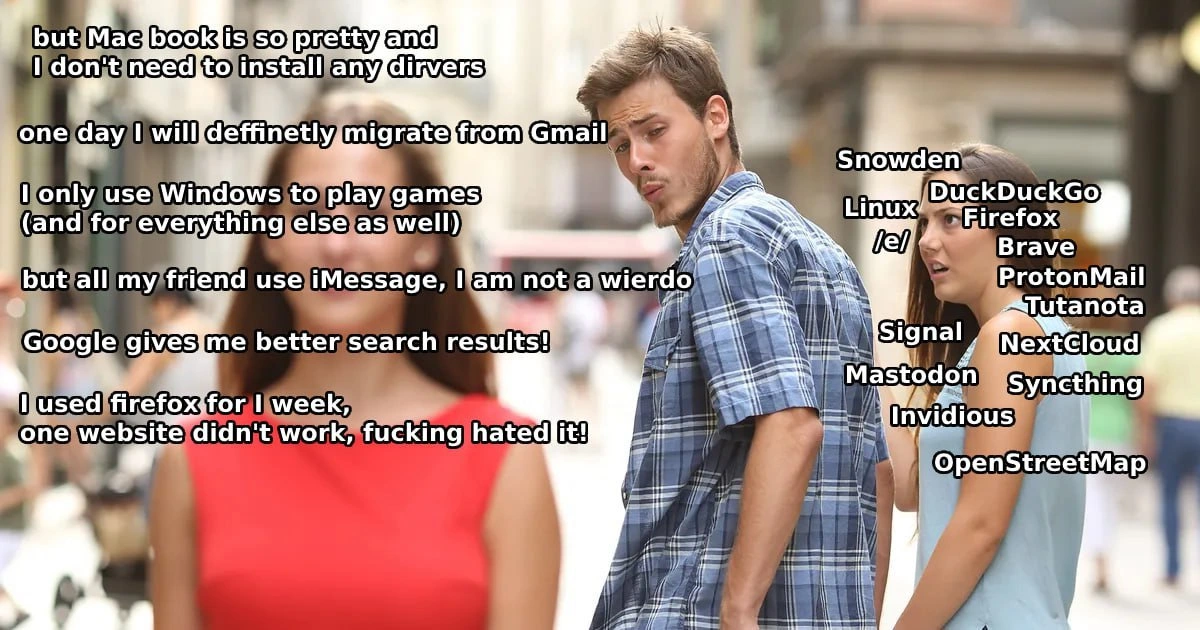
Let’s break down the meme’s elements in plainer terms. On the left (the upset girlfriend in red) we have common mainstream tech habits and the justifications people give for sticking with them. On the right (the tempting woman in blue) we see a bunch of privacy-focused alternatives – mostly open-source tools that protect data or break free from big tech ecosystems. Each caption is essentially a scenario many junior devs or tech enthusiasts will recognize:

  • “But MacBook is so pretty and I don’t need to install any drivers.”
    What does this mean? MacBooks (Apple’s laptops running macOS) are praised for sleek design and “just works” experience. You buy a Mac, and almost everything – camera, Wi-Fi, graphics – works out of the box with no extra setup. Drivers are small pieces of software that let an operating system talk to hardware (like your video card or printer). On Windows or Linux (a popular open-source operating system), you might sometimes have to manually install drivers for certain devices. This can be daunting if you’re new: imagine plugging in your printer and having to find and install its driver yourself. Apple controls both the Mac’s hardware and software, so they include all the necessary drivers, sparing the user that hassle. The meme’s joke is that the boyfriend uses Mac’s convenience (“no driver headaches!”) as an excuse to avoid switching to Linux. Linux is powerful and free, but on a custom-built PC you might have to fiddle with things like GPU drivers or Wi-Fi adapters, especially on older or very new hardware. The Mac’s “pretty” hardware and painless setup can seduce even privacy-conscious devs. It’s comfort vs. freedom: Linux gives you ultimate control and privacy (no Apple tracking, fully OpenSource OS), but Mac feels like a luxurious hotel where everything is already arranged for you. For a junior developer, this highlights the classic trade-off: Apple’s closed ecosystem is easy and polished, whereas switching to an open OS like Linux might require extra work (and maybe some Google searches to fix things!).

  • “One day I will definitely migrate from Gmail.”
    Many people say they’ll quit Google’s Gmail (the hugely popular email service) eventually, usually over privacy concerns. Gmail is free and ubiquitous, but it scans your emails to target ads and is part of Google’s data ecosystem. Alternatives like ProtonMail and Tutanota (mentioned on the right side) promise private, encrypted email – meaning even the email provider can’t read your messages. They often have robust security: for instance, ProtonMail uses end-to-end encryption and is based in privacy-friendly Switzerland. However, moving away from Gmail is easier said than done. Think about it: you’ve used Gmail for years, all your contacts have that address, and your old messages are stored there. “Migrating” means exporting emails, telling everyone a new address, and possibly losing the seamless integration with other Google services (Calendar, Drive, etc.). It’s like saying you’ll move to a new house but never actually packing up. “One day, definitely” in the meme is poking fun at procrastination — a junior dev may genuinely want to quit Gmail for ethical reasons, but keeps postponing because Gmail is just so convenient. It auto-sorts spam, it’s fast, and everyone else uses it. The meme highlights this gap between intention and action. ProtonMail or Tutanota might require a paid account for lots of storage, or their interfaces feel unfamiliar, providing friction to switch. So the boyfriend’s promise is half-hearted; it’s a well-meaning plan that never happens, much like someone saying “I’ll start that diet next week” while reaching for another cookie.

  • “I only use Windows to play games (and for everything else as well).”
    This is a tongue-in-cheek jab at people who claim they use Windows (Microsoft’s operating system) just for a specific purpose (here, PC gaming), when in reality Windows remains their primary OS for everything. Windows is often the go-to for PC gamers because many games are developed for Windows first. Gaming on Linux has historically been tricky — only recently, tools like Proton (from Steam) and better driver support have made many Windows games playable on Linux. The boyfriend’s excuse implies, “Oh, I have to keep Windows around because of games,” which is a common reason tech folks give for not switching entirely to Linux. The parenthetical (and for everything else as well) exposes the truth: they’re basically living in Windows world full-time, not just for games. For a junior reader, the context is that dual-booting or using two operating systems is possible (one could, for example, use Linux for programming and boot into Windows for games). But in practice, constantly rebooting or maintaining two OSes is cumbersome, so many just stick with one. Windows, being closed-source, is the comfortable default — it runs Microsoft Office, Adobe apps, and popular games without fuss. Linux is the alternative that offers more privacy (no Microsoft telemetry watching your system) and customization. The meme humor is that this person won’t admit Windows is their daily driver; they downplay it as “just for games.” It’s like someone saying “I only eat junk food on Saturdays” while munching on chips every day. We’ve all been that person who intends to use the open-source OS but finds ourselves logging into Windows out of habit or necessity.

  • “But all my friends use iMessage, I am not a weirdo.”
    This line illustrates social pressure and network effects. iMessage is Apple’s messaging service, and it’s hugely popular among iPhone and Mac users. Messages between iPhones show up as blue bubbles in the app; when an iPhone user texts someone on Android, it turns into a green bubble (using plain SMS). In many friend groups (especially in the US), having that dreaded green bubble marks you as the odd one out — it implies you’re not on an iPhone. The meme’s boyfriend is saying he doesn’t want to be the “weirdo” using a different chat app when all his friends are on iMessage. This is a barrier to adopting private messengers like Signal, which is one of the labels around the woman in blue. Signal is an open-source, end-to-end encrypted messaging app championed by privacy advocates (even Snowden has recommended it). It’s more secure and private than iMessage (Apple encrypts iMessages too, but Apple still holds keys in backup and non-iOS users can’t join iMessage at all). The problem? If your friends and family don’t also use Signal, you’ll be talking to an empty room. As a new developer, you might have encountered this with any communication tool — it’s only useful if others join you. The term network effect means a service becomes more valuable when more people use it. iMessage benefits from this: everyone uses it because… well, everyone uses it! The meme highlights the peer pressure: you don’t want to be the person forcing your group to switch to another app, or missing messages because you’re not on the common platform. The “I am not a weirdo” part is comedic exaggeration of how using a niche privacy tool can make someone feel socially awkward or labelled paranoid. It’s a genuine hurdle for privacy tech: the tools might be great, but convincing all your friends to join you on Mastodon (for social networking) or Signal (for chat) can feel like asking everyone to suddenly speak a new language. So people stick with the familiar, even if it’s less private. The boyfriend here effectively says, “I care about privacy, but not enough to be the odd one out among my friends.”

  • “Google gives me better search results!”
    Here the boyfriend defends using Google Search over a privacy-oriented search engine like DuckDuckGo (which is named on the right). DuckDuckGo doesn’t track your searches or personalize results based on a profile; it prioritizes privacy by not storing your queries. That sounds great, but the trade-off is Google’s results can sometimes be more convenient. Because Google does track and profile, it often knows what you’re looking for (sometimes spookily well) and constantly refines its algorithm with billions of searches. For example, if you type “Java” Google might know whether you likely mean coffee or the programming language based on your history or location. DuckDuckGo will give more generic results since it treats every search anonymously. Many people try DuckDuckGo for the principle of it, but occasionally they hit a query where Google’s result is just superior or where Google offers a specialized tool (like detailed maps, shopping snippets, or instant translation) that DuckDuckGo can’t match one-to-one. The meme’s joke is that one little inconvenience sends the user running back to Google, declaring Google inherently “better.” A junior dev might resonate with this if they’ve toggled between search engines: you might use private search 90% of the time, but keep Google bookmarked for those tough cases. However, proclaiming “Google is better!” is also a bit of a cop-out – it’s reinforcing the convenient status quo. The meme implicitly asks: is the slight improvement in search convenience worth giving up your privacy? For many, subconsciously, the answer has been “yes.” So the boyfriend’s exclamation is funny because it’s a dramatic, somewhat defensive justification – we can almost hear him saying “See? This is why I need Google,” as if no other search could ever find what he wants. It highlights how quickly we justify staying with a big-tech product the moment an alternative isn’t perfect.

  • “I used Firefox for 1 week, one website didn’t work, **** hated it!”
    This one is about web browsers. Firefox is a well-known open-source browser (developed by Mozilla) and a popular alternative to Google’s Chrome or Apple’s Safari. In the past (and even occasionally now), you might encounter a website that doesn’t display or function correctly in a non-dominant browser. It could be because the site’s developers only tested on Chrome, or they used some proprietary code that Firefox couldn’t run the same way. For example, if a site used a Chrome-specific extension or old Internet Explorer-only tech, Firefox might struggle or need a workaround. In most cases today Firefox actually handles the modern web fine, but some niche corporate applications or poorly coded sites might still favor Chrome. The boyfriend saying he “hated it” after one site issue is a playful exaggeration of how impatient we can be. It’s like trying a new phone for a day, finding one app that crashes, and declaring the whole phone unusable. Many junior developers have at least tried Firefox (or Brave, an up-and-coming privacy browser built on Chrome’s engine). If they hit a snag – maybe a streaming service didn’t play a video, or a web app said “use Chrome for best experience” – they might give up and go back to Chrome. The meme is poking fun at this flimsy resolve. It underscores a key point: the dominance of one platform (Chrome in this case) can cause a Browser War imbalance where other browsers get sidelined. It’s a bit like if you drove an alternative electric car that couldn’t charge at a common station, and you’d throw up your hands and say “Forget it, I’m going back to a Toyota!” instead of finding a workaround. The humor has a meta aspect: Firefox for one week is hardly giving it a fair shot, just as many people give up on privacy tools after the first inconvenience. It’s a gentle ribbing: “Seriously, you bailed that quickly?!” – a sentiment many techies share whenever a friend abandons Firefox or Linux after a tiny hiccup.

  • Privacy alternatives roll call (Snowden, Linux, /e/, Signal, Mastodon, etc.)
    The list of names around the woman in blue is basically the “dream team” of independent, privacy-respecting tech that our distracted boyfriend wishes he used. We’ve touched on some of them above individually, but here’s a quick who’s who for clarity:

    • Snowden – This refers to Edward Snowden, the former NSA contractor who became famous in 2013 for leaking documents about global surveillance programs. He’s not a software tool, but his name is included as a symbol. Snowden’s revelations woke a lot of people up to how companies like Google, Facebook, Apple, and telecoms were compelled to share data with governments. In privacy-conscious communities, citing Snowden is like citing a catalyst — “Snowden showed us why privacy matters.” In this meme, having “Snowden” near the attractive alternative side implies the boyfriend has been inspired by Snowden’s ideals. Snowden himself often advocates using open-source encrypted tools (for instance, he endorses Signal for messaging). So he’s basically the patron saint of ditching big tech excuses.
    • Linux – An open-source operating system kernel that, with various user-friendly distributions (like Ubuntu, Fedora, etc.), can replace Windows or macOS on PCs. “Linux” here stands for the idea of running your computer on free, community-developed software. It gives you control and privacy (no corporate OS maker snooping or dictating updates). Linux is highly customizable and powers most servers and gadgets behind the scenes, but on the desktop/laptop, it’s a bit of a leap for everyday users. Our meme boyfriend clearly is aware of Linux and its almost legendary status among programmers (“year of the Linux desktop” hope). He looks at Linux as the cooler, freedom-loving alternative to his Mac/Windows, even if he hasn’t fully committed to it.
    • /e/ – Pronounced just “E” or “slash E”, this one might be unfamiliar to many. /e/ is a privacy-focused mobile operating system based on Android (now known as “MurenaOS”). It’s essentially Android without Google’s tracking and services – an open source “de-Googled” Android fork. It comes with alternative app stores and cloud services that respect privacy. Think of it as a way to have an Android phone (like a Samsung or OnePlus) but without Google recording everything you do. You’d use /e/ if you want more control over your smartphone’s data than stock Android or iOS allow. The boyfriend has this in his vision of a perfect private setup (replace iPhone/Android with /e/). It’s a pretty hardcore move (flashing a phone with a custom OS isn’t trivial), which is why it’s part of the idealized list – he’s not actually doing it, just dreaming.
    • Signal – A secure messaging app that’s free and open source. It provides end-to-end encryption, meaning only you and the recipient can read the messages (no eavesdropping by service providers or governments). It’s often heralded as the gold standard for private messaging (it’s even the protocol WhatsApp uses under the hood). The catch, as we discussed, is getting everyone on it. Signal is cross-platform (works on iPhones, Androids, desktops), but someone switching to it may feel like shouting into the void until friends join. The meme boyfriend knows Signal is the right choice privacy-wise, in contrast to iMessage or standard SMS or other chat apps that might collect data.
    • Mastodon – This is a decentralized social network, part of what’s called the “Fediverse.” Instead of one big platform like Twitter or Facebook owned by a corporation, Mastodon is open source software anyone can run on their own server (these servers are called “instances”). Users on different instances can follow and talk to each other similar to Twitter, but there’s no single company in control. Mastodon saw a surge of interest whenever Twitter did things people disliked (for instance, policy changes or controversies). The idea is appealing: you get social media without a big tech company mining your data or deciding what you see. The boyfriend is eyeing Mastodon as an alternative to, say, Twitter or other mainstream social media. But moving to Mastodon might mean leaving behind friends still on traditional platforms, so it’s again that dilemma.
    • Invidious – This one is a bit niche but clever: Invidious is an open-source front-end client for YouTube. It lets you watch YouTube videos without the YouTube website tracking you or forcing ads. Basically, some volunteers run Invidious servers; you can visit an Invidious instance and search YouTube content, and Google can’t easily track that it’s you because you’re not hitting their servers directly with identifying information. YouTube (owned by Google) is infamous for tracking viewing habits, creating recommendation bubbles, and, of course, serving ads. Invidious gives people a way to consume the content more privately. The presence of Invidious in the meme’s list shows just how far the alternative ecosystem goes – even something as central as YouTube has a privacy workaround. It signals that the boyfriend’s ideal world is one where even his video streaming is de-Googled.
    • DuckDuckGo – As mentioned, it’s a search engine that doesn’t track your searches or build a profile on you. It’s an easy swap for Google Search as far as user interface (you type queries, get links), and for many day-to-day searches it works great. It sources results from various APIs and its own index, but without personalized ranking. So it might sometimes feel “dumber” than Google, but the trade is you gain privacy. The meme lists it to represent breaking away from Google’s data collection in one of the most common daily activities: searching the web.
    • Firefox & Brave – These are two web browsers on the privacy-friendly side. Firefox has been around for decades, known for being open source and maintained by the non-profit Mozilla Foundation. Using Firefox instead of, say, Google Chrome means you’re not feeding Google your browsing data (Chrome is Google’s browser and is known to collect some usage data by default). Firefox also tends to implement web standards and resist proprietary takeovers of the web (they famously stood against things like ActiveX and embrace open standards like HTML5). Brave is a newer browser that’s actually built on the same engine as Chrome (making it very compatible with sites) but with a strong emphasis on privacy and even built-in ad blocking. Brave tries to give Chrome-users the same speed and compatibility, minus Google’s surveillance. It even has options to use Tor for browsing and has its own cryptocurrency-based ad system (for the truly adventurous). Listing both Firefox and Brave shows the boyfriend is aware of multiple browser alternatives, each appealing to those fed up with the mainstream (Chrome, Safari, Edge). He tried at least Firefox (as his excuse indicates) but didn’t stick with it.
    • ProtonMail & Tutanota – These are both secure email services (as covered under Gmail migration). They encrypt your email contents such that even the provider can’t read them easily (especially true if exchanging email between ProtonMail users, for example). ProtonMail has a more Gmail-like interface and even a calendar and drive now, while Tutanota also focuses on open-source email encryption and has been innovating features like encrypted search of your inbox. They represent breaking away from the likes of Gmail, Yahoo, or Outlook.com which are centralized and often scan emails for features or ads.
    • NextCloud & Syncthing – These address the cloud storage and sync world. NextCloud is like having your own Google Drive or Dropbox that you control. It’s an open source server you can run (or use a trusted provider for) that offers file storage, calendar, contacts, document editing – all under your control. Instead of Google owning your files on Drive, you store them on a NextCloud either on your own server or a privacy-friendly host, and you get similar functionality through web and apps. Syncthing, on the other hand, is a bit different: it’s a peer-to-peer folder syncing tool. You install Syncthing on your devices (say your laptop and desktop); it will directly sync files between them over the internet or LAN without any central server. It’s like a DIY Dropbox with no third-party server at all – your devices sync directly with each other. Both NextCloud and Syncthing aim to replace services like Google Drive, iCloud, or Dropbox which are super handy but require trust in a company and often cost money or have storage limits. The meme’s inclusion of these means even the boyfriend’s file backups and notes are imagined to be on an open system, not on Google or Apple’s cloud.
    • OpenStreetMap – Often abbreviated OSM, this is essentially the Wikipedia of maps. It’s a crowd-sourced world map maintained by volunteers who contribute geographic data (roads, trails, cafes, you name it). Apps and services can use OSM data freely to create map applications. For example, when you use the maps in a privacy-respecting app or some small travel websites, they might be using OpenStreetMap data instead of Google Maps. Why switch from Google Maps? Privacy and openness: Google Maps not only is proprietary, but it also tracks location searches and movement (if you use it on your phone, Google often logs everywhere you go unless you opt out). OpenStreetMap, being open data, doesn’t track you – it’s just raw map info. There are apps like OsmAnd or map.at for using OSM on phones. The meme listing OSM shows the extent of the alternative stack: even maps and navigation can be done in an open way. The boyfriend’s perfect privacy-friendly life would mean using OpenStreetMap-based apps to search for places, instead of Google’s highly convenient but very track-y Maps app.

In summary, each quote on the “girlfriend” (left) side is a justification for sticking with closed-source, big-tech products that most of us grew up with, while each label on the “new girl” (right) side is an alternative that respects user freedom or privacy. The meme is funny to developers because it’s practically a checklist of dilemmas: We know what the alternatives are (heck, we can list them in our sleep and preach about them on forums), but we also know the exact friction or temptation that keeps us from fully embracing them. A junior developer reading this can learn that for almost every mainstream tech product you use, there is an alternative driven by the community or by a privacy ethos:

  • Your operating system? You could replace Windows or macOS with Linux.
  • Your phone OS? You could run something like /e/ or LineageOS instead of stock Google’s Android or iOS.
  • Your email? Try ProtonMail or host your own email server.
  • Your messaging? Use Signal or Element (Matrix protocol) instead of SMS, iMessage, or WhatsApp.
  • Your search engine? Use DuckDuckGo, Startpage, or others instead of Google.
  • Your browser? Firefox or Brave instead of Chrome or Safari.
  • Your social media? Mastodon instead of Twitter, Pixelfed instead of Instagram (not listed in meme, but similar concept).
  • Your video streaming? Use privacy front-ends like Invidious or applications like NewPipe, or support alternative platforms like PeerTube.
  • Your cloud and docs? NextCloud or Syncthing or even old-school external drives, rather than relying on Google Drive or Dropbox for everything.
  • Maps and navigation? OpenStreetMap-based apps instead of Google Maps.

The reality underlying the meme is that switching to all of these is a commitment and often a challenge. Each alternative might lack some polish or network that the mainstream option has. That’s why many of us do this incrementally or partially. For example, a dev might run Linux on their server or secondary laptop, but still carry an iPhone. Or use DuckDuckGo for most searches, but occasionally !g (bang Google) when needed (DuckDuckGo even has a shortcut to search Google when necessary). The meme’s humor comes from the boyfriend wanting to be that 100% privacy-respecting open-source superuser, but in practice being about 10% there and 90% making excuses. For someone newer to the field, it’s a relatable introduction: you discover these cool alternatives and they sound great in theory, but then you hit practical snags. It usually goes like, “I value privacy! I’ll switch everything!”“Oh no, this one thing is hard, maybe I’ll switch later…”. The meme just compiles all those “maybe later” moments into one scene.

Ultimately, this is a gentle tech lesson: Every mainstream tech convenience often has a trade-off in privacy or openness, and for each one, the tech community has likely created an alternative that tries to respect the user. Using them might mean sacrificing some convenience or popularity. Are you, as a user or junior dev, willing to sacrifice that to live by your principles? Many of us try, stumble, and laugh at ourselves – just like the guy in the blue plaid shirt.

Level 3: Lock-in Love Triangle

At the highest level, this meme highlights a privacy paradox in modern tech culture. On one side, developers praise OpenSource and DataPrivacy ideals – symbolized by the enticing woman labeled with privacy-first tools like Linux, Signal, and DuckDuckGo. On the other side, the current “girlfriend” represents comfortable big-tech products (MacBook, Gmail, Windows, Google Search, iMessage) and the excuses people use to stay with them. The distracted boyfriend (i.e., the tech user) is caught in a vendor lock-in love triangle: he’s emotionally drawn to the freedom of the FOSS privacy stack, yet he’s still attached to the convenience of mainstream tech. This ironic conflict is PrivacyHumor gold because it’s too real for anyone who’s tried (and failed) to fully ditch Big Tech.

From a senior developer perspective, the humor comes from hard-earned experience. We’ve all heard (or given) these rationalizations:

  • “I swear I’ll migrate from Gmail… just not today,” says the engineer who knows Google mines their emails but can’t quite abandon that reliable Gmail interface and integration.
  • “All my friends use iMessage, I don’t want to be the green bubble weirdo,” says another, painfully aware that Apple’s walled garden has effectively network-effect handcuffed their social circle.
  • “Google’s results are just better,” sighs the techie who tried a private search engine but came crawling back when DuckDuckGo didn’t auto-complete their oddly specific query as magically as Google’s AI.

Each excuse is a wink to systemic issues in tech: network effects, vendor lock-in, and the imbalance between privacy and convenience. iMessage lock-in is a classic example of closed_source_vs_open_source tension: Apple’s closed ecosystem makes messaging seamless if you’re on their devices, but it ostracizes those who aren’t. It’s an intentional strategy to retain users (nobody wants to be that friend excluded from the group chat). Similarly, Google’s dominance in search and email creates a de facto standard; alternatives exist, but they face the BrowserWars and platform wars where the big players set the rules. The meme’s joking complaint “I used Firefox for 1 week, one website didn’t work, hated it!” encapsulates the frustration of web compatibility. Veteran devs remember the Internet Explorer-only sites of the early 2000s – today, Chrome’s near-monopoly risks a similar one-browser world. A senior engineer reading this will nod knowingly: cross-browser bugs and proprietary “optimized for Chrome” web apps are the modern incarnation of the old “Works on My Machine” problem, just at the global browser scale.

There’s a deeper commentary here on technology inertia. Those mainstream rationalizations in white text aren’t just individual laziness; they point at the trade-offs and fears underlying the privacy debate. Migrating your entire digital life (email, chat, files, search, OS) is hard. There’s data lock-in (years of emails and photos in Gmail or iCloud that aren’t easily exported), and there’s mental lock-in (muscle memory for Mac’s UI, trust in Google’s results). The developer in the meme is experiencing what we jokingly call the “Year of the Linux Desktop” syndrome: every year he promises to switch to Linux (the open source OS on the woman in blue), and every year something (games, drivers, Adobe Photoshop, or sheer habit) pulls him back to Windows or macOS. The humor stings because, for all our idealism about OpenSource freedom, even the most principled coders have succumbed to a shiny Apple laptop or the path of least resistance. As a community, we preach using FirefoxBrowser and Linux, but we’ve also felt the pain of hardware that needs obscure driver tweaks, or a critical app that only runs on Windows. This meme playfully exposes that collective guilt and FOSS infidelity.

Historically, the meme taps into decades of BrowserWars and platform battles. Seniors recall when using Firefox (or Netscape before that) was an act of rebellion against Microsoft’s dominance, much like choosing Brave or Firefox over Chrome is today’s fight against Google’s web hegemony. We also remember the post-Snowden awakening around 2013: Snowden’s leaks about NSA surveillance put privacy tools like Signal, ProtonMail, and Tor into the spotlight. Back then, many developers vowed to purge Big Tech from their lives. Fast forward, and how many kept that promise? The meme’s plethora of FOSS names (Mastodon, Nextcloud, Tutanota, etc.) represents the ideal “privacy stack” you’d use to replace all Google/Apple services. The boyfriend’s yearning gaze says he knows about these great tools (he’s probably the guy who read about Syncthing on Hacker News and got excited). But the punchline is that his actual behavior hasn’t caught up – he’s still clutching his MacBook and Windows PC, still using Gmail “for now,” still stuck in the Apple ecosystem with iMessage, justifying it every step of the way.

The silent tragedy (wrapped in comedy) here is that switching costs and human habits often beat out technical merit. It’s a senior-level insight: the best technology doesn’t always win; the most user-friendly or entrenched does. Everyone in the industry has seen superior open solutions falter because average users won’t jump through hoops. The meme exaggerates it for effect – our distracted dev isn’t even average, he knows better – which adds a layer of self-deprecation recognized in developer circles. We laugh because we see ourselves: the engineer who lectures others about privacy while secretly enjoying the convenience of Google Maps and YouTube. It’s a form of imposter syndrome in the privacy realm, and the meme calls it out with each excuse in bold text. In essence, “Distracted Boyfriend longs for FOSS privacy stack over big-tech excuses” is a humorous mirror. It reflects how even Linux-loving, OpenSource-preaching devs can get seduced by the slick, hassle-free world of Apple and Google – and how we’ll rationalize it six ways to Sunday. In the end, it’s a knowing chuckle about our own tech hypocrisies, a mix of admiration for the FOSS ideals and a sigh that "one day, definitely" never seems to arrive.

Description

This image uses the popular 'Distracted Boyfriend' meme format to illustrate the conflict between adopting privacy-focused, open-source software and sticking with mainstream proprietary services. The boyfriend character represents the user, who is looking away from his current partner towards another woman. The neglected girlfriend is labeled with a long list of privacy-respecting and open-source alternatives, such as 'Snowden', 'Linux', 'DuckDuckGo', 'Firefox', 'Signal', 'ProtonMail', 'NextCloud', and 'OpenStreetMap'. The woman in the red dress, who has captured the user's attention, is overlaid with common excuses for not switching, such as 'but Mac book is so pretty', 'one day I will deffinetly migrate from Gmail', 'I only use Windows to play games', 'but all my friend use iMessage', 'Google gives me better search results!', and 'I used firefox for I week, one website didn't work, fucking hated it!'. The meme expertly satirizes the cognitive dissonance many tech-savvy individuals experience. They are aware of the ethical and technical benefits of the open-source and privacy-centric ecosystem but are held back by minor inconveniences, network effects, and the polished user experience of proprietary products. For senior engineers, it's a deeply relatable commentary on the practical barriers to digital sovereignty and the constant, low-grade guilt of knowing you could be using better tools but choosing not to for the sake of convenience
Comments

21
Anonymous ★ Top Pick My plan to migrate to a fully open-source stack has the same status as the 'refactor' ticket that's been in the backlog for five years: perpetually aspirational, technically feasible, but blocked by my own convenience dependencies
  1. Anonymous ★ Top Pick

    My plan to migrate to a fully open-source stack has the same status as the 'refactor' ticket that's been in the backlog for five years: perpetually aspirational, technically feasible, but blocked by my own convenience dependencies

  2. Anonymous

    “I’ll migrate off Gmail this weekend” has the same energy as “we’ll decommission the SOAP endpoint after the next sprint” - a decade later both are still handling 90% of prod traffic

  3. Anonymous

    After 15 years of advocating for privacy-first tools, you realize the hardest migration isn't from monolithic architectures to microservices - it's getting your team to switch from Slack to Matrix when 'the GIFs just don't work the same way.'

  4. Anonymous

    This perfectly captures the senior engineer who can architect a zero-trust microservices mesh with mTLS everywhere, advocates for security-first design in every PR review, but still uses Gmail because 'the migration script is on my TODO list' and runs macOS because 'I need a Unix shell but also don't want to spend three days configuring WiFi drivers.' We all know that developer who lectures juniors about vendor lock-in while their entire digital life is locked into the Apple ecosystem - because apparently, blue iMessage bubbles are a non-negotiable technical requirement for social acceptance

  5. Anonymous

    Every privacy stack looks production‑ready until your threat model meets “my friends are on iMessage” - network effects beat encryption, and the Gmail migration stays in backlog forever

  6. Anonymous

    Social CAP theorem: iMessage ensures consistency with friends, but partitions privacy from reality

  7. Anonymous

    We debate CAP all day; in consumer tech it is PCN: privacy, convenience, and network effects - pick two, then file a postmortem titled "tried Firefox for a week"

  8. @disembowlement 3y

    Brave, signal 🤡

    1. @alexandr_guluta 3y

      whats wrong about signal

      1. @disembowlement 3y

        Неудобное говно привязанное к номеру телефона. Тут или жабер какой-то юзать или телегу. Телега позволяет чат держать удобный, а жаберы - надёжный. А такие полу меры говно полное

        1. Deleted Account 3y

          There are lots of solutions, and each one is for its purposes. You don't wanna to depend on corpos? Throw all your gadgets away, this is the only solution for that. Wanna some privacy? Deploy your localhost encrypted messenger and chat with yourself absolutely securely. Wanna talk to people? So you need to use their means, not they will use yours. You communicate with society and you adapt, not society adapts to you.

        2. @RiedleroD 3y

          English only please

          1. @disembowlement 3y

            Sorry, I'll keep that in mind next time

  9. Felix 3y

    dirvers installation is also not a walk in the park

  10. @Ra_zor 3y

    Have been using only Firefox for about 17 years. Suddenly started to feel like hackerman.

  11. Deleted Account 3y

    It's not "privacy messenger" at any point at all. Every piece of software delivered by commercial companies is NOT private and NOT free. It's like the deal with the devil, you pay, but not with money.

  12. Deleted Account 3y

    Yes, we are (talking). Isn't it obvious that you cannot believe, trust or rely on corpos' claims? Just remember protonmail.

  13. Deleted Account 3y

    from a cryptographic standpoint signal is leading

  14. @deerspangle 3y

    Maybe https://simplex.chat/ is a better fit for y'all above?

  15. @deerspangle 3y

    I've not tried Syncthing in some years, it used to get jammed and try and sync files both directions forever? I remember going from BTSync to Syncthing when the former turned to poop. Then just.. stopped using either

  16. @weird_autumn 3y

    Protonmail is a honeypot, use cock li instead

Use J and K for navigation