Skip to content
DevMeme
4806 of 7435
The Resigned Surrender to Proprietary Data Collection Ecosystems
DataPrivacy Post #5265, on Jun 28, 2023 in TG

The Resigned Surrender to Proprietary Data Collection Ecosystems

Why is this DataPrivacy meme funny?

Level 1: No Secrets Allowed

Imagine your mom or dad says, “I put a microphone and camera in your room, and I’ll be listening and watching all the time. Don’t worry though – if you’re not doing anything wrong, you shouldn’t mind, right?” This meme is joking about a very similar idea, but with your online life. The “girlfriend” with all the tech logos is like a friendly face saying: “Please use our apps so we can see everything you do.” And the guy says, “Okay, sure, I’m not hiding anything.” It’s funny (and a bit scary) because normally people like to have some privacy – everyone has little secrets or just personal things that they wouldn’t want shared with the whole world. Here, the guy is basically agreeing to have no privacy at all just because he thinks he’s not a bad person.

It’s like having a diary and willingly giving it to a big company (or the government) to read because you say, “Well, I didn’t write any bad stuff in it, so it’s fine if they read it.” Most of us would find that silly; even if our diary is boring, we’d feel weird about someone reading every page. The joke in the meme is showing a person doing exactly that with all his online activities – treating these companies like a trusted girlfriend to whom he says “I have no secrets from you.” It’s laughing at how absurd it is to be so trusting and how companies (or the NSA) would just love that attitude. In the end, it’s humor with a hint of a lesson: just because you think you have no secrets, it doesn’t mean you should let everyone look at everything you do. But in this picture, he does – and that’s why we smirk, because giving up all privacy is a pretty goofy thing to do, no matter who asks for it.

Level 2: Logos & Lock-In

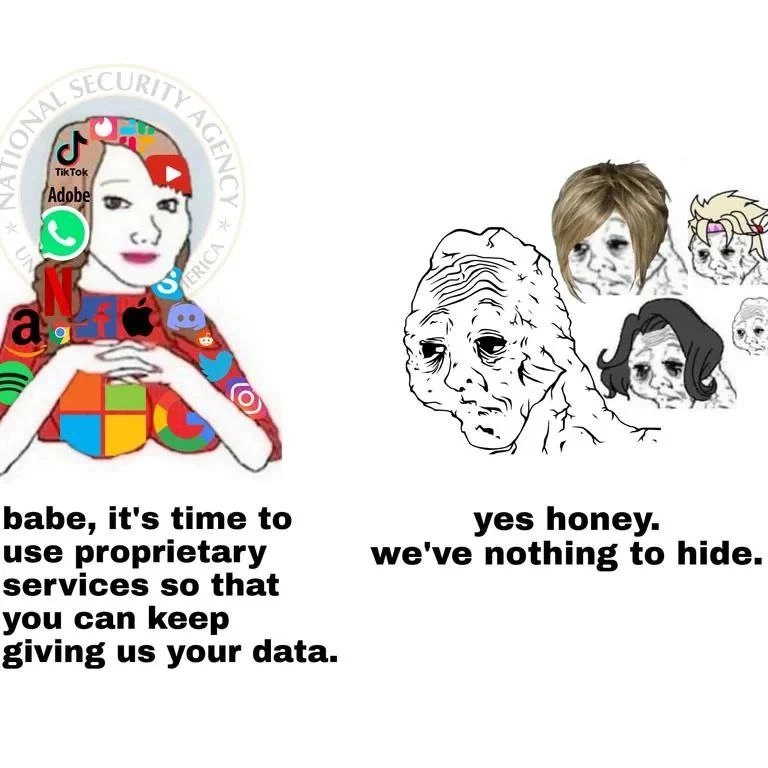
So what’s going on here from a simpler perspective? The left side of the meme shows a cartoon girlfriend made up of many famous tech logos (Google “G”, Facebook “f”, Apple’s apple, Netflix “N”, TikTok, WhatsApp, Microsoft, Reddit, Adobe, Amazon – a who’s who of big online services). There’s also an NSA logo ghosted behind her, which is the National Security Agency (the U.S. government’s spy organization). Essentially, she represents all the big technology companies and maybe government spies combined. When she says “babe, it’s time to use proprietary services so you can keep giving us your data,” she’s acting like these companies who want you to use their proprietary software.

Let’s break down a few terms in that sentence:

  • Proprietary services/software: This means apps or platforms that are owned by a company and usually closed-source (you cannot see or change their code). Examples are Facebook, TikTok, or iCloud – you use them on the company’s terms. You often have to agree to their privacy policy and terms of service, which usually allow them to collect and use a lot of your data.
  • Giving us your data: Whenever you use these online services, you often share personal information (either directly, like your name, photos, contacts, messages, or indirectly like your browsing habits, location, what you click on, etc.). Data collection is built into many apps – for example, a social media app might track how long you look at a post, or a shopping site logs everything you search for. This user information is very valuable. Companies use it for targeted advertising, improving their algorithms, or sometimes they sell insights to third parties. In short, if you’re using a free online service, it’s likely collecting data about you almost continuously.
  • Vendor lock-in: This is when a company makes it hard for you to switch to a competitor. For example, if all your friends use WhatsApp, you feel stuck using WhatsApp too, even if you don’t like it, because leaving means losing contact with friends (that’s a network effect and lock-in socially). Or if you’ve bought a lot of movies or books on Amazon’s platform, those purchases can’t easily transfer elsewhere, so you stay with Amazon. In the meme, all those logos on the girlfriend show how each tech vendor has you hooked in different parts of your life: one for email, one for chatting, one for entertainment, etc. They each hold some of your data. Lock-in keeps you giving them more data because it’s too inconvenient to quit.
  • Surveillance capitalism (mentioned in the context): This is a term describing how companies make money by surveilling (watching and recording) what users do. “Capitalism” because they turn that surveillance into profit (usually via ads or selling data-driven services). Think of Google showing you ads based on your search history – that’s surveillance (knowing your interests) turned to cash. In the meme, the girlfriend basically admits “we want your data” – which is exactly the goal of surveillance capitalism: get data, profit from data.

Now on the right side, we have the “doomer” wojak – a meme character with a tired, defeated look. He represents a user (maybe an average person, maybe a developer who knows better but is exhausted). His line “yes honey. we’ve nothing to hide.” is him agreeing to what the girlfriend (Big Tech) wants.

The phrase “nothing to hide” is crucial. It’s something people often say in privacy discussions: “Why should I worry if Google/Facebook/NSA collects my data? I haven’t done anything wrong, I have nothing to hide.” It implies that as long as you’re not doing anything illegal or embarrassing, you shouldn’t mind being watched. This meme is poking fun at that argument. Why? Because even if you’re not hiding bad deeds, you probably still value your privacy in some way. For example, you might not want strangers reading your journal even if it’s full of normal thoughts, right? Saying you have “nothing to hide” ignores that privacy is not about hiding bad things; it’s about choosing what you share and with whom.

For a junior developer or someone new to these concepts, it helps to connect this to everyday experiences:

  • Ever notice how after you search for a product, you suddenly see ads for it everywhere? That’s because your data (search keywords, or maybe an actual tracking cookie from that site) was shared among advertising networks. The meme’s scenario is basically all your apps saying “give me more information about you” so they can do things like that.

  • If you’ve used a phone app and it asks for permissions, like a flashlight app asking for internet and contacts access – that’s a red flag. It might be collecting data it doesn’t need. Many free apps make money by collecting and selling user data (like your location or usage patterns). This ties back to proprietary services because you can’t see what that closed-source app is really doing with those permissions. An open-source alternative might let you inspect the code (or at least others have audited it) to be sure it’s not snooping.

  • When you start working in tech, you might be asked to add analytics to your app or website – e.g., use Google Analytics or Firebase. This is a common task for a junior dev. It involves writing code or using an SDK that sends events whenever users do things in your app. For instance:

    analytics.logEvent("video_played", {
        user: "anonymous123",
        videoId: "abcXYZ",
        durationWatched: 42 
    });
    

    This little snippet (in a hypothetical app) sends data to a company’s servers about what the user is doing. Multiply that by thousands of events and millions of users, and you get a giant database of who did what, when, where. As a new developer implementing this, you learn how telemetry works: apps report home constantly. The meme basically has the “girlfriend” representing those server-side collectors saying: “Time to send me those analytics events, babe.” and the user shrugging, “Sure, I don’t mind, I’m not doing anything weird.”

The NSA reference is about government surveillance. The NSA (and other agencies worldwide) have been known to tap into data from these big companies. Ever heard of the Snowden leaks or the term “Big Brother”? In 2013, Edward Snowden revealed that the NSA was collecting massive amounts of data from regular citizens’ communications (phone records, emails, chats) under programs justified by anti-terrorism. A lot of that data came from big tech company servers or internet backbones. In plain terms: the government might not be “watching” you live, but it has the ability to pull records of your digital life if needed. So when the meme puts the NSA seal behind the girlfriend, it’s saying these companies and the government surveillance folks are hand in glove. It’s like the government saying, “Go on, use Facebook/Google, we’ll quietly take a peek at that data too.” This can sound like a conspiracy to someone new, but there’s documented truth to it (through laws and secret programs).

For a less extreme day-to-day example: Governments often request user data from tech companies (for criminal investigations, etc.). Usually there are legal processes, but it happens a lot. If you’re a junior dev working at a big company, you might even hear about the team that handles data subpoenas or government requests. It’s routine. So “nothing to hide” guy might trust both the company and government implicitly – basically saying “I’m okay with anyone looking at my stuff, I consent because I believe I’m an open book.” The meme is cheekily showing how that attitude appears to those who know the scope of data collection: pretty foolish or at least overly trusting.

In summary, the meme is about online privacy. It highlights:

  • How big tech companies (proprietary services) eagerly collect your information (your data is valuable!).
  • How some people respond with “I don’t care, I have nothing to hide,” not realizing what they give up.
  • The idea of surveillance capitalism where your data = profit, and vendor lock-in where you’re stuck using those services.
  • And the sneaky suggestion that government spy agencies are happily riding this data train in the background (so it’s not just companies that get your info, potentially).

For a newcomer, think of it this way: Using all these branded apps is like eating candy that might have a tracking chip inside. Each piece (each app) looks tasty and harmless. But as you enjoy it, those chips start feeding information about you to the candy factory (the companies) and maybe even to some government vault. The meme jokes that the person knows this on some level but says, “It’s fine, I’m doing nothing wrong,” which is a bit like saying “I don’t mind the cameras in my house because I’m not stealing anything.” It’s missing the point that it’s still your house and you normally wouldn’t want to be watched in it!

Level 3: Big Sister is Watching

In this meme, the “NSA-girlfriend” character represents Big Tech companies acting as a friendly face for mass surveillance – essentially Big Brother in the form of a soyjak girlfriend. She’s covered in the logos of proprietary services like Google, Facebook, Apple, Netflix, TikTok, WhatsApp, Amazon, etc., with the U.S. National Security Agency (NSA) emblem faintly in the background. This visual mash-up suggests that all these tech giants are in cahoots (directly or indirectly) with government surveillance programs. It’s a nod to real-world programs (like the NSA’s PRISM revealed by Snowden) where major cloud and social media platforms were essentially data funnels to government agencies. The girlfriend’s line is quoted almost like a routine chore:

Girlfriend: “babe, it’s time to use proprietary services so that you can keep giving us your data.”
Doomer: “yes honey. we’ve nothing to hide.”

This absurd pillow talk scenario is funny to developers because it personifies something we often discuss abstractly: surveillance capitalism and vendor lock-in turned into a relationship joke. The girlfriend’s demand is every privacy engineer’s nightmare: an expectation that you’ll happily upload your life to various closed platforms. It’s phrased sweetly (“babe, it’s time…”) as if she’s doing him a favor, which parodies how tech companies sugar-coat their data grabs as “convenient features” or “personalized experiences.”

The doomer boyfriend’s deadpan response, “we’ve nothing to hide,” is a classic line people use to dismiss privacy concerns. Seasoned developers recognize this as the “nothing to hide” argument – a flawed reasoning implying that only the guilty care about privacy. The meme exaggerates it: he’s basically saying “Sure, take all my personal data, I don’t mind, because I’m not doing anything wrong.” This is dark humor because in tech circles, we know even innocent data can be misused or lead to unintended consequences. It’s the kind of thing a jaded security engineer hears from non-technical folks and facepalms at, because it ignores issues of data misuse, profiling, or breaches. The doomer’s saggy, resigned face even suggests he’s not truly happy about it, but he’s given up resisting. That resignation resonates with many of us: for instance, developers who advocate for open-source or self-hosted tools for privacy often end up surrendering when team mates or family insist “just use Google Docs/Drive, it’s easier.” After enough pushback or inconvenience, even the privacy-conscious might sigh and say “okay, whatever, I’ll use it – I have nothing that sensitive to hide, I guess.” It’s a coping mechanism in a world where avoiding Big Tech is possible but painfully impractical.

The humor also lies in exposing surveillance capitalism in a relationship dynamic. Surveillance capitalism is the economic system where companies offer free or convenient services in exchange for harvesting user data to make money (often via targeted ads or selling insights). Here the girlfriend is basically saying out loud what these companies usually hide in fine print: “keep giving us your data.” It’s a comedic breaking of the fourth wall – the logos literally announce their true intentions. A senior developer reading this immediately recalls the countless EULAs and “Allow access” prompts where we’ve clicked Agree without reading, effectively giving away our data. The girlfriend’s blunt statement is like all those hidden privacy-invading clauses rolled into one cheeky demand.

From a security perspective, there’s an inside joke: “we’ve nothing to hide” is practically a meme in infosec circles for naïveté. Professionals know that having nothing to hide is not the same as having nothing worth protecting. Even benign data (your contacts, your location history, your shopping habits) can be aggregated into a profile that’s very revealing or can be exploited. For example, an engineer might recall how telemetry in software works: seemingly harmless usage stats from millions of users feed into powerful analytics. Those analytics can predict user behavior or uncover patterns that users never intended to share. We joke that if it’s free, you are the product, and here the doomer boyfriend literally becomes “the product” – his data is the commodity being consumed by the girlfriend’s collage of corporations (and by extension, the NSA).

The meme also slyly references vendor lock-in via all those logos. Each of those companies wants you to be dependent on their ecosystem – use all Google products, or stay in the Apple universe, etc. Why? Because the more you commit to one vendor’s proprietary services, the harder it is to leave, and the more comprehensive your data profile becomes within their silo. A senior dev has seen this pattern: e.g. a company might push all its users to log in via Facebook or Google accounts (OAuth), making those Big Tech logins practically identity services. It’s convenient, but it centralizes data. The “girlfriend” saying “it’s time to use proprietary services” is like Big Tech nudging you back into their walled garden every time you stray. She’s basically the embodiment of vendor lock-in temptation.

Why is this so relatable and funny (in a bitter way) to experienced tech folks? Because it captures the cognitive dissonance we deal with: we know these platforms are scooping up data. We might even rant about open-source alternatives or privacy tools. Yet, at the end of the day, many of us still say “yes, honey” to Big Tech – using Chrome, an iPhone, Google Maps, Office 365, you name it – because it’s just easier or necessary for our jobs and social lives. It’s that mix of guilt, resignation, and dark comedy of being complicit in our own surveillance. The doomer wojak character perfectly illustrates the feeling: weary acceptance. He’s surrounded by faint ghostly faces of other wojaks (perhaps representing peers or the public) who all have the same defeated look – implying this “oh well, we have nothing to hide” mindset is widespread, almost peer-pressured. Everyone’s doing it, so the individual gives in.

Lastly, there’s a subtext of security vs. convenience trade-off. A senior engineer knows that the secure path (avoiding proprietary data silos, using privacy tools) often conflicts with convenience (the seamless, polished experiences Big Tech provides). The meme mocks how easily convenience wins. The “yes honey” response is basically choosing convenience every time. It’s funny because it’s true. Like an ops engineer might joke: “Sure, I could self-host my own cloud and avoid Google... or I could just say ‘yes dear’ and spin up Google Drive in 2 seconds and hope the NSA isn’t indexing my cat photos.” That irony lands well with an audience that has fought and often lost the privacy battle in everyday life. In summary, the meme’s humor operates on exposing the absurd normalcy of surveillance: turning a serious privacy debate into a caricature of a loving relationship where being tracked is affectionately mandated. Big Sister is watching, and we’ve learned to just nod and smile.

Level 4: Proprietary Panopticon

At the most theoretical level, this meme touches on the idea of a modern digital panopticon – a system where a central authority (like the NSA or Big Tech) can observe everything without you knowing when or how. In a panopticon prison design, inmates behave because they might be watched at any time. Similarly, ubiquitous proprietary platforms create an architecture of surveillance-by-default. All your messages, searches, and clicks become bits of observable data. The user’s flippant “we’ve nothing to hide” stance ignores advanced truths: even innocuous data points can be aggregated to reveal sensitive information through clever algorithms and correlation. In security theory, there’s a concept that metadata (information about your communications, like who you talk to and when) can be more revealing than the content itself. The humor is underpinned by this ironic reality – the man in the meme trusts the system blindly, while the system itself (the girlfriend made of corporate logos) is an all-seeing eye, a Proprietary Panopticon smiling at his compliance.

On a technical front, this highlights the lack of cryptographic safeguards in everyday proprietary services. Truly having “nothing to hide” would require either saintly innocence or mathematically perfect privacy. Modern cryptography offers theoretical tools like end-to-end encryption, zero-knowledge proofs, and even fully homomorphic encryption that let you use services without revealing your data. For example, homomorphic encryption (an advanced encryption scheme) would let a cloud service run computations on your data without ever decrypting it – meaning they literally wouldn’t see the raw data. That’s like being able to get personalized services while keeping your secrets locked in a safe. But these techniques are computationally expensive or impractical for widespread use today. So instead, most proprietary apps operate in a trust model: you hand over data and trust they won't misuse it. The meme’s dark joke is that this trust is naïve; in reality, your data can be replicated, analyzed, and subpoenaed faster than you can say “privacy policy.” Fundamentally, the meme hints at an unsolved computer science dilemma: how do we enjoy the convenience of rich online services without creating an Orwellian surveillance infrastructure? Until that puzzle is cracked, saying “I have nothing to hide” is like saying you don’t mind living in a glass house because you think no one will look — technically true today only because we lack cost-effective blinds for all that glass.

Description

A two-panel 'Yes, Honey' Wojak meme criticizing data privacy. On the left, a female Wojak character, representing a dominant figure, is adorned with the logos of numerous major tech companies, including TikTok, Adobe, WhatsApp, Amazon, Netflix, Google, Microsoft, Apple, and Discord. Behind her head is the official seal of the National Security Agency (NSA). The caption below her reads, 'babe, it's time to use proprietary services so that you can keep giving us your data.' On the right, a collection of defeated, aged, and sad Wojak characters stare blankly, with the lead character responding, 'yes honey. we've nothing to hide.' The meme serves as a cynical commentary on the relationship between consumers, big tech, and government surveillance. It personifies the proprietary software ecosystem as a demanding partner that insists on data collection, implicitly backed by state power (the NSA). The user's response highlights the 'nothing to hide' fallacy - a common but flawed justification for surrendering privacy out of convenience or resignation. For senior developers, this meme resonates with the ongoing debate between open-source alternatives and the convenience of closed-source, data-hungry platforms, and the ethical dilemmas of participating in surveillance capitalism
Comments

8
Anonymous ★ Top Pick The 'nothing to hide' argument is the 2FA of privacy: the first factor is convenience, the second is complacency. Both get bypassed by a state-sponsored actor anyway
  1. Anonymous ★ Top Pick

    The 'nothing to hide' argument is the 2FA of privacy: the first factor is convenience, the second is complacency. Both get bypassed by a state-sponsored actor anyway

  2. Anonymous

    “Nothing to hide” works great - right up until the DPO asks you to purge one user across 17 proprietary SaaS dashboards, three “misc-backups” S3 buckets, and the intern’s personal Notion workspace

  3. Anonymous

    After 20 years of implementing 'privacy-first' architectures, I've learned the real P in GDPR stands for 'Pretend' - we all know those cookie banners are just theater while the real data collection happens through first-party telemetry that users can't even opt out of

  4. Anonymous

    The real architectural pattern here isn't microservices - it's 'surveillance as a service' with infinite horizontal scaling across every app you install. The NSA doesn't need to build data centers when millions of users voluntarily deploy distributed collection agents on their own hardware, complete with biometric sensors and 24/7 location tracking. It's the ultimate cloud-native solution: your data, their infrastructure, zero transparency in the SLA

  5. Anonymous

    Proprietary's CAP theorem: you pick Convenience and Analytics; Privacy's always partitioned away

  6. Anonymous

    Zero-trust everywhere except the proprietary analytics SDKs - because we’ve nothing to hide, just an ever-growing data lake labeled “marketing”

  7. Anonymous

    “We’ve nothing to hide” works great - until a data broker inner-joins your anonymous Mixpanel IDs with Okta auth logs; eventual consistency becomes eventual identity

  8. @NixonNumber1 3y

    CAESAAAAAR.

Use J and K for navigation