OpenAI Oracle Nvidia $100 Billion Power Strip Money Circle
Why is this AI ML meme funny?
Level 1: Dog Chasing Its Tail
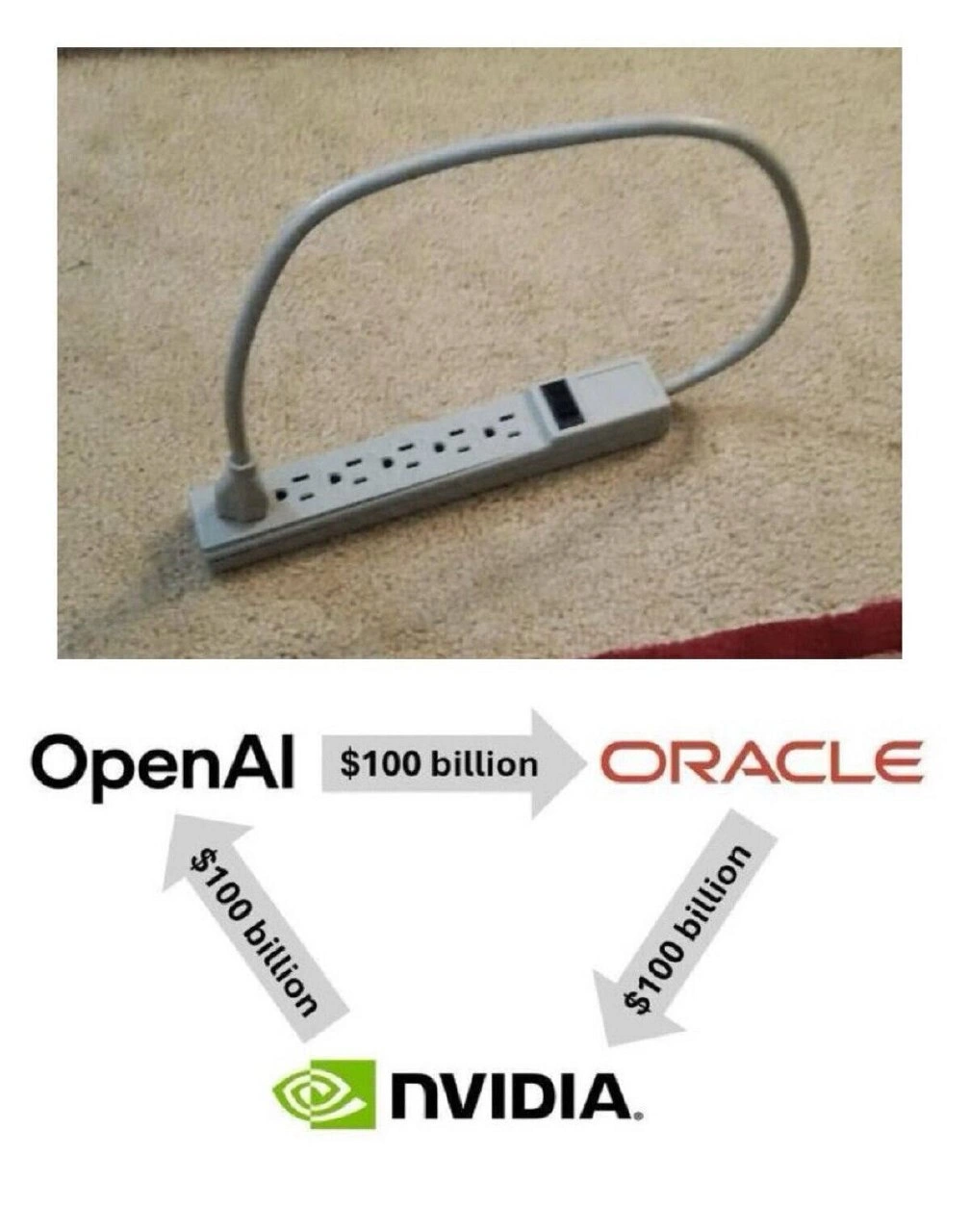
Imagine you have a power strip (those things with multiple outlets) and you plug its cord back into one of its own outlets. Would it magically start giving itself electricity? Of course not! It’s a silly idea – it can’t power itself without being plugged into the wall. That’s exactly what the picture in this meme shows, and it’s making fun of a similar situation with money. Think of three big friends passing the same $100 bill around in a circle. Friend A gives it to Friend B, Friend B gives it to Friend C, and Friend C hands it back to Friend A. They’re all acting like they each got $100, but really it’s just the one bill going in circles.
This meme is saying some huge tech companies are doing that with insanely large amounts of money – like $100 billion instead of $100! They’re basically swapping money among themselves and pretending it’s new wealth, kind of how our friends could pretend they each earned $100 when it was the same money recycled. It’s funny because it’s obviously a trick: no new money is made, just like the power strip isn’t creating new power. The humor comes from showing something impossible in a simple way. Even a kid can see plugging a cord into itself won’t turn on the light, and by analogy, the meme suggests these companies’ money games are just as empty. It’s a playful way to say, “Hey, you can’t just make something out of nothing!” and to poke fun at how ridiculous it looks when big folks try anyway.
Level 2: GPU Gold Rush
Let’s break down what’s going on in simpler terms. The meme shows three famous tech companies in a circle: OpenAI, Oracle, and NVIDIA. Each arrow between them is labeled "$100 billion," forming a closed loop of money. This is like saying “OpenAI gives $100B to Oracle, Oracle gives $100B to NVIDIA, NVIDIA gives $100B to OpenAI,” over and over. Why would they do that? Because of the big AI hype right now – everyone is excited (maybe overly excited) about artificial intelligence, and these companies are all trying to boost each other up (and themselves) in the process.
Here’s who these players are:
- OpenAI is the creator of ChatGPT and other advanced AI models. To build and run these AI models, OpenAI needs a huge amount of computing power – specifically, lots of powerful chips.
- NVIDIA makes those powerful chips, called GPUs (Graphics Processing Units). GPUs have become the workhorses for AI computations (training neural networks) because they can do many tasks in parallel. NVIDIA’s top GPUs (like the
A100orH100) are super expensive and in high demand. Right now, there’s actually a GPU shortage – it’s hard to get your hands on these chips because everyone in AI wants them (compute_crunch). - Oracle is a big enterprise tech company that nowadays also runs a cloud service (like data centers where you can rent computing power, similar to Amazon AWS or Microsoft Azure). Oracle isn’t as popular a cloud for developers as AWS/Azure, but they want to attract big customers. AI labs like OpenAI are the perfect customers because they need tons of cloud compute.
Now, what does a “$100B loop” mean in real life? It’s exaggerating real deals to make a point. For instance, OpenAI might not literally hand Oracle $100 billion in cash, but it could sign a huge contract to use Oracle’s cloud — say OpenAI commits to spend a very large amount on Oracle’s servers over a few years. Oracle, eager to have OpenAI on board (and to advertise “hey, we are the cloud behind the most famous AI!”), could give OpenAI a massive discount or even an investment. Sometimes these deals come as cloud credits: like gift cards for cloud services. So OpenAI gets, for example, “$X hundred million worth of Oracle cloud usage free” or as an investment. That’s effectively Oracle giving money (or service) to OpenAI so that OpenAI will use Oracle’s platform.
Oracle, in turn, needs to actually provide the computing power for OpenAI. That means buying a huge number of NVIDIA GPUs to install in its data centers – possibly billions of dollars worth of GPUs. So a lot of money flows from Oracle’s pocket to NVIDIA (Oracle buys hardware). NVIDIA loves this, of course, because selling more GPUs is basically their goal, and these are huge sales. NVIDIA’s revenue and profit skyrocket with such deals. NVIDIA’s stock price has also shot up thanks to AI demand; the company’s market value went over a trillion dollars. They have so much capital now that NVIDIA might even invest back into the AI ecosystem – for example, by partnering with companies like OpenAI or funding AI research (that would be money flowing from NVIDIA back to OpenAI or similar labs). Even if not direct, NVIDIA’s success builds more hype for OpenAI (“look, our models are so popular they made NVIDIA rich!”), helping OpenAI raise even more funding. And that brings us full circle.
So the “self-powered funding loop” is joking that these three are basically shuffling gigantic sums in a circle to keep the AI hype cycle going. Each one’s value is propped up by the others:
- OpenAI’s value rises because it has big-name investors and customers like Oracle and cutting-edge tech from NVIDIA.
- Oracle’s value rises because it’s seen as providing critical cloud infrastructure to top AI companies like OpenAI (and they can claim big future revenues from that $100B contract).
- NVIDIA’s value rises because every cloud and AI company (like Oracle and OpenAI) is buying their GPUs like crazy.
It’s a closed loop of publicity and money. Hype vs reality comes into play when you ask: are these $100B deals producing $100B worth of actual new product or profit? Or is it more like an accounting trick / PR move? Often, it’s partly real (OpenAI truly will use a lot of compute) but partly speculative (valuations assume AI will generate huge profits later, which is uncertain). It’s similar to a gold rush: during a gold rush, everyone invests in equipment and land, sometimes selling to each other at high prices, all believing they’ll strike gold. Here the “gold” is world-changing AI. NVIDIA is like the one selling the shovels and picks (GPUs), making guaranteed money. OpenAI is like the miner who needs the tools, and Oracle is the camp offering services to the miners. They’re all hyping each other up: “This next mine (AI model) will be huge, trust us!” – and pouring more money in.
For a junior developer or someone new to industry trends, the meme is highlighting a kind of circular investment. It’s a bit like three friends passing the same $10 around to each other and every time calling it a new sale. Friend A buys something from Friend B, Friend B buys something from Friend C, Friend C buys something from Friend A. In the end, each friend felt like they earned $10, but actually no new money came in from outside the circle – they just exchanged the same bills. In business, sometimes companies do that to boost their reported numbers or strategic relationships. It’s not always that blatantly circular, but the joke here is that with all the AI excitement, some deals really do seem to just funnel money in a loop to inflate everyone’s worth.
Also, note the top part: the power strip plugged into itself. That’s a visual way of saying “this thing is powering itself with its own output” – which is impossible in electricity. You always need an external power source. In the same way, the meme implies these companies are trying to power their growth using their own hype-money as the source. It pokes fun at how ridiculous it is when the tech industry hype gets out of hand. For a newcomer: it’s a caution that not every astronomical sum you hear in tech news is as solid as it sounds – sometimes it’s just an extension cord loop, not actually plugged into the wall of real revenue.
Level 3: Billion-Dollar Ouroboros
To experienced tech folks, this meme hits like a deja-vu of every AI hype cycle and bubble we’ve witnessed. The graphic joke is clear: three tech giants passing around the same $100 billion and claiming victory. It’s the Ouroboros of AI capital – a snake eating its tail – where AI hype fuels massive deals, which fuel more hype, in a closed circuit. The humor comes from seeing the usually hidden truth made literal: these companies’ valuations and deals often reference each other in a self-reinforcing way. The bottom image explicitly shows OpenAI → Oracle → NVIDIA → OpenAI with big grey arrows labeled "$100 billion". It feels like reading about one of those huge partnership announcements where, say, Oracle invests $X in an AI venture, OpenAI commits to spend $X on Oracle’s cloud, and NVIDIA sells $X of GPUs to Oracle. The meme exaggerates it to $100B each to underline how absurdly large and circular these arrangements have become.
In reality, we’ve seen hints of this loop in news: for example, OpenAI got giant cloud credit deals (and investment) from Microsoft Azure earlier, and Oracle—eager not to miss out on the gold rush—reportedly offered its own massive cloud infrastructure deals to AI startups. Oracle’s cloud division, lagging behind Amazon and Microsoft, could indeed pledge huge sums (or credits) to win OpenAI as a marquee customer. That’s the arrow from OpenAI to Oracle: OpenAI agreeing to use Oracle’s GPU-packed data centers, effectively sending billions Oracle’s way (even if via credits). Oracle then would take that money (or commitment) and run to NVIDIA to buy an insane number of high-end GPUs to actually provide the promised compute power – voilà, Oracle → NVIDIA $100B. NVIDIA, now swimming in revenue and enjoying a stratospheric stock price thanks to the AI compute compute_crunch, might turn around and support OpenAI’s growth (perhaps through equity investment, priority hardware allocations, or just by public boosterism that raises OpenAI’s valuation another $100B). That closes the triangle: NVIDIA → OpenAI $100B, possibly in the form of increased market cap or investment that flows back to OpenAI. Each leg of the triangle is ostensibly $100B of value, but a cynic would note it’s largely the same money counted three times. This is why the meme caption simply says “Brrr” – as if a money printer is running. It’s referencing the "money printer go brrr" meme, implying these companies found a way to print value out of thin air by cycling funds amongst themselves.
From a senior developer or industry observer perspective, it’s both funny and painfully familiar. We’ve seen IndustryTrends where companies in a hype bubble engage in circular deals:
- Company A invests in Company B,
- Company B spends that cash on A’s services,
- Everyone reports record sales/investments, stock prices soar, rinse and repeat.
It happened in the late-90s dot-com bubble (companies buying each other’s ads or stock to puff up metrics), and here we go again with AI. The TechIrony is rich: these are some of the most advanced AI organizations, yet they’re effectively relying on an age-old financial trick – round-tripping money – akin to plugging a power strip into itself and marveling that it’s “powered.” AIHypeVsReality indeed: the hype says we’re inventing the future, the reality is some of this is just financial engineering. Senior engineers have that knowing smile because they remember earlier hype cycles (VR, crypto, you name it) where everyone claimed the party would never end… until it did. There’s almost a whiff of déjà vu from the AI winter of the 1980s: back then, massive investment in AI hardware (like Lisp machines) and companies trading funding led nowhere and collapsed. Today’s version is bigger – GPUs instead of Lisp chips, cloud credits instead of government grants, but the circular pattern is similar.
Why is this “loop” so relatable (and cringey) to seasoned tech folks? Because it highlights multiple systemic issues:
- Circular dependency: Technically, circular dependencies in software are a nightmare; they lead to systems that can’t initialize or have hidden bugs. Here we have a business circular dependency: OpenAI’s growth depends on Oracle’s GPUs, Oracle’s cloud growth depends on NVIDIA’s hardware, NVIDIA’s valuation depends on AI successes like OpenAI. It’s a tight coupling. There’s no independent input of value; it’s all internally referenced. One break in the chain (say AI model results don’t live up to the hype) and everyone feels the hit.
- Vendor lock-in: Oracle giving huge credits to OpenAI is not just generosity – it’s betting OpenAI will be locked into Oracle’s ecosystem. OpenAI in turn is locking itself into Oracle’s hardware (which is really NVIDIA’s hardware). Each is locking into the other’s fate. In code or architecture, we avoid hard-coded circular dependencies for good reason. Here the companies willingly entangle themselves for short-term gain.
- GPU shortage & monopolistic supply: There’s a real GPU crunch in the market. NVIDIA is essentially the only game in town for cutting-edge AI chips (GPUs). Big players like Oracle, Microsoft, Google scramble to buy out entire shipments to feed AI models. This monopolistic supply (NVIDIA calls the shots on price) and oligopolistic demand (only a few can afford at scale) means prices skyrocket and even more money is thrown around to secure chips. It’s a feedback loop: hype drives demand for GPUs, which enriches NVIDIA, which in turn invests more in making GPUs and promoting AI, driving more hype. Meanwhile, smaller labs or startups can’t get a single H100 card because Oracle or another giant pre-bought them by the tens of thousands. Many devs have stories of waiting months for cloud GPU capacity or paying obscene rates – the compute_crunch is real. So when they see this meme, they chuckle: “yep, the big guys are tying up $100B in hardware among themselves while the rest of us have empty GPU clusters.”
- Valuation inflation: Each of these companies has seen its valuation balloon due to AI. OpenAI went from non-profit research org to a startup valued in tens of billions. Oracle’s stock jumped in 2023–2025 partly because they announced AI cloud deals (finally some cool factor for Oracle). NVIDIA famously became a trillion-dollar company as every investor chased the AI_ML boom. But how much of that is real demand versus anticipatory hype? Seasoned folks recall AIHypeCycle patterns: after the Peak of Inflated Expectations comes the Trough of Disillusionment. The meme hints we’re at peak hype – when dollars circulate freely in a frenzy. The unspoken punchline: if reality disappoints, this loop could unplug dramatically (valuations crash, deals get written down, GPUs end up on resale markets). It’s both comedy and cautionary tale.
In essence, this meme nails a tech industry trend with biting humor. It takes a jab at how the AI industry can sometimes feel like an echo chamber: big firms validating each other’s bets in a closed loop. An engineer who’s been around the block might sarcastically quip, “Sure, just plug the funding cycle into itself – that’ll keep the lights on forever 🙄.” It’s a form of coping humor too: when you’re on call at 3 AM because your GPU job died due to capacity issues, it’s easier to laugh at the absurd image of the self-powered extension cord than to cry about budget approvals for more GPUs. The meme distills a complex web of hype, economics, and tech into one absurdly perfect visual. We laugh, but we also know this is exactly the kind of thing that keeps happening whenever investors get starry-eyed: everyone convinces each other that by moving money in circles, they’ll defy gravity—until gravity inevitably wins.
Level 4: Perpetual Motion Hype Machine
The top image of a power strip plugging into itself is a literal attempt at a perpetual motion machine – an object trying to generate power from nothing. In physics, this fails because of thermodynamics: you can’t get more energy out than you put in (friction and resistance will sap it away). Likewise, in the tech economy, a closed loop of money can’t magically create value without some external input. The meme equates these ideas: OpenAI, Oracle, and NVIDIA are depicted as an impossible self-powering circuit, each company pouring $100B into the next in hopes of infinite growth. It’s a satirical nod to hype-driven capital flows violating the “conservation of value” principle, much like a self-plugged cord violates conservation of energy. No matter how clever it looks, no free energy and no free lunch hold true in both physics and finance.
Digging deeper, this is a commentary on feedback loops and runaway systems. In control theory and system dynamics, a positive feedback loop amplifies itself – here the hype in the AI industry keeps reinforcing valuations: high valuations enable massive spending, which generates more headlines and hype, further boosting valuations. It’s reminiscent of a recursive function with no base case: it just keeps calling itself (money → GPUs → cloud deals → more money ... loop) until something overflows or crashes. In computer science terms, this is a circular dependency in the real world: each entity’s growth is predicated on the others’, with no independent ground truth of value – a structure that is inherently brittle. We’ve seen analogous phenomena in history: self-referential economic bubbles and Ponzi schemes where internal money shuffling masked an absence of real output. The Ouroboros (snake eating its tail) of capital can sustain an illusion for a while, but eventually entropy (or reality) catches up.
There’s also an implicit reference to market structure. NVIDIA has a near-monopoly on high-end AI chips (GPUs like the sought-after H100), and the buyers of those GPUs are a small oligopoly of giant cloud providers (Oracle, AWS, Azure, etc.). This creates a weird monopsony-meets-monopoly dynamic in the GPU market: a single dominant seller and a few colossal buyers who all hype up the demand together. Classic economic theory says such imbalance can distort prices and supply. The meme’s $100B arrows exaggerate this, hinting that these big players might be over-valuing and over-paying in a frenzy to secure resources. In a more rational market, a $100B transfer would need justification by huge external revenue, but here it’s like each party bets that the other will eventually justify it. It’s as if they believe they’ve found an infinite energy glitch in capitalism. Of course, just as plugging a cable into itself won’t light up your house, pouring money in a circle won’t indefinitely prop up the industry – at some point, physics, economics, or plain common sense should trip a circuit breaker.
Description
Two-part meme. Top: Photo of a power strip plugged into itself forming a closed loop, representing a self-powering circuit that produces no actual energy. Bottom: A diagram showing OpenAI, Oracle, and Nvidia each sending $100 billion to one another in a triangular cycle (OpenAI -> $100 billion -> Oracle, Oracle -> $100 billion -> Nvidia, Nvidia -> $100 billion -> OpenAI). The meme draws a direct parallel between the power strip's impossible perpetual energy loop and the circular flow of massive investments in the AI industry, suggesting the money is just being passed around between the same players without generating real value
Comments
17Comment deleted
The first law of AI thermodynamics: money can neither be created nor destroyed in the OpenAI-Oracle-Nvidia system, it can only be transferred between press releases
The AI industry has achieved perpetual motion: OpenAI burns cash on Oracle Cloud, Oracle burns cash on NVIDIA GPUs, and NVIDIA invests the profits back into OpenAI. It's the world's most expensive closed circuit
It’s basically a three-way while(true) loop: emit $100 B, acquire GPUs, restart - proof that money, like power, can apparently be conserved via circular dependency injection
The real AGI was the circular dependencies we made along the way - where every dollar spent on AI compute somehow ends up back where it started, like a distributed system where the CAP theorem stands for 'Cash Always Propagates'
When your entire AI infrastructure budget is just three companies passing the same $100 billion around like a hot potato - it's not a supply chain, it's a circular linked list with O(1) lookup but infinite overhead. Oracle gets the cloud contract, buys NVIDIA GPUs for the compute, NVIDIA reinvests in OpenAI's next funding round, and OpenAI signs another Oracle deal. The only thing more recursive than their business model is a poorly written factorial function, except this one never hits a base case and somehow everyone's valuation goes up
AI's true CAP theorem: Cash Always Powers the vendor triangle - until the extension cord fries
Enterprise circular dependency: convert capex to opex, reserve H100s on OCI, and call the $100B loop “synergy” until procurement’s exponential backoff hits 18 months
Circular dependency injection, CFO edition: OpenAI buys OCI, Oracle buys H100s, and the only idempotent operation is NVIDIA’s quarterly revenue
Maybe the real AI is the Ponzi scheme we made along the way Comment deleted
The bubble will pop one day Comment deleted
Remember, if it's absolutely *not* a bubble, it is absolutely a bubble Comment deleted
I'm not usually one to defend scheming corporation, but that exchange is pretty much the opposite of a bubble. That's literally how economics works: parties exchange goods, services and money (the latter acting as a placeholder for the former two), the total value held by each participant remaining at an equilibrium throughout this process. Effectively Oracle and Nvidia gave OpenAI some compute, while OpenAI now has an obligation to pay some proportional dividends for it in the future. Comment deleted
They all have the same shareholders Comment deleted
True (probably, idk). But that's still just as balanced an economic transaction, even if it happened between three departments of openai. The circular payment seems funny when isolated like this, sure, but in reality it happens all the time, and the important thing is the exchange of goods and services that accompanies it Comment deleted
get foxed Comment deleted
Money laundering Comment deleted
it definitely might be considering Nvidia being the most enrooted mafia business Comment deleted