Skip to content
DevMeme
6535 of 7435
Script Kiddie Offers DDoS Free Trial at One Botnet Per Hour
Security Post #7163, on Sep 23, 2025 in TG

Script Kiddie Offers DDoS Free Trial at One Botnet Per Hour

Why is this Security meme funny?

Level 1: One Crowd per Hour

Imagine two kids planning a silly prank. They want to block the doorway to their school library so nobody can get in (kind of like causing a playful traffic jam). The first kid boasts, “I can get lots of friends to crowd the door. I’m even giving a free demo – watch, I’ll bring a couple of friends now to show you!” The second kid is curious and asks, “Whoa, how many friends can you bring in total? How big will this crowd be?” Now, instead of answering with a normal number, the first kid tries to sound super impressive and says, “Don’t worry, I can use one whole crowd per hour.”

Huh? One crowd per hour? That answer doesn’t really tell you anything clear, right? A crowd could be 5 people or 50, and saying “per hour” on top of it is just bizarre. The second kid would be left scratching their head, probably going, “What does that even mean?!” It’s funny because the first kid is talking like a business ad but ends up using a made-up unit that makes no sense. The joke is that he described his prank in such a goofy way that the other kid (and everyone listening) is just confused. In simple terms, the meme is making us laugh at how silly it sounds to measure an attack (or a prank) in a completely wrong way – it’s like bragging with big words that actually don’t explain anything!

Level 2: Botnet Basics

Let’s break down what’s happening in this chat. DDoS stands for Distributed Denial of Service. It’s a type of cyber attack where a bad actor tries to shut down an online service (like a website or game server) by overwhelming it with more traffic or requests than it can handle. “Denial of service” literally means legitimate users get denied the service because it’s too busy dealing with junk traffic. And “distributed” means the attacker isn’t using just one computer to do this – they’re using many at the same time, often thousands. Imagine a huge mob of people all trying to rush through a single door at once; the doorway gets jammed and nobody can get through. A DDoS attack creates that kind of traffic jam, but on the internet.

So how can one person command a whole mob of machines? That’s where a botnet comes in. A botnet is a network of computers or gadgets that have been infected with malware, allowing a hacker to control them remotely. The owners of those devices usually have no idea their computer is now a “zombie” in someone’s army. The hacker can tell all these enslaved computers (the bots) to perform tasks together – for example, to send a flood of garbage data to a target. If the hacker wants to DDoS a website, they instruct the entire botnet to bombard that site all at once. The sheer volume of fake requests or data from so many sources can overwhelm the target, kind of like getting hit by a firehose of traffic.

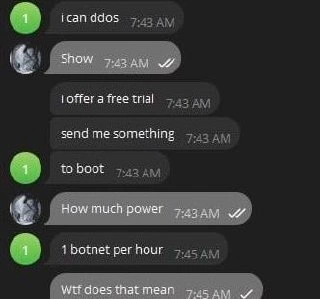
Now, in the meme’s chat screenshot, we have two people: one offering this nasty service (green messages) and one asking about it (grey messages). The person in green basically says, “I have the tools to take down a server – I can DDoS – and I’ll even let you try it free once.” It’s like a shady salesman saying you can sample the product. When they mention “send me something to boot”, they’re asking for a target. In hacker slang, “boot” or “boot offline” means to kick someone off the internet (imagine unplugging their connection, but via an attack). So, Green is saying: “Give me an IP address or a website that you want knocked offline, and I’ll prove I can do it.” Offering a free trial for an attack is wild, but in some illicit corners of the web, it happens – they demonstrate on a small scale so the customer trusts they really can take a site down.

The grey person responds with “How much power”, which is a sensible question. If you were about to pay someone to DDoS a target, you’d want to know how strong their attack is. Are we talking about a handful of computers sending a bit of traffic, or a massive network that can flatten almost any server? “How much power?” translates to “How big is your botnet?” or “How much traffic can you throw at the target?”. This is where a serious DDoS provider might say something like, “I have 10k bots” or “I can do a 10 Gigabit-per-second flood, which is a lot.”

Instead, our green friend answers with “1 botnet per hour.” That phrase is not a normal answer – it’s actually the joke of the meme. No one describes attack capability in that way. It’s as if you asked a runner “How fast can you run 100 meters?” and they replied, “I can use one pair of shoes per hour.” Huh? It doesn’t tell you the speed at all. Likewise, “1 botnet per hour” doesn’t tell us how many machines or how much data is involved. It sounds like the person is treating their entire botnet as a unit (one botnet) and renting it by time (per hour). The customer is left thinking, “What does that even mean? Is that a lot or a little? How many computers are in one botnet?” It’s just a very odd, almost laughable way to quantify an attack.

Unsurprisingly, grey is confused and texts back, “Wtf does that mean”. In plain language, that’s “What the heck are you talking about?” They expected a clear answer – like a number of gigabytes, or some count of compromised computers – but got back techy-sounding gibberish. This confusion is exactly the point of the meme’s humor. It highlights how the hacker (green) tried to sound slick and professional by using a cloud-computing style answer, yet completely failed to communicate. It’s akin to encountering a salesman who uses fancy buzzwords without substance.

For a bit of context, this meme is riffing on the idea of “DDoS-as-a-service” – basically, treating a cyberattack like an on-demand product you can buy. This chat looks like a sketchy negotiation you might see on a hacker forum or a private message on some platform. All the elements are there: someone advertising a hack, a free trial to entice the buyer, and then haggling over “how strong” it is. The tags like ddos_as_a_service and shady_chat_negotiation point exactly to that scenario. It’s an infosec hustle (an information security hustle) where the “service provider” is a person willing to break the law for money. And the meme is a joke about how that pitch is delivered.

To sum it up in simpler terms: the green-text hacker is offering a DDoS (flooding a target with data to knock it offline) using their botnet (army of hijacked devices). They speak in a way that imitates a cloud vendor (with a free trial and an hourly rate), but the way they measure their service – “1 botnet per hour” – is totally confusing. The grey-text person’s bewildered reaction (“Wtf does that mean”) is exactly what we’re meant to feel. It’s funny to tech folks because it’s a mix of serious cybercrime talk with silly, incorrect tech buzzwords. For someone new to this, just remember: in real life you’d describe an attack by its size (like gigabytes of traffic or number of machines), never by “botnets per hour” – that part is pure comedic nonsense. This meme lives at the intersection of Security and Networking humor, turning a scary concept (knocking websites offline) into something to laugh at because of how absurdly it’s presented.


Level 3: Bots by the Hour

In this meme, a shady chat conversation turns cyberattack into a commodity. One participant boasts “I can DDoS” and even offers “a free trial”, as if distributing denial-of-service attacks were a legitimate cloud service. The absurd punchline comes when they quote their capacity in a cloud-like pricing metric: “1 botnet per hour.” Seasoned engineers who deal with security and networking crack a grin here. It's hilariously reminiscent of cloud providers selling compute by the hour—except this is a botnet (a network of hijacked computers) being rented out like a virtual server. Essentially, the meme lampoons the idea of DDoS-as-a-Service (let’s call it BaaS: Botnet-as-a-Service), complete with a free trial and catastrophically vague units.

Why is “1 botnet per hour” so comically nonsensical? In real DDoS operations, attack strength is measured in concrete technical terms. Think of bandwidth (e.g. “I can hit you with 100 Gbps of traffic”) or raw volume (“I have 10,000 bots sending millions of packets per second”). A botnet is not a fixed unit of power—it’s a collection of compromised machines, which could be a modest herd of 50 IoT gadgets or a massive army of 500,000 PCs. Saying “one botnet per hour” is as undefined as a cloud provider advertising “one data center per hour” instead of specifying how many servers or CPU cores are included. It mixes quantity with time in a totally unscientific way. No wonder the other person responds, “Wtf does that mean”—they expected a real metric of attack power, not a buzzword cocktail.

The humor deepens when you consider how legitimate cloud computing uses clear, standardized units. Providers like AWS or Azure charge for vCPU-hours, GB of RAM, or requests per second. Those metrics map to actual capacity: you know what 4 vCPUs or 10GB of network throughput means. If instead AWS advertised “unlimited compute: 1 entire data center per hour”, engineers would be baffled. The meme mirrors this scenario: a hacker trying to sound professional ends up quoting a ridiculous unit that conveys nothing. It’s a perfect parody of tech marketing nonsense—taking the buzzwords of “X as a Service” to an illegal and illogical extreme.

What makes it relatable to seasoned devs is the subtext of tech culture bleeding into the underworld. In real life, DDoS-for-hire services (often called booters or stressers) do exist, and they do borrow tactics from mainstream SaaS. They might offer tiers of service, customer support via chat, and yes, sometimes even a “free trial” (which usually means they'll knock a small target offline briefly to prove they can). But even the most brazen cybercriminal marketer usually gives specifics: e.g. “We can deliver a 5-minute, 10 Gbps UDP flood for $50.” No one with real experience would ever market in “botnets per hour” because it’s meaningless — a botnet’s strength depends on its size and the bandwidth of each bot. The meme’s DDoS vendor either has no idea how to articulate his “product,” or is intentionally using grandiose jargon hoping the buyer is too ignorant to notice. It’s the classic tech hustle: overpromise with fancy-sounding units, under-deliver in reality.

This shared joke masks some real chaos behind the scenes. Defenders who’ve battled DDoS attacks know how messy and varied botnets can be. Machines drop offline, network conditions fluctuate — it’s nothing like the stable, metered world of cloud computing. By treating a botnet like a clean, hourly-billed resource, the meme highlights a fundamental disconnect between marketing and reality. It resonates with any engineer who’s sat through a meeting where someone threw around meaningless metrics. Here that disconnect is cranked to 11: an attacker sells mayhem with all the polish of a cloud vendor, yet fails to actually quantify it. The buyer’s exasperation (“Wtf does that mean”) is exactly how we feel when a salesperson touts something like “enterprise-grade synergy throughput” — it sounds impressive but says absolutely nothing specific.

Even small details in the image reinforce the gag. The timestamps (7:43 AM, 7:45 AM) and double-check read receipts give it the vibe of a casual business chat, as if discussing breakfast, not a felony. The line “send me something to boot” (slang for “give me a target to boot offline”) is tossed out as nonchalantly as a DevOps engineer saying “send me your endpoint to test.” This normalization of wrongdoing is both dark and amusing — the seller is almost customer-friendly in their approach, except the service on offer is highly illegal.

In summary, the meme’s humor comes from taking a serious cybersecurity threat (a DDoS via botnet) and wrapping it in the trivializing language of cloud services. It strikes a chord with tech professionals who’ve seen cutting-edge buzzwords misused or have dealt with the real threats behind those buzzwords. We laugh because “1 botnet per hour” is an absurd way to quantify chaos — a mashup of hacker bravado and misguided marketing. And as any grizzled engineer will tell you, when someone sells you “one botnet per hour”, you’re probably the one about to get taken for a ride.


Description

Screenshot of a chat conversation (appears to be Telegram or similar messenger with dark theme) showing someone attempting to sell DDoS-as-a-service. Messages read: 'i can ddos' / 'Show' / 'i offer a free trial' / 'send me something' / 'to boot' / 'How much power' / '1 botnet per hour' / 'Wtf does that mean'. The conversation hilariously exposes the seller as a clueless script kiddie who doesn't understand basic networking terminology - '1 botnet per hour' is a nonsensical unit of measurement, revealing they have no actual knowledge of DDoS attacks despite trying to sell the service

Comments

19
Anonymous ★ Top Pick Introducing the hottest new unit of measurement in cybersecurity: botnets per hour. Right up there with 'one SQL injection per commit' and 'three phishing emails per standup.'
  1. Anonymous ★ Top Pick

    Introducing the hottest new unit of measurement in cybersecurity: botnets per hour. Right up there with 'one SQL injection per commit' and 'three phishing emails per standup.'

  2. Anonymous

    I'm not worried about a DDoS from this guy. I'm more concerned my server might die of laughter after receiving an attack measured in 'botnets per hour'

  3. Anonymous

    Somewhere a PM is logging a Jira ticket: “Add support for surge pricing when demand exceeds one botnet-hour.”

  4. Anonymous

    After 20 years of building distributed systems, I've learned that the only thing more unreliable than a botnet's uptime is an AI's ability to understand why someone would measure computational power in 'botnets per hour' - though to be fair, it's still a more sensible metric than story points

  5. Anonymous

    When your DDoS-for-hire vendor measures botnets in 'per hour' units, you know you're dealing with someone who thinks bandwidth is measured in 'internets per second' and that a botnet is something you rent like a conference room. This is the cybercrime equivalent of ordering a 'one algorithm, please' - technically using the right words, but in a way that immediately reveals they have absolutely no idea what they're selling. At least legitimate SaaS vendors understand their own pricing models

  6. Anonymous

    If your DDoS provider quotes capacity in “botnets per hour,” your SOC’s Grafana just gained a new unit: vibes/min instead of Gbps, pps, or RPS

  7. Anonymous

    DDoSaaS: scales infinitely like Kubernetes, but skips the node provisioning drama

  8. Anonymous

    Anyone quoting DDoS capacity in 'botnets per hour' is the security equivalent of estimating throughput in story points - wake me when they specify sustained Gbps, pps, and L7 RPS

  9. @M4lenov 9mo

    10 bald eagles per football field 🦅🦅🦅🦅🦅 🏉

  10. @dwtexe 9mo

    Max I can do is 2 botnet per hour

  11. GL 9mo

    thx man

  12. @pavelflex 9mo

    Переведите

    1. @poppelr 9mo

      +15 от кремля

  13. Deleted Account 9mo

    when a kid said " I AM HACKER "

  14. @hur7m3 9mo

    "send me something" 127.0.0.1

  15. @pavelflex 9mo

    I know English

  16. @pavelflex 9mo

    Just I joke

  17. @hur7m3 9mo

    - comedic value + slop

  18. Deleted Account 9mo

    woooo! foxy 🦊

Use J and K for navigation