The Traumatic Aftermath of a Production Kubernetes Upgrade
Why is this OnCall ProductionIssues meme funny?
Level 1: The Domino Effect
Imagine you have a big setup of dominoes or building blocks that you worked hard to arrange. It’s late, and everything is finally perfect. Then you notice one small block is out of place. You think, “I’ll just fix that one real quick.” You gently adjust it... but oops! That tiny move makes the whole structure start to collapse like a chain reaction. Dominoes tumble everywhere, blocks scatter across the floor. It’s a huge mess, and it’s right before bedtime. Instead of sleeping, now you’re scrambling to pick everything up and rebuild the tower so it’s back to normal by morning. You feel shocked that something so small made such a big disaster, and you’re super tired and frustrated that you have to deal with it now.
This meme is joking about that kind of feeling. In tech terms, “upgrading Kubernetes in production” was like trying to fix one piece but accidentally knocking everything over. The joke is saying: that one change caused so much chaos, it was one of the craziest, most unpleasant experiences ever. It’s funny in a cheeky way because the person is comparing a computer problem to a really extreme experience, kind of like saying “I’ve never been through something so rough until I did that upgrade!” Anyone who’s had a small mistake turn into a big problem can chuckle at that. It’s an over-the-top way to say, “Wow, that was insanely bad.”
Level 2: When Upgrades Attack
At its core, this meme is highlighting a Kubernetes upgrade in a live environment (production) that went terribly wrong – and doing so with a bold, R-rated joke. Let’s break down the pieces more gently:
Kubernetes: Often abbreviated as K8s, it’s an open-source system that helps manage and run containers (lightweight, packaged applications) across many machines. Think of Kubernetes as a traffic controller and caretaker for all your app pieces running in the cloud or data center. It’s very powerful, used in many companies to keep applications running smoothly by automatically moving things around when needed.
Production Environment: This means the real-world, live system where actual users or customers are connected. Production (sometimes just “prod”) is where it really matters – if something breaks here, the website or service is actually down for the people using it. It’s opposite of a development or staging environment, which is for testing changes safely. Upgrading anything in production is high-stakes, because you’re essentially performing maintenance on a moving car (you don’t want the wheels to fall off while people are riding in it).
Upgrading Kubernetes: Kubernetes releases new versions regularly with improvements, security patches, etc. Upgrading means moving your cluster (the group of servers running Kubernetes and your containers) from one version to a newer one. It’s not as simple as clicking “update” on your phone; it involves coordinating multiple components – the control plane (the brains of Kubernetes) and all the worker nodes (the machines doing the work). A proper upgrade is done gradually to avoid stopping the world. For example, you might update the master components first, then each node one by one. During a node upgrade, you drain the node: this tells Kubernetes to move all workloads (containers/pods) off that machine to others, so the machine can be safely updated and rebooted if needed.
What Can Go Wrong: Oh boy, where to start. A cluster upgrade touches everything. If any part of your system isn’t compatible with the new version, things break. For example, the format or API for defining an app might have changed. There have been cases where something defined in the old version (like a configuration file format) is no longer accepted in the new version. If you haven’t updated those configs beforehand, your apps might fail to start or deploy. Even if configs are fine, upgrading means restarting parts of the system. While one node is down for upgrade, the others have to pick up the slack. If you move too many things at once, you may temporarily not have enough capacity, causing some apps to slow down or stop. If a node doesn’t rejoin properly after an update (maybe a network or Docker issue), you’ve effectively lost resources and things can get overloaded. In worst cases, the Kubernetes control plane itself (which schedules and orchestrates everything) can become unstable – like if the database (etcd) behind Kubernetes has an issue, or if the new control code has a bug. That’s like the traffic lights all going out in a busy city: chaos for the apps trying to run.
Downtime and On-Call: Downtime is when the service is unavailable or non-functional for users. Companies try hard to have zero downtime deployments, but during a failed upgrade, downtime can happen – parts of your site might not load, or whole features might be offline. On-call is a rotation of engineers who are responsible for handling emergencies. If you’re “on-call”, it means if something breaks at 3 AM, your phone will ring (or pager will buzz), and you need to jump in to fix the issue. It’s like being a firefighter for software systems. An on-call nightmare is when that call comes at an ungodly hour and the problem is really bad – you’ll probably be awake for many hours trying to put out the metaphorical fire. An incident bridge is basically a conference call or online meeting where everyone involved (developers, SREs, maybe managers) hops on to discuss and fix the incident in real time. Picture a bunch of sleepy engineers on a call saying “Okay, who deployed what? Did the database come back up? Where are the logs?”.
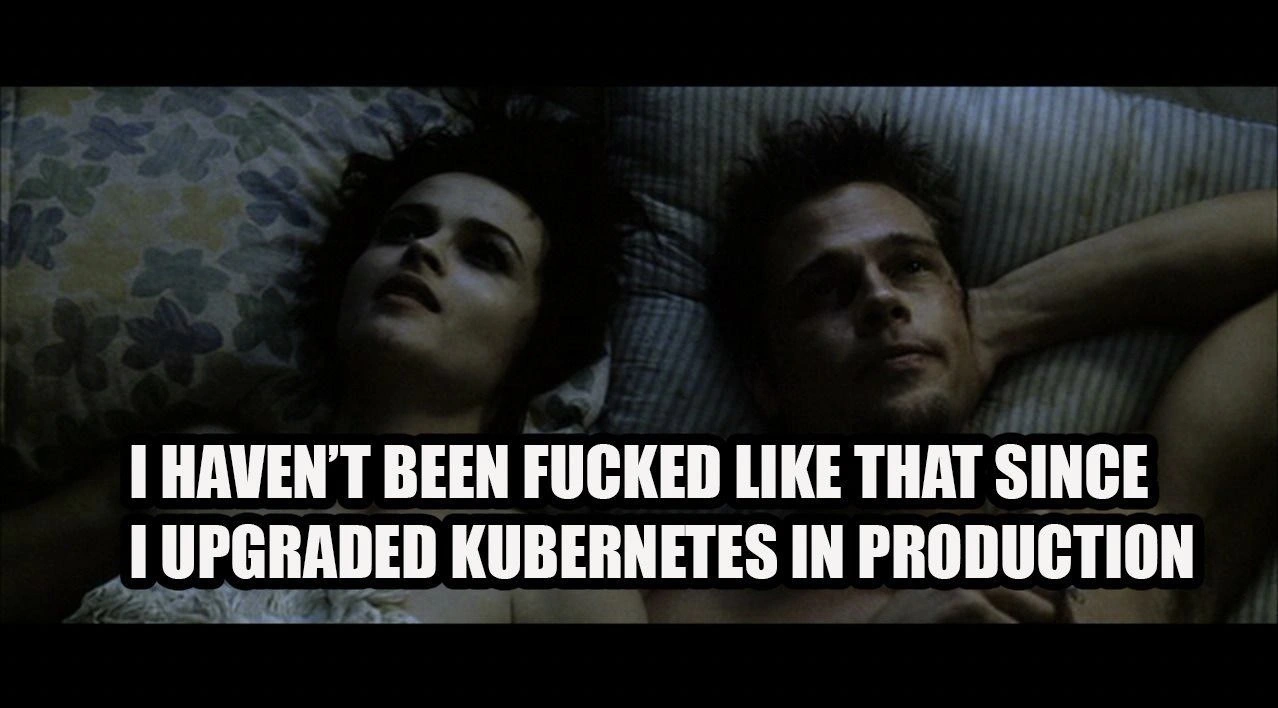
Shared Trauma, Dark Humor: The meme uses a scene from the film Fight Club. In the movie, after an intense... uh, romantic encounter, one character says a shockingly vulgar line: “I haven’t been fucked like that since ___.” It’s meant to be an over-the-top, jaw-dropping line even in the movie. The meme replaces the end of that line with “since I upgraded Kubernetes in production.” The shock value and extremeness is the joke – it implies that upgrading Kubernetes in production was as intense and damaging as a very extreme, somewhat unpleasant experience. People who work in DevOps (development & operations) or as SREs often develop a bit of a dark, snarky sense of humor. They deal with high stress and late-night crises, so they joke about it to cope. Saying “I got f’ed by that upgrade” is a very crude way to say “that upgrade completely messed things up for me.” It’s a hyperbole (exaggeration). Nobody was literally physically hurt, but it felt mentally and emotionally rough.
Why is it Funny?: If you’re new to this kind of tech, you might think, “This sounds awful, why would anyone laugh?” It’s funny because it’s awful and common. It’s a way to laugh at our own pain. Upgrading Kubernetes in production is known among engineers as a risky move. Many have stories like “yeah, we tried it and spent the whole night fixing stuff.” When people see this meme, they’re laughing in recognition: I remember that pain, haha, it’s so true. The Fight Club reference adds a pop-culture twist, basically saying “that upgrade screwed me over so bad, it’s as memorable as that infamous line from the movie.” It’s an in-joke: if you know Kubernetes and you know the chaos it can cause when things go wrong, you get the joke. The bold, spicy language is part of the humor style in these circles – it’s intentionally a bit shocking to outsiders, which makes it even funnier to those in the know.
Lessons Underneath: There’s also an implicit nod to best practices. Ideally, you never upgrade production directly without rehearsing it. You’d test the upgrade on a staging cluster, double-check all your configs for compatibility, maybe even do a blue-green deployment (where you bring up a new environment with the new version alongside the old one, then switch traffic gradually). The fact that the meme exists is like a warning: if you don’t take upgrades seriously, you’ll have a bad time. So it’s humor with a hint of “learn from our mistakes.” And for junior engineers or those just learning Kubernetes, it’s a peek into the war stories you gather over time.
StatefulSet and Breakage: One term, StatefulSet, is worth explaining because it was tagged. In Kubernetes, a StatefulSet is a way to manage stateful applications (like databases, or anything where each instance needs to remember things or keep data on disk). These are trickier during upgrades because you can’t just kill them and start new ones without risking data issues. If an upgrade caused a statefulset_breakage, it means perhaps a database cluster was taken down unexpectedly. That’s a big deal – it’s not just a front-end server that can reboot; it might be the thing storing user data or orders. When that breaks, you often have real downtime and potentially data recovery to worry about. So any upgrade affecting those is the stuff of engineers’ nightmares.
In summary, at Level 2 we see that the meme is combining a famous edgy movie line with a tale of DeploymentPainPoints. It’s describing a scenario where a Kubernetes version update in the real world (production) went so badly that it felt like a personal attack on the engineer’s well-being. Those who work in ContainerOrchestration and manage real systems often bond over these dramatic stories. The meme’s exaggerated comparison and salty language ironically make light of a very stressful situation that many have experienced. It’s a classic piece of DevOps humor: if you get it, you likely have a few gray hairs or tired eyes from exactly this kind of night.
Level 3: Orchestrated Ordeal
“I HAVEN’T BEEN FUCKED LIKE THAT SINCE I UPGRADED KUBERNETES IN PRODUCTION.”
This meme drops a Fight Club bombshell of a line to capture the sheer trauma of a Kubernetes upgrade gone horribly wrong. Seasoned DevOps/SRE folks read that and nod grimly (perhaps with a pained laugh) because they’ve lived it. Upgrading a live Kubernetes cluster is the kind of seemingly routine task that can escalate into a full-blown production nightmare. Why does this combination of movie quote and tech disaster land so well? It’s the absurd truth: a kube upgrade can hurt – not physically, but professionally and emotionally – in ways you wouldn’t believe until you’re there at 3 AM, bleary-eyed on an incident bridge, watching your cluster disintegrate in real time. The meme brilliantly pairs an infamously extreme line from Fight Club with the extreme pain of a botched upgrade. It’s dark, spicy humor for those who know that a “minor version bump” can turn into a major fiasco.
Let’s unpack the chaos: Upgrading Kubernetes in production is supposed to be done in a rolling, controlled fashion. You update the control plane components, then drain and update each node one by one, carefully orchestrating to avoid downtime. In theory, your container orchestration platform handles it smoothly. In reality? Ha! One misconfiguration, one deprecated API, or one impatient step, and you’ve got zero downtime downtime everywhere. Perhaps an updated kube-api broke compatibility with your older manifests, causing deployments to fail left and right. Maybe the cluster’s etcd (the database behind Kubernetes) decided to freak out mid-upgrade, splitting brain and forcing a raft election when half the control plane was on version N and the other half on N+1. Suddenly, services can’t find each other, pods are stuck in Pending, and your monitoring is lighting up like a Christmas tree.
To add insult to injury, these upgrades often happen during “maintenance windows” – typically late at night or on weekends – when user traffic is low. Great, fewer users impacted if something goes wrong… but guess who’s awake and suffering? The on-call engineer, who now hasn’t been to bed and is running on adrenaline and despair. The Fight Club bedroom scene in the image nails that post-disaster emptiness: the characters lying there, eyes glazed, like “What the hell just happened to us?” That’s the exact vibe on the conference call after you’ve spent hours wrestling the cluster back online. Node upgrades turned into a node drain storm – maybe the automation drained too many nodes at once, or a miscommunication meant multiple nodes rebooting together. The result: a cascade of pod evictions all at the same time. Critical services lost their instances simultaneously, and suddenly your high-availability setup wasn’t so available. It’s like an orchestral performance where half the instruments drop out mid-song, leaving a dreadful silence (or worse, dissonance). ProductionIssue? That doesn’t even cover it – it’s a production apocalypse.
Consider a real example of how a “kubernetes_upgrade” can go south: upgrading from Kubernetes 1.15 to 1.16. Harmless, right? Except 1.16 removed several deprecated API versions. Let’s say you had some apps defined with an old API version:
# Old manifest using a deprecated API version (pre-upgrade)
apiVersion: extensions/v1beta1
kind: Deployment
metadata:
name: legacy-app
spec:
replicas: 3
template:
metadata:
labels:
app: legacy-app
spec:
containers:
- name: web
image: legacy/web:1.0
In Kubernetes 1.16+, the extensions/v1beta1 API for Deployments is gone (moved entirely to apps/v1). Suddenly, when the cluster rolls over to the new version, any attempt to manage or redeploy legacy-app blows up with errors. Your CI/CD pipelines start failing their deployments. If you didn’t catch this in staging, congratulations: you just broke your production deploys in the middle of the night. Now you’re hurriedly editing dozens of YAML files to use the new apps/v1 API and applying hotfixes on a live cluster, praying nothing else breaks. This is the kind of DeploymentFailure the meme hints at – a supposedly “minor” kube-api change that ends in a frantic scramble.
And let’s not forget stateful services. The context tag statefulset_breakage is a nightmare scenario: imagine you have a StatefulSet (for a database, Kafka, or any service that needs stable storage and identity). Kubernetes upgrades are especially hairy here. One by one, each node draining means each database instance is taken down. If the upgrade tweaks storage drivers or network settings, those instances might not come back cleanly. Maybe the upgraded node can’t reattach the storage volume due to a version mismatch in the CSI (Container Storage Interface) driver. Now you’ve got a cluster downtime on your database tier – data is intact (hopefully), but unreachable. Users are seeing errors, and you and your team are essentially performing distributed open-heart surgery trying to get those critical pods healthy again. All while the clock keeps ticking and your pager keeps buzzing.
The humor (the horror) in this meme also lies in the shared trauma it invokes. It’s the kind of joke you only laugh at if you’ve been through it. The phrasing “I haven’t been **** like that since…” is intentionally extreme and a bit vulgar – because frankly, when you’re on your third mug of coffee, knee-deep in cluster issues, you adopt a gallows humor. Everyone on that 3 a.m. call probably did drop a few f-bombs (“We are so f–ked”), so the meme’s language rings true. Using the Fight Club reference amplifies it – that film’s gritty, chaotic energy mirrors the chaos of a failed deployment. Remember, the first rule of Fight Club is “You do not talk about Fight Club.” Similarly, the first rule of a terrible production incident is “we do not talk about that night” – except in dark-humor memes later, once the wounds have healed a bit. DevOpsHumor often involves these irreverent analogies because it’s a coping mechanism. When you see Marla Singer (Helena Bonham Carter’s character) lying there in post-coital gloom, and the caption about a Kubernetes upgrade pops up, you can’t help but chuckle if you know how utterly exhausted and violated a failed upgrade can make you feel. It’s funny because it’s true in a metaphorical sense.
From an industry perspective, this meme also jabs at the devastating gap between expectation and reality. Kubernetes is marketed as a resilient, self-healing system – and it is, to an extent. But that doesn’t mean upgrading it is like a simple app update. Enterprises learned the hard way that you need rigorous planning: test in staging, read release notes (all of them!), possibly upgrade one minor version at a time, and have a rollback plan. If you ignore best practices, Production will make you pay dearly. Even when you do everything “right,” stuff happens. Maybe your Ingress controller needed an update too and now external traffic isn’t routing properly. Maybe the new version changed the scheduling algorithm just enough that some workloads get starved. It’s always something. Senior engineers know this, which is why many have a healthy paranoia around upgrades. (There’s a reason a lot of clusters run embarrassingly old versions of Kubernetes – people are afraid of upgrading until forced!). The meme mocks this cycle: we delay upgrades out of fear, then the upgrade is even more painful because it’s a big jump, confirming our fear. OncallNightmares like these become war stories you share later. “Remember that time we upgraded kube and everything caught fire?” Groan… and then someone makes a meme about it.
Finally, consider the social aspect: “I haven’t been fucked like that since…” in Fight Club was a shocking one-liner delivered after an intense experience. In the film it was played for dark humor, much like here. By comparing an IT incident to an intense (and unpleasant) physical experience, the meme exaggerates to the point of absurdity – and that absurdity is what makes it funny. It’s a form of DevOps catharsis. Only someone who’s been dragged through the mud by a production Deployment would equate that misery to… well, getting absolutely wrecked in bed. It’s outrageous, a little bit offensive, and spot-on for the audience that’s been there. In summary, the meme resonates on multiple layers: the technical “oh no, production is down” layer, the emotional “this scarred me for life” layer, and the pop culture “haha they twisted that Fight Club quote” layer. It’s a perfect in-joke for the container crowd, one that elicits a pained chuckle and perhaps a comment like, “Too real, man. Too real.” It’s funny because we survived to tell the tale.
Description
A meme using a still image from the movie Fight Club, showing the characters Marla Singer (Helena Bonham Carter) and the Narrator (Edward Norton) lying in bed, looking exhausted and disheveled. A bold, white text with a black outline is superimposed over the image, reading: 'I HAVEN'T BEEN FUCKED LIKE THAT SINCE I UPGRADED KUBERNETES IN PRODUCTION.' The scene itself depicts a moment of post-coital exhaustion and emotional drain. The technical joke equates this intense, chaotic, and physically taxing experience with the process of upgrading a live Kubernetes cluster. For senior engineers, especially in DevOps or SRE roles, upgrading Kubernetes in production is a notoriously high-stakes, complex, and often painful process where a small mistake can lead to catastrophic failures, requiring intense, stressful effort to remediate. The humor lies in the relatable exaggeration of the trauma and difficulty associated with maintaining critical infrastructure
Comments
7Comment deleted
There are two types of Kubernetes upgrades: the ones where you read the changelog, and the ones where the incident report becomes the changelog
Kubernetes upgrades are the only time I’ve seen seasoned SREs quote Fight Club: “I am Jack’s complete lack of quorum.”
The only thing more backwards-incompatible than a Kubernetes minor version upgrade is explaining to the board why your 'zero-downtime' migration strategy resulted in a 3am war room with 47 participants across 4 time zones
Ah yes, the classic Kubernetes upgrade experience: you start with 'kubectl apply' and end with 'kubectl apply-for-new-jobs'. Nothing quite captures that special blend of hubris and regret like confidently running a major version upgrade on a Friday afternoon, only to discover that half your CRDs are deprecated, your Helm charts are incompatible, and your stateful sets have decided to enter witness protection. The real kicker? The rollback strategy you meticulously documented assumes etcd is still responding. Pro tip: if your post-mortem is longer than your original migration plan, you've achieved peak SRE enlightenment
Kubernetes prod upgrades: where 'kubectl drain' meets 'kubectl pray', proving blue-green is for clusters with spare capacity
“Minor” Kubernetes upgrades: where Ingress deprecates, webhook certs don’t rotate, CNI flips iptables mode, PDBs block drains - and you realize “stateless” was just emptyDir with ambitions
Zero-downtime upgrade is SRE for: take an etcd snapshot, play cordon/drain roulette, then discover every Helm chart relied on deprecated APIs