Skip to content
DevMeme
1856 of 7435
Gatekeeping Standards Escalate to Manual Transistor Wiring
DevCommunities Post #2064, on Sep 18, 2020 in TG

Gatekeeping Standards Escalate to Manual Transistor Wiring

Why is this DevCommunities meme funny?

Level 1: You Must Build the Car

Imagine you want to drive a car, and someone says: “Wait, you’re not a real driver unless you first build the entire car engine from scratch!” Sounds silly, right? You don’t need to assemble an engine piston by piston to prove you can drive – you just learn to use the car as it is. This meme is joking about a similar idea, but with programming. Some people joke that to be a “real programmer” you should do things the hardest way possible, like writing programs using only 0s and 1s or even by connecting the tiny electronic switches (transistors) inside the computer one by one. That’s as absurd as demanding someone forge their own steel and craft their own car just to drive to the grocery store. By exaggerating the requirement, the joke makes it clear how ridiculous gatekeeping can be. The feeling behind it is funny because we all recognize that doing something the super hard way doesn’t necessarily make you better at the normal way – it just makes things unnecessarily difficult. In simple terms: the meme is saying “it’s crazy to expect people to start from absolute scratch just to prove they belong.” You wouldn’t ask a chef to grow the wheat and mill the flour before they can bake a cake, and you wouldn’t ask a programmer to wire up a whole computer before they can write an app. It’s a funny exaggeration that reminds us to be more welcoming – everyone can ride in the car of coding without having to build the engine first!

Level 2: Bit by Bit Breakdown

So, what’s actually going on in this meme? It’s showing a fake (or at least humorously exaggerated) Twitter conversation to make fun of unrealistic expectations for programmers. The key terms here are “raw binary” and “wiring transistors,” which are both extremely low-level ways of programming a computer – far below what even most seasoned coders ever deal with. Let’s break those down:

  • Binary: Computers ultimately run on binary code, which is a sequence of 0s and 1s (bits). These 0s and 1s represent machine instructions that tell the CPU what to do (like add numbers, compare values, jump to another part of the program, etc.) and data. When the tweet talks about “code in raw binary,” it means writing out the actual 0s and 1s for every instruction. For example, imagine instead of writing print("Hello") in a high-level language, you had to write something like 01001000 01000101 01001100 01001100 01001111 (that’s the ASCII binary for “HELLO” in memory). That would be incredibly hard to manage! Normally, developers use languages like Python, Java, or C, and those get translated (by interpreters or compilers) into binary for the machine. Even when writing the lowest-level software, people use assembly language rather than raw binary. Assembly uses short codes (like MOV for move, ADD for addition) as human-friendly placeholders for binary instructions, and a program (an assembler) converts them to the actual bit patterns. So, requiring programmers to write in raw binary is almost unheard of today – it’s basically saying “don’t use any programming language at all, just directly toggle the bits!” That’s why this is funny: it’s taking the notion of being a “serious programmer” to a comically extreme place.

  • Transistors: A transistor is the fundamental electronic component inside a computer chip. Think of it like a tiny switch that can either allow current to flow or not, representing a 1 or 0 in binary logic. Transistors are combined to form logic gates (which perform basic binary operations like AND, OR, NOT) and memory cells. When the tweet joke says “write CPU instructions by individually wiring the transistors,” it’s describing something even more extreme than coding in binary. This would mean physically connecting transistors with wires to create the circuits that perform the instructions you want – essentially building a custom processor by hand for each program. In real life, this is not how programming is done. This is how you might breadboard a very simple circuit in an electronics class, or how the earliest computers (like ENIAC in the 1940s) and some analog systems were programmed – by physically reconfiguring the hardware. But modern computers are general-purpose: you have a CPU chip with fixed wiring (millions of transistors already connected in a specific architecture), and you just feed it different binary codes (software) to get it to do different tasks. Nobody is rewiring the silicon for each new program! The only people who deal with transistors directly are hardware engineers who design chips, and even they use computer tools to place and connect millions of transistors, rather than wiring each one manually. So this part of the meme dials the joke up to maximum absurdity. It hints: “Oh, you think coding in binary is tough? Real elites design the computer anew each time!” It’s absurd humor because connecting individual transistors to program is like performing brain surgery every time you want to change your mind about something – way overkill and impractical.

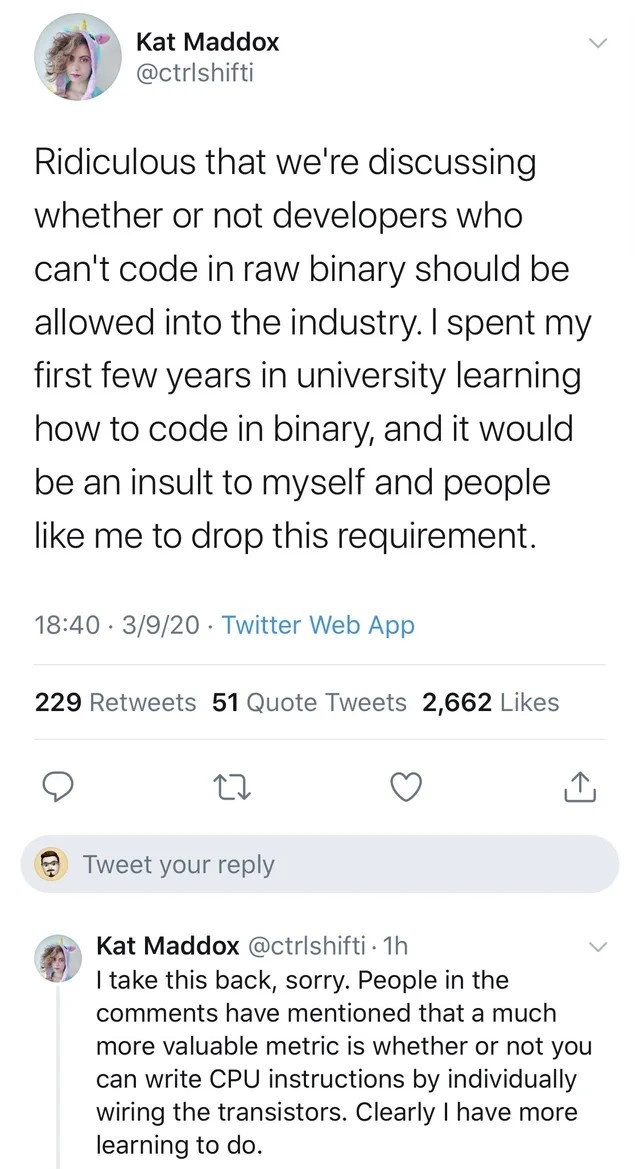
Now, why is this funny to developers? It’s a form of tech industry humor that pokes fun at gatekeeping. Gatekeeping in tech (or any field) means setting an unnecessary high bar for entry, often to exclude others or to feel superior. The first tweet in the meme pretends to be someone complaining that “we’re even discussing whether devs who can’t code in raw binary should be allowed into the industry.” That is a deliberately ridiculous statement, but it parodies real arguments people make. There are threads on forums and Twitter where some veteran developers say things like “if you don’t understand how memory is managed or can’t write some assembly, you shouldn’t call yourself a programmer.” These opinions are controversial and often criticized as elitist. The meme takes that kind of statement and humorously exaggerates it. The person in the tweet says they spent years in university coding in binary and would feel insulted if that wasn’t required anymore – this mirrors how some people feel their tough learning experiences should be mandatory for everyone else. It’s like someone saying, “I had to learn on a black-and-white TV, so modern students shouldn’t get color screens because that wouldn’t be fair to me.” It’s a flawed argument, but it does pop up in communities sometimes in all seriousness. By making the requirement so over-the-top (binary coding), it’s clear the tweet is mocking that attitude, not endorsing it.

Then the follow-up reply (from the same user, ironically) says basically, “Sorry, I was wrong – apparently the real yardstick is wiring transistors to create CPU instructions, so I guess I’m not hardcore enough either!” Here the joke escalates the absurd skill requirement even further to drive the point home. It highlights how, in these gatekeeping debates, there’s a slippery slope: if you demand X as a minimum, someone else can demand X+1. For instance, if someone says “a real web developer writes pure JavaScript without frameworks,” another might say “well, a real programmer writes in C, not even JavaScript,” and another might say “actually, real coders write in assembly,” and so forth. The transistor wiring is the logical extreme end of that line – beyond which you cannot go (unless you say “you must manufacture your own silicon from raw sand,” which would be even more absurd!). This “one-upsmanship” is a common comedic trope in tech jokes. It’s satire because it’s using exaggeration to criticize and make fun of the original idea (the gatekeeping of who “should be allowed in the industry”).

It’s worth noting that no actual tech job expects you to write raw binary or design circuits unless your job is designing circuits. Typical software developers work at much higher levels of abstraction. LowLevelProgramming skills, like understanding how memory works or how computers represent data in binary, can be very useful – they make you a better programmer in some respects – but they are by no means a basic barrier to entry for getting work done in most programming jobs. The industry runs on layers of abstraction: high-level languages, APIs, libraries, frameworks. We build on each other’s work. So, this meme is laughing at the idea that someone would seriously propose such an absurd barrier to keep new developers out. It’s a funny inside joke precisely because we all know real programming doesn’t require that level of pain, and suggesting it does is comically out-of-touch.

Also, notice the context: it’s presented as a Twitter screenshot with lots of likes and retweets. Often, on Tech Twitter, people make hyperbolic jokes or satirical statements to poke at industry issues. The engagement numbers (229 Retweets, 2,662 Likes) shown in the image suggest that many people found this relatable or hilarious. It’s a form of TechSatire delivered in a familiar format. People tag such content as #DeveloperHumor because only folks inside the developer community truly get why it’s funny. If you’re not aware of the gatekeeping debates or how programming works, you might be confused – which is why we’re breaking it down here!

In summary, the meme uses the idea of raw_binary_coding and transistor_level_programming as comedic exaggerations to mock elitist attitudes. It’s saying: “Look, arguing about these extreme low-level skills as a gatekeeping measure is as silly as this sounds – totally over the top.” For a junior developer or someone new to tech, don’t worry – no one is actually going to ask you to code in binary or wire up a CPU by hand as an interview question! (And if they do, you’re probably interviewing for a joke company or perhaps a role building actual CPUs, not typical software.) The meme is a lighthearted way the community calls out snobbery and reminds everyone that being welcoming and practical makes more sense than clinging to archaic requirements.

Level 3: Baptism by Binary

For seasoned developers, this meme immediately reads as a razor-sharp satire of gatekeeping in tech. It exaggerates a familiar elitist attitude to an absurd degree. In many developer communities, there’s an inside joke about the “real programmer”. You might have heard things like: “Real programmers code in assembly,” or “If you don’t know C pointers, are you even a developer?” – all examples of GatekeepingInTech where veterans sometimes (half-jokingly, half-pridefully) insist that newcomers master low-level skills or suffer the same hardships they did. Here, that attitude is blown out of proportion: the tweet claims we’re debating whether devs who can’t code in raw binary deserve jobs. It’s a perfect parody because nobody actually codes in raw binary in any normal software job – that’s what assemblers and compilers are for. So by using such an extreme requirement, the meme highlights the ridiculousness of real gatekeeping arguments. It’s riffing on the absurd skill requirements some purists throw around to assert superiority. The original poster (Kat Maddox, presumably playing a character) says she “spent years in university learning to code in binary” and would feel insulted if that requirement were dropped. This drips with irony: it mimics the tone of someone who went through a difficult, arguably unnecessary rite of passage and now insists everyone else should too, “or else it’s an insult to me and people like me.” This is essentially a hazing mentality“I suffered, therefore you must also suffer to earn your place.” Seasoned devs will recognize this as the fallacy it is (akin to the “No True Scotsman” or rather “No True Programmer” fallacy: “No true programmer would need abstraction X; we all coded on bare metal in my day!”).

The punchline comes in the follow-up reply from the same account: “I take this back, sorry. People in the comments have mentioned that a much more valuable metric is whether or not you can write CPU instructions by individually wiring the transistors. Clearly I have more learning to do.” This one-ups the original absurdity. Inside the joke, someone in the comments has apparently pointed out an even purer measure of a programmer’s worth – not just writing binary code (which at least is using the CPU as intended), but literally doing the work of an electrical engineer: manually wiring transistors to create the instructions. This escalation is a form of satirical one-upmanship, reflecting how in real tech debates, there’s often someone who will say “Oh, you think coding in binary is hardcore? Well, back in my day, we wired our own computers!” It lampoons the endless arms race of credibility: no matter how extreme a bar one sets (“must code in assembly”), someone more extreme will appear (“must code in machine code”), and here it goes to the logical extreme (“must build the machine from raw transistors”). The veteran reader chuckles because we’ve all seen threads where people argue over text editors (Vim vs Emacs), programming languages (“you use Python? Real devs use C, or better yet assembly”), or tools (“autosuggest is cheating, real devs memorize everything”). This meme captures that gatekeeping arms race in one screenshot.

From a DevCommunities perspective, it’s a commentary on elitism and exclusion. The industry has long battled the idea that you have to know everything from the ground up to be worthy. The tweet’s over-the-top demands shine a light on how exclusionary and silly that mindset is when taken literally. After all, software engineering has many layers of abstraction for a reason – so we can be productive without reinventing the wheel every time. Demanding transistor-level knowledge for a typical dev role is like a construction company demanding all its architects must know how to smelt their own steel and manufacture their own concrete. Sure, those are important skills for some specialists, but they’re not reasonable gatekeeping criteria for everyone in the field. The tech satire here resonates especially with experienced engineers who have faced gatekeeping or imposter syndrome. It’s basically saying: “Look how ridiculous these purity tests sound when we crank them up to eleven.” By using the format of a Twitter screenshot (very recognizable in dev humor circles), the meme also pokes fun at how such debates often play out on social media, with high engagement counts (retweets, likes) indicating many others find it relatable. The high like count (2,662 likes) on the absurd statement suggests people recognize the joke and are in on it, sharing a laugh about this developer humor.

In essence, the meme is an inside joke for programmers: it mocks the gatekeeper archetype by taking their argument to such an extreme that it collapses under the weight of its own absurdity. Seasoned developers grin (or groan) because they’ve met folks who genuinely flaunt their low-level chops to belittle others. This meme says, “Let’s imagine that attitude dialed up to 100 – pretty silly, huh?” It reinforces a healthier perspective: that being a “real developer” isn’t measured by how archaic or painful your coding method is. And for those of us who love low-level programming (yes, some of us do enjoy a bit of assembly or fiddling with memory addresses for fun), it’s a reminder that these skills are valuable tools, not badges that make us inherently superior. After all, if the industry really demanded raw binary or transistor wiring from everyone, we’d never ship any useful software – we’d be too busy counting bits or soldering wires at our workbenches! The humor lands because it highlights the gap between what some elitists fantasize about and the collaborative, abstraction-powered reality of modern software development.

Level 4: Gatekeeping at Gate Level

At the bit-and-transistor extreme, this meme touches the bedrock of computing. Coding in raw binary means dealing directly with the machine code of a computer’s CPU – the actual 0s and 1s that correspond to instructions. In modern systems, a single machine instruction (like “add two numbers”) is represented by a pattern of bits (for example, 10110000 01100001 in binary might be a simple operation on an x86 processor). Writing software in this form is essentially handcrafting the binary opcodes that the hardware understands, without any help from assemblers or compilers. It’s an incredibly low-level programming task, one step above configuring the hardware itself. Early computing pioneers sometimes did program this way: the first programmable computers in the 1940s had plugboards that had to be manually rewired for different calculations, and machines like the Altair 8800 (1975) literally required flipping switches to enter binary instructions. These were the days when programming was wiring: logic was configured by physically connecting circuits or by feeding in punched cards encoding binary data.

Requiring developers to code in raw binary today is both anachronistic and absurd. We invented programming languages specifically to avoid this tedium. By the 1950s, visionaries like Grace Hopper created compilers so that humans could write instructions in something resembling English (COBOL) or algebraic notation (FORTRAN) instead of memorizing binary patterns. A binary opcode like 1010 0001 might correspond to an instruction such as MOV CL, [BX+SI] in assembly, which in turn might correspond to a C statement like x = array[i]. Each higher level of abstraction lets us express intent without micromanaging bits. Demanding “raw binary coding” is essentially asking programmers to throw away decades of progress in abstraction. It’s akin to insisting a writer communicate only in Morse code taps instead of using written language. The meme pushes this premise even further by invoking transistor-level programming – literally wiring up transistors to create custom hardware for each program. A modern CPU contains billions of transistors acting as microscopic switches forming logic gates (AND, OR, NOT) and storage cells (flip-flops). They collectively execute instructions, but no sane engineer would manually wire each transistor for a new piece of software; instead, we write code, and the CPU’s generalized circuitry executes it. Even when engineers do design custom hardware (like building an FPGA circuit or writing VHDL/Verilog code for a chip), they still operate at the level of logic gates or higher, not individual electrons and silicon junctions! The suggestion of “writing CPU instructions by individually wiring the transistors” is a tongue-in-cheek reference to taking low-level to the lowest possible level – a theoretical nadir of programming where software and hardware completely blur. It underscores how impractical and theoretically ludicrous such a requirement is in a world where even kernel developers and embedded systems engineers rely on layers of tools and abstraction. By invoking this extreme, the meme sets the stage for a satirical critique of gatekeeping in tech: it’s a hyperbolic scenario to expose the folly of valuing needless purity over practicality.

; Example of what "coding in raw binary" might look like vs. assembly:
; Assembly instruction to move the value 4 into the EAX register (32-bit):
MOV EAX, 4              ; human-friendly assembly mnemonic

; The corresponding machine code in hexadecimal bytes:
;    B8 04 00 00 00 
; In raw binary, those bytes are:
;    10111000 00000100 00000000 00000000 
; Imagine having to write out each 0 and 1 by hand for every instruction!

This code snippet illustrates how a simple operation is represented in raw binary. Even this trivial task requires 32 bits of precise binary. Real programs are millions or billions of bits long – clearly, nobody writes them out directly. Modern computer architecture, from the boolean algebra that governs logic gates up to multi-layered operating systems, is designed so that developers don’t have to manipulate individual bits and transistors manually. In theoretical terms, the meme humorously references the lowest conceivable level of programming (direct hardware configuration) to poke fun at the cult of ultra-low-level purity. It’s an absurdist way to remind us that all software ultimately becomes binary and electrical signals – but expecting humans to work at that level unassisted is a travesty of efficiency. In short, the meme’s scenario is technically possible only in the same sense that building a computer from scratch is possible: true in principle, but wildly impractical except as an educational exercise or eccentric hobby.

Description

A screenshot of a satirical Twitter thread by Kat Maddox (@ctrlshifti). The first tweet, posted at 18:40 on 3/9/20, reads: 'Ridiculous that we're discussing whether or not developers who can't code in raw binary should be allowed into the industry. I spent my first few years in university learning how to code in binary, and it would be an insult to myself and people like me to drop this requirement.' A follow-up tweet posted an hour later says: 'I take this back, sorry. People in the comments have mentioned that a much more valuable metric is whether or not you can write CPU instructions by individually wiring the transistors. Clearly I have more learning to do.' The tweet is a form of satire common in the tech community, mocking gatekeeping and elitism. It starts with an absurd premise - that coding in raw binary is a necessary skill - and then escalates it to the even more ludicrous requirement of manually wiring transistors to write CPU instructions, thereby exposing the folly of arbitrary and impractical standards for entry into the tech industry


Comments

7
Anonymous ★ Top Pick Some interviewers ask if you can write code in binary. The real veterans ask if you can modulate the 5V signal on the USB port by hand to transmit the ones and zeros yourself
  1. Anonymous ★ Top Pick

    Some interviewers ask if you can write code in binary. The real veterans ask if you can modulate the 5V signal on the USB port by hand to transmit the ones and zeros yourself

  2. Anonymous

    Our architecture guild just raised the hiring bar: if you deploy via kubectl you’re junior; staff-level means shipping to prod by manually clocking the flip-flops with a probe - anything above transistor toggling is “low-code automation.”

  3. Anonymous

    Meanwhile, the same hiring managers who demand you code in binary are still deploying to production by SSHing into servers and editing files with nano because "Kubernetes is too complex."

  4. Anonymous

    This perfectly captures the absurdity of tech gatekeeping: 'You're not a real developer unless you can toggle bits with a magnetized needle.' Next week someone will argue that true engineers hand-dope their own silicon wafers. The follow-up about wiring transistors individually is chef's kiss - because clearly, if you haven't personally implemented NAND gates using discrete components, can you even call yourself a software engineer? It's the logical conclusion of the 'back in my day' mentality taken to its beautiful, reductio ad absurdum extreme

  5. Anonymous

    Amazing - our hiring bar for a TypeScript CRUD role is now “re-implement MOV by hand on doped silicon,” yet the hardest part of the job remains naming the service and wrangling YAML

  6. Anonymous

    Binary gatekeeping is like requiring SREs to etch silicon wafers - impressive resume fodder, zero help for 3AM Kubernetes evacuations

  7. Anonymous

    Sure, hire only people who code in binary - then our on-call runbooks can be front-panel toggle sequences and the SLO can be measured in correct bit flips per minute

Use J and K for navigation