Skip to content
DevMeme
4451 of 7435
When leadership finally funds all the infosec headcount you begged for
Security Post #4878, on Sep 26, 2022 in TG

When leadership finally funds all the infosec headcount you begged for

Why is this Security meme funny?

Level 1: Buying Locks After a Break-In

Think of it like this: you told your parents for a long time that the house needs good locks on the doors and maybe an alarm system. They kept saying, “Nah, it’s fine, we’ve never had a break-in. Why spend the money?” But then one night, a thief sneaks in and steals some stuff. 😬 The next day, your worried parents rush out to buy the best locks, an alarm, and hire a night guard all at once. Now they’re in a big hurry to secure the house, when before they wouldn’t even buy one lock.

That’s exactly the feeling of this meme. The “house” is a company’s computer systems, the “thief” is a hacker, and the “parents” are the company’s bosses. The security team (like the kid who wanted locks) had been begging for more help to keep things safe. The bosses ignored them until something bad happened. The meme is joking about how only after the break-in do the bosses finally agree to bring in the extra security. It’s funny in a face-palming way – you’re glad they’re fixing it, but you really wish they had listened earlier and prevented the mess in the first place.

Level 2: Better Late Than Breached

For those newer to the industry, let's break down why this scenario is both funny and frustrating. InfoSec (information security) teams are responsible for protecting a company’s data and systems from hackers, breaches, and other threats. They often ask for more headcount (which means permission to hire more people) when they feel understaffed. Headcount is essentially a budget item – each new hire costs salary, benefits, etc., so those have to be approved by leadership or HR based on the company’s priorities and budget.

In this meme, the security team had been begging leadership to fill certain roles, likely because they knew the company had vulnerabilities or too few people to handle all the security work. Leadership initially said "No" – perhaps they thought it was too expensive, or they didn’t see an immediate need. This is a common CorporateCulture issue: security is sometimes seen as a cost with no obvious payoff until something goes wrong. It’s like a homeowner saying "Why spend money on locks if we haven’t been robbed?" – a risky game of chance.

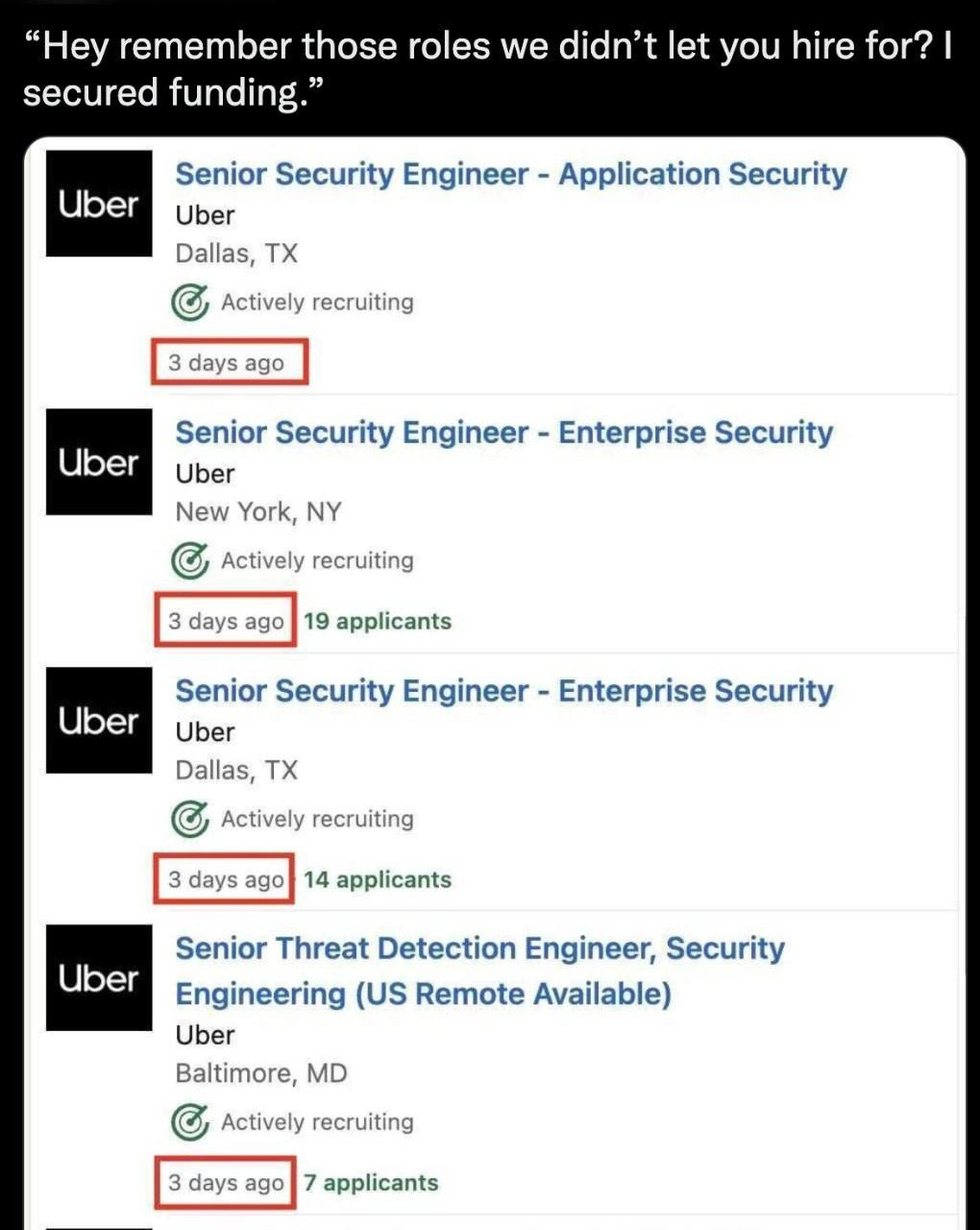
Now suddenly, the boss comes back saying, “Great news, I got funding for those roles!” and opens a bunch of job listings all at once. The meme shows four LinkedIn job postings from Uber: all titled Senior Security Engineer in different specializations, posted within days of each other. The listings are marked "Actively recruiting" with fresh timestamps (“3 days ago”), which screams urgency. It’s basically the company shouting, “Security experts wanted, like, yesterday!”

Why the urgency? Often, this happens after a security scare or an incident. Maybe there was a hack, a data breach, or a near-miss that frightened the leadership. In tech, there’s an unfortunate pattern of reactive hiring: not hiring the safety net until you’ve already fallen. From a junior perspective, it’s a bit like not doing your homework until the night before the exam – only here, the “exam” is a hacker testing your defenses. If the company got a bad grade (i.e., got breached), now they’re scrambling to study (i.e., hiring experts).

Let’s clarify the roles being hired, since they give clues about what the company felt was lacking:

  • Senior Security Engineer – Application Security: This person focuses on keeping the company’s software safe. They review application code for vulnerabilities, ensure developers follow secure coding practices, and test the apps so hackers can’t easily break in through the software.
  • Senior Security Engineer – Enterprise Security: “Enterprise” here means the broader company infrastructure. This engineer protects internal systems – things like corporate networks, employee laptops, cloud services, and internal tools. They make sure the doors and windows of the company’s digital office are locked.
  • (There were two listings for Enterprise Security in different cities – likely to cover multiple regions or teams, meaning Uber realized they need more than one person in that area.)
  • Senior Threat Detection Engineer, Security Engineering: This is a specialist who builds and tunes the alarms. They monitor logs and alerts to detect if an intruder is in the network, kind of like a security guard watching CCTV for suspicious activity. If something bad is happening, they figure it out quickly and help sound the alarm and respond.

All these roles being Senior implies the company wants folks with experience who can hit the ground running. That’s telling – it suggests they don’t feel they have time for junior hires to ramp up. If leadership just unlocked these positions, they likely want immediate expertise to patch holes and build missing security processes fast. The “Actively recruiting” label on LinkedIn further underlines how eager they are to fill these jobs; it’s not a normal slow hire, it’s a priority.

The context also hints this might be Uber responding to a real event. Around the date of the meme (late September 2022), Uber had a known security breach incident. Post_breach_hiring is even one of the tags given: companies often react to a breach by hiring more security engineers as a remedy and a signal to the public/regulators that “we’re fixing it.” It’s somewhat like how a city might hire more firefighters right after a big fire burned down half a block. There’s a bit of irony: those extra firefighters could have helped prevent so much damage had they been there before the fire, just as these security engineers could have helped prevent or limit the breach if hired earlier.

For someone early in their career, this highlights an important bit of Career_HR reality: getting approval to hire people (especially for “protective” roles like security or quality assurance) often requires convincing non-technical leadership of the value. If those leaders only measure value in features shipped or immediate profit, they might push back on hiring “too many” security folk – until a disaster proves their value the hard way. Then suddenly the budget appears. It’s a mix of Security concerns and internal politics. The humor here has a “finally, they get it” tone – it’s funny because management’s change of heart is so abrupt and tied to crisis, and anyone who’s been in that situation feels a sort of vindication seeing it acknowledged in meme form.

In summary, to a junior dev or someone new, the meme is pointing out the absurdity that companies sometimes only do the right, safe thing when they no longer have a choice. It’s both a laugh and a lesson: invest in security early, or you might be forced to play catch-up later. As the saying goes, better late than never… but in security, late can be expensive.

Level 3: Breach-Driven Budgeting

At the senior engineer level, this meme hits like an I-told-you-so saga in Security and CorporateCulture. It's highlighting a classic industry pattern: reactive security investment. The humor comes from the painfully familiar scenario where leadership only opens the hiring floodgates after a crisis or sudden scare. Imagine the security team begging for months, "We need more people to lock things down," and getting back a budget nod of “not this quarter.” Then – boom – something happens (perhaps a major hack or a close call) and magically the CFO finds money under the couch cushions for a massive infosec hiring spree. It’s CorporateHumor with a dark twist: critical roles that were previously deemed "unnecessary expense" are now "urgent priority."

This particular meme uses actual LinkedIn job postings from Uber as evidence. Four Senior Security Engineer positions were all posted almost simultaneously (“3 days ago” on each, with that green “Actively recruiting” urgency badge). The caption sets the tone:

"Hey remember those roles we didn’t let you hire for? I secured funding."

That line drips with sarcasm. It’s basically leadership coming back around after a breach, acting like they just had a brilliant idea to do exactly what the security team had been pleading for. The phrase "I secured funding" is even a little punny — finally something is secure, albeit just the budget. Seasoned security folks smirk (or groan) at this because it's a textbook example of BudgetConstraints whiplash. One week it’s "Do more with less," the next it’s "Why haven’t we fixed all these vulnerabilities yesterday? Hire everyone!"

In real organizations, this often follows a nasty security incident or a high-profile breach. Behind the scenes, maybe customer data was stolen or a regulator started asking questions. Suddenly the risk isn’t theoretical anymore; it’s on the front page of Hacker News. Now the board and execs are in panic mode and go into post_breach_hiring overdrive. This shift is sometimes grimly joked about among senior engineers: a serious incident can do more to expand a security budget than a year of careful risk reports. It’s HiringHumor drawn from bitter experience.

All four posted roles are Senior positions across different specialties (Application Security, Enterprise Security, Threat Detection). The fact they’re all senior-level and went up at once screams “we need experts ASAP to put out fires!” There’s no time to train juniors when you’re likely plugging active leaks. The meme implies “massive_security_hiring_spree” and possibly “last_minute_budget_approval” – basically, leadership’s epiphany came so late that now they’re throwing headcount at the problem in bulk. It's the tech equivalent of ordering a fleet of fire trucks after half the building has burned.

A cynical veteran eye also catches the irony in those LinkedIn details:

  • The red timestamps ("3 days ago") on every listing indicate they were all opened virtually together – a sign of reactive, not strategic, planning.
  • The applicant counts (19, 14, 7...) show folks are already jumping in; security talent is in demand, and now this company is actively competing to attract them overnight.
  • This flurry likely followed some Oh no moment in a security review or incident post-mortem where leadership finally felt the fear. It’s a form of “closing the barn door after the horse has bolted.”

To a seasoned engineer, the meme is both validating and exasperating. It validates that you weren’t crazy for wanting more staff – clearly, those roles were needed. But it’s exasperating because now you’re hiring under duress, possibly after damage is done. Everyone in the on-call rotation who endured those 3 AM emergency calls is thinking “Great, now you listen…” The shared trauma of being understaffed and then suddenly flush with requisitions is real. This humor is cutting close to the bone of CareerHumor in tech: sometimes the quickest way to get approval for doing things right is for something to go horribly wrong first.

In pseudo-code, the situation looks something like:

# Leadership's security strategy in pseudocode:
try:
    operate_company(security_team_size="bare_minimum")
except MajorSecurityIncident:
    leadership.approve_hiring([
        "Senior AppSec Engineer", 
        "Senior Enterprise Sec Engineer", 
        "Senior Threat Detection Engineer",
        # ... basically ALL the roles we previously rejected
    ])

The code joke above is exactly what this meme is poking fun at – only after an exception (a breach) does leadership execute the hiring logic. Security veterans chuckle (or facepalm) because they've seen this pattern too often. It's a form of “breach-driven development”: improvements happen not when they’re first needed, but when failure forces their hand. As a result, this meme’s punchline lands with a knowing sting: the crisis that could have been prevented is now the reason it finally gets addressed.

Description

The meme has a black banner caption reading, “Hey remember those roles we didn’t let you hire for? I secured funding.” Below it is a stitched screenshot of four LinkedIn postings from Uber, each with the Uber logo at left and bold blue job titles: “Senior Security Engineer - Application Security,” “Senior Security Engineer - Enterprise Security” (New York), another “Senior Security Engineer - Enterprise Security” (Dallas), and “Senior Threat Detection Engineer, Security Engineering (US Remote Available).” Every listing shows the green “Actively recruiting” badge and a red-boxed time stamp saying “3 days ago,” with applicant counts (19, 14, 7) on three of them. Visually, it implies an urgent, simultaneous hiring burst. Technically, the joke pokes fun at corporate budgeting cycles where security headcount is denied until after a crisis or sudden budget approval, highlighting real-world tensions between engineering needs, risk management, and management funding decisions

Comments

13
Anonymous ★ Top Pick Amazing what a Sev-0 in the Wall Street Journal does to hiring velocity - overnight the CFO’s basically kubectl autoscale security headcount to ∞
  1. Anonymous ★ Top Pick

    Amazing what a Sev-0 in the Wall Street Journal does to hiring velocity - overnight the CFO’s basically kubectl autoscale security headcount to ∞

  2. Anonymous

    Nothing says 'strategic workforce planning' quite like denying your security team's headcount requests for six months, then panic-hiring four senior engineers the moment the board approves funding - because apparently cyber threats only become real when VCs write checks

  3. Anonymous

    Nothing says 'we take security seriously' quite like waiting until Series B to hire the people who could have prevented the breach that almost killed Series A. At least now the threat detection engineer can document all the vulnerabilities that have been sitting in production for the past 18 months while finance was optimizing burn rate

  4. Anonymous

    Great news: after the breach, our MTTA (Mean Time To Approve headcount) finally beat our MTTR - “Actively recruiting” in three days

  5. Anonymous

    Funding secured: because nothing says 'mature engineering org' like hiring appsec after the Series B leak

  6. Anonymous

    Security hiring is event-driven: publish('breach') and Finance processes open_reqs with a 3-day timestamp

  7. @lord_nani 3y

    Explain

    1. @MarchukRoman 3y

      They got hacked (or leaked some info, I don't remember)

      1. @lord_nani 3y

        Yeah, makes sense

    2. @callofvoid0 3y

      they never hired these roles IG

      1. @lord_nani 3y

        FiveHead

        1. @callofvoid0 3y

          huh ?

          1. @domokrch 3y

            guess he implied u r smart

Use J and K for navigation